

Word Clock

Antelope Audio OCX HD Master Clock

Antelope Audio·Model OCX HD·antelope-ocx-hd

Photos

Manufacturer product photography — the drawn faceplate above stays true to panel layout; these show the hardware itself.

Photo: Antelope Audio1 / 2

About the Antelope Audio OCX HD

The Antelope Audio OCX HD is the current standard-bearer master clock: oven-controlled oscillator stability, eight word clock outputs, and rates to 768kHz. Studios and broadcast rigs hang whole digital ecosystems off it where clocking integrity is the difference between clean and brittle. Succeeds the discontinued Trinity in the Antelope line.

The OCX HD is a dedicated master clock — its entire job is to be the timing authority for every digital device in your rig. When you have multiple converters, a digital console, and a stage box all sharing a word clock, the question isn't whether clocking matters but who's doing it. Antelope's answer is an oven-controlled crystal oscillator, which keeps the internal reference thermally stable rather than drifting with ambient temperature. In a touring IEM rig or a broadcast truck where the gear cold-soaks in a trailer overnight and warms up fast, that thermal stability is exactly the kind of problem a standard oscillator ignores.

Eight BNC word clock outputs means you can feed a console, a redundant playback system, an interface, and several converters simultaneously without daisy-chaining — which is the right way to do it. Daisy-chaining distributes jitter down the chain; star-wiring from a single reference keeps each device on the same footing. The AES and S/PDIF outputs add flexibility for devices that don't take word clock directly. Support for rates up to 768kHz is largely academic for live work, but it means the unit is not a bottleneck if your session runs at 96kHz and you want to clock everything at session rate rather than converting down. At 15 watts steady draw in a 1U shallow 220mm depth, it fits cleanly in most rack builds without a fight.
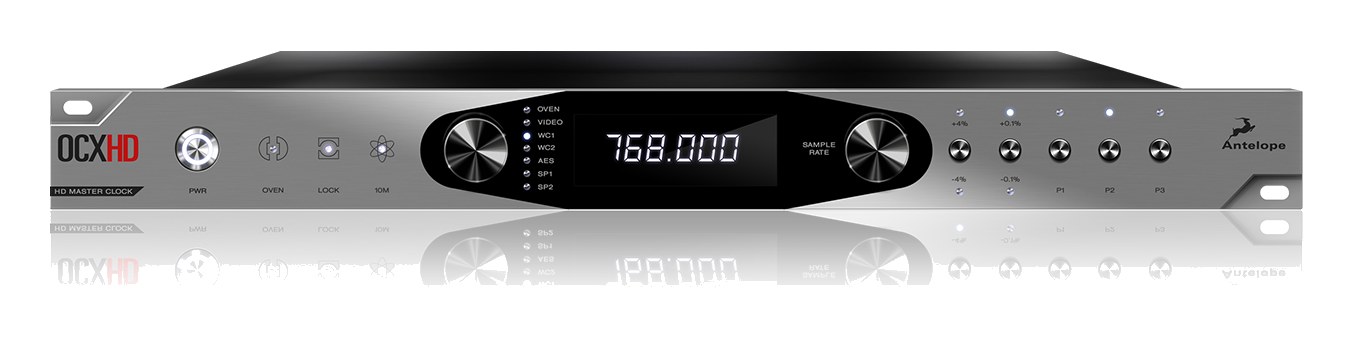
If you're running three or more digital devices that need a common clock reference — especially on a show where drop-outs or digital noise are unacceptable — the OCX HD earns its place and its price. A $1,690 clock is hard to justify if your rig is a single interface feeding a console via ADAT and you're happy letting one device clock the other. In that scenario, the internal clock on a quality converter or console is good enough. This unit is for the engineer who has hit the ceiling of internal clocking and needs a reliable hub, or who is building a rig sophisticated enough that clock discipline is part of the design from day one.

In the rack

  • Star-wire all eight BNC outputs individually to each device — never loop word clock out of one device into the next. The whole point of having eight outputs is avoiding that chain.
  • Power the OCX HD first in your startup sequence and last off at shutdown. Every downstream device should lock to it, not scramble to find a reference while it's still booting.
  • If your venue or truck has access to a 10MHz atomic or GPS reference, the BNC 10M input on the rear lets you lock the OCX HD to that source — one step tighter than the internal oscillator alone, and worth using in broadcast situations.
  • Rack it with at least a half-unit of ventilation clearance above or below; 15 watts from an oven-controlled oscillator means the unit runs warm by design, and trapping that heat against a power conditioner or dense patchbay shortens component life.

Current Antelope master clock — 768kHz, 8 word clock outs.

I/O Ports (5)

PortConnectorDirectionSignalChannels
Word Clock Out 1-8BNCoutputdigital audio8
AES OutAES3 XLRoutputdigital audio
S/PDIF OutSPDIF COAXoutputdigital audio
10M Atomic InBNCinputdigital audio
Power
  • Power (IEC C14)

Deciding between two?

Rack space, watts, weight and every connector, side by side.

Related gear

Related articles

Guides from our library that cover planning around word clock gear.