The Antelope Trinity is a high-precision master clock with an atomic rubidium oscillator and GPS disciplining that provides the most stable clocking available for professional audio. In complex digital rigs with multiple converters and interfaces, a dedicated master clock ensures all devices are sample-accurately synchronized, which reduces jitter and improves audio quality. Ten word clock outputs can feed an entire rack of digital gear from a single reference.
Discontinued. Trinity discontinued — succeeded by OCX HD in the Antelope clock line.
Documented outputs
44 destination connections
Documented inputs
2Based on documented inputs
Rack space
1UBuilder checks available rail space
Power draw
20W25W documented maximum
Catalog estimate
~$3,495Use retailer rows for current price and stock
01 · What it does—and what that changes in your rig.
Product overview
Start with the payoff, then work through how it functions, where it fits, and the details that change a real build.
The payoff
Word Clock decisions, organized around the whole rig.
The Trinity is Antelope Audio's statement-level master clock, and it earns that position with a rubidium atomic oscillator disciplined by GPS — the same basic principle used in broadcast and scientific timing applications. In a digital audio rig, every converterThe circuitry that turns analog audio into digital data and back (A/D and D/A). Converter quality sets a digital rig’s sound ceiling., interface, and digital router needs to agree on exactly when each sample begins, and the quality of that agreement is the clock. Most devices run off their own internal crystal oscillators, which drift and vary with temperature and load. The Trinity replaces all of that with a single, extraordinarily stable reference and distributes it outward.
Documented outputs
44 destination connections
Documented inputs
2Based on documented inputs
Rack space
1UBuilder checks available rail space
Antelope Audio product panel1U · 20W
Function
How it works in the path
The catalog record shows four BNCThe twist-lock coax connector used for word clock and antenna runs — it locks, so it can’t be pulled out mid-show.word clockThe shared heartbeat keeping every digital box sampling in lockstep. One device leads, the rest follow — or you get clicks and pops. outputs, though Antelope's notes reference ten — plan your cabling based on confirmed hardware in front of you. Either way, the architecture is the same: one box drives the entire rack, and everything downstream locks to it. At twenty watts nominal draw in a single rack unitThe standard slice of rack height: 1U = 1.75″. A 3U box takes three slices; half-rack gear pairs two units side by side in one., it's an easy fit in any power budget. The BNC word clock input means you can also slave the Trinity to an external house reference or broadcast sync if the venue provides one, which keeps it useful in hybrid plant environments as well as self-contained touring rigs.
Best fit
Where it earns its place in the rack
If your rig is all-analog or lives entirely inside a single digital ecosystem that shares clock internally — a standalone DanteThe most common audio-over-network standard: dozens of channels of uncompressed digital audio down one ordinary Ethernet cable between Dante boxes. network feeding one console, for example — the Trinity is more than you need and the price reflects that. It belongs in rigs where multiple high-end convertersThe circuitry that turns analog audio into digital data and back (A/D and D/A). Converter quality sets a digital rig’s sound ceiling., recorders, or interfaces from different manufacturers need to coexist cleanly: a serious IEMIn-Ear Monitor — earpieces that replace floor wedges, feeding each player their own mix. The reason this whole rack exists. rig with separate playback, IEM transmitter processing, and recording, or a complex FOHFront Of House — the main mix the audience hears, and the console position out in the room where it gets mixed. setup where the AD/DA chain matters. At $3,495 it's a professional tool for professional problems, not a box you add hoping to hear a difference.
In the rack
Details worth deciding before load-in.
Run dedicated 75-ohm BNCThe twist-lock coax connector used for word clock and antenna runs — it locks, so it can’t be pulled out mid-show. cables from the Trinity to each device — don't daisy-chain word clockThe shared heartbeat keeping every digital box sampling in lockstep. One device leads, the rest follow — or you get clicks and pops. through multiple boxes, as each additional link introduces the jitterTiny timing wobble in a digital clock. Enough of it smears detail and stereo image — why serious rigs care about clocking. you're paying to eliminate.
Power the Trinity from your conditioner's unswitched outlets if available, or bring it up first and take it down last; devices downstream that lose clock mid-show can produce loud digital artifacts.
If the venue offers a house black-burst or word clockThe shared heartbeat keeping every digital box sampling in lockstep. One device leads, the rest follow — or you get clicks and pops. feed, use the Trinity's BNCThe twist-lock coax connector used for word clock and antenna runs — it locks, so it can’t be pulled out mid-show. input to lock to it rather than running the Trinity as free master — this keeps your rig in sync with broadcast or video elements without adding a second reference conflict.
Mount it away from high-heat neighbors like power amplifiers; the atomic oscillator's stability is partially temperature-dependent, and a cool, stable rack environment is worth the shelf planning.
02 · Know the whole path before you buy.
Signal path
Learn the route as a block diagram: source, product function, transport, and destination. Select any block to see what enters, what changes, and what leaves.
Interactive block diagramAuto-looping · hover, focus, or tap to hold a stage
Port-type signalProduct functionSystem boundary
Follow one signal from source to destination
Each block answers the same three questions: what arrives, what changes here, and what leaves.
01 · Source · selected
bnc + IEC C14
bnc
01 · Source
2 documented inputs
bnc + IEC C14
Arrives as
2 documented inputs
Connector
bnc + IEC C14
Signal
digital audio
03 · What this product asks of the rest of the system.
Compatibility
Treat connector names as the start of the check—not the answer. These are the boundaries that determine a complete working path.
Best fit · Word Clock
Use it when 1U and 250 mm of depth fit the case.
Plan the companion path
Complete the path with upstream and downstream gear that matches connector, direction, signal type, protocol, and wiring standard.
Connector boundary
Documented connectors: bnc, IEC C14. Match connector, direction, and signal type—not shape alone.
04 · Every connector, grouped by job.
I/O ports
Switch the product view and the documented port inventory updates with it—hardware and data stay side by side.
Every connector, grouped by job.
Switch panels to keep the hardware view and the documented port list in sync.
Front panelRear panel
All documented ports for Antelope Audio Trinity Master Clock
Port
Panel
Connector
Direction
Signal
Channels
Word Clock Out 1 (BNC)
rear
bnc
output
digital audio
—
Word Clock Out 2 (BNC)
rear
bnc
output
digital audio
—
Word Clock Out 3 (BNC)
rear
bnc
output
digital audio
—
Word Clock Out 4 (BNC)
rear
bnc
output
digital audio
—
Word Clock In (BNC)
rear
bnc
input
digital audio
—
Power (IEC)
rear
IEC C14
input
power
—
Showing 6 of 6 documented physical ports.
05 · Compare the decision, not just the price.
Alternatives
The rows are organized around fit, power, I/O, and system role so a cheaper unit cannot hide a more expensive workflow.
TrinityThe Antelope Trinity is a high-precision master clock with an atomic rubidium oscillator and GPS disciplining that provides the most stable clocking available for professional audio. In complex digital rigs with multiple converters and interfaces, a dedicated master clock ensures all devices are sample-accurately synchronized, which reduces jitter and improves audio quality. Ten word clock outputs can feed an entire rack of digital gear from a single reference.View gear →
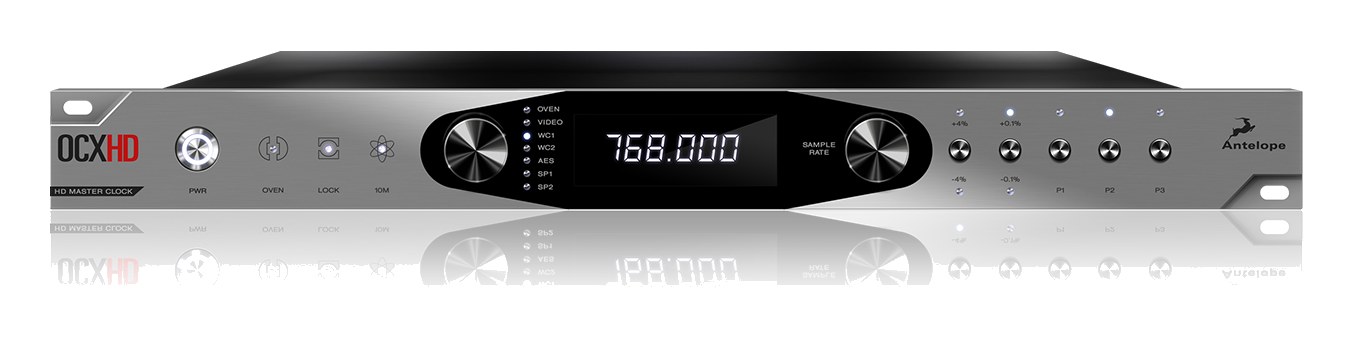
OCX HDThe Antelope Audio OCX HD is the current standard-bearer master clock: oven-controlled oscillator stability, eight word clock outputs, and rates to 768kHz. Studios and broadcast rigs hang whole digital ecosystems off it where clocking integrity is the difference between clean and brittle. Succeeds the discontinued Trinity in the Antelope line.View gear →
06 · Resolve the questions that can change the purchase or build plan.
Planning questions
Short, source-backed answers surface rack fit, power, cabling, and connection details before they become surprises.
How will the Antelope Audio Trinity Master Clock affect rack fit and case depth?
It occupies 1U. Its documented depth is 250 mm.
How much power does the Antelope Audio Trinity Master Clock draw?
Typical draw is 20W and documented maximum draw is 25W.
What connections does the Antelope Audio Trinity Master Clock have?
6 documented physical ports, including Word Clock Out 1 (BNC), Word Clock Out 2 (BNC), Word Clock Out 3 (BNC), Word Clock Out 4 (BNC), Word Clock In (BNC), Power (IEC).
Is the Antelope Audio Trinity Master Clock discontinued?
Trinity discontinued — succeeded by OCX HD in the Antelope clock line.
07 · See this unit inside a real rack plan.
Builder preview
Placement is only the start. Builder checks space · depth · weight, power headroom, dependencies, and compatible signal paths around this exact catalog item.Open in Builder