

Clear-Com HelixNet HMS-4X Main Station
Clear-Com·Model HMS-4X·clearcom-hms-4x
Photos
Manufacturer product photography — the drawn faceplate above stays true to panel layout; these show the hardware itself.
About the Clear-Com HMS-4X
The Clear-Com HelixNet HMS-4X is a four-channel digital intercom main station running over a single shielded Cat5eStandard network cable grades. In an audio rig one cheap Cat5e run can replace a 48-channel copper snake; AES50 wants it shielded. to all the beltpacks on the channel — replacing the analog two-pair partyline with cleaner audio, more channels, and more beltpacks per run. Lives in stage manager, FOHFront Of House — the main mix the audience hears, and the console position out in the room where it gets mixed., and monitor worldThe side-stage domain of the monitor engineer — console, IEM racks, and everything feeding the band’s ears instead of the audience. racks at touring shows + theatres + corporate AV. Bridges to analog partylines for legacy commsProduction intercom — the wired or wireless party line connecting FOH, monitors, stage managers, and lighting during a show. inventory, and ties into RTS via 4-wire when needed.
The HMS-4X is Clear-Com's four-channel digital intercom main station, and for most touring, theatre, and corporate AV rigs it's the nerve center of show communications. A single shielded Cat5eStandard network cable grades. In an audio rig one cheap Cat5e run can replace a 48-channel copper snake; AES50 wants it shielded. run from this box carries all four HelixNet channels out to beltpacks, which means you're replacing the old two-pair partyline snakeA multicore cable bundling many channels into one stage-to-console run. A sub-snake collects one corner of the stage into a drop box. with one cable and getting cleaner audio and more beltpack capacity per run in return. The two analog partyline ports let you bridge legacy belt stations or a second building's existing comm infrastructure, and the 4-wire XLRThe standard 3-pin locking connector for mics and balanced line signals — pin 1 is the shield, pins 2 and 3 carry the balanced pair. pair ties directly into RTS matrixA routing grid that builds extra outputs from any mix of mixes or channels — fills, lobby, stream feeds — without touching the main mix. systems when the show demands it. One rack unitThe standard slice of rack height: 1U = 1.75″. A 3U box takes three slices; half-rack gear pairs two units side by side in one., 3.8 kg, and it handles the entire commsProduction intercom — the wired or wireless party line connecting FOH, monitors, stage managers, and lighting during a show. topology.
At load-in, the single-cable architecture pays off immediately — you're pulling Cat5eStandard network cable grades. In an audio rig one cheap Cat5e run can replace a 48-channel copper snake; AES50 wants it shielded. instead of multi-pair, and the Ethernet config port means you can adjust channel assignments and beltpack permissions from a laptop without touching the front panel. The 25-watt nominal draw is light enough that it won't stress a standard power conditionerFilters venue AC, clamps surges, and gives the rack one tidy inlet. Not a voltage regulator and not a battery — just cleaner power. circuit even when you're daisy-chaining beltpacks off a long run. The gooseneck mic input and stage-announce XLRThe standard 3-pin locking connector for mics and balanced line signals — pin 1 is the shield, pins 2 and 3 carry the balanced pair. output mean the station engineer has a dedicated announce path without stealing a channel slot, which matters on a complex show where all four commsProduction intercom — the wired or wireless party line connecting FOH, monitors, stage managers, and lighting during a show. channels are already assigned. At 230mm deep it's a standard fit in most 14-inch-deep rack lids.
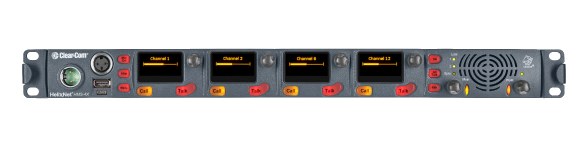
If you're running more than a handful of beltpacks across multiple departments on a touring production or a mid-to-large theatre, the HMS-4X is the right call — the four-channel digital architecture gives you discrete commsProduction intercom — the wired or wireless party line connecting FOH, monitors, stage managers, and lighting during a show. for stage management, monitor worldThe side-stage domain of the monitor engineer — console, IEM racks, and everything feeding the band’s ears instead of the audience., FOHFront Of House — the main mix the audience hears, and the console position out in the room where it gets mixed., and deck crew without cross-talk or level-sharing compromises. For a small club rig or a two-person broadcast workflow, it's more station than you need and the price reflects that; a single-channel partyline system or a simpler two-channel digital station is a better fit. The analog partyline bridge ports make it a realistic upgrade path rather than a forklift replacement if your crew still carries older belt packs.
In the rack
- Run the HelixNet Cat5eStandard network cable grades. In an audio rig one cheap Cat5e run can replace a 48-channel copper snake; AES50 wants it shielded. on its own dedicated cable pull — don't bundle it with RFRadio Frequency — the wireless part of wireless. RF planning is why big rigs scan, coordinate, and combine antennas instead of hoping. or audio snakeA multicore cable bundling many channels into one stage-to-console run. A sub-snake collects one corner of the stage into a drop box. runs if you can avoid it, especially over long stage-to-FOHFront Of House — the main mix the audience hears, and the console position out in the room where it gets mixed. distances where interference risk increases.
- Use the Ethernet config port during advance and save your channel/beltpack assignments as a named show file; at the next load-in you're restoring a config rather than rebuilding from scratch.
- Patch the 4-wire Out into your IEMIn-Ear Monitor — earpieces that replace floor wedges, feeding each player their own mix. The reason this whole rack exists. or monitor console's auxAn auxiliary mix output — each aux is its own independent blend of the channels, typically one per monitor mix or effects send. return if you need program feed on commsProduction intercom — the wired or wireless party line connecting FOH, monitors, stage managers, and lighting during a show. — it's a cleaner integration than routing through FOHFront Of House — the main mix the audience hears, and the console position out in the room where it gets mixed. and back.
- Label both partyline XLRThe standard 3-pin locking connector for mics and balanced line signals — pin 1 is the shield, pins 2 and 3 carry the balanced pair. ports clearly on a patch bayA panel of front-facing jacks wired to everything behind it — re-route any signal with a short cable instead of climbing behind the rack. or rack lid label strip; they're bidirectional and easy to swap under pressure, and a reversed partyline connection is a non-obvious troubleshoot mid-show.
Four-channel digital intercom main station. The reference for show-commsProduction intercom — the wired or wireless party line connecting FOH, monitors, stage managers, and lighting during a show. on touring + theatre.
I/O Ports (10)
| Port | Connector | Direction | Signal | Channels |
|---|---|---|---|---|
| HelixNet Channel A (RJ45) | RJ45 | bidirectional | data | — |
| HelixNet Channel B (RJ45) | RJ45 | bidirectional | data | — |
| Partyline A (XLR-3) | XLR FEMALE | bidirectional | analog audio | — |
| Partyline B (XLR-3) | XLR FEMALE | bidirectional | analog audio | — |
| IFB / 4-wire In (XLR) | XLR FEMALE | input | analog audio | — |
| IFB / 4-wire Out (XLR) | XLR MALE | output | analog audio | — |
| Ethernet (config) | RJ45 | bidirectional | data | — |
| Stage Announce / Aux Out | XLR MALE | output | analog audio | — |
| Gooseneck Mic In (XLR) | XLR FEMALE | input | analog audio | — |
- Power (IEC) (IEC C14)

