

Lab.gruppen / Lake LM 44 Loudspeaker Processor
Lab.gruppen / Lake·Model LM 44·lake-lm44
About the Lab.gruppen / Lake LM 44
The Lake LM 44 is the touring-grade loudspeaker system processor — the box that sits between FOHFront Of House — the main mix the audience hears, and the console position out in the room where it gets mixed. and the amplifier rows, doing crossoverSplits audio into frequency bands so each speaker only gets what it can handle — lows to the subs, highs to the horns., limiting, EQ, alignment delay, and Lake's signature mesh-networked control. Used on top-tier touring rigs (Coachella main stages, arena tours, system tech worlds) where reliability and remote control of dozens of LM units from a single laptop is the gig. Iso-Float ground isolation eliminates loops between FOH and the stage.
The Lake LM 44 is the box that sits between your console outputs and your amplifier inputs and makes the entire loudspeaker system behave like a single engineered thing. Four analog inputs, four analog outputs, AES/EBUThe pro standard for stereo digital audio over an XLR cable — balanced, so it runs much farther than consumer S/PDIF. digital input, and Lake's mesh networking over dual RJ45 ports — this is a crossoverSplits audio into frequency bands so each speaker only gets what it can handle — lows to the subs, highs to the horns., limiterA compressor with a hard ceiling: nothing gets past the level you set. In an IEM rig it’s hearing protection as much as tone., FIR/IIR EQ engine, alignment delay, and remote control node all in one 1UThe standard slice of rack height: 1U = 1.75″. A 3U box takes three slices; half-rack gear pairs two units side by side in one. chassis. On arena tours and festival main stages, system techs will chain a dozen or more of these across FOHFront Of House — the main mix the audience hears, and the console position out in the room where it gets mixed., delays, fills, and stage systems, managing the entire network from one laptop running Lake Controller. That's the world this processor was built for.
In practice at load-in, the dual network ports let you daisy-chain units or build redundantA second copy of anything critical — supply, computer, network path — already running so one failure can’t stop the show. ring topologies without adding a separate managed switchA network switch you can configure — VLANs, QoS, IGMP — so audio traffic gets priority. Dante rigs beyond a few boxes want one. for smaller rigs — that saves real time and real rack space. The Iso-Float ground isolation is not a marketing feature: it actively breaks ground loopsHum from gear seeing two ground paths at slightly different voltage — the classic buzz when two racks share audio and power. between the FOHFront Of House — the main mix the audience hears, and the console position out in the room where it gets mixed. console and stage amplifier racks, and if you've ever chased a hum through a festival compound at 2am you understand exactly what that's worth. At 30W idle draw and a max of 50W, the LM 44 is thermally gentle, which matters when it's sitting between hot power amps in a packed amp rack. The 360mm depth is substantial, so measure your rack before you commit.
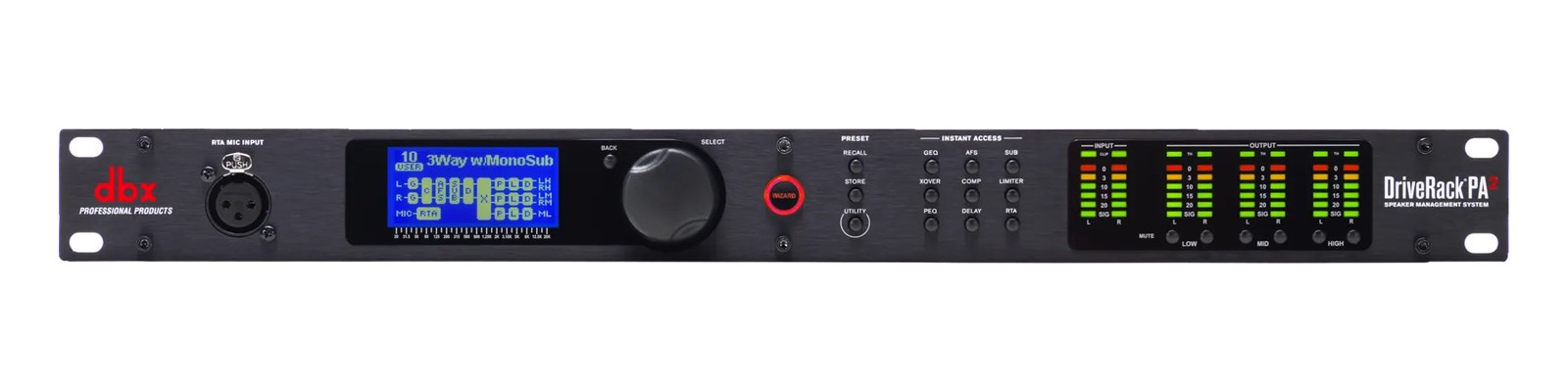
If you're running a Lab.gruppen or other Lake-compatible amp ecosystem, or inheriting a rig that already speaks Lake, the LM 44 is the natural and correct answer — it integrates tightly, the processing headroomThe margin between your normal level and where things clip — headroom is what absorbs the snare hit you didn’t see coming. is real, and remote recall of presets mid-tour is genuinely useful when venues vary. If your rig is smaller, analog-only, and you're not managing multiple zones remotely, the $5,499 price tag is hard to justify against capable alternatives from BSS, Xilica, or Linea Research's own processing options. This is professional touring infrastructure, not a utility processor for a club install or a modest IEMIn-Ear Monitor — earpieces that replace floor wedges, feeding each player their own mix. The reason this whole rack exists. rack.
In the rack
- Use Network Port A for the primary Lake mesh chain and leave Network Port B for a direct laptop connection during system check — you can pull up Lake Controller without interrupting the live network path.
- Map Analog Inputs 1–2 to your main PA outputs and Inputs 3–4 to fills or delays from the start; keeping that assignment consistent across dates means any sub covering your show can patch and verify in minutes.
- At 360mm deep, confirm your rack's usable internal depth before packing — shallow road cases will require a rear-mount shelf or the unit will hang unsupported past the rack earsThe flanges that bolt gear to the rack rails. Desktop boxes without them need a shelf, tray, or drawer to live in the case..
- Save a 'flat' baseline preset on every unit before the first show; if a limiterA compressor with a hard ceiling: nothing gets past the level you set. In an IEM rig it’s hearing protection as much as tone. threshold or delay value gets changed during a panicked line-checkThe quick pre-show pass confirming every input reaches the console, one line at a time. Not a soundcheck — just does it work., you can restore the vetted system tune in one recall rather than rebuilding from notes.
Touring-grade 4-in/4-out system processor. Lake mesh networking, Iso-Float ground isolation.
I/O Ports (13)
| Port | Connector | Direction | Signal | Channels |
|---|---|---|---|---|
| Analog In 1 (XLR) | XLR FEMALE | input | analog audio | — |
| Analog In 2 (XLR) | XLR FEMALE | input | analog audio | — |
| Analog In 3 (XLR) | XLR FEMALE | input | analog audio | — |
| Analog In 4 (XLR) | XLR FEMALE | input | analog audio | — |
| AES/EBU In 1 | AES3 XLR | input | digital audio | — |
| AES/EBU In 2 | AES3 XLR | input | digital audio | — |
| Analog Out 1 (XLR) | XLR MALE | output | analog audio | — |
| Analog Out 2 (XLR) | XLR MALE | output | analog audio | — |
| Analog Out 3 (XLR) | XLR MALE | output | analog audio | — |
| Analog Out 4 (XLR) | XLR MALE | output | analog audio | — |
| Lake Network A (RJ45) | RJ45 | bidirectional | data | — |
| Lake Network B (RJ45) | RJ45 | bidirectional | data | — |
- Power (IEC) (IEC C14)


