
System Processor

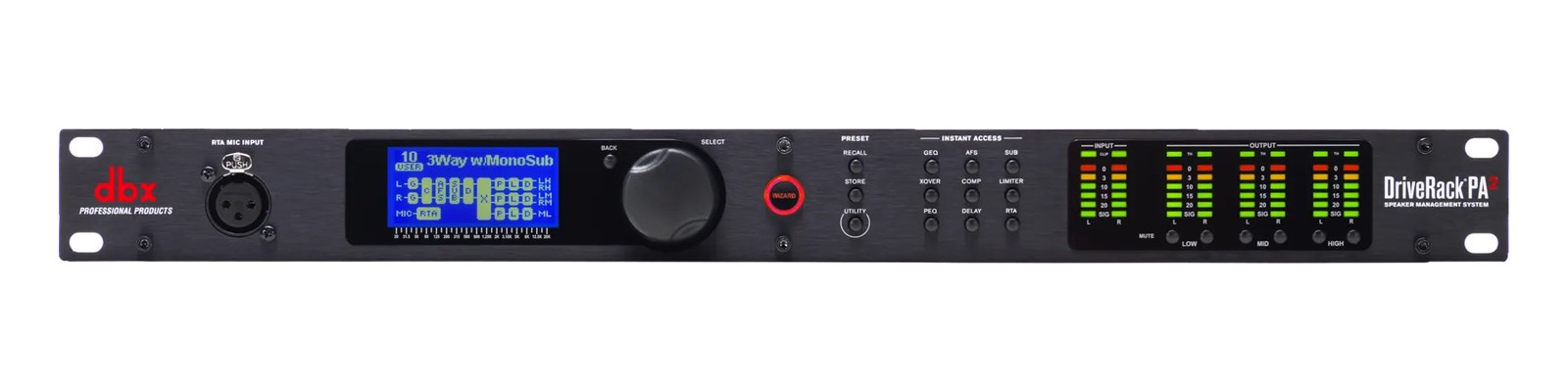
dbx DriveRack PA2

dbx·Model DriveRack PA2·dbx-driverack-pa2

Photos

Manufacturer product photography — the drawn faceplate above stays true to panel layout; these show the hardware itself.

Photo: dbxClick to zoom

About the dbx DriveRack PA2

The dbx DriveRack PA2 is the budget loudspeaker management workhorse — stereo input, six outputs, AutoEQ for room tuning, AFS (Advanced Feedback Suppression) for taming wedges, plus crossover and alignment delay for sub/top systems. Lives between a small console and the amp racks at houses of worship, regional touring, and bar bands. Not a Lake LM, but at one-tenth the price it gets the job done for thousands of small-and-mid-size shows a year.

The DriveRack PA2 sits between your console outputs and your amp rack, doing the work that separates a tuned system from a pile of boxes pointed at an audience. Two XLR inputs split to six XLR outputs, which gives you enough legs for a typical two-way main system plus subwoofers — or a simple three-way if you're running mono. It handles crossover duties, alignment delay so your subs don't smear the low end of your tops, and system-level EQ so you're shaping the room rather than fighting it at the mix position. For houses of worship, regional touring, and bar-gig rigs where a dedicated system tech and a Lake processor aren't in the budget, this is the unit thousands of engineers reach for.

At load-in, the RTA mic input and AutoEQ wizard are the practical headline. You're not getting a full acoustic measurement platform here — it's a pink-noise sweep with a built-in correction curve — but it gives you a faster starting point than walking in blind, especially in rooms you've never touched before. AFS feedback suppression is genuinely useful if your rig doubles as a front-fill or floor-monitor source, where ring buildup is a real threat before doors. Ethernet control via the dbx Drive app means you can walk the room and trim the system from your phone without running back to the rack. Power draw is 14 watts nominal, topping at 18, so it's nearly invisible on any conditioner's budget.
If you're running a straightforward two-way or 2.1 system in a fixed or semi-fixed install, a regional club rig, or a portable church setup, the PA2 earns its rack space comfortably. If you're running a more complex system — multiple amplifier zones, line arrays with per-cabinet drive requirements, or a rig where the system engineer and mix engineer are different people with network recall expectations — you'll outgrow it quickly and should be looking at dedicated DSP platforms with more robust software ecosystems. This is not a knock on the unit; it's an honest description of where its ceiling is.

In the rack

  • Map your six outputs on paper before you plug anything in — crossover point, polarity, and delay for each zone — so the wizard setup reflects your actual system topology rather than a generic preset you'll regret at soundcheck.
  • Use the alignment delay on outputs feeding your subwoofers to time-align them to your tops before you do any EQ work; chasing low-end problems with EQ when the real issue is phase is the most common mistake on rigs like this.
  • The Ethernet port is worth using even if you don't need remote control day-to-day — save a named snapshot of your tuned system before every show so you have a clean restore point if the unit gets bumped or reset.
  • If AFS is on and you're using any outputs as front-fill or near-fill feeds rather than pure FOH, keep the AFS filter count conservative; let it catch the obvious rings rather than maxing out the filters and letting it reshape your frequency response mid-show.

Stereo loudspeaker management for budget touring + houses of worship. AutoEQ + AFS feedback suppression.

I/O Ports (11)

PortConnectorDirectionSignalChannels
Input L (XLR)XLR FEMALEinputanalog audio
Input R (XLR)XLR FEMALEinputanalog audio
Output 1 (XLR)XLR MALEoutputanalog audio
Output 2 (XLR)XLR MALEoutputanalog audio
Output 3 (XLR)XLR MALEoutputanalog audio
Output 4 (XLR)XLR MALEoutputanalog audio
Output 5 (XLR)XLR MALEoutputanalog audio
Output 6 (XLR)XLR MALEoutputanalog audio
RTA Mic In (XLR)XLR FEMALEinputanalog audio
Ethernet (control)RJ45bidirectionaldata
Power
  • Power (IEC) (IEC C14)

Related gear