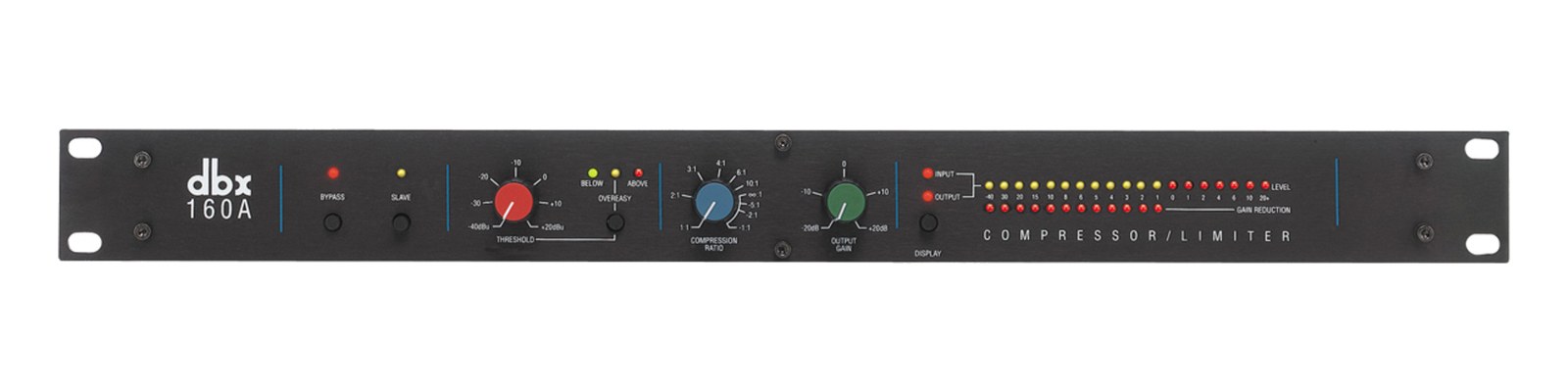
The dbx 160A is the spiritual successor to the legendary 160 series — a single-channel VCA compressor that has been on more touring lead-vocal channels than any other piece of outboard gear. Hard-knee characteristics, OverEasy switchable, peak limiter built in. Most engineers slot it on lead vox and drum bus where its quick attack and consistent gain reduction earn it years of road work.
Discontinued. Dropped by Sweetwater/major retail 2025-2026; dbx-direct only. Price reflects last new street. Kept for owners — classic still in countless racks.
Photos
Manufacturer product photography — the drawn faceplate stays true to panel layout; these show the hardware itself.
~$769Use retailer rows for current price and stock
01 · What it does—and what that changes in your rig.
Product overview
Start with the payoff, then work through how it functions, where it fits, and the details that change a real build.
The payoff
Compressor decisions, organized around the whole rig.
The dbx 160A is a single-channel VCA compressor that has earned its place as a touring-rack staple the hard way — through decades of consistent, predictable behavior on lead-vocal channels and drum busesA path where multiple channels sum into one signal — mixes, groups, and mains are all buses. A 25-bus console can build 25 blends at once. across every size of venue. It carries the lineage of the original 160 series, offering both hard-knee compression and the switchable OverEasy mode that softens the threshold knee for sources that need a gentler on-ramp. A built-in peak limiterA compressor with a hard ceiling: nothing gets past the level you set. In an IEM rig it’s hearing protection as much as tone. adds a second line of defense without requiring a separate unit, which matters when rack space is already spoken for.
Documented outputs
1One destination connection
Documented inputs
3Based on documented inputs
Rack space
1U · half-rackBuilder checks available rail space
Photo: dbx1U · half-rack · 12W
Function
How it works in the path
At load-in, the 160A's half-rackThe standard slice of rack height: 1U = 1.75″. A 3U box takes three slices; half-rack gear pairs two units side by side in one. footprint is either its best feature or a minor logistical puzzle depending on how your rack is built. You need a half-rack shelf or a paired unit to fill the 1U slot cleanly — plan for that before the truck arrives. The XLRThe standard 3-pin locking connector for mics and balanced line signals — pin 1 is the shield, pins 2 and 3 carry the balanced pair. in and out keep your signal path professional and solid, and the side-chain detector TRSTip-Ring-Sleeve — a 1/4″ jack with three contacts carrying a balanced signal or a stereo pair. A guitar plug with one extra ring. jack lets you feed an external key signal if you're doing anything like de-essingA compressor that only clamps the harsh sss frequencies of a vocal — tames sibilance without dulling the whole voice. or ducking without an additional processor. At 12 watts nominal draw, it's a negligible load on your conditioner, and the 200mm depth fits comfortably in a shallow utility rack.
Best fit
Where it earns its place in the rack
If you're running a live vocal chain and want a compressor that behaves the same way every night without asking much of you, the 160A is a defensible choice at $769 — it's not cheap, but it's not experimental either. Where it makes less sense is stereo work: you'd need two units and a way to link them, which gets expensive fast. Engineers chasing a completely transparent, colorless compressor may also find the 160A's character more present than they want. For those cases, a stereo or dual-channel alternative is a better fit. But for a single critical channel in a touring IEMIn-Ear Monitor — earpieces that replace floor wedges, feeding each player their own mix. The reason this whole rack exists. or monitor rig, it's hard to argue with the track record.
In the rack
Details worth deciding before load-in.
If you're pairing two 160As in a 1UThe standard slice of rack height: 1U = 1.75″. A 3U box takes three slices; half-rack gear pairs two units side by side in one. slot, confirm your rack shelf has the correct mounting ears — dbx's own half-rack adapter bracket keeps them from rattling loose after a few show days on the road.
Use the detector TRSTip-Ring-Sleeve — a 1/4″ jack with three contacts carrying a balanced signal or a stereo pair. A guitar plug with one extra ring. input to feed a high-passed copy of the vocal signal from your console's insert send; this lets the compressor react to the body of the voice rather than low-end rumble from stage, tightening up the gainHow much the preamp amplifies the incoming signal. Too low and you’re hunting through hiss; too high and peaks clip. reduction behavior significantly.
Set the peak limiterA compressor with a hard ceiling: nothing gets past the level you set. In an IEM rig it’s hearing protection as much as tone. as a true ceiling, not as the primary dynamic tool — dial your compression ratio and threshold first, then bring the limiter in just below clip to protect downstream gear, not to do the heavy lifting.
In an IEMIn-Ear Monitor — earpieces that replace floor wedges, feeding each player their own mix. The reason this whole rack exists. rig, place the 160A post-console insert on the lead-vocal channel before the IEM transmitter feed so artists hear consistent, compressed audio in their ears regardless of how the vocalist is riding the mic.
02 · Know the whole path before you buy.
Signal path
Learn the route as a block diagram: source, product function, transport, and destination. Select any block to see what enters, what changes, and what leaves.
Interactive block diagramAuto-looping · hover, focus, or tap to hold a stage
Port-type signalProduct functionSystem boundary
Follow one signal from source to destination
Each block answers the same three questions: what arrives, what changes here, and what leaves.
01 · Source · selected
XLR female + ¼-inch TRS
XLR male
01 · Source
3 documented inputs
XLR female + ¼-inch TRS
Arrives as
3 documented inputs
Connector
XLR female + ¼-inch TRS
Signal
analog audio
03 · What this product asks of the rest of the system.
Compatibility
Treat connector names as the start of the check—not the answer. These are the boundaries that determine a complete working path.
Best fit · Compressor
Use it when 1U · half-rack and 200 mm of depth fit the case.
Plan the companion path
Complete the path with upstream and downstream gear that matches connector, direction, signal type, protocol, and wiring standard.
Connector boundary
Documented connectors: XLR female, XLR male, ¼-inch TRS, IEC C14. Match connector, direction, and signal type—not shape alone.
04 · Every connector, grouped by job.
I/O ports
Switch the product view and the documented port inventory updates with it—hardware and data stay side by side.
Every connector, grouped by job.
Switch panels to keep the hardware view and the documented port list in sync.
Front panelRear panel
All documented ports for dbx 160A
Port
Panel
Connector
Direction
Signal
Channels
Input
rear
XLR female
input
analog audio
—
Output
rear
XLR male
output
analog audio
—
Detector
rear
¼-inch TRS
input
analog audio
—
AC (captive)
rear
IEC C14
input
power
—
Showing 4 of 4 documented physical ports.
05 · Compare the decision, not just the price.
Alternatives
The rows are organized around fit, power, I/O, and system role so a cheaper unit cannot hide a more expensive workflow.
160AThe dbx 160A is the spiritual successor to the legendary 160 series — a single-channel VCA compressor that has been on more touring lead-vocal channels than any other piece of outboard gear. Hard-knee characteristics, OverEasy switchable, peak limiter built in. Most engineers slot it on lead vox and drum bus where its quick attack and consistent gain reduction earn it years of road work.View gear →
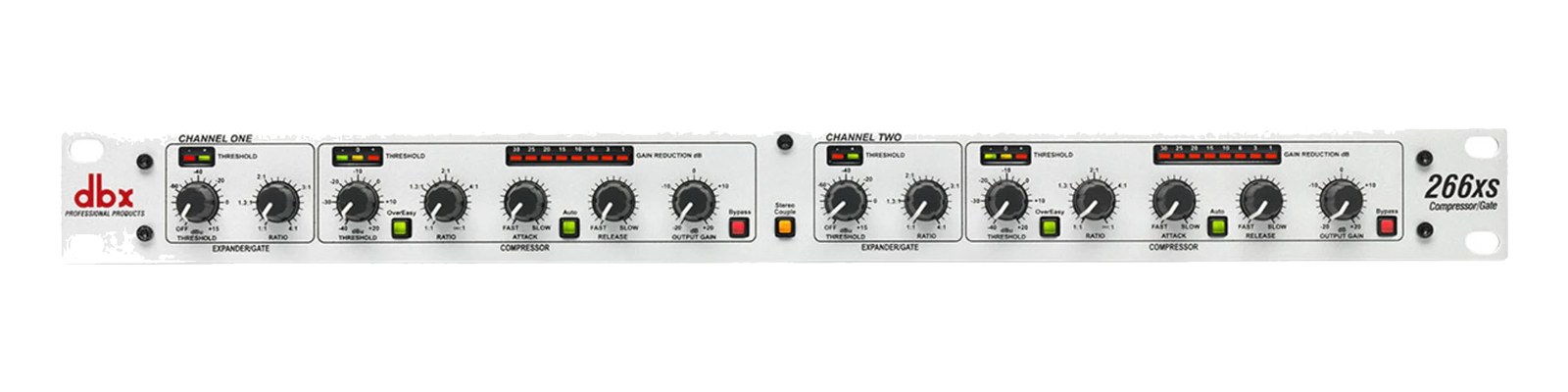
266xsThe dbx 266xs is the compressor that shows up in more racks than any other: two channels of OverEasy compression plus gating for under three hundred dollars. In an IEM or playback rig it earns a slot taming hot playback stems or protecting a house feed, with XLR and TRS on every channel and true stereo linking. Not fancy — dependable.View gear →
DL241XLRDrawmer's DL241 is a two-channel auto-compressor with their signature musical, transparent character — engineers who don't want to think about ratios just hit "auto" and let it work. Stereo-link switch makes it a quick stereo bus tool; in dual-mono it earns its rack space across vocals, guitars, and the FOH master. A staple on UK and European touring rigs.View gear →
EL8-XThe Empirical Labs Distressor EL8-X is the one hardware compressor that still tours: a digitally controlled analog design whose Nuke and British modes made it the vocal and drum weapon of three decades of records and broadcast trucks. In a rig it earns its rack space on a money channel — lead vocal to broadcast, or a stem pair that needs attitude. Image Link joins two units for stereo.View gear →
06 · Resolve the questions that can change the purchase or build plan.
Planning questions
Short, source-backed answers surface rack fit, power, cabling, and connection details before they become surprises.
How will the dbx 160A affect rack fit and case depth?
It occupies 1U · half-rack. Its documented depth is 200 mm.
How much power does the dbx 160A draw?
Typical draw is 12W and documented maximum draw is 15W.
What connections does the dbx 160A have?
4 documented physical ports, including Input, Output, Detector, AC (captive).
Is the dbx 160A discontinued?
Dropped by Sweetwater/major retail 2025-2026; dbx-direct only. Price reflects last new street. Kept for owners — classic still in countless racks.
07 · See this unit inside a real rack plan.
Builder preview
Placement is only the start. Builder checks space · depth · weight, power headroom, dependencies, and compatible signal paths around this exact catalog item.Open in Builder