The Empirical Labs Distressor EL8-X is the one hardware compressor that still tours: a digitally controlled analog design whose Nuke and British modes made it the vocal and drum weapon of three decades of records and broadcast trucks. In a rig it earns its rack space on a money channel — lead vocal to broadcast, or a stem pair that needs attitude. Image Link joins two units for stereo.
~$1,799Use retailer rows for current price and stock
01 · What it does—and what that changes in your rig.
Product overview
Start with the payoff, then work through how it functions, where it fits, and the details that change a real build.
The payoff
Compressor decisions, organized around the whole rig.
The Distressor is the one character compressor that never really left the road. Empirical Labs built a digitally controlled analog circuit that gives you repeatable settings across nights and cities — a rarity in a genre of gear that's usually all feel and no recall. On a live rack it earns its single U on a money channel: lead vocal, broadcast feed, a kick or snare insert, a stem that needs to survive a rough front-of-houseFront Of House — the main mix the audience hears, and the console position out in the room where it gets mixed. without disappearing into the mix. It isn't a utility transparent compressor; it's the unit you reach for when the channel needs to work harder and sound better doing it.
Documented outputs
22 destination connections
Documented inputs
3Based on documented inputs
Rack space
1UBuilder checks available rail space
Empirical Labs product panel1U · 15W
Function
How it works in the path
The XLRThe standard 3-pin locking connector for mics and balanced line signals — pin 1 is the shield, pins 2 and 3 carry the balanced pair. and TRSTip-Ring-Sleeve — a 1/4″ jack with three contacts carrying a balanced signal or a stereo pair. A guitar plug with one extra ring. I/O pairs mean you can drop it into a console insert loop or run it balancedCarries the signal on two wires and cancels whatever noise both pick up — why mic cables can run hundreds of feet hum-free.line-levelThe strong signal that runs between pieces of gear (about a volt) — hotter than mic level, far below speaker level. without an adapter scramble at load-in. Image Link on a TRS connector lets two EL8-X units slew their gainHow much the preamp amplifies the incoming signal. Too low and you’re hunting through hiss; too high and peaks clip. reduction together for stereo operation — useful if you're running a stereo effects return or a broadcast stem. Power draw sits between 15 and 20 watts, so it's essentially free on any sensible conditioner. At 254 mm deep and 3.6 kg it fits a standard shallow rack without drama. The British Mode and Nuke settings are hardware switches, which means your recall sheet is your safety net — write it down every soundcheck.
Best fit
Where it earns its place in the rack
If you're building a one-compressor-per-rack role where that slot is specifically for a high-value mono channel, the Distressor at $1,799 makes a serious argument. It's overkill as a utility busA path where multiple channels sum into one signal — mixes, groups, and mains are all buses. A 25-bus console can build 25 blends at once. compressor and genuinely wrong for someone needing stereo transparency — a different tool wins that fight. Engineers who already know the Distressor from studio or broadcast work will find it behaves identically live, which is exactly the point. If you're new to it, the learning curve is real: budget rehearsal time before the first show.
In the rack
Details worth deciding before load-in.
Label your British Mode and Nuke switch positions with a paint pen or label maker — these don't recall digitally, and re-dialing by ear during a line checkThe quick pre-show pass confirming every input reaches the console, one line at a time. Not a soundcheck — just does it work. under pressure is a bad time.
Use the Image Link TRSTip-Ring-Sleeve — a 1/4″ jack with three contacts carrying a balanced signal or a stereo pair. A guitar plug with one extra ring. to slave a second EL8-X for stereo operation; the primary unit drives, the secondary follows — keep that cable short and tucked so it doesn't get pulled during a changeover.
Patch via the TRSTip-Ring-Sleeve — a 1/4″ jack with three contacts carrying a balanced signal or a stereo pair. A guitar plug with one extra ring. insert jacks when dropping into a console insert loop; it keeps your XLRsThe standard 3-pin locking connector for mics and balanced line signals — pin 1 is the shield, pins 2 and 3 carry the balanced pair. free for a clean parallel or alternate routing without re-patching under the stage.
Place it adjacent to your patchbayA panel of front-facing jacks wired to everything behind it — re-route any signal with a short cable instead of climbing behind the rack. if possible — the Distressor rewards quick ratio and attack swaps between acts, and physical access matters when you're dialing it in on the fly.
02 · Know the whole path before you buy.
Signal path
Learn the route as a block diagram: source, product function, transport, and destination. Select any block to see what enters, what changes, and what leaves.
Interactive block diagramAuto-looping · hover, focus, or tap to hold a stage
Port-type signalProduct functionSystem boundary
Follow one signal from source to destination
Each block answers the same three questions: what arrives, what changes here, and what leaves.
01 · Source · selected
XLR female + ¼-inch TRS
XLR male + ¼-inch TRS
01 · Source
3 documented inputs
XLR female + ¼-inch TRS
Arrives as
3 documented inputs
Connector
XLR female + ¼-inch TRS
Signal
analog audio
03 · What this product asks of the rest of the system.
Compatibility
Treat connector names as the start of the check—not the answer. These are the boundaries that determine a complete working path.
Best fit · Compressor
Use it when 1U and 254 mm of depth fit the case.
Plan the companion path
Complete the path with upstream and downstream gear that matches connector, direction, signal type, protocol, and wiring standard.
Connector boundary
Documented connectors: XLR female, XLR male, ¼-inch TRS, IEC C14. Match connector, direction, and signal type—not shape alone.
04 · Every connector, grouped by job.
I/O ports
Switch the product view and the documented port inventory updates with it—hardware and data stay side by side.
Every connector, grouped by job.
Switch panels to keep the hardware view and the documented port list in sync.
Front panelRear panel
All documented ports for Empirical Labs Distressor EL8-X
Port
Panel
Connector
Direction
Signal
Channels
Input
rear
XLR female
input
analog audio
—
Output
rear
XLR male
output
analog audio
—
Input (TRS)
rear
¼-inch TRS
input
analog audio
—
Output (TRS)
rear
¼-inch TRS
output
analog audio
—
Image Link
rear
¼-inch TRS
bidirectional
analog audio
—
Power
rear
IEC C14
input
power
—
Showing 6 of 6 documented physical ports.
05 · Compare the decision, not just the price.
Alternatives
The rows are organized around fit, power, I/O, and system role so a cheaper unit cannot hide a more expensive workflow.
EL8-XThe Empirical Labs Distressor EL8-X is the one hardware compressor that still tours: a digitally controlled analog design whose Nuke and British modes made it the vocal and drum weapon of three decades of records and broadcast trucks. In a rig it earns its rack space on a money channel — lead vocal to broadcast, or a stem pair that needs attitude. Image Link joins two units for stereo.View gear →
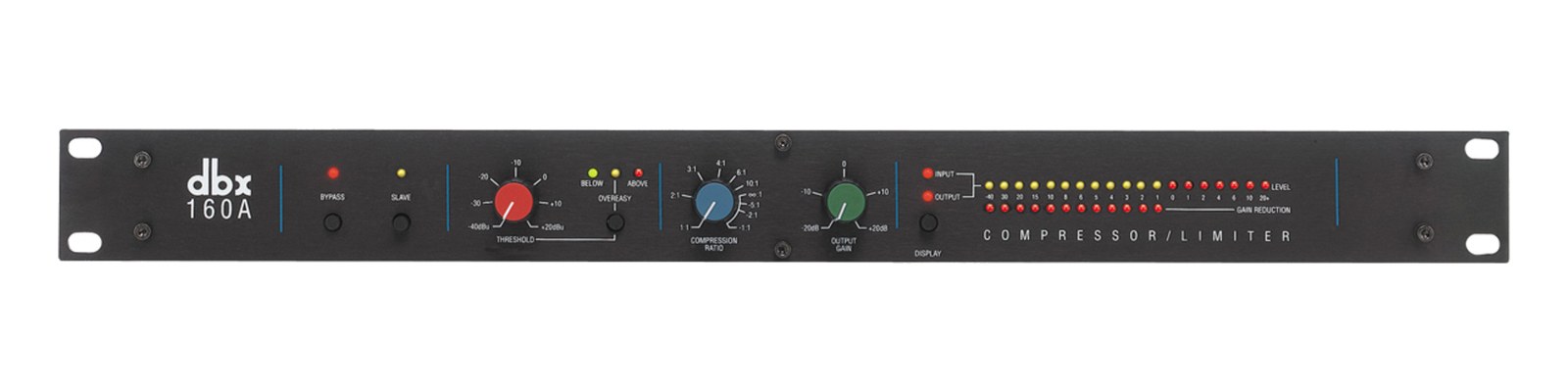
160AThe dbx 160A is the spiritual successor to the legendary 160 series — a single-channel VCA compressor that has been on more touring lead-vocal channels than any other piece of outboard gear. Hard-knee characteristics, OverEasy switchable, peak limiter built in. Most engineers slot it on lead vox and drum bus where its quick attack and consistent gain reduction earn it years of road work.View gear →
Placement is only the start. Builder checks space · depth · weight, power headroom, dependencies, and compatible signal paths around this exact catalog item.Open in Builder