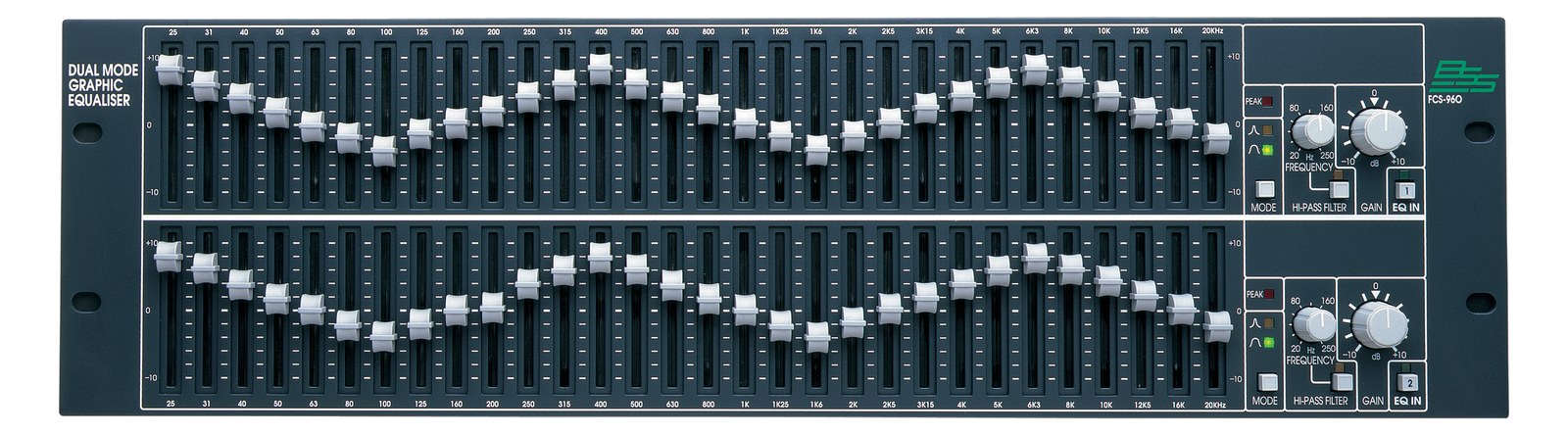
The BSS FCS-960 brings dual 30-band graphic EQ with BSS's Frequency Conscious filter shapes — narrower Q on cut, wider on boost — that make ringing out monitors faster and cleaner than a vanilla constant-Q design. Touring sound rigs from the 90s through today have leaned on FCS-series for monitor and FOH duty. A solid alternative to the Klark DN360 that some engineers prefer for its slightly warmer character.
~$1,399Use retailer rows for current price and stock
01 · What it does—and what that changes in your rig.
Product overview
Start with the payoff, then work through how it functions, where it fits, and the details that change a real build.
The payoff
Equalizer decisions, organized around the whole rig.
The BSS FCS-960 is a dual-channel 30-band graphic EQAn equalizer with one fader per fixed frequency band (31 on a pro unit) — fast broad tone-shaping, classic for ringing out monitors. built around BSS's Frequency Conscious filter design — a proprietary approach where cuts behave with a narrower Q and boosts open up wider. That asymmetry matters in real ring-out work: you can notch a feedback frequency tightly without gutting the surrounding octave, then add a gentle presence lift without creating a harsh spike. Two fully independent channels in 2UThe standard slice of rack height: 1U = 1.75″. A 3U box takes three slices; half-rack gear pairs two units side by side in one. means a single unit handles a stereo IEMIn-Ear Monitor — earpieces that replace floor wedges, feeding each player their own mix. The reason this whole rack exists. mix or two discrete monitor sends, which is exactly how most touring monitor racks use it.
Documented outputs
22 destination connections
Documented inputs
3Based on documented inputs
Rack space
2UBuilder checks available rail space
BSS Audio product panel2U · 24W
Function
How it works in the path
At 240mm deep and 5.8kg, the FCS-960 sits comfortably in a standard shallow rack without fighting for real estate, and 24 watts idle means it won't stress a modest power strip. Both channels are XLRThe standard 3-pin locking connector for mics and balanced line signals — pin 1 is the shield, pins 2 and 3 carry the balanced pair. in and out — balancedCarries the signal on two wires and cancels whatever noise both pick up — why mic cables can run hundreds of feet hum-free., line levelThe strong signal that runs between pieces of gear (about a volt) — hotter than mic level, far below speaker level. throughout — so there's no adapter gymnastics patching it between a console auxAn auxiliary mix output — each aux is its own independent blend of the channels, typically one per monitor mix or effects send. and a drive rack or amplifier. The faders are long-throw and well-spaced for a 30-band unit, which makes precise adjustments under stage lighting less of a guess. Thirty bands at ISO centers gives you the resolution to chase a specific monitor build's resonances without the coarse compromises of a 15-band.
Best fit
Where it earns its place in the rack
If your workflow is analog monitor worldThe side-stage domain of the monitor engineer — console, IEM racks, and everything feeding the band’s ears instead of the audience. or you're maintaining a touring rig that needs a physical graphic in the chain, the FCS-960 earns its rack space. Engineers who prefer its filter character over the Klark DN360 often cite a slightly warmer quality in the low-mids when boosting. If you're running a fully digital signal path with a console that already provides per-output GEQ — an SD-Range or a DiGiCo with internal processing — a hardware graphic may be redundantA second copy of anything critical — supply, computer, network path — already running so one failure can’t stop the show. weight and cost. Similarly, if you only need one channel, look at the single-channel FCS-966 before doubling your rack space.
In the rack
Details worth deciding before load-in.
Label each channel's fader position with tape or a photo after a successful ring-out — the FCS-960 has no recall, and rebuilding a tuned system from scratch mid-tour is avoidable.
Patch it after any drive processor or delay unit in the chain but before the amp input; if you're using it for FOHFront Of House — the main mix the audience hears, and the console position out in the room where it gets mixed. correction, it should sit post-matrixA routing grid that builds extra outputs from any mix of mixes or channels — fills, lobby, stream feeds — without touching the main mix. so you're EQing the actual output path, not something that gets re-summed downstream.
Keep both channels in use even on a mono send — leave the unused channel flat and bypassed rather than unpatched, so you always have a clean spare path if a fader develops a scratch or a channel develops noise mid-show.
The shallow 240mm depth pairs well with a 250mm or 300mm deep rack shelf if you're building a compact fly rig; no need for a full 450mm touring case just to seat it properly.
02 · Know the whole path before you buy.
Signal path
Learn the route as a block diagram: source, product function, transport, and destination. Select any block to see what enters, what changes, and what leaves.
Interactive block diagramAuto-looping · hover, focus, or tap to hold a stage
Port-type signalProduct functionSystem boundary
Follow one signal from source to destination
Each block answers the same three questions: what arrives, what changes here, and what leaves.
01 · Source · selected
XLR female + IEC C14
XLR male
01 · Source
3 documented inputs
XLR female + IEC C14
Arrives as
3 documented inputs
Connector
XLR female + IEC C14
Signal
analog audio
03 · What this product asks of the rest of the system.
Compatibility
Treat connector names as the start of the check—not the answer. These are the boundaries that determine a complete working path.
Best fit · Equalizer
Use it when 2U and 240 mm of depth fit the case.
Plan the companion path
Complete the path with upstream and downstream gear that matches connector, direction, signal type, protocol, and wiring standard.
Connector boundary
Documented connectors: XLR female, XLR male, IEC C14. Match connector, direction, and signal type—not shape alone.
04 · Every connector, grouped by job.
I/O ports
Switch the product view and the documented port inventory updates with it—hardware and data stay side by side.
Every connector, grouped by job.
Switch panels to keep the hardware view and the documented port list in sync.
Front panelRear panel
All documented ports for BSS Audio FCS-960 Dual 30-band Graphic EQ
Port
Panel
Connector
Direction
Signal
Channels
Input A (XLR)
rear
XLR female
input
analog audio
—
Input B (XLR)
rear
XLR female
input
analog audio
—
Output A (XLR)
rear
XLR male
output
analog audio
—
Output B (XLR)
rear
XLR male
output
analog audio
—
Power (IEC)
rear
IEC C14
input
power
—
Showing 5 of 5 documented physical ports.
05 · Compare the decision, not just the price.
Alternatives
The rows are organized around fit, power, I/O, and system role so a cheaper unit cannot hide a more expensive workflow.
FCS-960The BSS FCS-960 brings dual 30-band graphic EQ with BSS's Frequency Conscious filter shapes — narrower Q on cut, wider on boost — that make ringing out monitors faster and cleaner than a vanilla constant-Q design. Touring sound rigs from the 90s through today have leaned on FCS-series for monitor and FOH duty. A solid alternative to the Klark DN360 that some engineers prefer for its slightly warmer character.View gear →
DN360The Klark Teknik DN360 is the reference graphic EQ for live touring — a stereo 30-band on 1/3-octave centers with the smooth, musical filter shapes that earned the Klark name. On FOH it lives between the console and the system processor for room correction; on monitor world it's the first tool a monitor engineer reaches for to ring out a wedge before showcall. Outlasts most consoles in the rack.View gear →
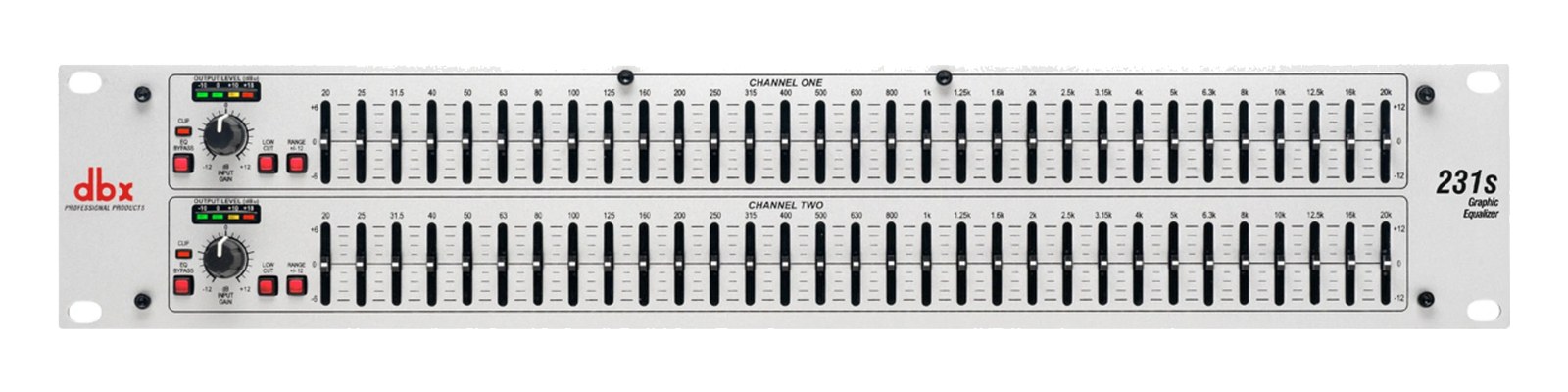
231sThe dbx 231s is the graphic EQ that still ships new: two channels of 31-band correction with the constant-Q filters and build quality that made dbx graphics the install standard. In rigs it tames wedges, rings out a room feed, or smooths a house handoff. The current-production answer where the classic Klark and BSS analogs have gone to the used market.View gear →
06 · Resolve the questions that can change the purchase or build plan.
Planning questions
Short, source-backed answers surface rack fit, power, cabling, and connection details before they become surprises.
How will the BSS Audio FCS-960 Dual 30-band Graphic EQ affect rack fit and case depth?
It occupies 2U. Its documented depth is 240 mm.
How much power does the BSS Audio FCS-960 Dual 30-band Graphic EQ draw?
Typical draw is 24W and documented maximum draw is 30W.
What connections does the BSS Audio FCS-960 Dual 30-band Graphic EQ have?
5 documented physical ports, including Input A (XLR), Input B (XLR), Output A (XLR), Output B (XLR), Power (IEC).
Is the BSS Audio FCS-960 Dual 30-band Graphic EQ discontinued?
FCS-960 discontinued (BSS analog line ended). Used-market classic.
07 · See this unit inside a real rack plan.
Builder preview
Placement is only the start. Builder checks space · depth · weight, power headroom, dependencies, and compatible signal paths around this exact catalog item.Open in Builder