
DirectOut EXBOX.MD Dante/MADI Converter
DirectOut·Model EXBOX.MD·directout-exbox-dante
Photos
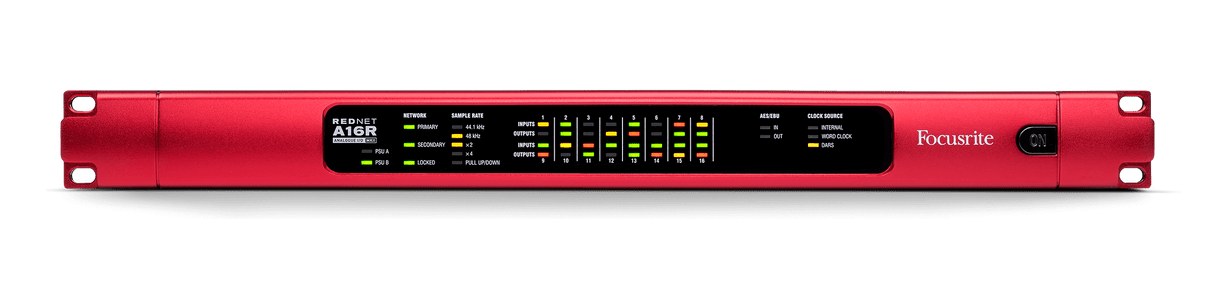
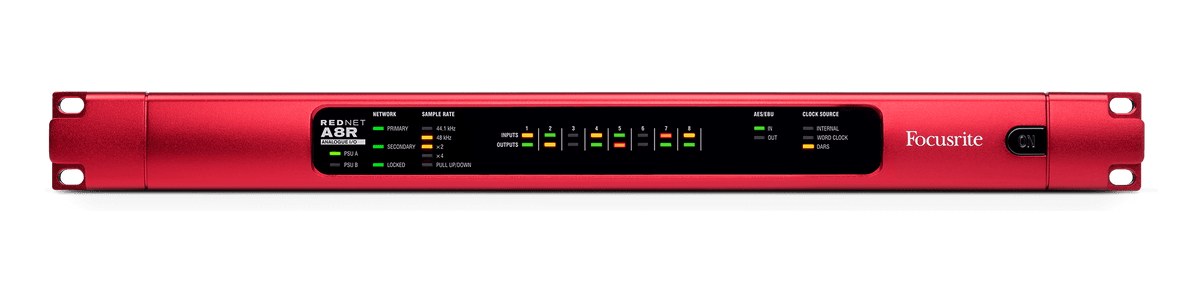
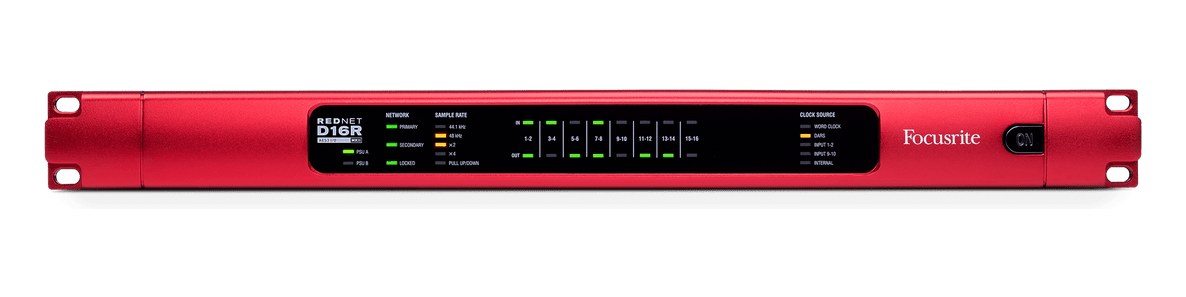
Manufacturer product photography — the drawn faceplate above stays true to panel layout; these show the hardware itself.
About the DirectOut EXBOX.MD
The DirectOut EXBOX.DANTEThe most common audio-over-network standard: dozens of channels of uncompressed digital audio down one ordinary Ethernet cable between Dante boxes. is a Swiss Army knife format converterThe circuitry that turns analog audio into digital data and back (A/D and D/A). Converter quality sets a digital rig’s sound ceiling. that bridges between MADIA pro digital format carrying 64 channels on one coax or optical cable. Point-to-point — one sender, one receiver, no network required., Dante, ADATOptical digital audio: 8 channels at 48 kHz down one Toslink lightpipe (4 at 96 kHz). The usual way to add more channels to an interface., and AES digital audio formats. It is invaluable in hybrid rigs where you need to interface equipment from different digital ecosystems, such as connecting a MADI-based console to a Dante network feeding your IEMIn-Ear Monitor — earpieces that replace floor wedges, feeding each player their own mix. The reason this whole rack exists. transmitters. The flexibility to convert between multiple formats in a single 1UThe standard slice of rack height: 1U = 1.75″. A 3U box takes three slices; half-rack gear pairs two units side by side in one. box can save you from needing multiple dedicated converters.
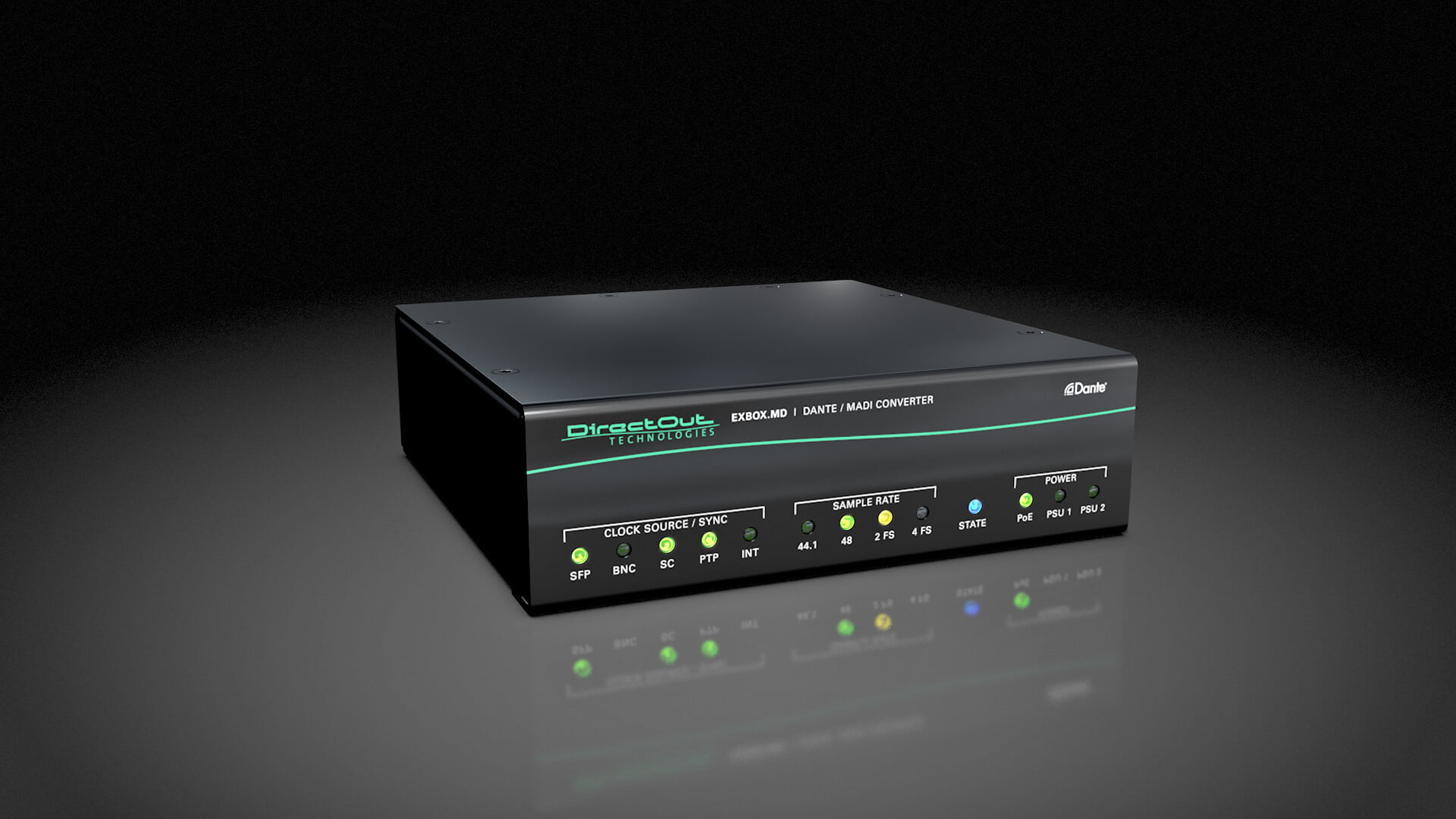
The DirectOut EXBOX.MD lives at the boundary between two dominant digital audio ecosystems — MADIA pro digital format carrying 64 channels on one coax or optical cable. Point-to-point — one sender, one receiver, no network required. and DanteThe most common audio-over-network standard: dozens of channels of uncompressed digital audio down one ordinary Ethernet cable between Dante boxes. — and its job is to make that boundary invisible. In a live rig, that means you can run a MADI-native console or stageboxThe I/O endpoint on stage: mics plug in there and one digital line (AES50, Dante) carries everything to the console. The snake, digitized. on one side and a Dante network feeding IEMIn-Ear Monitor — earpieces that replace floor wedges, feeding each player their own mix. The reason this whole rack exists. transmitters, playback systems, or a digital split on the other, without reclocking through a console's I/O matrixA routing grid that builds extra outputs from any mix of mixes or channels — fills, lobby, stream feeds — without touching the main mix. or compromising channel count. At 64 channels bidirectional on both sides simultaneously, it moves a full MADI stream across the protocol divide without you having to make compromises about what travels with it.
The half-rackThe standard slice of rack height: 1U = 1.75″. A 3U box takes three slices; half-rack gear pairs two units side by side in one., 1U form factor and 15-watt draw mean it fits cleanly into a side-car or utility rack without demanding a dedicated shelf or a significant power budget. The dual EtherConAn Ethernet plug inside a rugged XLR-style locking shell — tour-grade network connections that can’t be yanked loose. ports for DanteThe most common audio-over-network standard: dozens of channels of uncompressed digital audio down one ordinary Ethernet cable between Dante boxes. primary and secondary give you proper redundantA second copy of anything critical — supply, computer, network path — already running so one failure can’t stop the show. network topology — not a luxury on a show where a network hiccup is a production-stopping event. The BNCThe twist-lock coax connector used for word clock and antenna runs — it locks, so it can’t be pulled out mid-show. MADIA pro digital format carrying 64 channels on one coax or optical cable. Point-to-point — one sender, one receiver, no network required. I/O is point-to-point and deterministic, which matters when you're troubleshooting at 45 minutes to doors. At $3,339 this is not an impulse purchase, but for a box doing this much conversion work at this channel count, the cost is defensible against the alternative of two or three single-format convertersThe circuitry that turns analog audio into digital data and back (A/D and D/A). Converter quality sets a digital rig’s sound ceiling. taking up rack space and power.
If your rig already lives entirely in one world — all DanteThe most common audio-over-network standard: dozens of channels of uncompressed digital audio down one ordinary Ethernet cable between Dante boxes. or all MADIA pro digital format carrying 64 channels on one coax or optical cable. Point-to-point — one sender, one receiver, no network required. end to end — this box has no role to play for you. It earns its place the moment you're bridging ecosystems: a MADI console feeding a Dante IEMIn-Ear Monitor — earpieces that replace floor wedges, feeding each player their own mix. The reason this whole rack exists. network, a Dante playback rig connecting to a MADI split snakeA multicore cable bundling many channels into one stage-to-console run. A sub-snake collects one corner of the stage into a drop box., or a venue's installed MADI infrastructure meeting your touring Dante rig at the interface point. Engineers running hybrid festival or corporate touring setups where the console and the network don't share a protocol will find this solves a genuinely painful problem cleanly. If your conversion needs are smaller — eight or sixteen channels — there are cheaper options at lower channel counts worth considering first.
In the rack
- Place it on the DanteThe most common audio-over-network standard: dozens of channels of uncompressed digital audio down one ordinary Ethernet cable between Dante boxes. network segment closest to the MADIA pro digital format carrying 64 channels on one coax or optical cable. Point-to-point — one sender, one receiver, no network required. source to keep BNCThe twist-lock coax connector used for word clock and antenna runs — it locks, so it can’t be pulled out mid-show. cable runs short — MADI over BNC is reliable but coax at longer lengths in a messy stage environment is a liability you can avoid by keeping the box physically near the console or stageboxThe I/O endpoint on stage: mics plug in there and one digital line (AES50, Dante) carries everything to the console. The snake, digitized..
- Enable DanteThe most common audio-over-network standard: dozens of channels of uncompressed digital audio down one ordinary Ethernet cable between Dante boxes. redundancyA second copy of anything critical — supply, computer, network path — already running so one failure can’t stop the show. from day one: connect both EtherConAn Ethernet plug inside a rugged XLR-style locking shell — tour-grade network connections that can’t be yanked loose. ports to separate network switches on your redundant ring or tree topology. If you're only using the primary port, you've paid for a feature you're not using and left yourself exposed.
- Label your DanteThe most common audio-over-network standard: dozens of channels of uncompressed digital audio down one ordinary Ethernet cable between Dante boxes. channel routing in Dante Controller before load-in, not at the venue — the EXBOX.MD passes 64 channels each direction and an unlabeled 64-channel device in a shared festival Dante network is a troubleshooting nightmare you don't want to solve under time pressure.
- Because it ships with a DC barrel power connector rather than a standard IECThe standard three-prong appliance power inlet on rack gear — the kettle lead. C13/C14 in spec-sheet speak. inlet, confirm your rack power solution can supply the appropriate DC voltage — or factor in a suitable power supply — before the unit arrives on site.
Format converterThe circuitry that turns analog audio into digital data and back (A/D and D/A). Converter quality sets a digital rig’s sound ceiling.: MADIA pro digital format carrying 64 channels on one coax or optical cable. Point-to-point — one sender, one receiver, no network required., DanteThe most common audio-over-network standard: dozens of channels of uncompressed digital audio down one ordinary Ethernet cable between Dante boxes., ADATOptical digital audio: 8 channels at 48 kHz down one Toslink lightpipe (4 at 96 kHz). The usual way to add more channels to an interface., AES. Highly flexible.
I/O Ports (5)
| Port | Connector | Direction | Signal | Channels |
|---|---|---|---|---|
| Dante Primary | ETHERCON | bidirectional | digital audio | 64 |
| Dante Secondary | ETHERCON | bidirectional | digital audio | 64 |
| MADI In | MADI BNC | input | digital audio | 64 |
| MADI Out | MADI BNC | output | digital audio | 64 |
- DC In (DC BARREL)
Deciding between two?
Rack space, watts, weight and every connector, side by side.
Related gear


Related articles
Guides from our library that cover planning around dante converter gear.
A practical comparison of the three audio-over-network protocols you’ll encounter in a rack rig, with guidance on when each one is the right pick.
How to split mic signals between FOH and your IEM rack: transformer-isolated splitters, phantom power rules, and where to place the split in the chain.