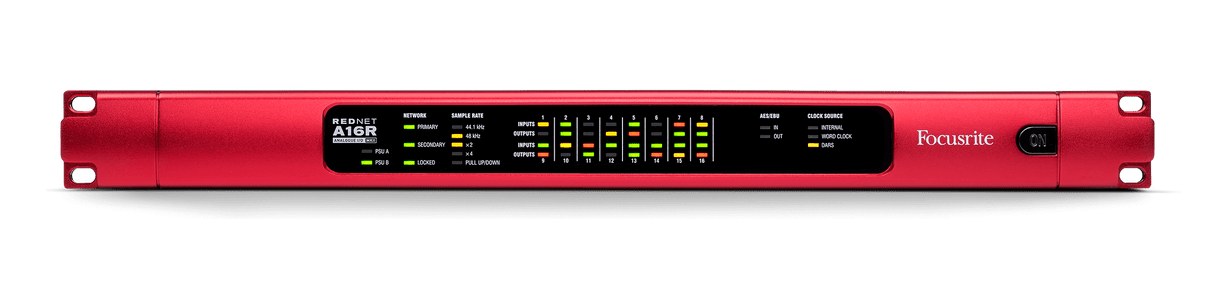
The RedNet A16R MkII is a Dante-networked analog I/O unit that bridges your audio network to the analog world, providing 16 inputs and 16 outputs with excellent conversion quality. Redundant power supplies and dual Dante ports make it highly reliable for live applications where downtime is not an option. In an IEM/playback rig, it serves as the critical link between your Dante network and analog-input IEM transmitters or stage feeds.
~$4,400Use retailer rows for current price and stock
01 · What it does—and what that changes in your rig.
Product overview
Start with the payoff, then work through how it functions, where it fits, and the details that change a real build.
The payoff
Dante Converter decisions, organized around the whole rig.
The RedNet A16R MkII is a 1UThe standard slice of rack height: 1U = 1.75″. A 3U box takes three slices; half-rack gear pairs two units side by side in one.DanteThe most common audio-over-network standard: dozens of channels of uncompressed digital audio down one ordinary Ethernet cable between Dante boxes.-to-analog bridge — 16 channels in, 16 channels out, all moving through two DB25A 25-pin D-shaped connector carrying 8 channels of analog or AES audio in one multicore — the Tascam pinout is the de-facto standard. pairs on each side and landing on the Dante network via dual EtherCONAn Ethernet plug inside a rugged XLR-style locking shell — tour-grade network connections that can’t be yanked loose. ports. In a modern IEMIn-Ear Monitor — earpieces that replace floor wedges, feeding each player their own mix. The reason this whole rack exists. or playback rig, this is the box that closes the loop between whatever is happening on the network and the physical world of transmitter inputs, amplifier feeds, and analog consoles. If your rig routes audio over Dante and eventually needs to hit an analog destination — and almost every serious live rig does — you need something like this sitting at that boundary.
Documented outputs
22 destination connections
Documented inputs
3Based on documented inputs
Rack space
1UBuilder checks available rail space
Focusrite product panel1U · 25W
Function
How it works in the path
Sixteen analog outputs in a single rack unitThe standard slice of rack height: 1U = 1.75″. A 3U box takes three slices; half-rack gear pairs two units side by side in one. is a dense proposition, and the DB25A 25-pin D-shaped connector carrying 8 channels of analog or AES audio in one multicore — the Tascam pinout is the de-facto standard.breakoutA cable that splits one multichannel connector (like a DB25) into individual plugs — the octopus that turns 8 channels into 8 XLRs. format means you're committing to loomSeveral cables bundled and run as one — keeps rack interconnects tidy and makes load-in one grab instead of eight. cables or custom snakesA multicore cable bundling many channels into one stage-to-console run. A sub-snake collects one corner of the stage into a drop box. rather than pulling individual XLRsThe standard 3-pin locking connector for mics and balanced line signals — pin 1 is the shield, pins 2 and 3 carry the balanced pair.. That's the right trade at scale: a single DB25 carries eight balancedCarries the signal on two wires and cancels whatever noise both pick up — why mic cables can run hundreds of feet hum-free. lines cleanly and keeps the back of the rack manageable when you're feeding eight or sixteen IEMIn-Ear Monitor — earpieces that replace floor wedges, feeding each player their own mix. The reason this whole rack exists. transmitters. The dual DanteThe most common audio-over-network standard: dozens of channels of uncompressed digital audio down one ordinary Ethernet cable between Dante boxes. ports matter on a real gig — primary and secondary network paths mean a cable pull or switch failure doesn't kill the show. The redundantA second copy of anything critical — supply, computer, network path — already running so one failure can’t stop the show. internal power supply adds another layer in the same spirit. At 25 watts nominal draw in a 1U chassis, thermal load is modest. Shallow depth at 235mm means it fits comfortably in most shallow tour racks without fighting other gear for space.
Best fit
Where it earns its place in the rack
This unit belongs in rigs where analog I/O count is high and DanteThe most common audio-over-network standard: dozens of channels of uncompressed digital audio down one ordinary Ethernet cable between Dante boxes. is already the transport layer — large IEMIn-Ear Monitor — earpieces that replace floor wedges, feeding each player their own mix. The reason this whole rack exists. setups, split playback rigs feeding multiple mixes, or hybrid systems where a Dante-capable console needs a clean analog return path. The $4,400 price reflects professional-tier conversion and genuine redundancyA second copy of anything critical — supply, computer, network path — already running so one failure can’t stop the show. features, so if you're running four outputs to a simple two-person IEM rig, a smaller converterThe circuitry that turns analog audio into digital data and back (A/D and D/A). Converter quality sets a digital rig’s sound ceiling. will do the job for less. Likewise, if your whole signal chain is AES or MADIA pro digital format carrying 64 channels on one coax or optical cable. Point-to-point — one sender, one receiver, no network required., look elsewhere — this box is analog I/O only. But if your riderThe document attached to a booking that lists what the band needs — inputs, monitors, power, backline (and the green-room snacks). involves sixteen channels of IEM transmitter feeds and a Dante backbone, the A16R MkII is purpose-built for exactly that load-in.
In the rack
Details worth deciding before load-in.
Run loomSeveral cables bundled and run as one — keeps rack interconnects tidy and makes load-in one grab instead of eight. cables pre-terminated with DB25A 25-pin D-shaped connector carrying 8 channels of analog or AES audio in one multicore — the Tascam pinout is the de-facto standard. on one end and XLRsThe standard 3-pin locking connector for mics and balanced line signals — pin 1 is the shield, pins 2 and 3 carry the balanced pair. on the other, labeled by channel block (1-8, 9-16), and coil them with the unit so they're ready to plug straight into transmitters at load-in without hunting.
Use DanteThe most common audio-over-network standard: dozens of channels of uncompressed digital audio down one ordinary Ethernet cable between Dante boxes. Controller to lock your channel assignments before doors and save a snapshot — on a fast changeover, you want to confirm routing with a glance, not rebuild it from memory.
Put the secondary DanteThe most common audio-over-network standard: dozens of channels of uncompressed digital audio down one ordinary Ethernet cable between Dante boxes. port on a physically separate network switch from the primary, ideally on a separate cable run back to the stageboxThe I/O endpoint on stage: mics plug in there and one digital line (AES50, Dante) carries everything to the console. The snake, digitized. or FOHFront Of House — the main mix the audience hears, and the console position out in the room where it gets mixed.. RedundancyA second copy of anything critical — supply, computer, network path — already running so one failure can’t stop the show. only protects you if the failure mode can't take out both paths simultaneously.
If you're daisy-chaining DB25A 25-pin D-shaped connector carrying 8 channels of analog or AES audio in one multicore — the Tascam pinout is the de-facto standard.breakoutsA cable that splits one multichannel connector (like a DB25) into individual plugs — the octopus that turns 8 channels into 8 XLRs. to transmitters, test the full loomSeveral cables bundled and run as one — keeps rack interconnects tidy and makes load-in one grab instead of eight. under show conditions before the first rehearsal — a wiring error at pin level in a dense DB25 run is slow to troubleshoot mid-show.
02 · Know the whole path before you buy.
Signal path
Learn the route as a block diagram: source, product function, transport, and destination. Select any block to see what enters, what changes, and what leaves.
Interactive block diagramAuto-looping · hover, focus, or tap to hold a stage
Port-type signalProduct functionSystem boundary
Follow one signal from source to destination
Each block answers the same three questions: what arrives, what changes here, and what leaves.
01 · Source · selected
db25 + IEC C14
etherCON
db25
01 · Source
3 documented inputs
db25 + IEC C14
Arrives as
3 documented inputs
Connector
db25 + IEC C14
Signal
analog audio
03 · What this product asks of the rest of the system.
Compatibility
Treat connector names as the start of the check—not the answer. These are the boundaries that determine a complete working path.
Best fit · Dante Converter
Use it when 1U and 235 mm of depth fit the case.
Plan the companion path
Complete the path with upstream and downstream gear that matches connector, direction, signal type, protocol, and wiring standard.
Protocol boundary
This product declares DANTE; matching plugs alone do not make other protocols compatible.
04 · Every connector, grouped by job.
I/O ports
Switch the product view and the documented port inventory updates with it—hardware and data stay side by side.
Every connector, grouped by job.
Switch panels to keep the hardware view and the documented port list in sync.
Front panelRear panel
All documented ports for Focusrite RedNet A16R MkII
Port
Panel
Connector
Direction
Signal
Channels
Analog In 1-8 (DB25)
rear
db25
input
analog audio
8
Analog In 9-16 (DB25)
rear
db25
input
analog audio
8
Analog Out 1-8 (DB25)
rear
db25
output
analog audio
8
Analog Out 9-16 (DB25)
rear
db25
output
analog audio
8
Dante Primary
rear
etherCON
bidirectional
digital audio
16
Dante Secondary
rear
etherCON
bidirectional
digital audio
16
Power (IEC)
rear
IEC C14
input
power
—
Showing 7 of 7 documented physical ports.
05 · Compare the decision, not just the price.
Alternatives
The rows are organized around fit, power, I/O, and system role so a cheaper unit cannot hide a more expensive workflow.
RedNet A16R MkIIThe RedNet A16R MkII is a Dante-networked analog I/O unit that bridges your audio network to the analog world, providing 16 inputs and 16 outputs with excellent conversion quality. Redundant power supplies and dual Dante ports make it highly reliable for live applications where downtime is not an option. In an IEM/playback rig, it serves as the critical link between your Dante network and analog-input IEM transmitters or stage feeds.View gear →
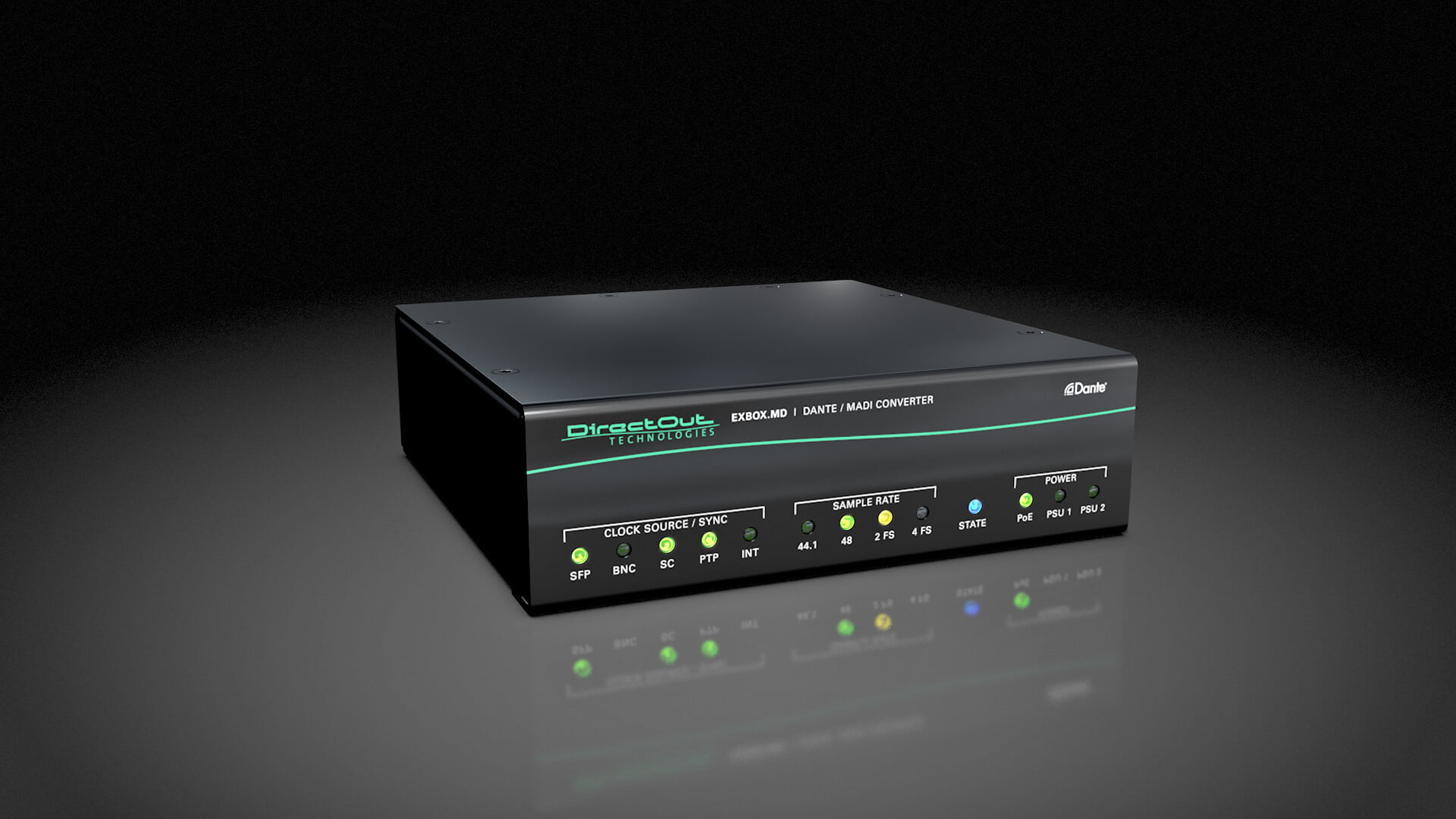
EXBOX.MDThe DirectOut EXBOX.DANTE is a Swiss Army knife format converter that bridges between MADI, Dante, ADAT, and AES digital audio formats. It is invaluable in hybrid rigs where you need to interface equipment from different digital ecosystems, such as connecting a MADI-based console to a Dante network feeding your IEM transmitters. The flexibility to convert between multiple formats in a single 1U box can save you from needing multiple dedicated converters.View gear →
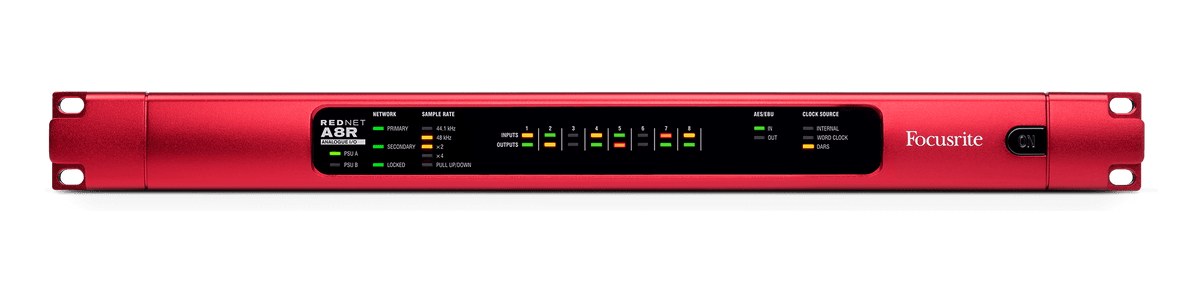
RedNet A8RThe RedNet A8R provides eight channels of Dante-to-analog conversion with redundant networking and power, making it a reliable workhorse for medium-sized IEM and playback rigs. It fits neatly in a single rack unit and offers the same build quality and redundancy as the larger A16R. Use it when you need fewer channels but still want the reliability of redundant Dante and power connections.View gear →
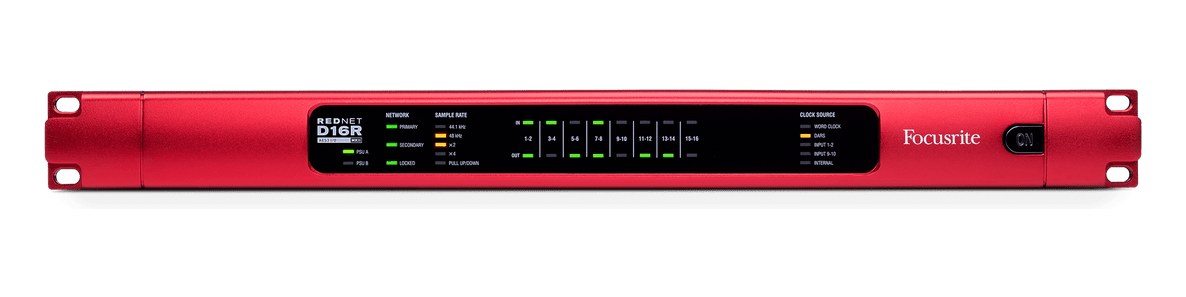
RedNet D16R MkIIThe RedNet D16R bridges between AES3 digital audio and Dante networking, handling 16 channels in each direction with word clock I/O for synchronization. It is essential in rigs where AES3-equipped consoles or processors need to interface with a Dante network, or where you need a reliable word clock reference alongside your format conversion. Dual Dante ports provide redundant networking for mission-critical applications.View gear →
06 · Resolve the questions that can change the purchase or build plan.
Planning questions
Short, source-backed answers surface rack fit, power, cabling, and connection details before they become surprises.
How will the Focusrite RedNet A16R MkII affect rack fit and case depth?
It occupies 1U. Its documented depth is 235 mm.
How much power does the Focusrite RedNet A16R MkII draw?
Typical draw is 25W and documented maximum draw is 35W.
What connections does the Focusrite RedNet A16R MkII have?
7 documented physical ports, including Analog In 1-8 (DB25), Analog In 9-16 (DB25), Analog Out 1-8 (DB25), Analog Out 9-16 (DB25), Dante Primary, Dante Secondary.
07 · See this unit inside a real rack plan.
Builder preview
Placement is only the start. Builder checks space · depth · weight, power headroom, dependencies, and compatible signal paths around this exact catalog item.Open in Builder