
Focusrite RedNet D16R MkII
Focusrite·Model RedNet D16R MkII·focusrite-rednet-d16r
Photos
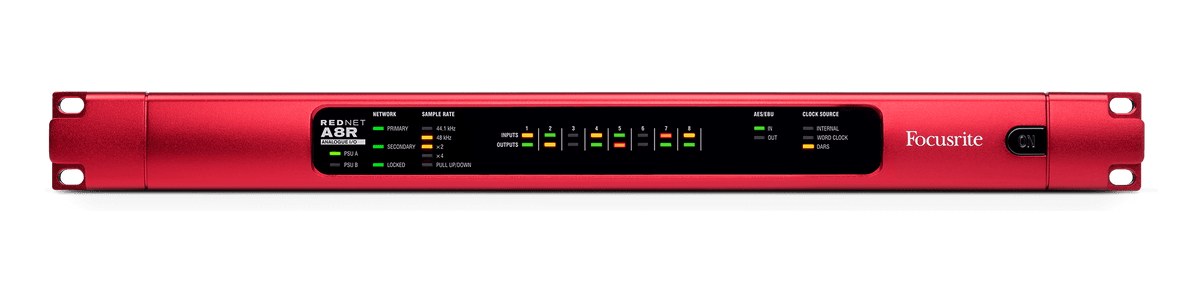
Manufacturer product photography — the drawn faceplate above stays true to panel layout; these show the hardware itself.
About the Focusrite RedNet D16R MkII
The RedNet D16R bridges between AES3The pro standard for stereo digital audio over an XLR cable — balanced, so it runs much farther than consumer S/PDIF. digital audio and DanteThe most common audio-over-network standard: dozens of channels of uncompressed digital audio down one ordinary Ethernet cable between Dante boxes. networking, handling 16 channels in each direction with word clockThe shared heartbeat keeping every digital box sampling in lockstep. One device leads, the rest follow — or you get clicks and pops. I/O for synchronization. It is essential in rigs where AES3-equipped consoles or processors need to interface with a Dante network, or where you need a reliable word clock reference alongside your format conversion. Dual Dante ports provide redundantA second copy of anything critical — supply, computer, network path — already running so one failure can’t stop the show. networking for mission-critical applications.
The RedNet D16R MkII is a single-rack-unit AES3The pro standard for stereo digital audio over an XLR cable — balanced, so it runs much farther than consumer S/PDIF.-to-DanteThe most common audio-over-network standard: dozens of channels of uncompressed digital audio down one ordinary Ethernet cable between Dante boxes. bridge, and its job in a rig is exactly that specific: it converts 16 channels of AES3 in both directions simultaneously, connecting gear that speaks AES3 — consoles, processors, stageboxThe I/O endpoint on stage: mics plug in there and one digital line (AES50, Dante) carries everything to the console. The snake, digitized. outputs — to a Dante network carrying audio everywhere else. Four DB25A 25-pin D-shaped connector carrying 8 channels of analog or AES audio in one multicore — the Tascam pinout is the de-facto standard. connectors handle all the digital audio on the rear panel, two for AES3 inputs and two for outputs, which keeps the wiring dense but organized if you're already working in the Tascam pinout world. This is not an analog converterThe circuitry that turns analog audio into digital data and back (A/D and D/A). Converter quality sets a digital rig’s sound ceiling., and it doesn't pretend to be anything else.
At 25 watts nominal and a shallow 235mm depth, the D16R MkII fits cleanly into a touring IEMIn-Ear Monitor — earpieces that replace floor wedges, feeding each player their own mix. The reason this whole rack exists. rack without fighting for space or burning up your power budget. The dual EtherConAn Ethernet plug inside a rugged XLR-style locking shell — tour-grade network connections that can’t be yanked loose. ports for DanteThe most common audio-over-network standard: dozens of channels of uncompressed digital audio down one ordinary Ethernet cable between Dante boxes. primary and secondary networks are the headline feature at show time — if your primary network path drops, the secondary takes over without an audible interruption, which matters when the D16R is sitting between a playback system and sixteen artists' ears. Word clockThe shared heartbeat keeping every digital box sampling in lockstep. One device leads, the rest follow — or you get clicks and pops. in and out via BNCThe twist-lock coax connector used for word clock and antenna runs — it locks, so it can’t be pulled out mid-show. means you can slot this into an existing clock topology rather than forcing a Dante clock takeover, giving you flexibility when sharing a rack with other synchronized digital gear.
If your workflow is built around a DanteThe most common audio-over-network standard: dozens of channels of uncompressed digital audio down one ordinary Ethernet cable between Dante boxes. network and you're interfacing with any AES3The pro standard for stereo digital audio over an XLR cable — balanced, so it runs much farther than consumer S/PDIF.-native device — a DiGiCo console's local I/O, a TC Electronic processor, a legacy stageboxThe I/O endpoint on stage: mics plug in there and one digital line (AES50, Dante) carries everything to the console. The snake, digitized. — this unit earns its place without much debate. Where it doesn't belong is in a rig that's entirely analog at the edges and only needs a single Dante endpoint; something with analog I/O would serve you better and cost less. Similarly, if you only need eight channels of conversion, you're buying headroomThe margin between your normal level and where things clip — headroom is what absorbs the snare hit you didn’t see coming. you may never use. But for 16-channel AES3 connectivity in a redundantA second copy of anything critical — supply, computer, network path — already running so one failure can’t stop the show. Dante infrastructure, the D16R MkII is the purpose-built answer.
In the rack
- Use Tascam-pinout DB25A 25-pin D-shaped connector carrying 8 channels of analog or AES audio in one multicore — the Tascam pinout is the de-facto standard. breakoutA cable that splits one multichannel connector (like a DB25) into individual plugs — the octopus that turns 8 channels into 8 XLRs. loomsSeveral cables bundled and run as one — keeps rack interconnects tidy and makes load-in one grab instead of eight. and label every connector at both ends before load-in — four identical DB25s on the rear panel are easy to transpose under pressure.
- Assign the D16R MkII as a DanteThe most common audio-over-network standard: dozens of channels of uncompressed digital audio down one ordinary Ethernet cable between Dante boxes. clock follower rather than leader unless you have a specific reason to do otherwise; let your console or a dedicated clock master own the network timing.
- Patch the secondary DanteThe most common audio-over-network standard: dozens of channels of uncompressed digital audio down one ordinary Ethernet cable between Dante boxes. port to a physically separate switch or network path — if both ports feed the same switch, you've built redundancyA second copy of anything critical — supply, computer, network path — already running so one failure can’t stop the show. on paper but not in practice.
- Verify word clockThe shared heartbeat keeping every digital box sampling in lockstep. One device leads, the rest follow — or you get clicks and pops. lock status on the front panel during line checkThe quick pre-show pass confirming every input reaches the console, one line at a time. Not a soundcheck — just does it work., before the room gets loud; a clock mismatch here will corrupt all 16 channels at once and is easy to overlook until someone starts hearing artifacts.
16-channel AES3The pro standard for stereo digital audio over an XLR cable — balanced, so it runs much farther than consumer S/PDIF. to DanteThe most common audio-over-network standard: dozens of channels of uncompressed digital audio down one ordinary Ethernet cable between Dante boxes. bridge with word clockThe shared heartbeat keeping every digital box sampling in lockstep. One device leads, the rest follow — or you get clicks and pops..
I/O Ports (9)
| Port | Connector | Direction | Signal | Channels |
|---|---|---|---|---|
| AES3 In 1-8 (DB25) | DB25 | input | digital audio | 8 |
| AES3 In 9-16 (DB25) | DB25 | input | digital audio | 8 |
| AES3 Out 1-8 (DB25) | DB25 | output | digital audio | 8 |
| AES3 Out 9-16 (DB25) | DB25 | output | digital audio | 8 |
| Dante Primary | ETHERCON | bidirectional | digital audio | 16 |
| Dante Secondary | ETHERCON | bidirectional | digital audio | 16 |
| Word Clock Out (BNC) | BNC | output | digital audio | — |
| Word Clock In (BNC) | BNC | input | digital audio | — |
- Power (IEC) (IEC C14)
Deciding between two?
Rack space, watts, weight and every connector, side by side.
Related gear


Related articles
Guides from our library that cover planning around dante converter gear.
A practical comparison of the three audio-over-network protocols you’ll encounter in a rack rig, with guidance on when each one is the right pick.
How to split mic signals between FOH and your IEM rack: transformer-isolated splitters, phantom power rules, and where to place the split in the chain.