

Neural DSP Quad Cortex
Neural DSP·Model Quad Cortex·neural-dsp-quad-cortex
Photos
Manufacturer product photography — the drawn faceplate above stays true to panel layout; these show the hardware itself.
About the Neural DSP Quad Cortex
The Neural DSPDigital Signal Processing — the number-crunching that does EQ, compression, and effects inside a box. More DSP means more processing at once. Quad Cortex is a floor-based guitar and bass modeler with quad-core processing that captures and reproduces amp tones with remarkable accuracy. Its neural capture technology can learn the characteristics of any real amp or pedal, making it a powerful tool for guitarists who want their exact studio tones on stage. Multiple outputs including XLRThe standard 3-pin locking connector for mics and balanced line signals — pin 1 is the shield, pins 2 and 3 carry the balanced pair. make it easy to feed both your IEMIn-Ear Monitor — earpieces that replace floor wedges, feeding each player their own mix. The reason this whole rack exists. mix and FOHFront Of House — the main mix the audience hears, and the console position out in the room where it gets mixed. simultaneously with independent tone shaping.
The Quad Cortex is a floor-based amp modeler and effects processor from Neural DSPDigital Signal Processing — the number-crunching that does EQ, compression, and effects inside a box. More DSP means more processing at once., built around quad-core processing and the company's neural capture technology — a system that can profile real amplifiers and pedals and reproduce their behavior with convincing accuracy. In a live rig context, it functions as the complete signal chain for a guitarist or bassist: amp models, cab simulation, drive pedals, time-based effects, all in one unit. The two XLRThe standard 3-pin locking connector for mics and balanced line signals — pin 1 is the shield, pins 2 and 3 carry the balanced pair. outputs and two TRSTip-Ring-Sleeve — a 1/4″ jack with three contacts carrying a balanced signal or a stereo pair. A guitar plug with one extra ring. outputs let you split your signal meaningfully — XLR direct to FOHFront Of House — the main mix the audience hears, and the console position out in the room where it gets mixed., TRS into your IEMIn-Ear Monitor — earpieces that replace floor wedges, feeding each player their own mix. The reason this whole rack exists. personal mix — with independent routing and level control for each.
At 1.6 kg and 190 mm deep, the Quad Cortex lives on the floor, not in the rack. The catalog flags it as rack-mountable, but that requires a third-party adapter bracket; out of the box it sits flat on stage. Power draw is modest at 18 W nominal, topping at 25 W, so it won't stress a standard power conditionerFilters venue AC, clamps surges, and gives the rack one tidy inlet. Not a voltage regulator and not a battery — just cleaner power.. The touchscreen interface means patch changes and live tweaks don't require menu-diving in the dark. What matters at show time is that your XLRThe standard 3-pin locking connector for mics and balanced line signals — pin 1 is the shield, pins 2 and 3 carry the balanced pair. outputs are balancedCarries the signal on two wires and cancels whatever noise both pick up — why mic cables can run hundreds of feet hum-free., line-levelThe strong signal that runs between pieces of gear (about a volt) — hotter than mic level, far below speaker level., and ready to hit a DIDirect Injection box — converts an instrument’s unbalanced signal to a balanced mic-level XLR so it can run long cables without noise. box or stage boxThe I/O endpoint on stage: mics plug in there and one digital line (AES50, Dante) carries everything to the console. The snake, digitized. directly — no additional direct box needed for the FOHFront Of House — the main mix the audience hears, and the console position out in the room where it gets mixed. feed.
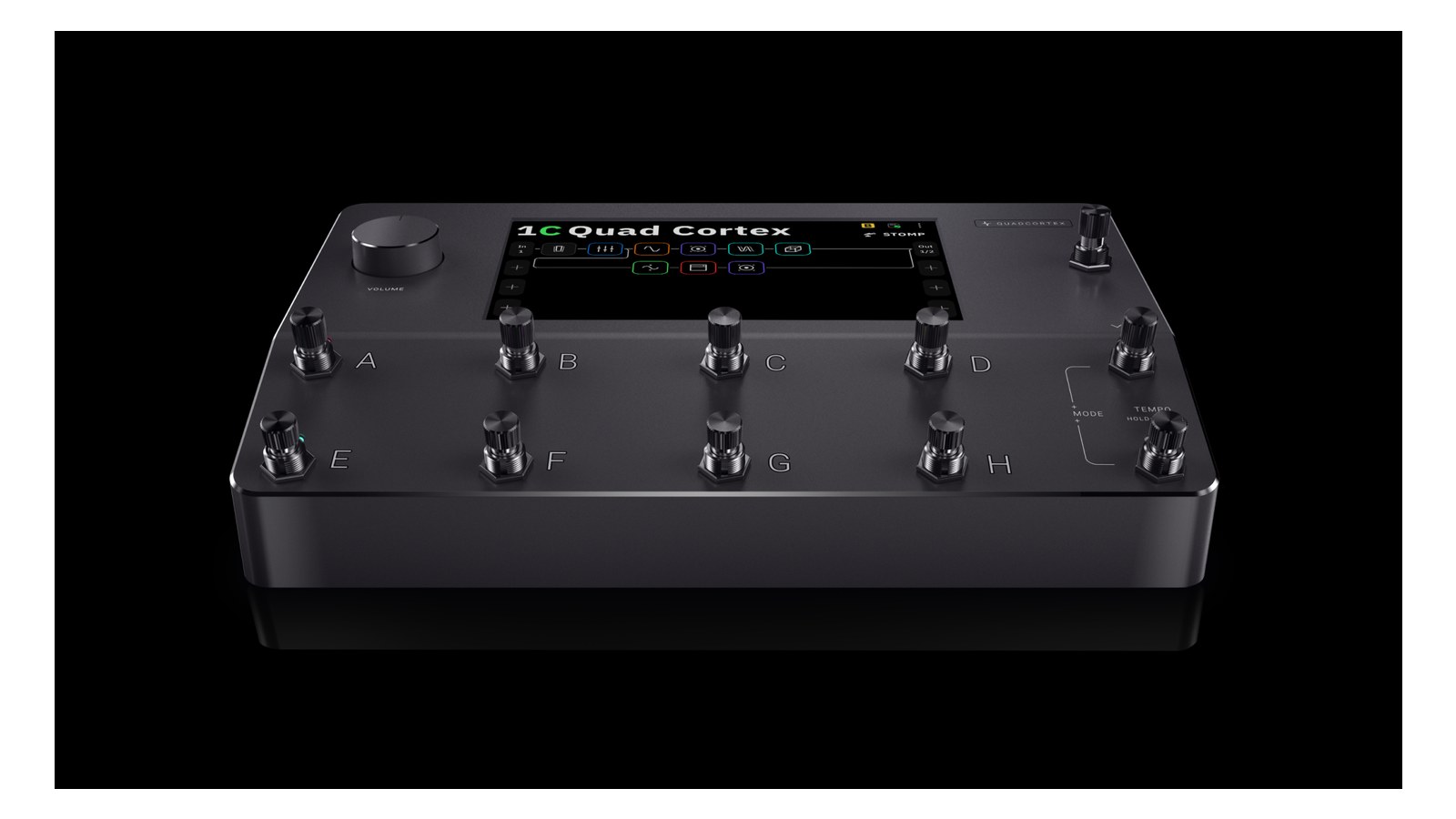
This unit belongs in the rig of a guitarist or bassist who has invested in capturing their own real-world tones and wants to reproduce them consistently night after night without hauling amplifiers. If you're running a purely IEMIn-Ear Monitor — earpieces that replace floor wedges, feeding each player their own mix. The reason this whole rack exists.-based rig with no amp on stage, the Quad Cortex handles that cleanly with its direct outputs. It's less obviously the right call if you need deep MIDI integration into a complex switching rig, or if your workflow centers around a platform like Line 6's ecosystem where Helix Native plugin editing is already baked in — the Quad Cortex's editor ecosystem, while improving, has historically lagged the hardware's capabilities.
In the rack
- Run Output 3 or 4 (XLRThe standard 3-pin locking connector for mics and balanced line signals — pin 1 is the shield, pins 2 and 3 carry the balanced pair.) directly to your stage boxThe I/O endpoint on stage: mics plug in there and one digital line (AES50, Dante) carries everything to the console. The snake, digitized. for FOHFront Of House — the main mix the audience hears, and the console position out in the room where it gets mixed. and keep Outputs 1–2 (TRSTip-Ring-Sleeve — a 1/4″ jack with three contacts carrying a balanced signal or a stereo pair. A guitar plug with one extra ring.) feeding your IEMIn-Ear Monitor — earpieces that replace floor wedges, feeding each player their own mix. The reason this whole rack exists. mix — set separate cab IR or EQ blocks on each path so FOH and your ears aren't hearing the same mix-dependent compromise.
- If you're bracket-mounting it in a rack, confirm the adapter positions the touchscreen at a usable angle before you commit to the rack layout — the screen is your primary interface and needs to be visible from standing height at load-in.
- Use the USB-C port with a laptop running the Cortex Control editor to back up your preset library before every tour leg; cloud sync exists but having a local backup on a tour drive costs nothing and saves the gig if firmware goes sideways.
- The unit draws up to 25 W at peak — plug it into its own outlet on your power conditionerFilters venue AC, clamps surges, and gives the rack one tidy inlet. Not a voltage regulator and not a battery — just cleaner power. rather than daisy-chaining it with other high-draw processors, and leave the IECThe standard three-prong appliance power inlet on rack gear — the kettle lead. C13/C14 in spec-sheet speak. cable slack managed so it doesn't pull at the connector when the unit is repositioned on stage.
Quad-core guitar/bass processor with touchscreen. Floor unit.
I/O Ports (7)
| Port | Connector | Direction | Signal | Channels |
|---|---|---|---|---|
| Input 1 (TRS) | TRS QUARTER | input | analog audio | — |
| Input 2 (TRS) | TRS QUARTER | input | analog audio | — |
| Output 1 (TRS) | TRS QUARTER | output | analog audio | — |
| Output 2 (TRS) | TRS QUARTER | output | analog audio | — |
| Output 3 (XLR) | XLR MALE | output | analog audio | — |
| Output 4 (XLR) | XLR MALE | output | analog audio | — |
| USB-C | USB C | bidirectional | data | — |
Deciding between two?
Rack space, watts, weight and every connector, side by side.

