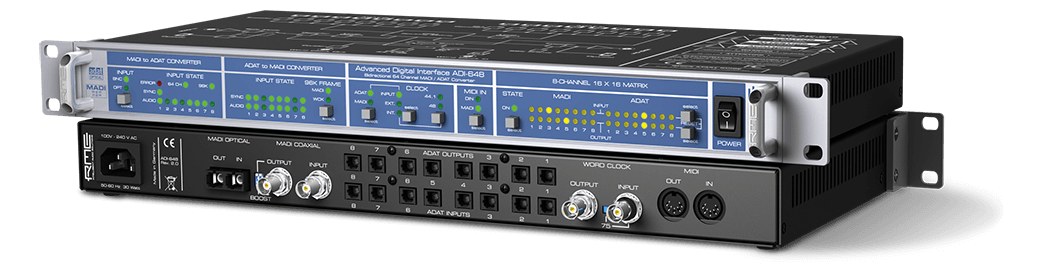
The RME ADI-648 converts between MADI and ADAT formats, handling up to 128 channels across two independent MADI streams. It is the go-to solution for integrating ADAT-equipped interfaces or effects processors into a MADI-based infrastructure. Particularly useful in playback rigs where your interface speaks ADAT but your console or distribution system runs on MADI.
~$1,999Use retailer rows for current price and stock
01 · What it does—and what that changes in your rig.
Product overview
Start with the payoff, then work through how it functions, where it fits, and the details that change a real build.
The payoff
MADI Converter decisions, organized around the whole rig.
The RME ADI-648 exists to solve one specific problem cleanly: your console or snakeA multicore cable bundling many channels into one stage-to-console run. A sub-snake collects one corner of the stage into a drop box. infrastructure speaks MADIA pro digital format carrying 64 channels on one coax or optical cable. Point-to-point — one sender, one receiver, no network required., and something else in your chain — a playback interface, a hardware effects unit, a legacy recorder — speaks ADATOptical digital audio: 8 channels at 48 kHz down one Toslink lightpipe (4 at 96 kHz). The usual way to add more channels to an interface.. Instead of rearchitecting your whole signal flow, you drop this 1UThe standard slice of rack height: 1U = 1.75″. A 3U box takes three slices; half-rack gear pairs two units side by side in one. box in the rack and let it translate. It handles two independent 64-channel MADI streams simultaneously, each converting to or from eight ADAT optical ports, giving you up to 128 channels of bidirectional conversion in a single rack unit that draws less than 25 watts.
Documented outputs
22 destination connections
Required cable runs
2madi bnc
Rack space
1UBuilder checks available rail space
RME product panel1U · 20W
Function
How it works in the path
In practice, those two independent MADIA pro digital format carrying 64 channels on one coax or optical cable. Point-to-point — one sender, one receiver, no network required. streams are what separate the ADI-648 from simpler single-stream convertersThe circuitry that turns analog audio into digital data and back (A/D and D/A). Converter quality sets a digital rig’s sound ceiling.. You can feed console returns on one stream while routing playback outputs on the other, keeping those signal paths discrete all the way to the optical connections. The BNCThe twist-lock coax connector used for word clock and antenna runs — it locks, so it can’t be pulled out mid-show. MADI connections are robust and locking in a way that optical MADI connectors simply aren't under load-in abuse. At 200mm depth and 1.7kg, it sits without complaint in a shallow touring rack. RME's clock handling is reliable enough that in most rigs it will lock and hold without babysitting.
Best fit
Where it earns its place in the rack
This box belongs in a MADIA pro digital format carrying 64 channels on one coax or optical cable. Point-to-point — one sender, one receiver, no network required.-centric rig that has ADATOptical digital audio: 8 channels at 48 kHz down one Toslink lightpipe (4 at 96 kHz). The usual way to add more channels to an interface. gear it can't replace — a DanteThe most common audio-over-network standard: dozens of channels of uncompressed digital audio down one ordinary Ethernet cable between Dante boxes. or AVBAudio Video Bridging — open network audio (MOTU, PreSonus) where the switch reserves bandwidth so streams can’t glitch. Milan is its pro profile. playback rig pushing audio through an ADAT-equipped interface toward a MADI console, or a festival monitor rack bridging a legacy analog stage boxThe I/O endpoint on stage: mics plug in there and one digital line (AES50, Dante) carries everything to the console. The snake, digitized. with optical outs into a digital infrastructure. If your entire chain is already MADI end-to-end, you don't need it. If you're running a fully modern Dante or AES67The interop standard that lets different audio-network flavors (Dante, Ravenna, Livewire) exchange streams on the same network. system, a network bridge is a better answer. But for the MADI-to-ADAT translation problem specifically, there isn't a more trusted tool at this form factor.
In the rack
Details worth deciding before load-in.
Label each BNCThe twist-lock coax connector used for word clock and antenna runs — it locks, so it can’t be pulled out mid-show. connection at both ends with stream number and channel range before the cable leaves the rack — 'MADIA pro digital format carrying 64 channels on one coax or optical cable. Point-to-point — one sender, one receiver, no network required. In 1: Ch 1–64 Playback' saves real time at a dark festival stage.
If you're using this as a playback interface bridge, verify your sample rateHow many times per second audio is measured when digitized — 48 kHz is the live standard; 96 kHz measures twice as often. and word clockThe shared heartbeat keeping every digital box sampling in lockstep. One device leads, the rest follow — or you get clicks and pops. source in RME's TotalMix or via the front panel before doors open; a clock mismatch here shows up as dropoutsA brief audio gap when the radio link fails — the thing diversity, distros, and coordination all exist to prevent. that are easy to misdiagnose as a network or DAWDigital Audio Workstation — the recording and playback software (Logic, Ableton Live, Pro Tools) at the center of a computer rig. issue.
Keep the ADATOptical digital audio: 8 channels at 48 kHz down one Toslink lightpipe (4 at 96 kHz). The usual way to add more channels to an interface. optical ports covered with dust caps during transport — contaminated ToslinkThe square optical connector that carries ADAT or S/PDIF audio as light down a fiber — immune to hum and ground loops. connectors are a common and avoidable failure point that won't show up until you're mid-soundcheck.
With two independent MADIA pro digital format carrying 64 channels on one coax or optical cable. Point-to-point — one sender, one receiver, no network required. streams available, consider dedicating one stream to playback sends and the other to monitor returns so a routing error on one path can't cascade into the other.
02 · Know the whole path before you buy.
Signal path
Learn the route as a block diagram: source, product function, transport, and destination. Select any block to see what enters, what changes, and what leaves.
Interactive block diagramAuto-looping · hover, focus, or tap to hold a stage
Port-type signalProduct functionSystem boundary
Follow one signal from source to destination
Each block answers the same three questions: what arrives, what changes here, and what leaves.
01 · Source · selected
madi bnc + IEC C14
madi bnc
madi bnc
01 · Source
3 documented inputs
madi bnc + IEC C14
Arrives as
3 documented inputs
Connector
madi bnc + IEC C14
Signal
digital audio
03 · What this product asks of the rest of the system.
Compatibility
Treat connector names as the start of the check—not the answer. These are the boundaries that determine a complete working path.
Best fit · MADI Converter
Use it when 1U and 200 mm of depth fit the case.
Plan the companion path
Complete the path with upstream and downstream gear that matches connector, direction, signal type, protocol, and wiring standard.
Connector boundary
Documented connectors: madi bnc, IEC C14. Match connector, direction, and signal type—not shape alone.
04 · Every connector, grouped by job.
I/O ports
Switch the product view and the documented port inventory updates with it—hardware and data stay side by side.
Every connector, grouped by job.
Switch panels to keep the hardware view and the documented port list in sync.
Front panelRear panel
All documented ports for RME ADI-648 MADI/ADAT Converter
Port
Panel
Connector
Direction
Signal
Channels
MADI In 1 (BNC)
rear
madi bnc
input
digital audio
64
MADI In 2 (BNC)
rear
madi bnc
input
digital audio
64
MADI Out 1 (BNC)
rear
madi bnc
output
digital audio
64
MADI Out 2 (BNC)
rear
madi bnc
output
digital audio
64
Power (IEC)
rear
IEC C14
input
power
—
Showing 5 of 5 documented physical ports.
05 · Compare the decision, not just the price.
Alternatives
The rows are organized around fit, power, I/O, and system role so a cheaper unit cannot hide a more expensive workflow.
ADI-648The RME ADI-648 converts between MADI and ADAT formats, handling up to 128 channels across two independent MADI streams. It is the go-to solution for integrating ADAT-equipped interfaces or effects processors into a MADI-based infrastructure. Particularly useful in playback rigs where your interface speaks ADAT but your console or distribution system runs on MADI.View gear →
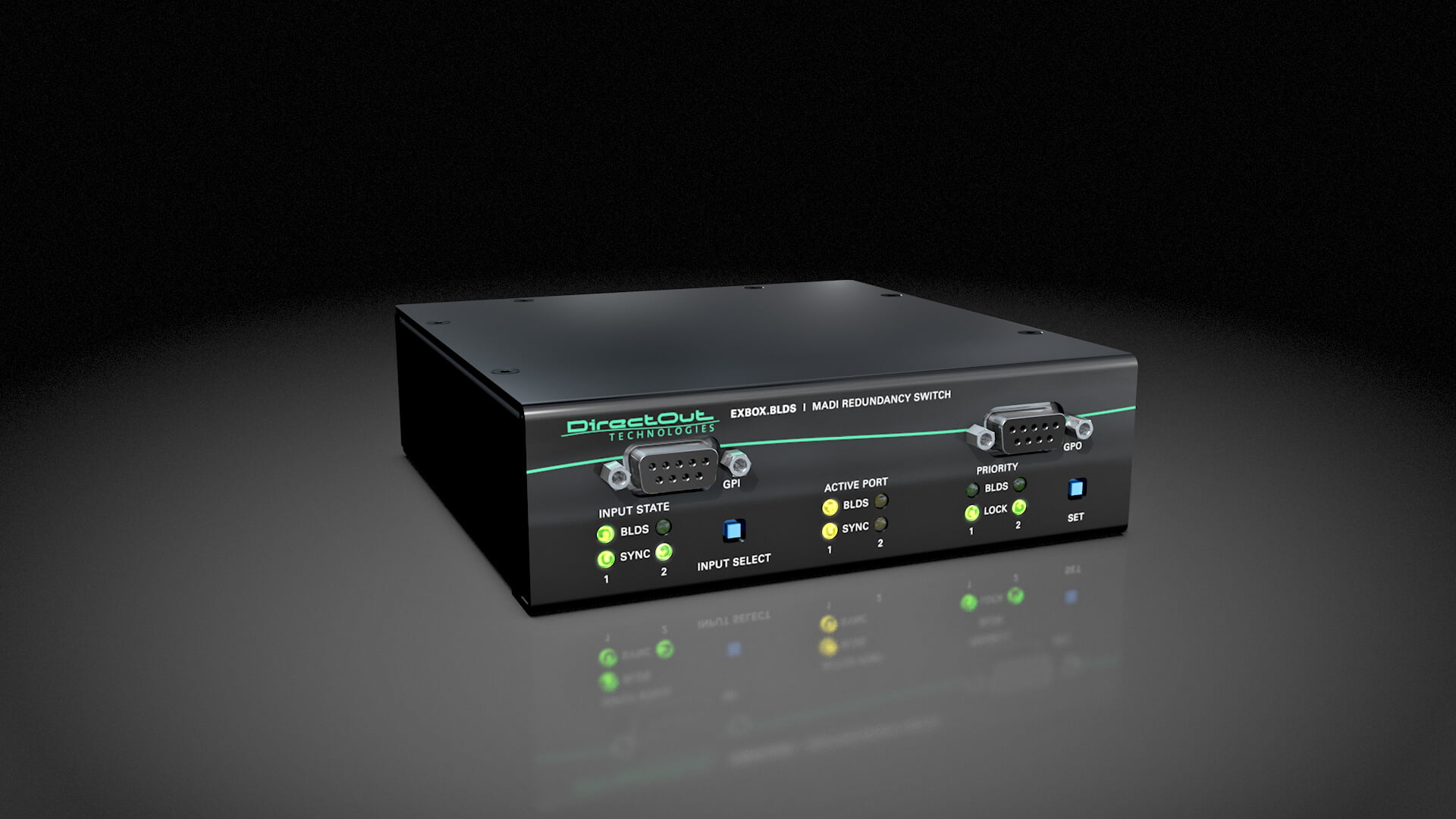
EXBOX.BLDSThe EXBOX.BLDS is a two-input MADI redundancy switch with Buffer Loop Detection. It monitors two MADI sources and can switch automatically or manually to keep a critical stream online; coaxial, optical, or SFP I/O modules are configurable per slot.View gear →
06 · Resolve the questions that can change the purchase or build plan.
Planning questions
Short, source-backed answers surface rack fit, power, cabling, and connection details before they become surprises.
How will the RME ADI-648 MADI/ADAT Converter affect rack fit and case depth?
It occupies 1U. Its documented depth is 200 mm.
How much power does the RME ADI-648 MADI/ADAT Converter draw?
Typical draw is 20W and documented maximum draw is 25W.
What connections does the RME ADI-648 MADI/ADAT Converter have?
5 documented physical ports, including MADI In 1 (BNC), MADI In 2 (BNC), MADI Out 1 (BNC), MADI Out 2 (BNC), Power (IEC).
Is the RME ADI-648 MADI/ADAT Converter discontinued?
ADI-648 discontinued (legacy MADI/ADAT bridge). Kept for owners.
07 · See this unit inside a real rack plan.
Builder preview
Placement is only the start. Builder checks space · depth · weight, power headroom, dependencies, and compatible signal paths around this exact catalog item.Open in Builder