
Audio Interface

RME Babyface Pro FS

RME·Model Babyface Pro FS·rme-babyface-pro-fs

Photos

Manufacturer product photography — the drawn faceplate above stays true to panel layout; these show the hardware itself.

Photo: RMEClick to zoom

About the RME Babyface Pro FS

The RME Babyface Pro FS is a portable powerhouse with the same legendary driver stability and low latency that RME is known for in their rack-mount units. Bus-powered over USB means no external power supply to worry about, and the 12 channels provide enough I/O for a compact playback rig. Its TotalMix FX software mixer is exceptionally capable for monitoring and routing, making it a favorite among touring musicians who need reliability in a small package.

The Babyface Pro FS is RME's compact USB interface, and in a live context it earns its place as the engine of a stripped-down playback or IEM rig. It handles 12 channels over USB-C, offers two mic preamps on XLR and two TRS line outputs, and draws the whole picture from bus power — no wall wart, no IEC tail, just a cable to your laptop or playback machine. For a solo performer, small touring act, or pit musician running tracks and routing their own in-ear mix, this is the kind of interface that disappears into the workflow.

Eight watts bus-powered is genuinely light work on a rack's power strip, but the real operational story is RME's driver reputation and TotalMix FX. Low-latency, rock-solid operation under macOS and Windows is what separates this from similarly sized competitors — show time is not when you want to be troubleshooting a dropout. The two XLR inputs let you bring in a click return or audience mic without a separate preamp, and the two TRS outputs feed your IEM transmitter or FOH send cleanly. The FS designation indicates femtosecond clock — internal clocking is tight enough that external word clock is a non-issue for most applications at this scale.
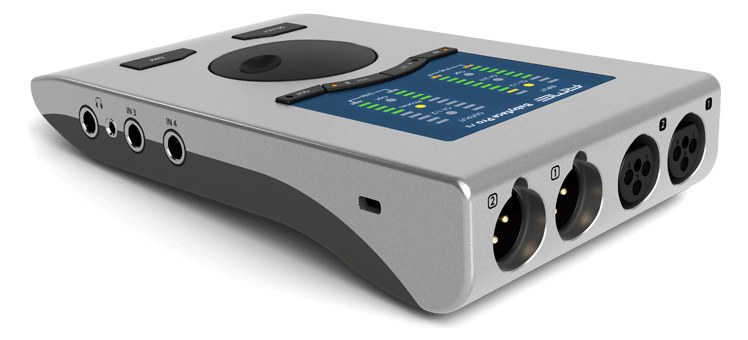
If you're running a compact self-contained playback rig and your channel count fits inside 12, the Babyface Pro FS is a serious, proven choice at $999. Where it stops making sense is when you need more than two analog outputs — feeding multiple aux mixes, running stems to both FOH and monitors simultaneously, or needing ADAT expansion for larger channel counts all push you toward something like RME's own Fireface UCX II or a rack-mount interface with more I/O. Also worth being honest about: it is not rack-mountable in the conventional sense — it needs a shelf or a mounting adapter, which adds a little planning work.

In the rack

  • Mount it on a half-rack shelf with a piece of hook-and-loop securing the unit — at 0.6 kg it will slide around on a bare shelf if the rack sees any road vibration.
  • Use a quality USB-C cable under 1 meter between the interface and your playback machine; longer or cheaper cables introduce the exact kind of intermittent connection issues that are hard to diagnose mid-show.
  • TotalMix FX can save and recall snapshots — build your show routing before load-in, save it to a named preset, and reopen it on arrival so you're not rebuilding from scratch on a borrowed laptop.
  • Bus power means the interface draws from your computer's USB bus; verify your laptop or playback machine actually delivers enough current on its USB-C port, especially if it's also powering a dongle or drive on the same controller.

12-channel portable USB interface. Bus powered — requires rack shelf to mount.

I/O Ports (5)

PortConnectorDirectionSignalChannels
Mic In 1 (XLR)XLR FEMALEinputanalog audio
Mic In 2 (XLR)XLR FEMALEinputanalog audio
Line Out 1 (TRS)TRS QUARTERoutputanalog audio
Line Out 2 (TRS)TRS QUARTERoutputanalog audio
USB-CUSB Cbidirectionaldata

Requires

This component depends on the following gear to function in a typical rig:

Deciding between two?

Rack space, watts, weight and every connector, side by side.

Related gear

Related articles

Guides from our library that cover planning around audio interface gear.