
Analog Snake

Whirlwind Catdusa CT-M

Whirlwind·Model Catdusa CT-M·whirlwind-catdusa-ct-m

Photos

Manufacturer product photography — the drawn faceplate above stays true to panel layout; these show the hardware itself.

Photo: WhirlwindClick to zoom

About the Whirlwind Catdusa CT-M

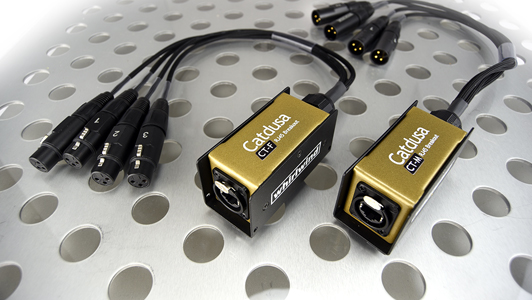
The Whirlwind Catdusa CT-M breaks a Cat5e etherCON run out to four male XLR tails, turning one network cable into a four-channel analog drop. Dual etherCON IN/THRU jacks let you daisy-chain boxes down a stage, and with shielded Cat cable it passes phantom power — wired with 110-ohm cable so AES and DMX survive the trip too. A lighter, cheaper stage drop than copper multicore for IEM sends and playback feeds.

The Whirlwind Catdusa CT-M is a passive breakout box that takes one Cat5e etherCON run and splits it into four male XLR outputs. Its job in a rig is simple and specific: replace a heavy copper multicore snake for short analog distribution runs — IEM transmitter feeds, playback outputs to a stage box, or a small broadcast split drop. At 0.7 kg and $163, it sits at the affordable, lightweight end of what Whirlwind's Catdusa line does, and it asks nothing of your power distribution because it draws exactly zero watts.

The dual etherCON IN/THRU jacks are the feature that makes this genuinely useful at load-in. You can daisy-chain multiple CT-M units down a single Cat5e home run, dropping four channels wherever you need them without running separate cables to each position. Shielded Cat cable carries phantom power through the box, so condenser mics and active DI boxes on the XLR tails will work as expected — just confirm you're using properly shielded Cat5e or Cat6, because the phantom pass-through depends on it. The 110-ohm wiring also means AES digital and DMX signals can share the same infrastructure if your system uses those alongside analog.
This box earns its place in IEM rigs and playback setups where you're already running etherCON infrastructure for analog distribution and want a clean, lightweight stage drop without coiling a multicore. If you need more than four channels at a drop point, you'll want a larger Catdusa variant or a proper stage box. It's also not a solution if your runs are long and unshielded — phantom reliability and noise rejection degrade quickly with the wrong cable. Engineers who've standardized on etherCON analog infrastructure will find the CT-M an obvious, inexpensive piece of that system; engineers still running copper multicore everywhere may not have enough Cat infrastructure in place yet to use it.

In the rack

  • Always use shielded Cat5e or Cat6 cable — unshielded runs will technically carry audio, but phantom power reliability drops and you'll introduce noise you won't easily trace during a rushed line check.
  • When daisy-chaining multiple CT-M units, label the THRU port's downstream cable at both ends before load-in; the IN and THRU jacks look identical under stage lighting and a wrong connection will kill the whole chain silently.
  • The XLR outputs are male, so the CT-M sends signal out to female-input destinations — double-check your gender before ordering if you're dropping directly into a female-output device and need a turnaround.
  • Mount or gaff the box securely at the drop point; at 0.7 kg with four XLR cables pulling on it, an unsecured unit will migrate during the set and stress the etherCON connector on the home run.

4-channel Cat5e etherCON fan to 4x XLRM tails; IN/THRU daisy chain; passes phantom on shielded Cat.

I/O Ports (6)

PortConnectorDirectionSignalChannels
etherCON InETHERCONinputanalog audio
etherCON ThruETHERCONoutputanalog audio
XLR 1XLR MALEoutputanalog audio
XLR 2XLR MALEoutputanalog audio
XLR 3XLR MALEoutputanalog audio
XLR 4XLR MALEoutputanalog audio

Related gear

Related articles

Guides from our library that cover planning around analog snake gear.