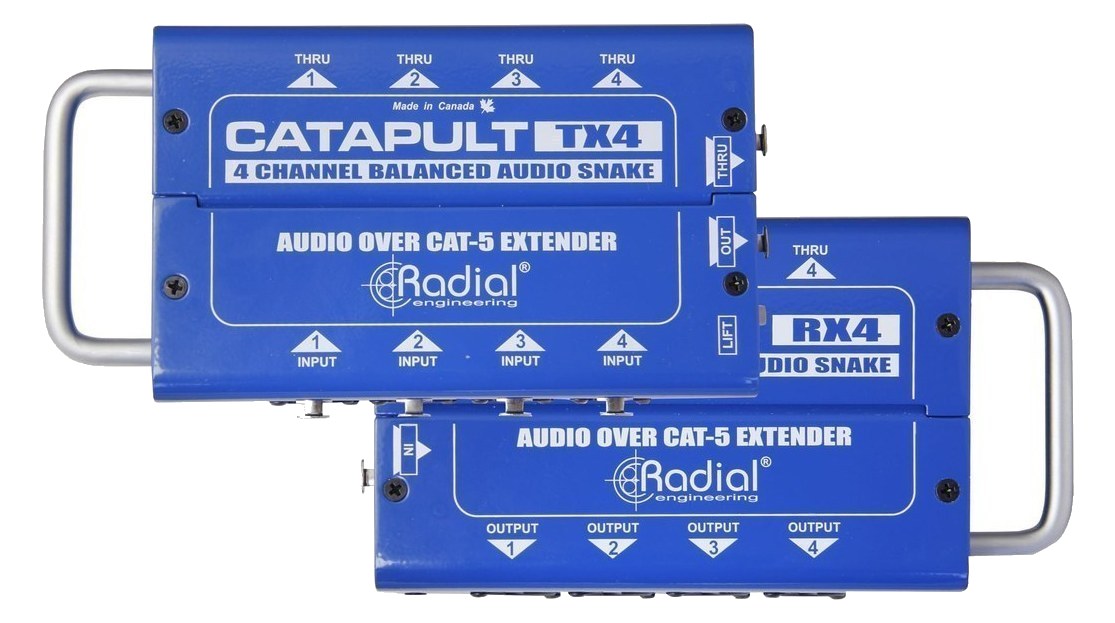
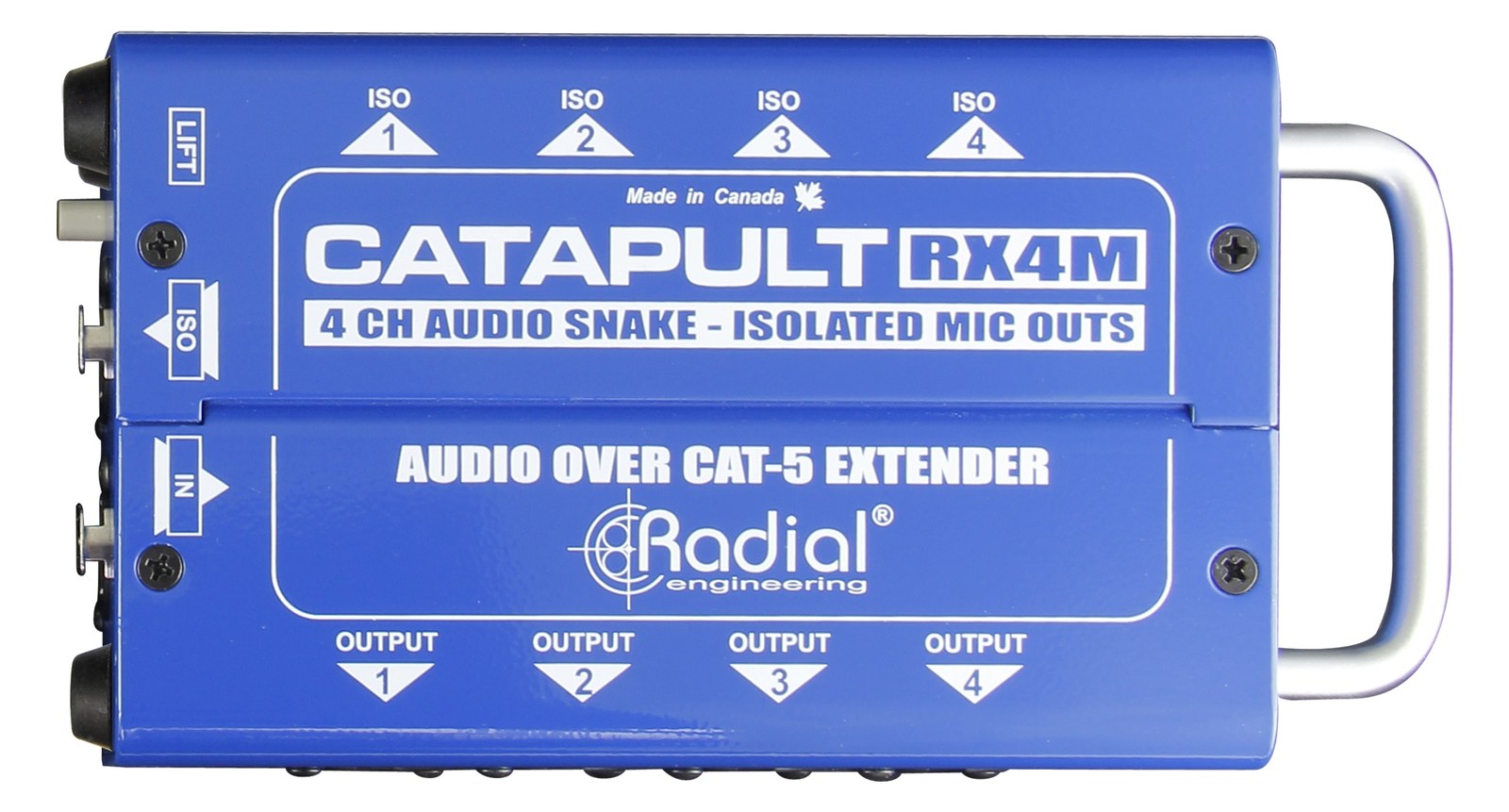
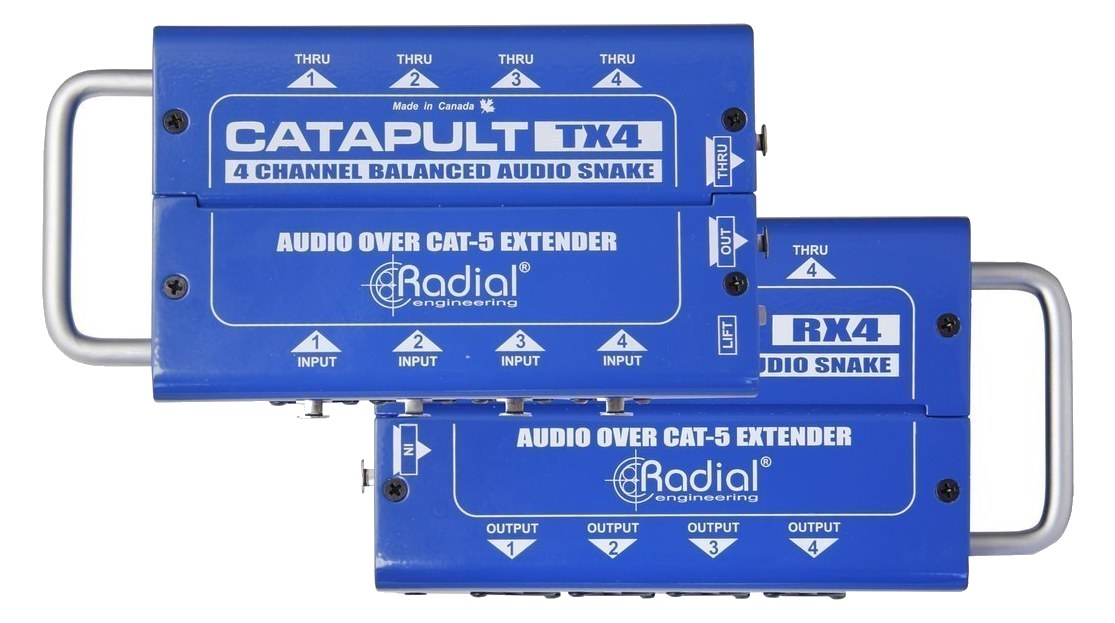
The Radial Catapult RX4 is the receive end of Radial's modular Cat5 snake system, breaking one shielded Cat5 run back out to four XLR outputs in a rugged floor-box format. Male and female XLRs on every channel let it feed a console while passing signal through to a second destination, and it pairs with any Catapult transmit module. It is the standard stage-side drop for IEM sends and playback feeds without hauling copper multicore.
UnverifiedPower requirement is not verified in the catalog
Catalog estimate
~$235Current listings stay in the price tracker
01 · What it does—and what that changes in your rig.
Product overview
Start with the payoff, then work through how it functions, where it fits, and the details that change a real build.
The payoff
8 channels. 1 cable runs. Outside rack.
The Catapult RX4 is the stage-side half of Radial's modular Cat5Standard network cable grades. In an audio rig one cheap Cat5e run can replace a 48-channel copper snake; AES50 wants it shielded.snakeA multicore cable bundling many channels into one stage-to-console run. A sub-snake collects one corner of the stage into a drop box. system — the box that takes one shielded Cat5 run from your rack and hands you back four analog XLRThe standard 3-pin locking connector for mics and balanced line signals — pin 1 is the shield, pins 2 and 3 carry the balanced pair. channels wherever you need them. In an IEMIn-Ear Monitor — earpieces that replace floor wedges, feeding each player their own mix. The reason this whole rack exists. or playback rig, that typically means running a single Cat5 from the rack to a floor drop near the band, then patching IEM transmitter inputs or click feeds straight off the RX4's male XLR outputs. It's a passive, zero-power device, so there's nothing to switch on, nothing to fail electrically, and no rack space consumed — it parks on the floor or clips to a stand.
Four male XLRThe standard 3-pin locking connector for mics and balanced line signals — pin 1 is the shield, pins 2 and 3 carry the balanced pair. outputs carry the broken-out analog signals, and each channel also has a female XLR thru, so you can simultaneously feed a second destination — a wedgeA floor monitor speaker angled up at the performer — the thing IEMs replace, and the thing you fall back on when they die. amp, a recording split, or a second IEMIn-Ear Monitor — earpieces that replace floor wedges, feeding each player their own mix. The reason this whole rack exists. transmitter — without a Y-cable or an active splitter. The Cat5Standard network cable grades. In an audio rig one cheap Cat5e run can replace a 48-channel copper snake; AES50 wants it shielded. run itself handles the grunt work of getting signal across stage, replacing a bulky copper multicore for four channels. The RX4 weighs 1.6 kg and is built in Radial's typical steel enclosure, meaning it can take a kick from a monitor wedge or a cable cart without drama. Passive transformerA magnetic coupling that passes audio between two windings with no wire contact — isolates splits and kills ground-loop hum, no power needed.-based designs like this are inherently resistant to ground loopsHum from gear seeing two ground paths at slightly different voltage — the classic buzz when two racks share audio and power. introduced by long cable runs, which matters when your rack is sitting 30 meters from the stage.
Best fit
Where it earns its place in the system
This box earns its place in a compact IEMIn-Ear Monitor — earpieces that replace floor wedges, feeding each player their own mix. The reason this whole rack exists. or playback rig where you're already running Cat5Standard network cable grades. In an audio rig one cheap Cat5e run can replace a 48-channel copper snake; AES50 wants it shielded. infrastructure and need a clean, reliable stage drop without adding active gear or extra power runs. If you only need two channels, Radial makes smaller Catapult variants. If you're running more than four channels or need mic-levelThe tiny signal straight out of a microphone — roughly a thousandth of line level. It needs a preamp before anything else touches it. signals traveling the other direction, you'll want the appropriate transmit module on the rack end and potentially additional RX units. Anyone expecting digital audio or AES routing should look elsewhere entirely — this is strictly analog, strictly passive, and strictly one-way.
Radial Catapult RX4 — end panel with dual etherCON Cat 5 connectionsPhoto: Radial Engineering
In the rack
Details worth deciding before load-in.
Use the thru XLRsThe standard 3-pin locking connector for mics and balanced line signals — pin 1 is the shield, pins 2 and 3 carry the balanced pair. to daisy-chain a personal monitor amp or a second IEMIn-Ear Monitor — earpieces that replace floor wedges, feeding each player their own mix. The reason this whole rack exists. transmitter for dual-band or backup setups — no splitter box needed, and you keep the signal path passive.
Label both ends of your Cat5Standard network cable grades. In an audio rig one cheap Cat5e run can replace a 48-channel copper snake; AES50 wants it shielded. run with channel numbers before load-in; the RX4 has no onboard labeling, and swapping a Cat5 at the rack end is much faster than tracing which output is which on a dark stage.
Secure the RX4 to a monitor stand base or tape it to the floor with a cable anchor — it's light enough that a single tug on a connected XLRThe standard 3-pin locking connector for mics and balanced line signals — pin 1 is the shield, pins 2 and 3 carry the balanced pair. can flip it, and four disconnected IEMIn-Ear Monitor — earpieces that replace floor wedges, feeding each player their own mix. The reason this whole rack exists. feeds mid-set is a bad night.
Test the full Cat5Standard network cable grades. In an audio rig one cheap Cat5e run can replace a 48-channel copper snake; AES50 wants it shielded. run with your transmit module before doors, not during line checkThe quick pre-show pass confirming every input reaches the console, one line at a time. Not a soundcheck — just does it work.; passive systems don't announce faults the way networked gear does, and a pinched cable reads as silence with no error light to warn you.
02 · Know the whole path before you buy.
Signal path
Learn the route as a block diagram: source, product function, transport, and destination. Select any block to see what enters, what changes, and what leaves.
Interactive block diagramAuto-looping · hover, focus, or tap to hold a stage
Port-type signalProduct functionSystem boundary
Follow one signal from source to destination
Each block answers the same three questions: what arrives, what changes here, and what leaves.
01 · Source · selected
1 bank · 8 ch each
Analog over Cat cable
8 × XLR male + XLR female
01 · Source
Compatible analog-snake transmitter
The matching send end accepts separate analog sources and assigns them to repeatable cable banks.
Required
Compatible transmitter or breakout
Groups
8 source channels
Verify
Matching bank labels
03 · What this product asks of the rest of the system.
Compatibility
Treat connector names as the start of the check—not the answer. These are the boundaries that determine a complete working path.
Best fit · Analog Snake
Use it as analog snake tracked outside rack rails; follow the manufacturer’s mounting and form-factor guidance.
Plan the companion path
Complete both ends with a compatible sender, receiver, or breakout. Match connector, channel wiring, direction, and shielded-cable requirements.
Connector boundary
Documented connectors: RJ45, XLR male, XLR female. Match connector, direction, and signal type—not shape alone.
04 · Every connector, grouped by job.
I/O ports
Switch the product view and the documented port inventory updates with it—hardware and data stay side by side.
Every connector, grouped by job.
Switch panels to keep the hardware view and the documented port list in sync.
Front panelRear panel
All documented ports for Radial Catapult RX4
Port
Panel
Connector
Direction
Signal
Channels
Cat5 In
rear
RJ45
input
analog audio
—
XLR Out 1
rear
XLR male
output
analog audio
—
XLR Out 2
rear
XLR male
output
analog audio
—
XLR Out 3
rear
XLR male
output
analog audio
—
XLR Out 4
rear
XLR male
output
analog audio
—
XLR Thru 1
rear
XLR female
output
analog audio
—
XLR Thru 2
rear
XLR female
output
analog audio
—
XLR Thru 3
rear
XLR female
output
analog audio
—
XLR Thru 4
rear
XLR female
output
analog audio
—
Showing 9 of 9 documented physical ports.
05 · Compare the decision, not just the price.
Alternatives
The rows are organized around fit, power, I/O, and system role so a cheaper unit cannot hide a more expensive workflow.
Catapult RX4The Radial Catapult RX4 is the receive end of Radial's modular Cat5 snake system, breaking one shielded Cat5 run back out to four XLR outputs in a rugged floor-box format. Male and female XLRs on every channel let it feed a console while passing signal through to a second destination, and it pairs with any Catapult transmit module. It is the standard stage-side drop for IEM sends and playback feeds without hauling copper multicore.View gear →
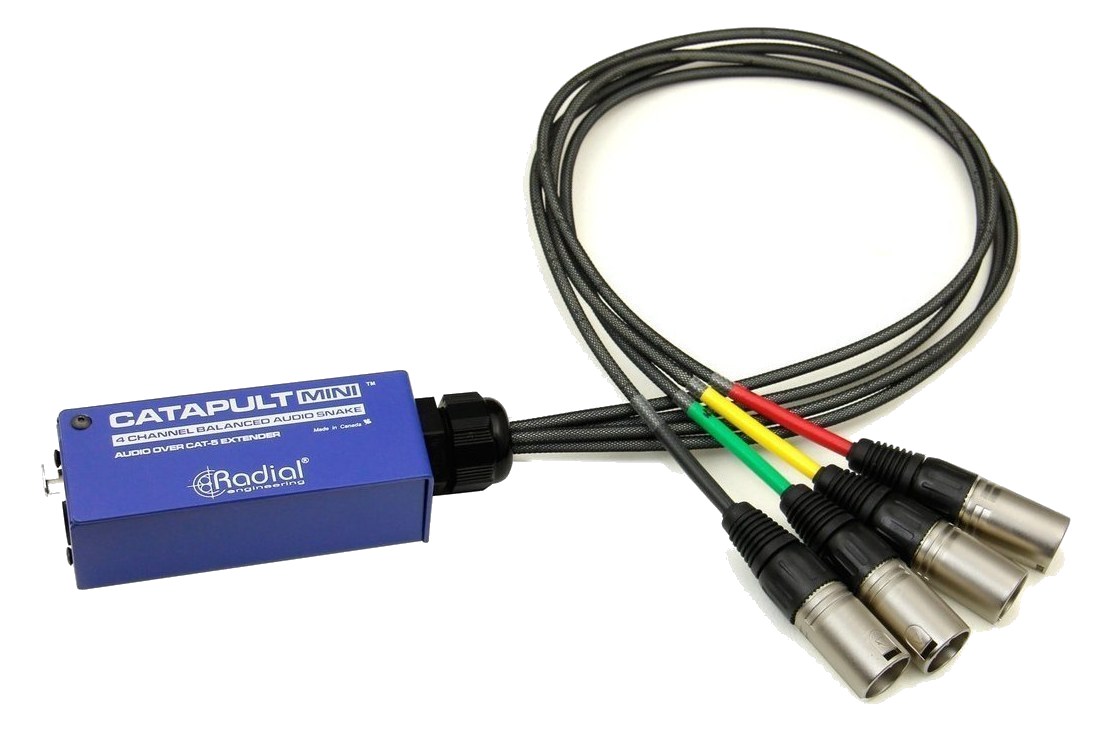
Catapult Mini RXThe Radial Catapult Mini RX converts four channels of audio carried over a single Cat5 cable back to individual XLR outputs, making it the receive end of a lightweight analog snake solution. This approach replaces heavy multi-pair audio cables with inexpensive and readily available Cat5 cable, dramatically reducing cable weight and bulk for stage runs. Pair it with a Catapult Mini TX at the other end for a complete four-channel analog snake.View gear →
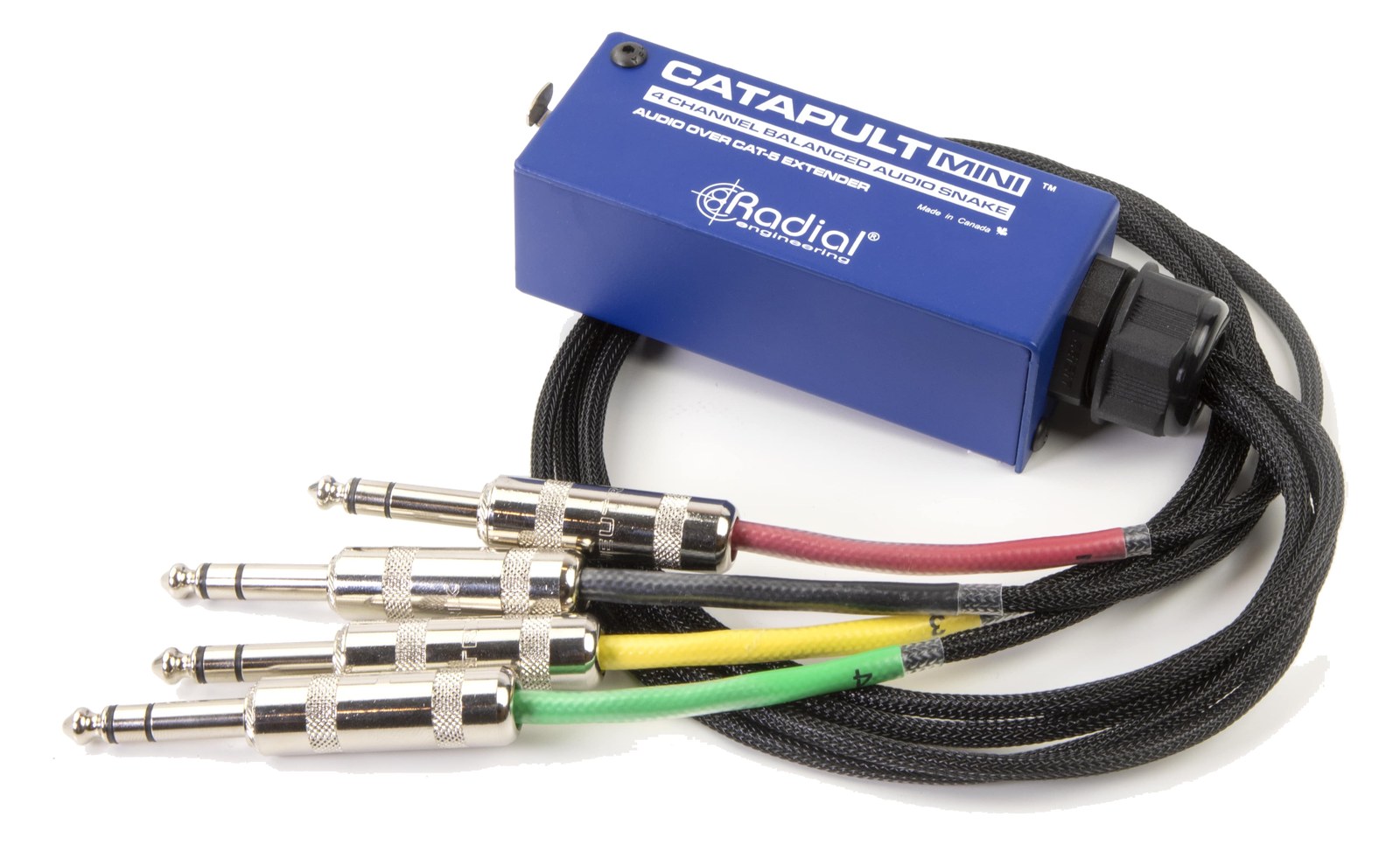
Catapult Mini TRSThe Radial Catapult Mini TRS puts four balanced 1/4-inch TRS connectors on the Cat5 snake system, matching the jacks found on rackmount interfaces and playback rigs. Use it at the rack end to lift four interface outputs onto one Cat5 run to stage, with a Mini RX or RX4 breaking out to XLR at the other end. Passive, compact, and interchangeable with every other Catapult module.View gear →
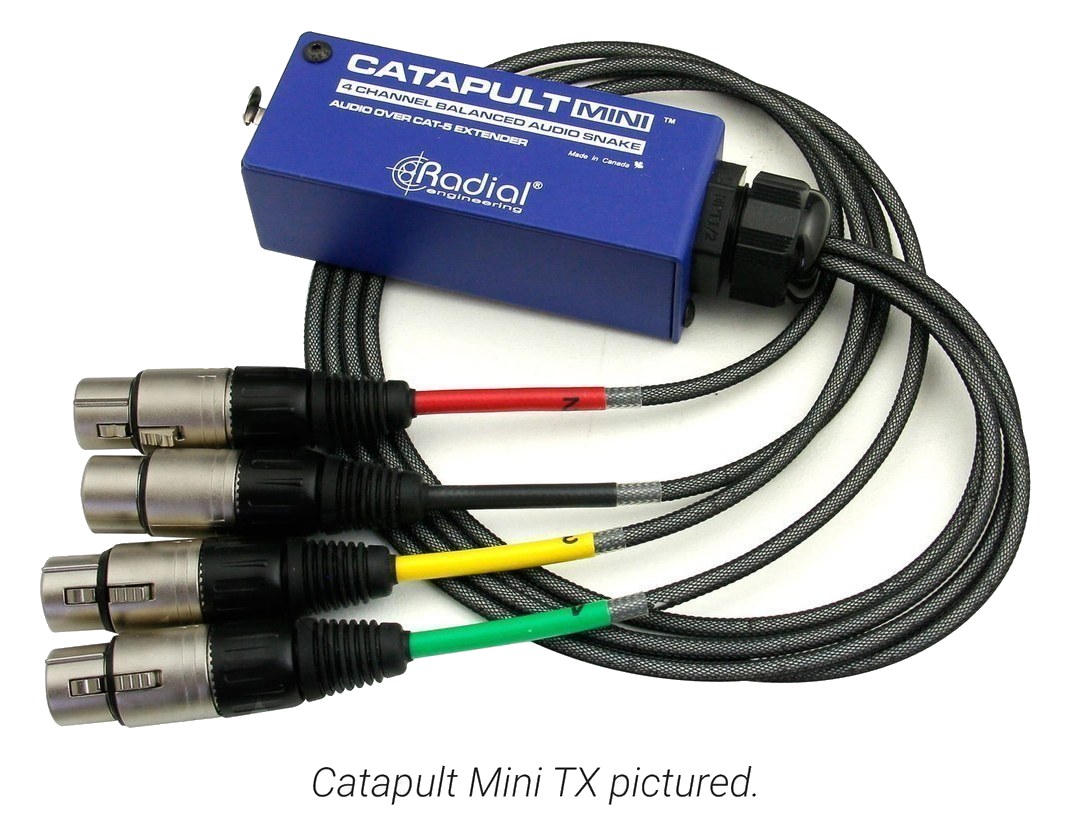
Catapult Mini TXThe Radial Catapult Mini TX is the transmit side of a Cat5 analog snake, converting four XLR inputs to a single Cat5 cable for lightweight long-distance audio runs. It is perfect for sending monitor mixes, playback feeds, or microphone signals from the rack to stage positions without heavy analog snakes. The compact form factor means it can sit at either end of the cable run without taking up much space.View gear →
06 · Resolve the questions that can change the purchase or build plan.
Planning questions
Short, source-backed answers surface rack fit, power, cabling, and connection details before they become surprises.
Where does the Radial Catapult RX4 live in a complete rig?
The catalog assigns it no rack units. Builder tracks it as non-rack gear; follow the manufacturer’s mounting, case, and form-factor guidance.
How much power does the Radial Catapult RX4 draw?
Its power requirement is not yet verified in the catalog.
What connections does the Radial Catapult RX4 have?
9 documented physical ports, including Cat5 In, XLR Out 1, XLR Out 2, XLR Out 3, XLR Out 4, XLR Thru 1.
07 · See this gear inside a complete system plan.
Builder preview
Builder keeps non-rack gear in the same bill of materials, budget, dependency, and connection plan as the rack-mounted system around it.Open in Builder