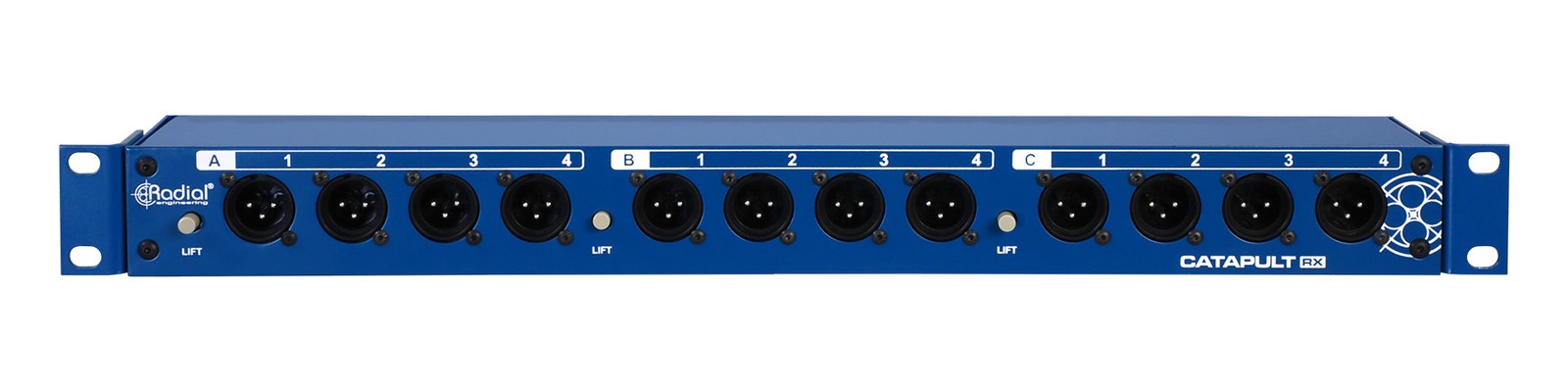
The Radial Catapult Rack RX is a 1U passive receiver that carries 12 channels of analog audio from three shielded Cat 5/6 cable runs to 12 XLR outputs. It is the rack end of a lightweight analog snake for IEM, monitor, playback, and touring systems. The signal remains analog end to end, with per-bank ground lift and no AC power required.
01 · What it does—and what that changes in your rig.
Product overview
Start with the payoff, then work through how it functions, where it fits, and the details that change a real build.
The payoff
12 channels. 3 cable runs. 1U.
Catapult Rack RX is the receiving half of a 12-channel analog snakeA multicore cable bundling many channels into one stage-to-console run. A sub-snake collects one corner of the stage into a drop box.: three shielded Cat 5/6 runs arrive at the rack and break out to twelve male XLRThe standard 3-pin locking connector for mics and balanced line signals — pin 1 is the shield, pins 2 and 3 carry the balanced pair. outputs. Each Cat cable carries four channels as balancedCarries the signal on two wires and cancels whatever noise both pick up — why mic cables can run hundreds of feet hum-free. analog audio, so there is no conversion, network setup, clocking, or latencyThe delay between sound entering and leaving a digital system. IEM rigs fight to keep the whole chain down to a few milliseconds. to manage.
Signal channels
12Balanced analog paths end to end
Cable runs
34 channels per Cat cable
Rack space
1UBuilder checks available rail space
Photo: Radial Engineering1U · 0W
Function
How it works in the path
The useful planning insight is the cable math. A full twelve-channel path needs three Cat runs and a compatible Catapult TX or breakoutA cable that splits one multichannel connector (like a DB25) into individual plugs — the octopus that turns 8 channels into 8 XLRs. at the source. The three banks remain independent, making four- or eight-channel deployments practical without wiring the entire unit.
Best fit
Where it earns its place in the rack
This is a direct passive Cat-to-XLRThe standard 3-pin locking connector for mics and balanced line signals — pin 1 is the shield, pins 2 and 3 carry the balanced pair. path with per-bank ground liftA switch that disconnects a cable’s shield at one end to break a ground loop. Lift on DIs and isolators — never on AC safety grounds., not an isolation transformerA magnetic coupling that passes audio between two windings with no wire contact — isolates splits and kills ground-loop hum, no power needed.. Use shielded Cat cable for the intended grounding behavior, label each bank at both ends, and add transformer isolation elsewhere only when the application calls for it.
Budget one shielded Cat 5/6 run per four channels: three runs for all twelve outputs.
Pair each bank with a compatible Catapult TX or breakoutA cable that splits one multichannel connector (like a DB25) into individual plugs — the octopus that turns 8 channels into 8 XLRs. wired to the same analog-audio pinout.
Use the per-bank ground liftA switch that disconnects a cable’s shield at one end to break a ground loop. Lift on DIs and isolators — never on AC safety grounds. to troubleshoot shield-current noise; it is not a substitute for galvanic isolation.
At roughly 3.25 inches deep and 1UThe standard slice of rack height: 1U = 1.75″. A 3U box takes three slices; half-rack gear pairs two units side by side in one. high, it can sit near the rear rail without consuming rack power.
02 · Know the whole path before you buy.
Signal path
Learn the route as a block diagram: source, product function, transport, and destination. Select any block to see what enters, what changes, and what leaves.
Interactive block diagramAuto-looping · hover, focus, or tap to hold a stage
Port-type signalProduct functionSystem boundary
Follow one signal from source to destination
Each block answers the same three questions: what arrives, what changes here, and what leaves.
01 · Source · selected
3 banks · 4 ch each
Analog over Cat cable
12 × XLR male
01 · Source
Compatible analog-snake transmitter
The matching send end accepts separate analog sources and assigns them to repeatable cable banks.
Required
Compatible transmitter or breakout
Groups
12 source channels
Verify
Matching bank labels
03 · What this product asks of the rest of the system.
Compatibility
Treat connector names as the start of the check—not the answer. These are the boundaries that determine a complete working path.
Best fit · Analog Snake
Use it when 1U and 82.55 mm of depth fit the case.
Plan the companion path
Complete both ends with a compatible sender, receiver, or breakout. Match connector, channel wiring, direction, and shielded-cable requirements.
Connector boundary
Documented connectors: etherCON, XLR male. Match connector, direction, and signal type—not shape alone.
04 · Every connector, grouped by job.
I/O ports
Switch the product view and the documented port inventory updates with it—hardware and data stay side by side.
Every connector, grouped by job.
Switch panels to keep the hardware view and the documented port list in sync.
Front panelRear panel
All documented ports for Radial Catapult Rack RX
Port
Panel
Connector
Direction
Signal
Channels
A etherCON 1
rear
etherCON
input
analog audio
—
B etherCON 1
rear
etherCON
input
analog audio
—
C etherCON 1
rear
etherCON
input
analog audio
—
A etherCON 2
rear
etherCON
bidirectional
analog audio
—
B etherCON 2
rear
etherCON
bidirectional
analog audio
—
C etherCON 2
rear
etherCON
bidirectional
analog audio
—
OUT A1
front
XLR male
output
analog audio
—
OUT A2
front
XLR male
output
analog audio
—
OUT A3
front
XLR male
output
analog audio
—
OUT A4
front
XLR male
output
analog audio
—
OUT B1
front
XLR male
output
analog audio
—
OUT B2
front
XLR male
output
analog audio
—
OUT B3
front
XLR male
output
analog audio
—
OUT B4
front
XLR male
output
analog audio
—
OUT C1
front
XLR male
output
analog audio
—
OUT C2
front
XLR male
output
analog audio
—
OUT C3
front
XLR male
output
analog audio
—
OUT C4
front
XLR male
output
analog audio
—
Showing 18 of 18 documented physical ports. Scroll to review the remaining rows.
05 · Compare the decision, not just the price.
Alternatives
The rows are organized around fit, power, I/O, and system role so a cheaper unit cannot hide a more expensive workflow.
Catapult Rack RXThe Radial Catapult Rack RX is a 1U passive receiver that carries 12 channels of analog audio from three shielded Cat 5/6 cable runs to 12 XLR outputs. It is the rack end of a lightweight analog snake for IEM, monitor, playback, and touring systems. The signal remains analog end to end, with per-bank ground lift and no AC power required.View gear →
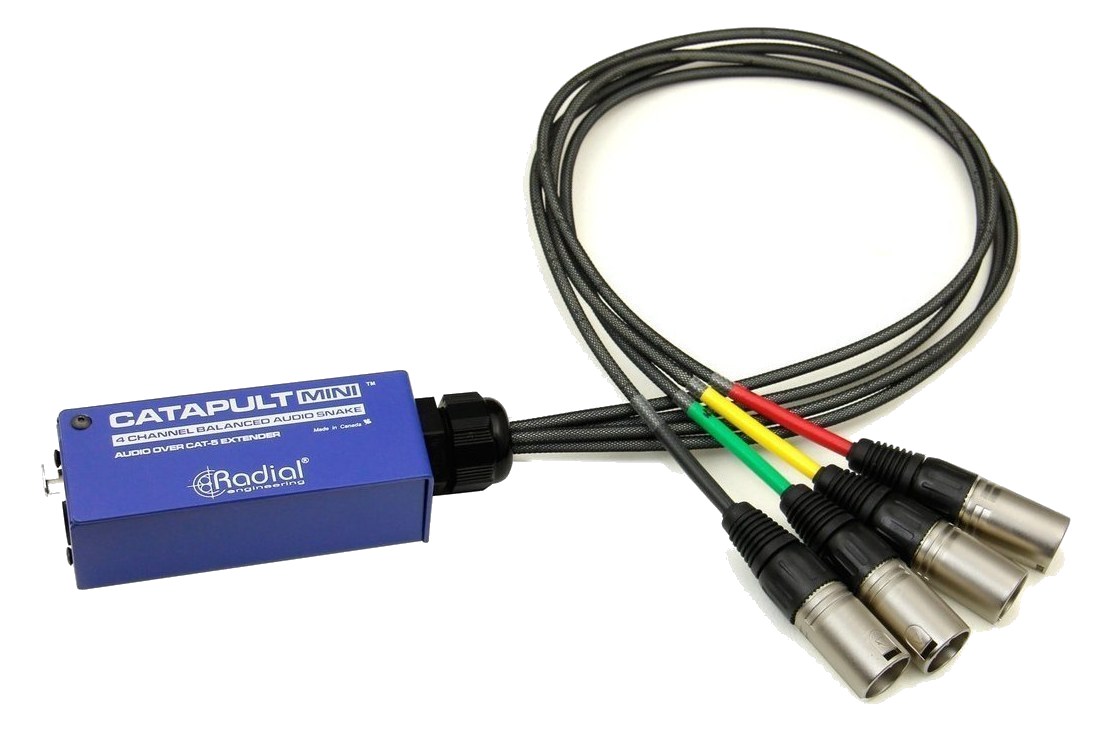
Catapult Mini RXThe Radial Catapult Mini RX converts four channels of audio carried over a single Cat5 cable back to individual XLR outputs, making it the receive end of a lightweight analog snake solution. This approach replaces heavy multi-pair audio cables with inexpensive and readily available Cat5 cable, dramatically reducing cable weight and bulk for stage runs. Pair it with a Catapult Mini TX at the other end for a complete four-channel analog snake.View gear →
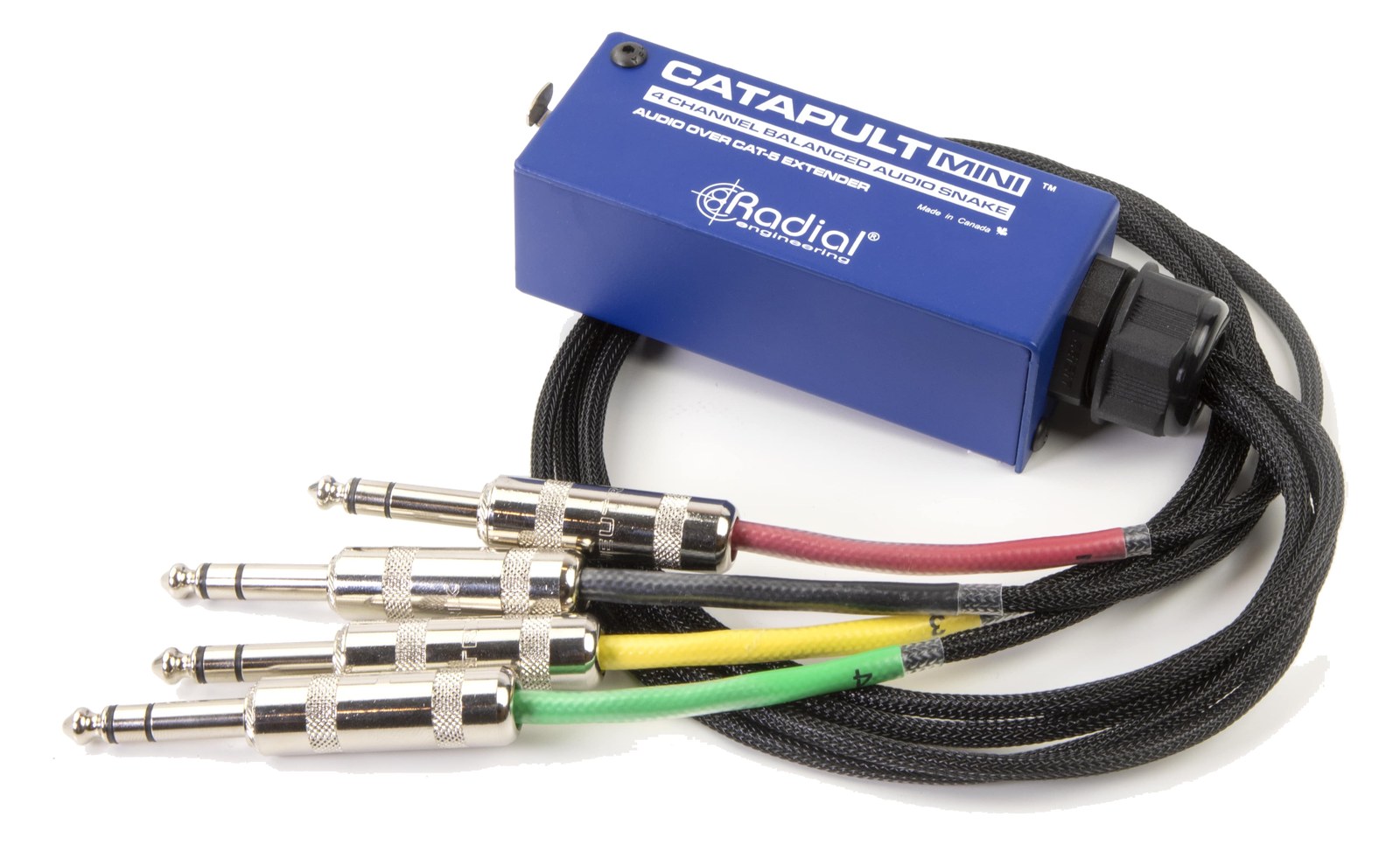
Catapult Mini TRSThe Radial Catapult Mini TRS puts four balanced 1/4-inch TRS connectors on the Cat5 snake system, matching the jacks found on rackmount interfaces and playback rigs. Use it at the rack end to lift four interface outputs onto one Cat5 run to stage, with a Mini RX or RX4 breaking out to XLR at the other end. Passive, compact, and interchangeable with every other Catapult module.View gear →
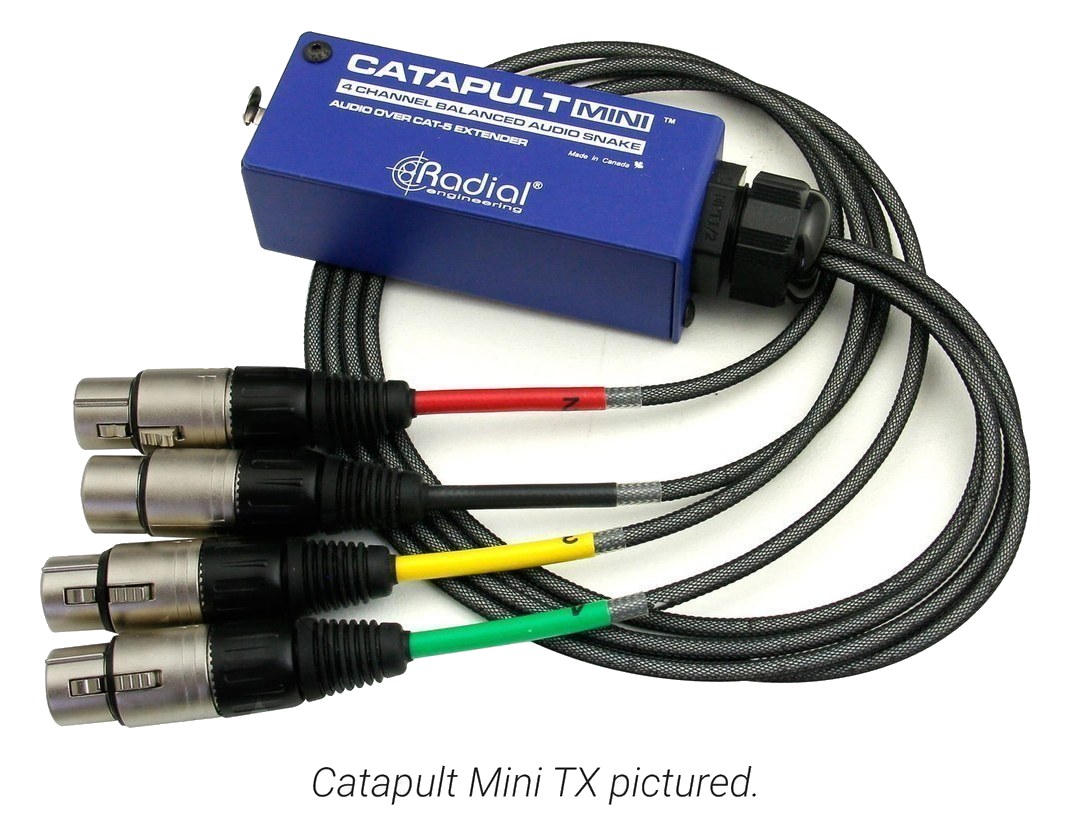
Catapult Mini TXThe Radial Catapult Mini TX is the transmit side of a Cat5 analog snake, converting four XLR inputs to a single Cat5 cable for lightweight long-distance audio runs. It is perfect for sending monitor mixes, playback feeds, or microphone signals from the rack to stage positions without heavy analog snakes. The compact form factor means it can sit at either end of the cable run without taking up much space.View gear →
06 · Resolve the questions that can change the purchase or build plan.
Planning questions
Short, source-backed answers surface rack fit, power, cabling, and connection details before they become surprises.
How will the Radial Catapult Rack RX affect rack fit and case depth?
It occupies 1U. Its documented depth is 82.55 mm.
How much power does the Radial Catapult Rack RX draw?
It is verified passive and requires no AC power.
What connections does the Radial Catapult Rack RX have?
18 documented physical ports, including A etherCON 1, B etherCON 1, C etherCON 1, A etherCON 2, B etherCON 2, C etherCON 2.
07 · See this unit inside a real rack plan.
Builder preview
Placement is only the start. Builder checks space · depth · weight, power headroom, dependencies, and compatible signal paths around this exact catalog item.Open in Builder
See this gear used in context, outside the catalog.
Video field notes
Human-reviewed, ranked by a dated public activity snapshot, with enough detail to judge the workflow without leaving the product page.