The Behringer MS8000 is a budget-friendly 8-channel mic splitter that provides both direct and isolated outputs for each input. While the transformers are not in the same league as Jensen-equipped alternatives, it gets the job done for basic signal splitting needs at a fraction of the cost. A practical choice for smaller rigs or rehearsal setups where you need to split signals between two systems.
01 · What it does—and what that changes in your rig.
Product overview
Start with the payoff, then work through how it functions, where it fits, and the details that change a real build.
The payoff
Splitter decisions, organized around the whole rig.
The MS8000 is a passive 8-channel mic splitter occupying a single rack unitThe standard slice of rack height: 1U = 1.75″. A 3U box takes three slices; half-rack gear pairs two units side by side in one. and drawing zero power. Its job is straightforward: take eight microphone-level signals and deliver each one to two destinations simultaneously — a direct output that passes the signal through as-is, and a transformer-isolatedA magnetic coupling that passes audio between two windings with no wire contact — isolates splits and kills ground-loop hum, no power needed. output that breaks the ground connection between the two receiving systems. In a typical deployment, that means FOHFront Of House — the main mix the audience hears, and the console position out in the room where it gets mixed. console on the direct outs and monitor console on the isolated outs, or IEMIn-Ear Monitor — earpieces that replace floor wedges, feeding each player their own mix. The reason this whole rack exists. rack on one side and recording interface on the other, with ground loopsHum from gear seeing two ground paths at slightly different voltage — the classic buzz when two racks share audio and power. kept out of the picture.
Documented outputs
1616 destination connections
Documented inputs
8Based on documented inputs
Rack space
1UBuilder checks available rail space
Behringer product panel1U · 0W
Function
How it works in the path
Because it's passive, there's no gainHow much the preamp amplifies the incoming signal. Too low and you’re hunting through hiss; too high and peaks clip. on tap — what goes in comes out, and both output paths share the source signal. The transformer isolationA magnetic coupling that passes audio between two windings with no wire contact — isolates splits and kills ground-loop hum, no power needed. on the secondary outputs is the real functional feature here, and it does its job of breaking ground paths between consoles. At $89, the transformers are not in the same league as Jensen- or Lundahl-equipped splitters, which means you may hear subtle high-frequency roll-off or slightly softer transient detail on the isolated outputs under close scrutiny. On a club stage with a drummer and a loud PA, that distinction rarely surfaces. What you will not get is active buffering, so line-levelThe strong signal that runs between pieces of gear (about a volt) — hotter than mic level, far below speaker level. signals are not appropriate inputs here — this is a mic-splitter, not a general-purpose signal distribution amp.
Best fit
Where it earns its place in the rack
The MS8000 makes sense in a rehearsal studio, a small theatre pit, a house-of-worship rig, or as a cost-conscious backup unit on a tour where the real splitter lives at FOHFront Of House — the main mix the audience hears, and the console position out in the room where it gets mixed. and you just need the monitor worldThe side-stage domain of the monitor engineer — console, IEM racks, and everything feeding the band’s ears instead of the audience. separated safely. It is not the right tool for a high-stakes touring rig where audio quality is under scrutiny, where you need more than two split destinations per channel, or where the transformerA magnetic coupling that passes audio between two windings with no wire contact — isolates splits and kills ground-loop hum, no power needed. quality needs to hold up alongside premium preampsThe gain stage that lifts a mic’s tiny signal up to line level — the first thing a signal hits, and a big part of how a console sounds.. Engineers running DanteThe most common audio-over-network standard: dozens of channels of uncompressed digital audio down one ordinary Ethernet cable between Dante boxes. or MADIA pro digital format carrying 64 channels on one coax or optical cable. Point-to-point — one sender, one receiver, no network required. splits at the console stage can skip this entirely — it solves an analog-world problem.
In the rack
Details worth deciding before load-in.
Run the direct outputs to your primary console — the direct path skips the transformerA magnetic coupling that passes audio between two windings with no wire contact — isolates splits and kills ground-loop hum, no power needed. entirely, so your most signal-critical destination gets the cleanest feed.
At only 200mm deep, the MS8000 fits comfortably in a shallow utility rack; just confirm your rear panel has enough clearance for 16 XLRThe standard 3-pin locking connector for mics and balanced line signals — pin 1 is the shield, pins 2 and 3 carry the balanced pair. connectors plus a cable bend radius before you lock it in.
Label both output banks at the rear panel with the destination name before load-in — with 24 XLRThe standard 3-pin locking connector for mics and balanced line signals — pin 1 is the shield, pins 2 and 3 carry the balanced pair. connectors on a single 1UThe standard slice of rack height: 1U = 1.75″. A 3U box takes three slices; half-rack gear pairs two units side by side in one. panel, wrong-cable mistakes happen fast in dim stage light.
If you're hearing hum on the isolated outputs, verify that the console receiving them has its input gainHow much the preamp amplifies the incoming signal. Too low and you’re hunting through hiss; too high and peaks clip. trim set before you chase a transformerA magnetic coupling that passes audio between two windings with no wire contact — isolates splits and kills ground-loop hum, no power needed. problem — a floating ground on the receiving end is the more common culprit.
02 · Know the whole path before you buy.
Signal path
Learn the route as a block diagram: source, product function, transport, and destination. Select any block to see what enters, what changes, and what leaves.
Interactive block diagramAuto-looping · hover, focus, or tap to hold a stage
Port-type signalProduct functionSystem boundary
Follow one signal from source to destination
Each block answers the same three questions: what arrives, what changes here, and what leaves.
01 · Source · selected
XLR female
XLR male
01 · Source
8 documented inputs
XLR female
Arrives as
8 documented inputs
Connector
XLR female
Signal
analog audio
03 · What this product asks of the rest of the system.
Compatibility
Treat connector names as the start of the check—not the answer. These are the boundaries that determine a complete working path.
Best fit · Splitter
Use it when 1U and 65 mm of depth fit the case.
Plan the companion path
Complete the path with upstream and downstream gear that matches connector, direction, signal type, protocol, and wiring standard.
Connector boundary
Documented connectors: XLR female, XLR male. Match connector, direction, and signal type—not shape alone.
04 · Every connector, grouped by job.
I/O ports
Switch the product view and the documented port inventory updates with it—hardware and data stay side by side.
Every connector, grouped by job.
Switch panels to keep the hardware view and the documented port list in sync.
Front panelRear panel
All documented ports for Behringer Ultralink MS8000
Port
Panel
Connector
Direction
Signal
Channels
Input 1 (XLR)
rear
XLR female
input
analog audio
—
Input 2 (XLR)
rear
XLR female
input
analog audio
—
Input 3 (XLR)
rear
XLR female
input
analog audio
—
Input 4 (XLR)
rear
XLR female
input
analog audio
—
Input 5 (XLR)
rear
XLR female
input
analog audio
—
Input 6 (XLR)
rear
XLR female
input
analog audio
—
Input 7 (XLR)
rear
XLR female
input
analog audio
—
Input 8 (XLR)
rear
XLR female
input
analog audio
—
Direct Out 1 (XLR)
rear
XLR male
output
analog audio
—
Direct Out 2 (XLR)
rear
XLR male
output
analog audio
—
Direct Out 3 (XLR)
rear
XLR male
output
analog audio
—
Direct Out 4 (XLR)
rear
XLR male
output
analog audio
—
Direct Out 5 (XLR)
rear
XLR male
output
analog audio
—
Direct Out 6 (XLR)
rear
XLR male
output
analog audio
—
Direct Out 7 (XLR)
rear
XLR male
output
analog audio
—
Direct Out 8 (XLR)
rear
XLR male
output
analog audio
—
Isolated Out 1 (XLR)
rear
XLR male
output
analog audio
—
Isolated Out 2 (XLR)
rear
XLR male
output
analog audio
—
Isolated Out 3 (XLR)
rear
XLR male
output
analog audio
—
Isolated Out 4 (XLR)
rear
XLR male
output
analog audio
—
Isolated Out 5 (XLR)
rear
XLR male
output
analog audio
—
Isolated Out 6 (XLR)
rear
XLR male
output
analog audio
—
Isolated Out 7 (XLR)
rear
XLR male
output
analog audio
—
Isolated Out 8 (XLR)
rear
XLR male
output
analog audio
—
Showing 24 of 24 documented physical ports. Scroll to review the remaining rows.
05 · Compare the decision, not just the price.
Alternatives
The rows are organized around fit, power, I/O, and system role so a cheaper unit cannot hide a more expensive workflow.
MS8000The Behringer MS8000 is a budget-friendly 8-channel mic splitter that provides both direct and isolated outputs for each input. While the transformers are not in the same league as Jensen-equipped alternatives, it gets the job done for basic signal splitting needs at a fraction of the cost. A practical choice for smaller rigs or rehearsal setups where you need to split signals between two systems.View gear →
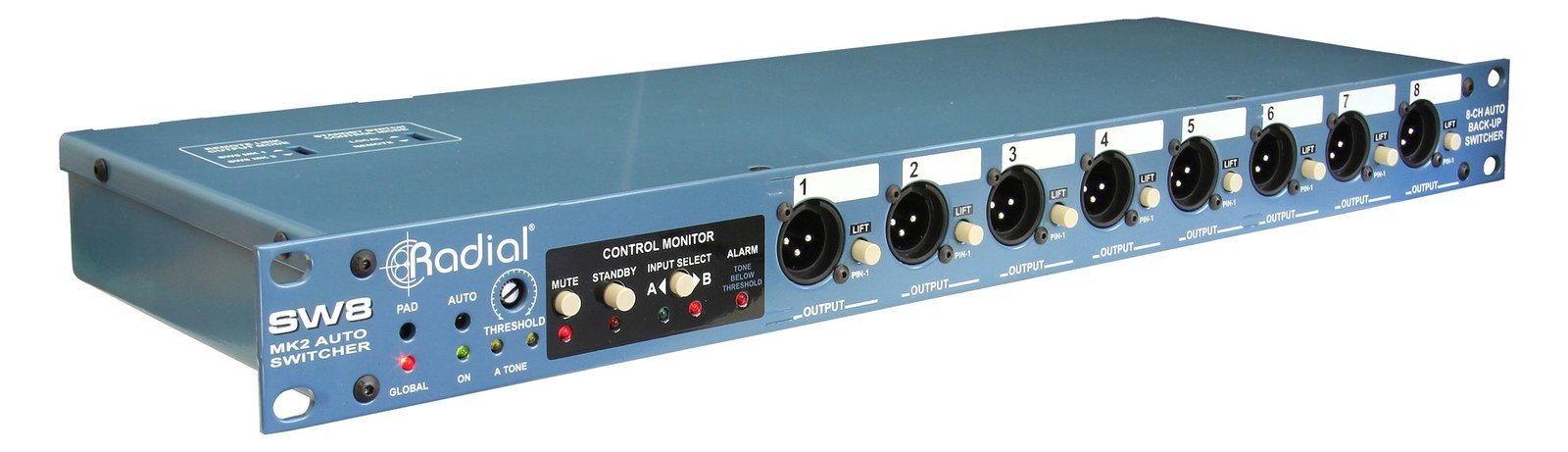
SW8The Radial SW8 is a cornerstone of redundant playback rigs, automatically switching between two stereo sources so that if your primary playback computer drops out, the backup takes over seamlessly. It monitors pilot tones on each input and switches to the healthy source without any audible gap, which is exactly what you need for tracks-dependent live shows. The eight balanced outputs let you distribute the playback signal to multiple destinations like FOH, monitors, and IEM feeds.View gear →
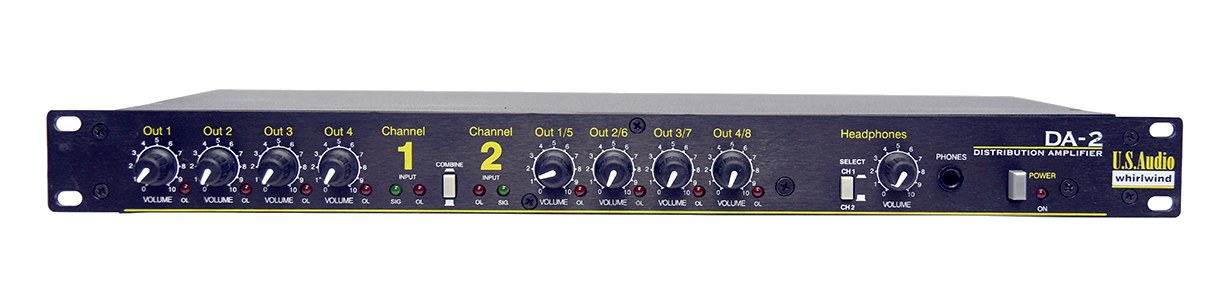
DA-2The Whirlwind DA-2 is a simple, reliable audio distribution amplifier for splitting or combining balanced audio signals. Use it to take a single stereo output from your playback rig and distribute it to multiple destinations, or to sum two sources into one feed. Its straightforward design and rugged build make it a dependable utility piece in any rack.View gear →
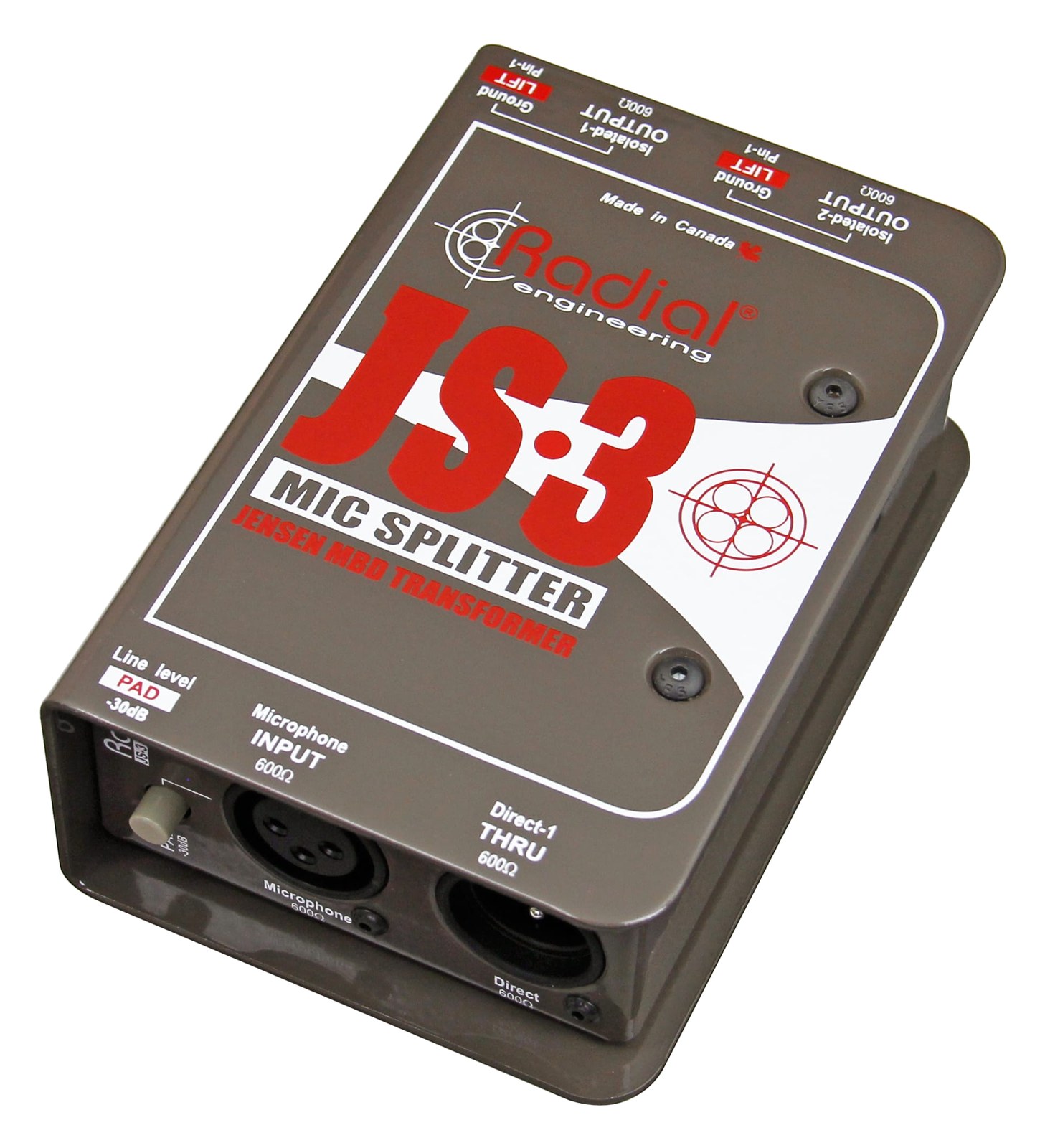
JS3The Radial JS3 is a premium single-channel mic splitter with Jensen transformer isolation that cleanly splits one microphone signal to three destinations without ground loops or signal degradation. Use it to feed a mic signal simultaneously to FOH, monitors, and a recording rig. The passive design with transformer isolation is the gold standard for preventing hum and buzz between separate audio systems.View gear →
Placement is only the start. Builder checks space · depth · weight, power headroom, dependencies, and compatible signal paths around this exact catalog item.Open in Builder