
Radial SW8 Auto-Switcher
Radial·Model SW8·radial-sw8
Photos
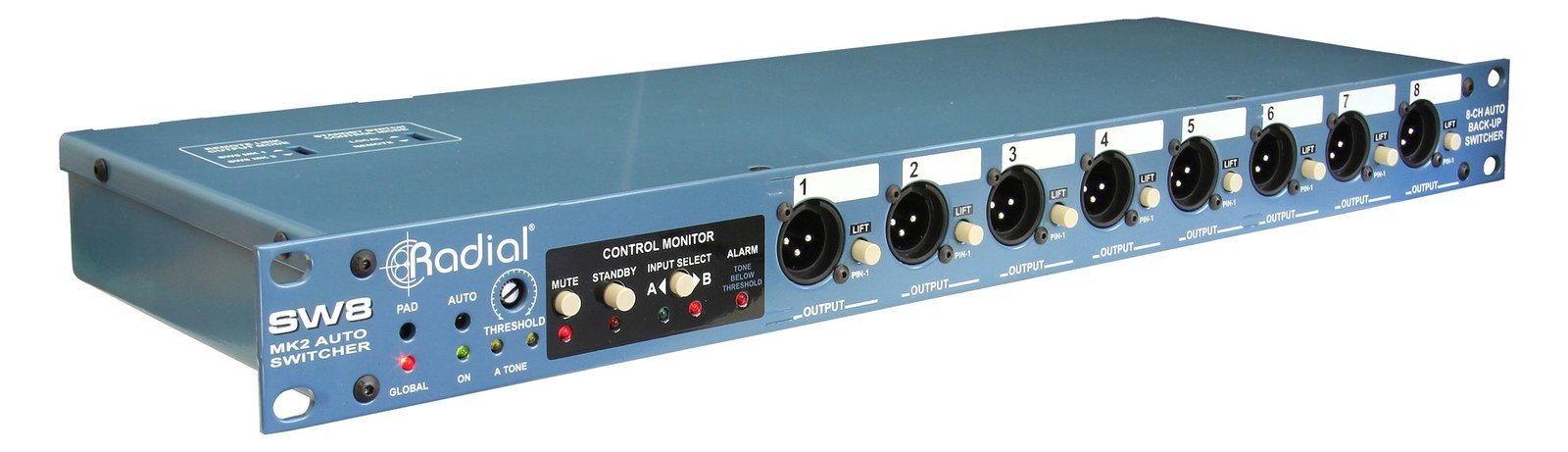
Manufacturer product photography — the drawn faceplate above stays true to panel layout; these show the hardware itself.
About the Radial SW8
The Radial SW8 is a cornerstone of redundantA second copy of anything critical — supply, computer, network path — already running so one failure can’t stop the show. playback rigs, automatically switching between two stereo sources so that if your primary playback computer drops out, the backup takes over seamlessly. It monitors pilot tones on each input and switches to the healthy source without any audible gap, which is exactly what you need for tracks-dependent live shows. The eight balancedCarries the signal on two wires and cancels whatever noise both pick up — why mic cables can run hundreds of feet hum-free. outputs let you distribute the playback signal to multiple destinations like FOHFront Of House — the main mix the audience hears, and the console position out in the room where it gets mixed., monitors, and IEMIn-Ear Monitor — earpieces that replace floor wedges, feeding each player their own mix. The reason this whole rack exists. feeds.
The Radial SW8 is the insurance policy that lives inside a redundantA second copy of anything critical — supply, computer, network path — already running so one failure can’t stop the show. playback rack. Its job is simple and critical: monitor two stereo playback sources simultaneously, and the moment the primary source loses its pilot tone — computer crash, software freeze, cable fault — switch to the backup without a gap the audience or the band will ever hear. Eight balancedCarries the signal on two wires and cancels whatever noise both pick up — why mic cables can run hundreds of feet hum-free. XLRThe standard 3-pin locking connector for mics and balanced line signals — pin 1 is the shield, pins 2 and 3 carry the balanced pair. outputs let you send that stereo playback signal to FOHFront Of House — the main mix the audience hears, and the console position out in the room where it gets mixed., to the monitor desk, to IEMIn-Ear Monitor — earpieces that replace floor wedges, feeding each player their own mix. The reason this whole rack exists. transmitters, and wherever else the show depends on it. If your production runs tracks, this is the box that keeps the track from stopping the show.
In practice, the SW8 occupies one rack unitThe standard slice of rack height: 1U = 1.75″. A 3U box takes three slices; half-rack gear pairs two units side by side in one. and draws a modest 15 watts, so it won't stress your power budget. The stereo inputs arrive on quarter-inch TRSTip-Ring-Sleeve — a 1/4″ jack with three contacts carrying a balanced signal or a stereo pair. A guitar plug with one extra ring. — standard for playback rigs coming out of a laptop or dedicated playback machine — and the eight outputs are XLRThe standard 3-pin locking connector for mics and balanced line signals — pin 1 is the shield, pins 2 and 3 carry the balanced pair. male, which means you're running balancedCarries the signal on two wires and cancels whatever noise both pick up — why mic cables can run hundreds of feet hum-free. lines straight to your snakeA multicore cable bundling many channels into one stage-to-console run. A sub-snake collects one corner of the stage into a drop box. or patch bayA panel of front-facing jacks wired to everything behind it — re-route any signal with a short cable instead of climbing behind the rack. without any adapters in the signal path. At load-in, the critical task is dialing in pilot tones on both machines and confirming the switch actually triggers cleanly during soundcheck, not during the show. The shallow 190mm depth fits comfortably in a shallow tour rack alongside a laptop shelf.
Pick the SW8 if your show runs backing tracks and the cost of a dropoutA brief audio gap when the radio link fails — the thing diversity, distros, and coordination all exist to prevent. is unacceptable — touring productions, theatrical runs, any situation where the band can't just vamp while someone reboots a computer. If you're running a simple playback rig with no redundancyA second copy of anything critical — supply, computer, network path — already running so one failure can’t stop the show. requirement, or if your switcher needs digital inputs to interface with a DanteThe most common audio-over-network standard: dozens of channels of uncompressed digital audio down one ordinary Ethernet cable between Dante boxes. or MADIA pro digital format carrying 64 channels on one coax or optical cable. Point-to-point — one sender, one receiver, no network required.-based system, the SW8 won't fit that workflow — its inputs are analog only. At $1,400 it's a professional tool priced for professional stakes, and the math is easy: it costs far less than one cancelled show.
In the rack
- Run both playback machines through the full signal chain during soundcheck and deliberately trigger the switch — mute the primary source — so you know the failoverThe automatic switch to the backup when the primary dies — good failover is seamless enough that the audience never knows. works before doors open.
- Label the eight outputs on the rear panel with gaffer tape before the rig ships: FOHFront Of House — the main mix the audience hears, and the console position out in the room where it gets mixed. L, FOH R, MON L, MON R, IEMIn-Ear Monitor — earpieces that replace floor wedges, feeding each player their own mix. The reason this whole rack exists. L, IEM R, and so on. In a dark stage wing at load-in, you'll thank yourself.
- Keep both playback machines on the same power circuit as the SW8 if possible — a breaker trip that kills one machine but not the other is exactly the scenario the unit is built for, and it should switch cleanly.
- Sync both playback computers to the same clock source or set them to the same sample rateHow many times per second audio is measured when digitized — 48 kHz is the live standard; 96 kHz measures twice as often. and buffer; the SW8 handles the audio switching, but a sample-rate mismatch on the backup machine will still produce artifacts when it takes over.
Auto-switcher for backing tracks. Switches between 2 stereo sources (A/B playback).
I/O Ports (13)
| Port | Connector | Direction | Signal | Channels |
|---|---|---|---|---|
| Input A Left (TRS) | TRS QUARTER | input | analog audio | — |
| Input A Right (TRS) | TRS QUARTER | input | analog audio | — |
| Input B Left (TRS) | TRS QUARTER | input | analog audio | — |
| Input B Right (TRS) | TRS QUARTER | input | analog audio | — |
| Output 1 (XLR) | XLR MALE | output | analog audio | — |
| Output 2 (XLR) | XLR MALE | output | analog audio | — |
| Output 3 (XLR) | XLR MALE | output | analog audio | — |
| Output 4 (XLR) | XLR MALE | output | analog audio | — |
| Output 5 (XLR) | XLR MALE | output | analog audio | — |
| Output 6 (XLR) | XLR MALE | output | analog audio | — |
| Output 7 (XLR) | XLR MALE | output | analog audio | — |
| Output 8 (XLR) | XLR MALE | output | analog audio | — |
- Power (IEC) (IEC C14)
Deciding between two?
Rack space, watts, weight and every connector, side by side.
Related gear
Related articles
Guides from our library that cover planning around splitter gear.
A walking tour of the signal path from microphone to in-ear monitor, with what every box in the rack actually does to the audio along the way.
A plain-English guide to writing the input list, stage plot, and patch sheet that house engineers want — without the jargon, with examples, and with a free way to generate one.
How to split mic signals between FOH and your IEM rack: transformer-isolated splitters, phantom power rules, and where to place the split in the chain.