
Black Lion Audio PBR XSplit8
Black Lion Audio·Model PBR XSplit8·black-lion-pg-xlr8
About the Black Lion Audio PBR XSplit8
Black Lion Audio's 8-channel passive splitter with their hand-selected transformerA magnetic coupling that passes audio between two windings with no wire contact — isolates splits and kills ground-loop hum, no power needed. pairs — sits between the budget Seismic / ART tier and the Jensen-equipped Radial JS3 / Whirlwind SP212 in price and audio quality. Common in pro project studios that double as live rigs and care about transparent splits.
The PBR XSplit8 is a passive 8-channel mic splitter — the piece of gear that lets two consoles share the same eight sources without sharing each other's ground problems. In a monitor rig, it lives at the top of the signal chain, accepting eight mic-levelThe tiny signal straight out of a microphone — roughly a thousandth of line level. It needs a preamp before anything else touches it. inputs and handing a direct output to FOHFront Of House — the main mix the audience hears, and the console position out in the room where it gets mixed. while passing a transformer-isolatedA magnetic coupling that passes audio between two windings with no wire contact — isolates splits and kills ground-loop hum, no power needed. copy to your IEMIn-Ear Monitor — earpieces that replace floor wedges, feeding each player their own mix. The reason this whole rack exists. or monitor console. No power draw, no DSPDigital Signal Processing — the number-crunching that does EQ, compression, and effects inside a box. More DSP means more processing at once., no moving parts: just transformers doing the quiet work of keeping two electrical worlds from fighting each other through the cable snakeA multicore cable bundling many channels into one stage-to-console run. A sub-snake collects one corner of the stage into a drop box..
Each channel delivers both a direct out and a transformer-isolatedA magnetic coupling that passes audio between two windings with no wire contact — isolates splits and kills ground-loop hum, no power needed. out, so your split topology is baked in — no choosing per channel, no adapters. At 170 mm deep and 2.4 kg, it's shallow and light enough to sit comfortably in a standard 1UThe standard slice of rack height: 1U = 1.75″. A 3U box takes three slices; half-rack gear pairs two units side by side in one. position without crowding the rear bay. The passive design means a brownout or a power strip failure simply doesn't affect it. What Black Lion is selling here is the transformer selection: hand-matched pairs aimed at a low noise floorThe constant background hiss a device produces on its own. Everything you pass through it sits on top — lower is better. and minimal coloration, landing this unit between budget passive splitters and the premium Jensen-equipped options from Radial or Whirlwind in both cost and measured performance.
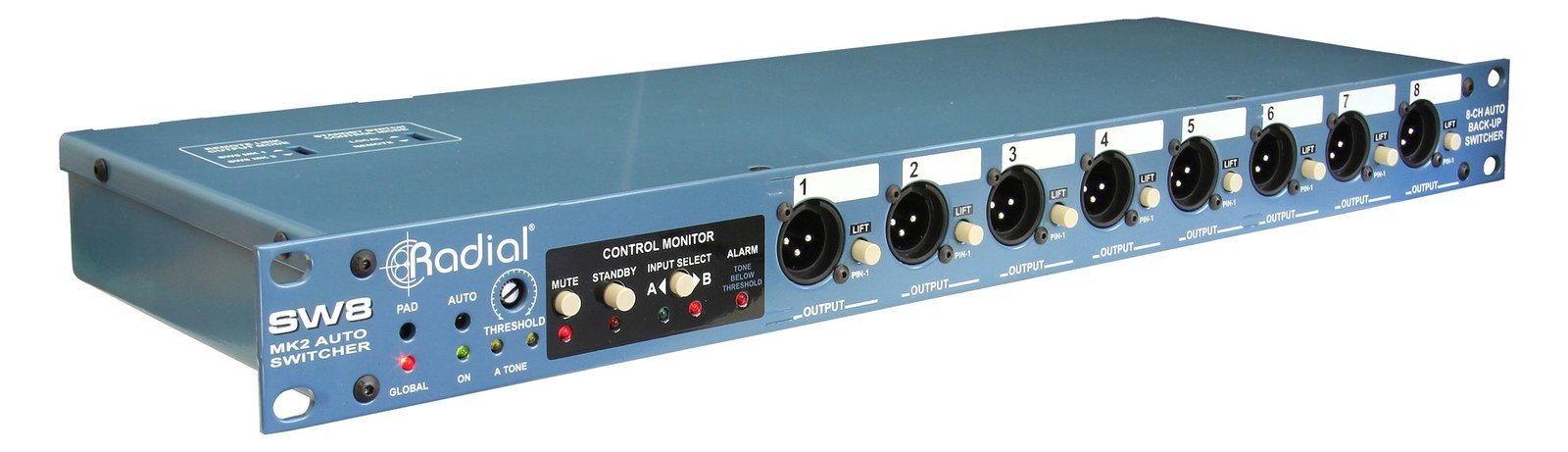
This box suits a monitor engineer running an analog or hybrid rig who needs clean, quiet splits on eight channels and can't justify the jump to a Jensen-loaded unit for a touring budget that doesn't require it. It's also well-matched to the project-studio-meets-live-rig workflow described by Black Lion's own positioning — a rig that moves between recording sessions and weekend shows. If you need more than eight channels, you're stacking units or looking at a larger frame entirely. If your system is fully digital and you're splitting post-converterThe circuitry that turns analog audio into digital data and back (A/D and D/A). Converter quality sets a digital rig’s sound ceiling. at the stageboxThe I/O endpoint on stage: mics plug in there and one digital line (AES50, Dante) carries everything to the console. The snake, digitized., a passive analog splitter doesn't belong in your chain at all.
In the rack
- Route the direct outs to FOHFront Of House — the main mix the audience hears, and the console position out in the room where it gets mixed. and the isolated outs to your monitor console — that way the monitor worldThe side-stage domain of the monitor engineer — console, IEM racks, and everything feeding the band’s ears instead of the audience. carries the transformerA magnetic coupling that passes audio between two windings with no wire contact — isolates splits and kills ground-loop hum, no power needed. buffer and FOH sees the lowest-impedanceOpposition to signal flow, in ohms. Low-impedance IEMs are easier to drive loud; mismatches shift level and tone., most transparent path.
- Label both output rows clearly at patch time, not just the inputs. Under a stage with two engineers asking questions, an unlabeled isolated output looks identical to a direct output and mistakes get made fast.
- Because it draws zero power, it can live in a passive rack shelf or even a non-powered rack section — useful if you're building a compact split rack that doesn't need a PDU just for this unit.
- Coil and tie the unused direct outs with a short XLRThe standard 3-pin locking connector for mics and balanced line signals — pin 1 is the shield, pins 2 and 3 carry the balanced pair. cap or loopback plug during transport to protect the pins; passive transformersA magnetic coupling that passes audio between two windings with no wire contact — isolates splits and kills ground-loop hum, no power needed. are robust, but bent XLR pins on the output row will ruin a load-in.
8-channel boutique splitter — premium transformersA magnetic coupling that passes audio between two windings with no wire contact — isolates splits and kills ground-loop hum, no power needed., low-noise floorThe constant background hiss a device produces on its own. Everything you pass through it sits on top — lower is better..
I/O Ports (24)
| Port | Connector | Direction | Signal | Channels |
|---|---|---|---|---|
| Input 1 (XLR) | XLR FEMALE | input | analog audio | — |
| Input 2 (XLR) | XLR FEMALE | input | analog audio | — |
| Input 3 (XLR) | XLR FEMALE | input | analog audio | — |
| Input 4 (XLR) | XLR FEMALE | input | analog audio | — |
| Input 5 (XLR) | XLR FEMALE | input | analog audio | — |
| Input 6 (XLR) | XLR FEMALE | input | analog audio | — |
| Input 7 (XLR) | XLR FEMALE | input | analog audio | — |
| Input 8 (XLR) | XLR FEMALE | input | analog audio | — |
| Direct Out 1 (XLR) | XLR MALE | output | analog audio | — |
| Direct Out 2 (XLR) | XLR MALE | output | analog audio | — |
| Direct Out 3 (XLR) | XLR MALE | output | analog audio | — |
| Direct Out 4 (XLR) | XLR MALE | output | analog audio | — |
| Direct Out 5 (XLR) | XLR MALE | output | analog audio | — |
| Direct Out 6 (XLR) | XLR MALE | output | analog audio | — |
| Direct Out 7 (XLR) | XLR MALE | output | analog audio | — |
| Direct Out 8 (XLR) | XLR MALE | output | analog audio | — |
| Isolated Out 1 (XLR) | XLR MALE | output | analog audio | — |
| Isolated Out 2 (XLR) | XLR MALE | output | analog audio | — |
| Isolated Out 3 (XLR) | XLR MALE | output | analog audio | — |
| Isolated Out 4 (XLR) | XLR MALE | output | analog audio | — |
| Isolated Out 5 (XLR) | XLR MALE | output | analog audio | — |
| Isolated Out 6 (XLR) | XLR MALE | output | analog audio | — |
| Isolated Out 7 (XLR) | XLR MALE | output | analog audio | — |
| Isolated Out 8 (XLR) | XLR MALE | output | analog audio | — |
Deciding between two?
Rack space, watts, weight and every connector, side by side.
Related gear
Related articles
Guides from our library that cover planning around splitter gear.
A walking tour of the signal path from microphone to in-ear monitor, with what every box in the rack actually does to the audio along the way.
A plain-English guide to writing the input list, stage plot, and patch sheet that house engineers want — without the jargon, with examples, and with a free way to generate one.
How to split mic signals between FOH and your IEM rack: transformer-isolated splitters, phantom power rules, and where to place the split in the chain.