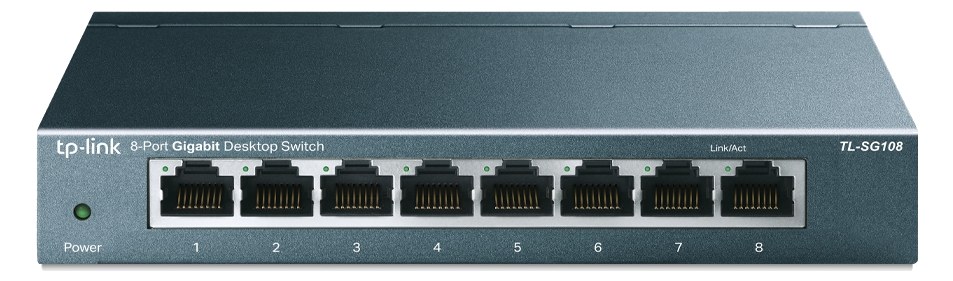

Cisco SG110D-08 8-Port Switch
Cisco·Model SG110D-08·cisco-sg110d-08
About the Cisco SG110D-08
The Cisco SG110D-08 is a step up from consumer-grade switches with Cisco's reputation for reliability, while still being unmanaged and plug-and-play. Its metal chassis and slightly higher build quality make it a sensible choice for rigs that will see regular touring use. The Cisco name also provides confidence when integrating with IT infrastructure at corporate venues.
The SG110D-08 is Cisco's unmanaged eight-port gigabit switch — the network hub that ties your IEMIn-Ear Monitor — earpieces that replace floor wedges, feeding each player their own mix. The reason this whole rack exists. rack together when you need a laptop, a wireless system, a personal mixer hub, and a stage boxThe I/O endpoint on stage: mics plug in there and one digital line (AES50, Dante) carries everything to the console. The snake, digitized. all talking to each other over Cat5Standard network cable grades. In an audio rig one cheap Cat5e run can replace a 48-channel copper snake; AES50 wants it shielded.. It lives in the same category as a dozen cheap plastic switches you'd find at any big-box store, but the metal chassis and Cisco manufacturing standards push it meaningfully above that tier. At $49, it's not trying to be a managed network appliance — it's trying to be the reliable, invisible backbone that never causes a problem at midnight in a loading dock.
All eight ports run gigabit, which matters when you're pushing DanteThe most common audio-over-network standard: dozens of channels of uncompressed digital audio down one ordinary Ethernet cable between Dante boxes. or AVBAudio Video Bridging — open network audio (MOTU, PreSonus) where the switch reserves bandwidth so streams can’t glitch. Milan is its pro profile. streams alongside show-control traffic. The 4-watt typical draw (6-watt max) means it barely registers on your power budget, and the 300-gram weight won't shift your rack's balance. What this switch is not: it has no VLANsVirtual LAN — slicing one physical switch into separate isolated networks, like keeping Dante away from lighting and guest WiFi., no QoSQuality of Service — switch settings that let time-critical packets (like Dante’s clock) jump the queue ahead of bulk traffic. prioritization, no port mirroring — none of the managed features that a serious Dante network with heavy channel counts might require to isolate audio traffic from control traffic. It also requires a rack shelf to mount; it does not have its own rack earsThe flanges that bolt gear to the rack rails. Desktop boxes without them need a shelf, tray, or drawer to live in the case.. The 100mm depth is shallow enough to sit cleanly on almost any half-rackThe standard slice of rack height: 1U = 1.75″. A 3U box takes three slices; half-rack gear pairs two units side by side in one. shelf.
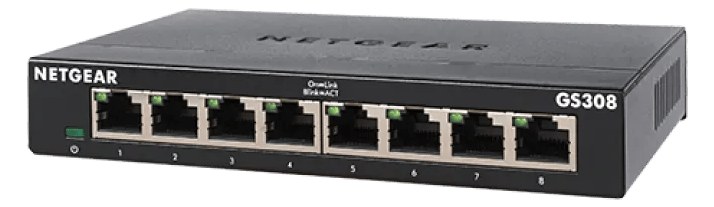
Pick this switch if your network needs are straightforward — a handful of devices, moderate DanteThe most common audio-over-network standard: dozens of channels of uncompressed digital audio down one ordinary Ethernet cable between Dante boxes. channel counts, or a corporate gig where the venue IT team will feel better seeing a Cisco logo than a no-name white box. Pass on it if you're running high-density Dante with multiple domains, or if you need to enforce network segmentation between audio and control data — in that case, step up to a managed switchA network switch you can configure — VLANs, QoS, IGMP — so audio traffic gets priority. Dante rigs beyond a few boxes want one. with QoSQuality of Service — switch settings that let time-critical packets (like Dante’s clock) jump the queue ahead of bulk traffic. configuration. For a clean, uncomplicated IEMIn-Ear Monitor — earpieces that replace floor wedges, feeding each player their own mix. The reason this whole rack exists. rig where network reliability matters more than network configurability, this earns its half-rackThe standard slice of rack height: 1U = 1.75″. A 3U box takes three slices; half-rack gear pairs two units side by side in one. shelf space without argument.
In the rack
- Mount it on a half-rackThe standard slice of rack height: 1U = 1.75″. A 3U box takes three slices; half-rack gear pairs two units side by side in one. shelf toward the rear of the rack — you rarely need to touch an unmanaged switch mid-show, so save front-panel real estate for gear you actually interact with.
- Label each port at patch time with a strip of colored tape or a label maker: laptop, wireless hub, stage boxThe I/O endpoint on stage: mics plug in there and one digital line (AES50, Dante) carries everything to the console. The snake, digitized., and so on. With no management interface, visual identification at the switch itself is your only troubleshooting aid under pressure.
- Run this switch off your conditioned rack power, not a wall wart dangling outside the rack — losing network mid-show because someone kicked a plug is an avoidable problem at 6 watts.
- At corporate venues with in-house IT infrastructure, having Cisco on your switch often removes a friction point when you need to plug into their backbone — it's a recognized name in IT conversations that a generic switch isn't.
Unmanaged 8-port gigabit desktop switch — requires rack shelf to mount.
I/O Ports (9)
| Port | Connector | Direction | Signal | Channels |
|---|---|---|---|---|
| Ethernet 1 | RJ45 | bidirectional | data | — |
| Ethernet 2 | RJ45 | bidirectional | data | — |
| Ethernet 3 | RJ45 | bidirectional | data | — |
| Ethernet 4 | RJ45 | bidirectional | data | — |
| Ethernet 5 | RJ45 | bidirectional | data | — |
| Ethernet 6 | RJ45 | bidirectional | data | — |
| Ethernet 7 | RJ45 | bidirectional | data | — |
| Ethernet 8 | RJ45 | bidirectional | data | — |
- DC In (12V) (DC BARREL)
Requires
This component depends on the following gear to function in a typical rig:
Deciding between two?
Rack space, watts, weight and every connector, side by side.
Related gear


Related articles
Guides from our library that cover planning around network switch gear.