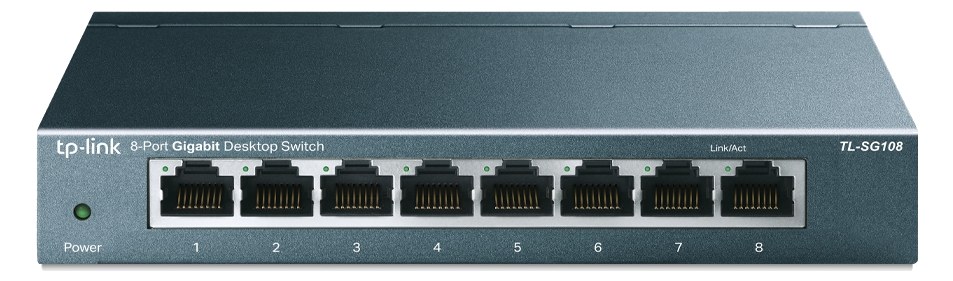
The TP-Link SG108 is an inexpensive unmanaged gigabit switch that works well for simple Dante or control network setups where you just need to connect a few devices. Its tiny desktop form factor fits easily in a rack drawer or on a shelf, and it requires zero configuration. While it lacks the QoS and VLAN features of managed switches, it handles small Dante networks reliably when traffic is minimal.
01 · What it does—and what that changes in your rig.
Product overview
Start with the payoff, then work through how it functions, where it fits, and the details that change a real build.
The payoff
Network Switch decisions, organized around the whole rig.
The TL-SG108 is an unmanaged eight-port gigabit switch — the kind of piece that quietly holds a small network together without asking anything of you. In a live-audio rack its job is simple: give your DanteThe most common audio-over-network standard: dozens of channels of uncompressed digital audio down one ordinary Ethernet cable between Dante boxes. devices, a laptop, a wireless system, or a remote control app somewhere to talk to each other. It draws 5 watts at most, weighs next to nothing at 300 grams, and at $24 it's genuinely disposable enough to carry a spare. That price point tells you exactly what tier of rig this belongs in.
Documented outputs
00 destination connections
Documented inputs
1Based on documented inputs
Rack space
1U · half-rackBuilder checks available rail space
TP-Link product panel1U · half-rack · 4W
Function
How it works in the path
Unmanaged means plug-and-play and nothing else. There is no web interface, no QoSQuality of Service — switch settings that let time-critical packets (like Dante’s clock) jump the queue ahead of bulk traffic. configuration, no VLANVirtual LAN — slicing one physical switch into separate isolated networks, like keeping Dante away from lighting and guest WiFi. tagging — the switch forwards traffic and that's the entire feature set. For a small DanteThe most common audio-over-network standard: dozens of channels of uncompressed digital audio down one ordinary Ethernet cable between Dante boxes. network carrying a handful of channels between a stageboxThe I/O endpoint on stage: mics plug in there and one digital line (AES50, Dante) carries everything to the console. The snake, digitized. and a console, or a control network linking a few wireless receivers to a laptop, that's often enough. Where it breaks down is under heavier multicastOne network stream delivered to many receivers at once — efficient for audio networks, but it needs IGMP snooping to stay polite. load: without IGMP snoopingThe switch feature (IGMP snooping) that keeps multicast audio streams from flooding every port on the network., all Dante multicast floods every port, which on a larger network chews into headroomThe margin between your normal level and where things clip — headroom is what absorbs the snare hit you didn’t see coming. fast. Keep your device count modest — think four to six Dante endpoints max — and this switch handles the job cleanly. The 100mm depth is genuinely short, which matters when rack real estate is tight.
Best fit
Where it earns its place in the rack
Pick this switch if you're running a small IEMIn-Ear Monitor — earpieces that replace floor wedges, feeding each player their own mix. The reason this whole rack exists. or playback rig where the network is a convenience layer — remote control, a channel or two of DanteThe most common audio-over-network standard: dozens of channels of uncompressed digital audio down one ordinary Ethernet cable between Dante boxes., maybe timecodeA clock signal (SMPTE) shared between systems so playback, lights, and video all chase the same position in the song. over IP — and managed features would be overkill for the gig. It's also a solid choice as a dedicated control-only network isolated from your main Dante infrastructure. Skip it if you're routing double-digit Dante channels, mixing multicastOne network stream delivered to many receivers at once — efficient for audio networks, but it needs IGMP snooping to stay polite.-heavy workflows, or need any level of traffic prioritization. For those situations, a managed switchA network switch you can configure — VLANs, QoS, IGMP — so audio traffic gets priority. Dante rigs beyond a few boxes want one. with IGMP snoopingThe switch feature (IGMP snooping) that keeps multicast audio streams from flooding every port on the network. — a Cisco SG series or similar — is worth every extra dollar. The TL-SG108 is a tool for the right job, not a budget shortcut for a job that needs more.
In the rack
Details worth deciding before load-in.
This is a desktop unit, not a rackmount — you'll need a rack shelf or drawer to mount it cleanly. A half-rackThe standard slice of rack height: 1U = 1.75″. A 3U box takes three slices; half-rack gear pairs two units side by side in one. shelf paired with a small power strip keeps the footprint to one rack unit.
Use a short patch of colored electrical tape or a label maker on each port at load-in. With eight identical unlabeled RJ45s, tracing a loose cable in low stage light is slower than it needs to be.
Dedicate this switch to one function — either DanteThe most common audio-over-network standard: dozens of channels of uncompressed digital audio down one ordinary Ethernet cable between Dante boxes. audio or control network, not both. Mixing Dante multicastOne network stream delivered to many receivers at once — efficient for audio networks, but it needs IGMP snooping to stay polite. with laptop control and wireless management traffic on the same unmanaged switch removes your ability to troubleshoot cleanly if something misbehaves.
Power it from a switched outlet on your rack conditioner so it cycles cleanly with the rest of the rig. Leaving a network switch on while everything else reboots can cause devices to lock onto stale network state.
02 · Know the whole path before you buy.
Signal path
Learn the route as a block diagram: source, product function, transport, and destination. Select any block to see what enters, what changes, and what leaves.
Interactive block diagramAuto-looping · hover, focus, or tap to hold a stage
Port-type signalProduct functionSystem boundary
Follow one signal from source to destination
Each block answers the same three questions: what arrives, what changes here, and what leaves.
01 · Source · selected
dc barrel
RJ45
01 · Source
1 documented input
dc barrel
Arrives as
1 documented input
Connector
dc barrel
Signal
power
03 · What this product asks of the rest of the system.
Compatibility
Treat connector names as the start of the check—not the answer. These are the boundaries that determine a complete working path.
Best fit · Network Switch
Use it when 1U · half-rack and 100 mm of depth fit the case.
Companion gear required
Plan Penn Elcom 1U Half-Rack Shelf before treating this path as complete.
Connector boundary
Documented connectors: RJ45, dc barrel. Match connector, direction, and signal type—not shape alone.
04 · Every connector, grouped by job.
I/O ports
Switch the product view and the documented port inventory updates with it—hardware and data stay side by side.
Every connector, grouped by job.
Switch panels to keep the hardware view and the documented port list in sync.
Front panelRear panel
All documented ports for TP-Link TL-SG108 8-Port Switch
Port
Panel
Connector
Direction
Signal
Channels
Ethernet 1
rear
RJ45
bidirectional
data
—
Ethernet 2
rear
RJ45
bidirectional
data
—
Ethernet 3
rear
RJ45
bidirectional
data
—
Ethernet 4
rear
RJ45
bidirectional
data
—
Ethernet 5
rear
RJ45
bidirectional
data
—
Ethernet 6
rear
RJ45
bidirectional
data
—
Ethernet 7
rear
RJ45
bidirectional
data
—
Ethernet 8
rear
RJ45
bidirectional
data
—
DC In (9V)
rear
dc barrel
input
power
—
Showing 9 of 9 documented physical ports.
05 · Compare the decision, not just the price.
Alternatives
The rows are organized around fit, power, I/O, and system role so a cheaper unit cannot hide a more expensive workflow.
TL-SG108The TP-Link SG108 is an inexpensive unmanaged gigabit switch that works well for simple Dante or control network setups where you just need to connect a few devices. Its tiny desktop form factor fits easily in a rack drawer or on a shelf, and it requires zero configuration. While it lacks the QoS and VLAN features of managed switches, it handles small Dante networks reliably when traffic is minimal.View gear →
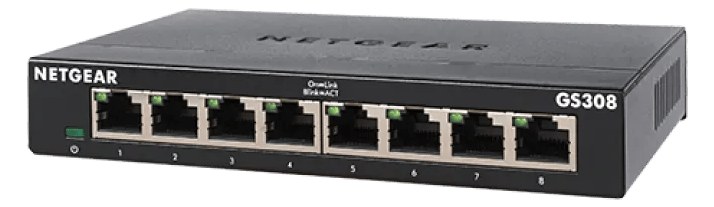
GS308The Netgear GS308 is another solid budget option for simple networking needs in a small audio rig. It provides eight gigabit ports in a metal desktop chassis that is compact enough to velcro inside a rack or place on a shelf. Like other unmanaged switches, it is plug-and-play with no configuration needed, making it ideal for basic device interconnection when you do not need advanced network management.View gear →
Placement is only the start. Builder checks space · depth · weight, power headroom, dependencies, and compatible signal paths around this exact catalog item.Open in Builder