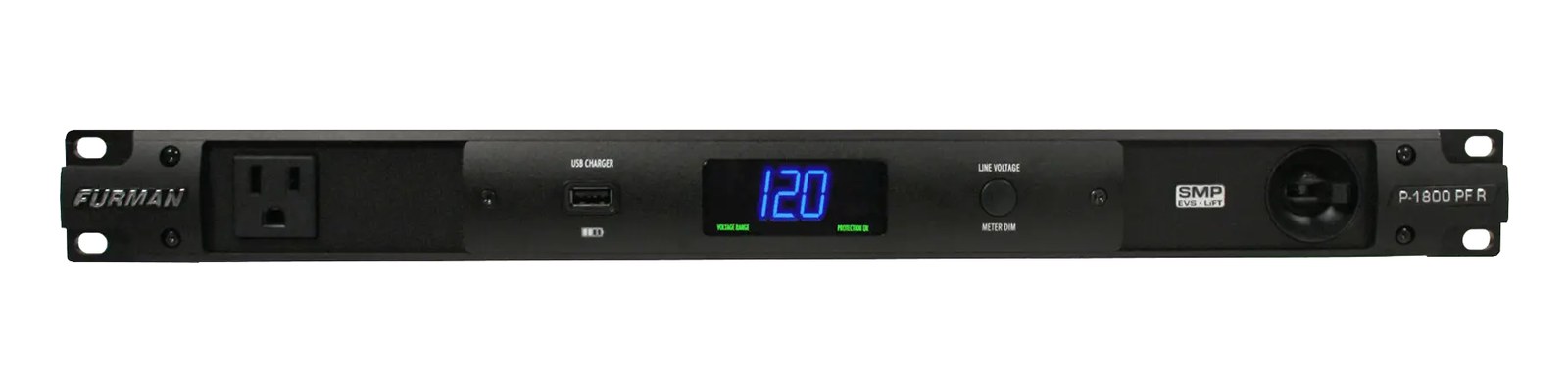

Furman P-1800 AR Voltage Regulator
Furman·Model P-1800 AR·furman-p1800-ar
About the Furman P-1800 AR
The Furman P-1800 AR is a voltage regulatorActively holds the output at a steady 120 V while venue power sags or spikes — a step beyond filtering, one short of a battery. that actively corrects incoming AC voltage to a stable output, protecting your gear from the wildly varying power conditions found at outdoor festivals, older venues, and generator-powered stages. Unlike a basic power conditionerFilters venue AC, clamps surges, and gives the rack one tidy inlet. Not a voltage regulator and not a battery — just cleaner power., it continuously adjusts voltage rather than just filtering noise, which prevents equipment malfunctions caused by under- or over-voltage. Essential for touring rigs that encounter unpredictable power sources regularly.
The Furman P-1800 AR is not a power conditionerFilters venue AC, clamps surges, and gives the rack one tidy inlet. Not a voltage regulator and not a battery — just cleaner power. in the everyday sense — it is an active voltage regulatorActively holds the output at a steady 120 V while venue power sags or spikes — a step beyond filtering, one short of a battery., and that distinction matters enormously when you are standing in a festival tent on generator power or patching into a 40-year-old venue panel that nobody has touched since the Carter administration. Where a standard conditioner filters noise and calls it a day, the P-1800 AR continuously monitors incoming voltage and actively corrects it, delivering a stable output regardless of what the wall is doing. For a touring IEMIn-Ear Monitor — earpieces that replace floor wedges, feeding each player their own mix. The reason this whole rack exists. or playback rig, that is the difference between a show and a very expensive paperweight.
Thirteen and a half kilograms in a single rack unitThe standard slice of rack height: 1U = 1.75″. A 3U box takes three slices; half-rack gear pairs two units side by side in one. tells you this is not a lightweight filtering strip with a nicer faceplate — there is real transformerA magnetic coupling that passes audio between two windings with no wire contact — isolates splits and kills ground-loop hum, no power needed. iron in here doing real work. The unit draws no meaningful power of its own and passes up to 15 amps downstream across eight rear NEMA outlets, which is enough to supply a fully loaded IEMIn-Ear Monitor — earpieces that replace floor wedges, feeding each player their own mix. The reason this whole rack exists. rack cleanly. At load-in, the practical value is immediate: plug it in, watch your downstream gear come up stable, and stop worrying about whether the house electrician's idea of 120 volts matches yours. At show time, if the generator load shifts mid-set, the regulator absorbs that variation before your Shure PSM or Aviom system ever sees it.
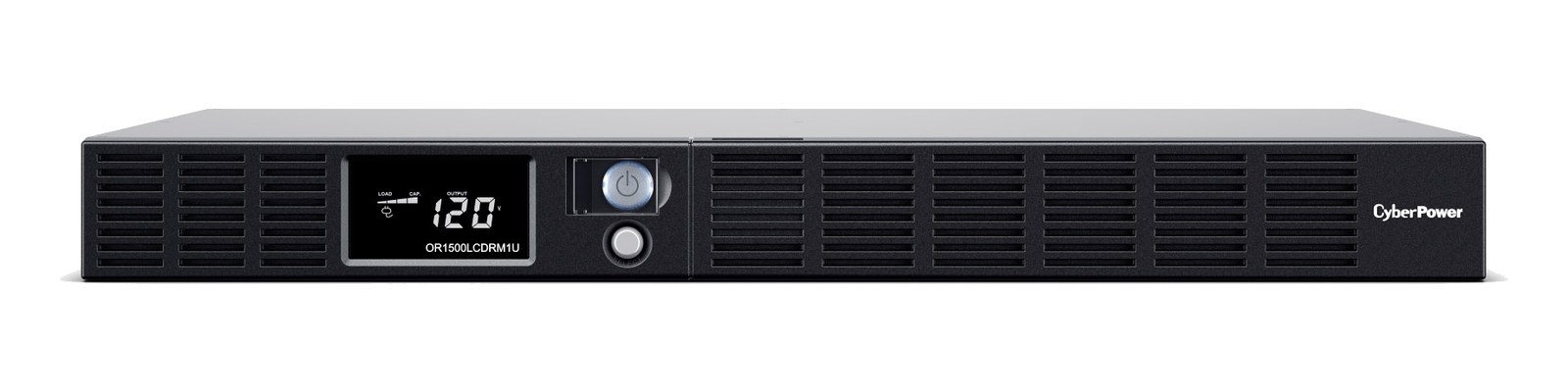
This unit belongs in any touring rack that regularly visits venues where power quality is a known gamble — outdoor festivals, amphitheaters on long generator runs, international touring where voltage swings are common even on 120V-compatible supplies, or any rig where a single unexplained reboot mid-show is unacceptable. If your rig lives permanently in a well-maintained install with clean, stable utility power, the P-1800 AR is more than you need and the $1,099 is better spent elsewhere. Also be clear about what it is not: this is not a UPSUninterruptible Power Supply — a battery that rides the rig through brownouts and generator hiccups so computers never reboot mid-song., so a hard power cut will still drop your rig instantly — pair it with a UPS upstream if blackout protection is also a requirement.
In the rack
- Position it at the bottom of the rack rather than the top — at nearly 14 kg it improves rolling stability and keeps the center of gravity low, which matters when you are wrestling the case up a ramp.
- Budget your downstream load carefully: 15 amps at 120V gives you roughly 1,800 watts total. Add up the actual draw of every device on those eight outlets before load-in so you are not hunting a tripped breaker during soundcheck.
- On generator-powered stages, give the P-1800 AR a few minutes after power-up before bringing sensitive digital gear online — let the regulator stabilize the output first, especially if the generator is still warming up and hunting for its idle.
- If you are also running a UPSUninterruptible Power Supply — a battery that rides the rig through brownouts and generator hiccups so computers never reboot mid-song. for blackout protection, put the UPS upstream of the P-1800 AR so the regulator is always seeing clean, stable UPS output rather than forcing the UPS to correct a swinging input on its own.
15A voltage regulatorActively holds the output at a steady 120 V while venue power sags or spikes — a step beyond filtering, one short of a battery./power conditionerFilters venue AC, clamps surges, and gives the rack one tidy inlet. Not a voltage regulator and not a battery — just cleaner power. with stable AC output.
I/O Ports (10)
- Power In (NEMA) (NEMA 5 15)
- AC Out Rear (8x NEMA) (NEMA 5 15)
- AC Out Rear 1 (NEMA 5 15)
- AC Out Rear 2 (NEMA 5 15)
- AC Out Rear 3 (NEMA 5 15)
- AC Out Rear 4 (NEMA 5 15)
- AC Out Rear 5 (NEMA 5 15)
- AC Out Rear 6 (NEMA 5 15)
- AC Out Rear 7 (NEMA 5 15)
- AC Out Rear 8 (NEMA 5 15)
Related gear


Related articles
Guides from our library that cover planning around ups gear.
How to budget power for an audio rack, why a power conditioner is not a UPS, and the practical math that keeps you from blowing a 15A circuit mid-show.
How to build an IEM rack: choosing case size and depth, ordering gear by weight and heat, power sequencing rules, wiring practice, and a pre-show checklist.