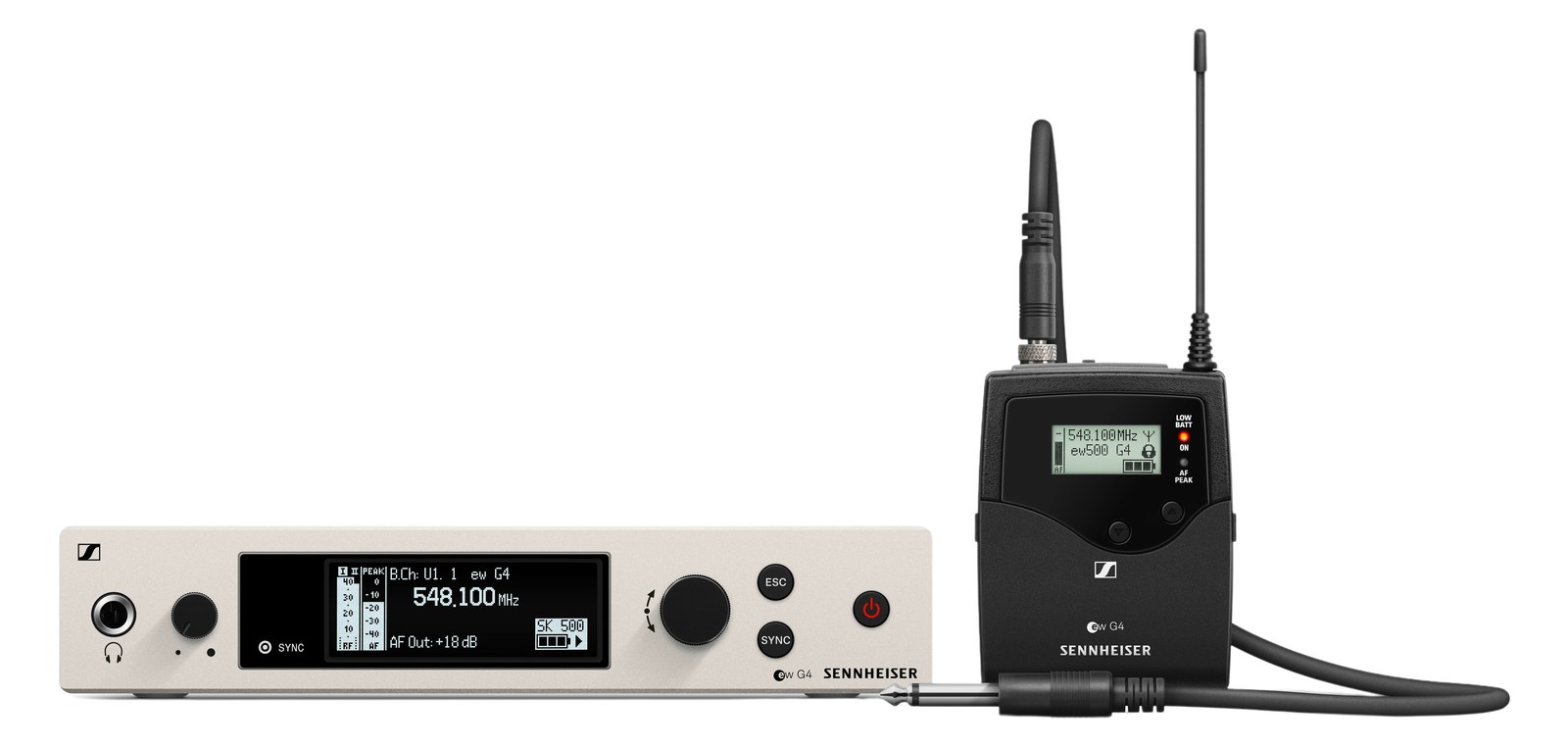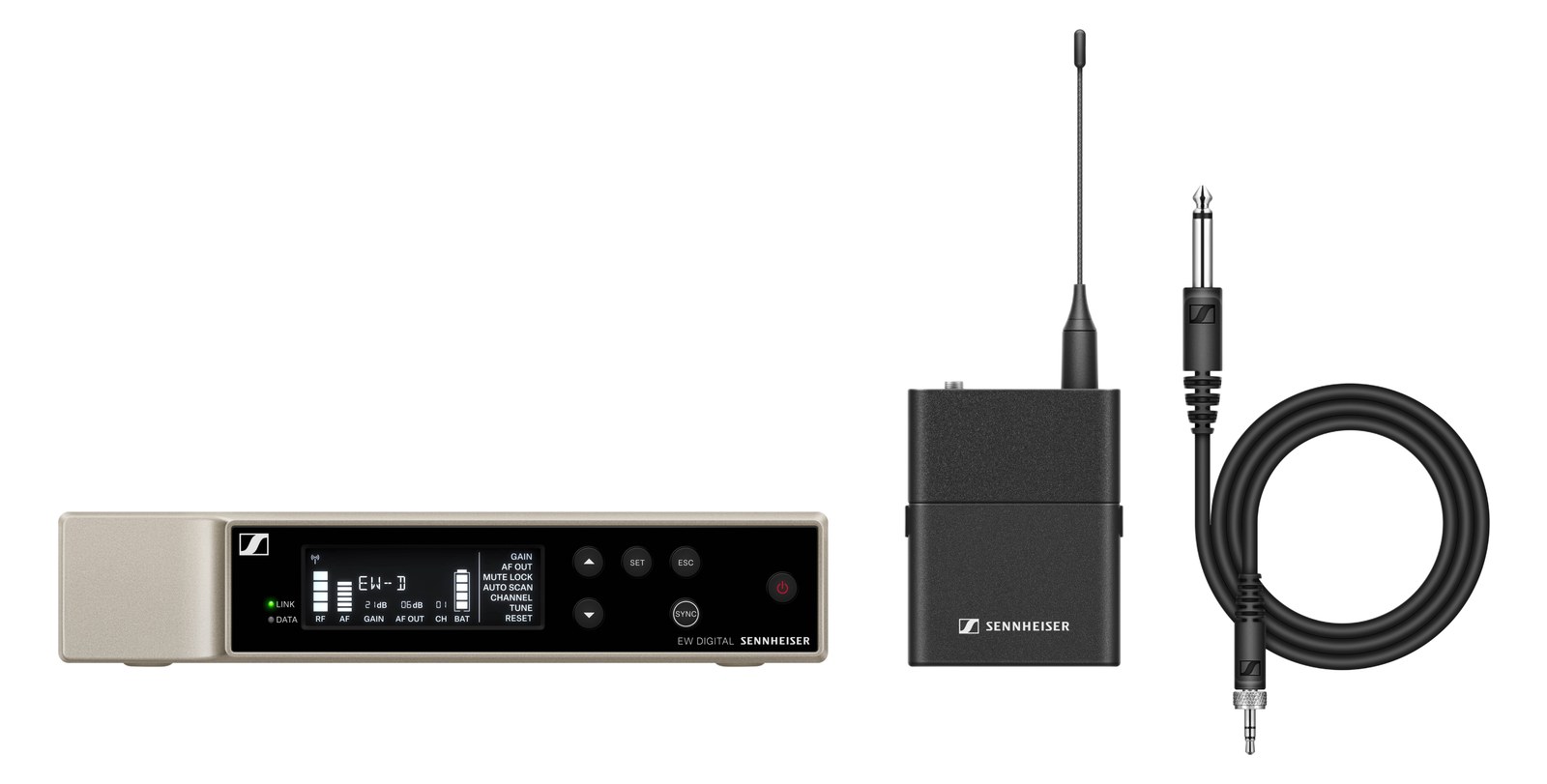

Shure ULXD4D Dual Wireless Receiver
Shure·Model ULXD4D·shure-ulxd4d-g50
Photos
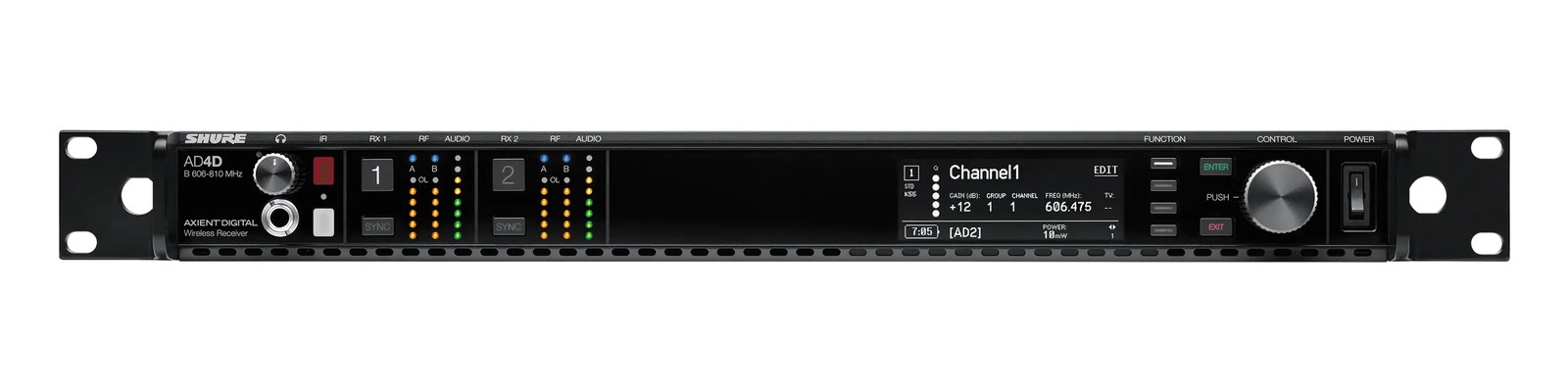
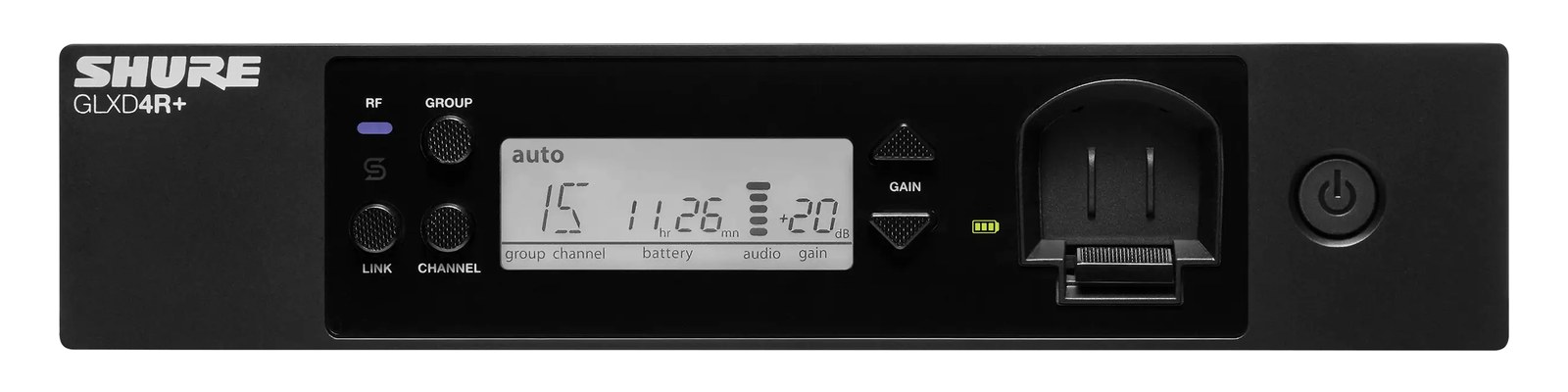
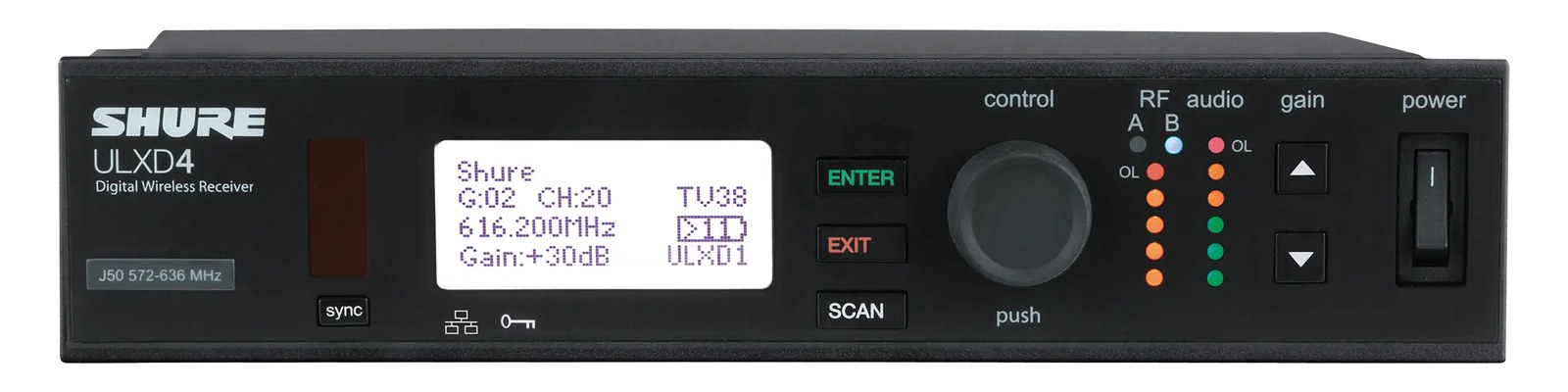
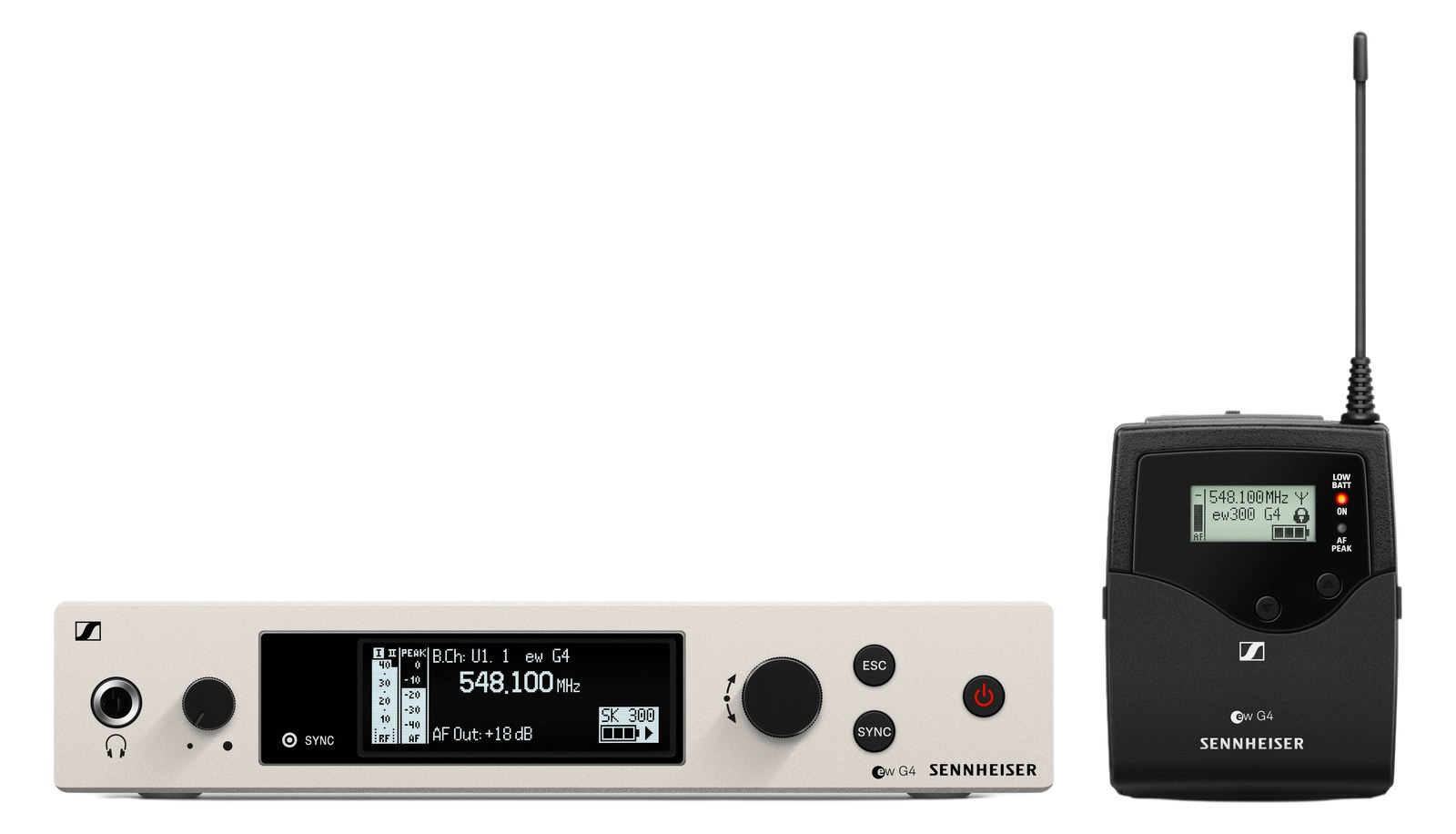
Manufacturer product photography — the drawn faceplate above stays true to panel layout; these show the hardware itself.
About the Shure ULXD4D
The Shure ULXD4D puts two ULX-D receivers in a single full-rack unitThe standard slice of rack height: 1U = 1.75″. A 3U box takes three slices; half-rack gear pairs two units side by side in one., halving the rack space needed for multi-channel wireless guitar or instrument deployments. Available DanteThe most common audio-over-network standard: dozens of channels of uncompressed digital audio down one ordinary Ethernet cable between Dante boxes. output lets you route the wireless audio directly onto your network without analog conversion, simplifying signal flow in Dante-based rigs. This is the efficient choice when you need two wireless instrument channels and want to minimize rack footprint.
The ULXD4D is Shure's answer to the two-channel wireless problem in a single rack unitThe standard slice of rack height: 1U = 1.75″. A 3U box takes three slices; half-rack gear pairs two units side by side in one.: two full ULX-D receivers sharing one 1U panel, each with its own XLRThe standard 3-pin locking connector for mics and balanced line signals — pin 1 is the shield, pins 2 and 3 carry the balanced pair. and quarter-inch output, independent antenna inputs, and a shared DanteThe most common audio-over-network standard: dozens of channels of uncompressed digital audio down one ordinary Ethernet cable between Dante boxes. port for network routing. In a touring instrument rig — two guitars trading off, a bass and a guitar running simultaneously, or any configuration where you need two discrete wireless channels without burning two rack slots — this is the efficient path. It sits in the ULX-D family, which sits above the SLX-D and below the Axient Digital in Shure's wireless hierarchy: professional-grade digital audio with solid RFRadio Frequency — the wireless part of wireless. RF planning is why big rigs scan, coordinate, and combine antennas instead of hoping. performance, not entry-level.
At load-in, the two BNCThe twist-lock coax connector used for word clock and antenna runs — it locks, so it can’t be pulled out mid-show. antenna inputs mean you're splitting or distributing your antenna signal across both channels, so plan your antenna placement and any active distribution accordingly — a single pair of paddlesA directional antenna (paddle, LPDA, helical) aimed at the stage — focuses coverage where the performers are and rejects RF from elsewhere. won't automatically serve both channels without a splitter. The dual XLRThe standard 3-pin locking connector for mics and balanced line signals — pin 1 is the shield, pins 2 and 3 carry the balanced pair. outputs mean you're patching two discrete lines to your console or snakeA multicore cable bundling many channels into one stage-to-console run. A sub-snake collects one corner of the stage into a drop box., which is clean and unambiguous. The DanteThe most common audio-over-network standard: dozens of channels of uncompressed digital audio down one ordinary Ethernet cable between Dante boxes. port is a real advantage in network-audio rigs: both channels can travel a single Ethernet cable to your Dante ecosystem, eliminating two analog runs entirely. At 18–22 watts draw and 1.8 kg, it's light and easy on your power strip, and 220 mm depth fits standard shallow rack cases without drama.
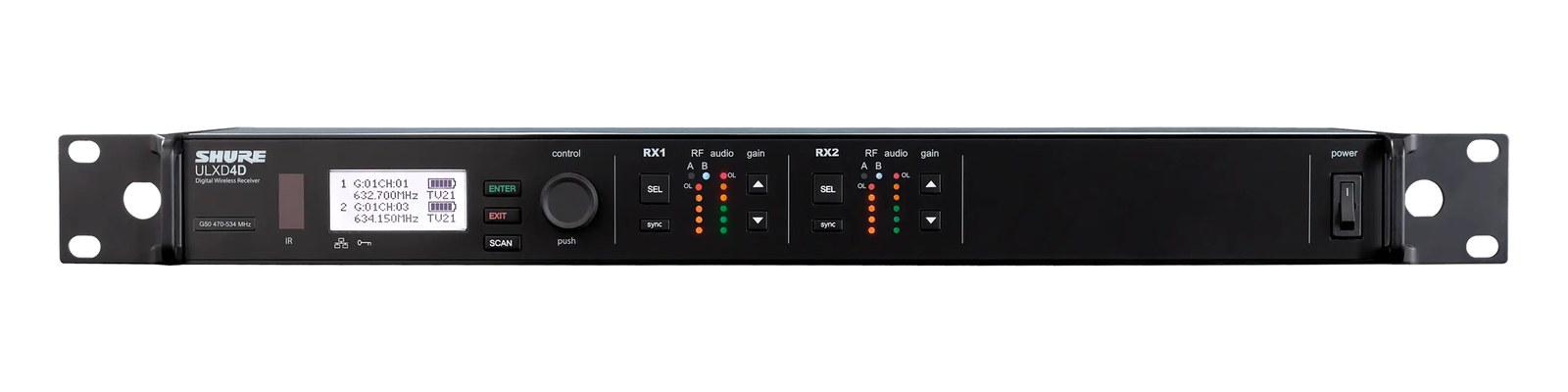
Pick the ULXD4D if you need exactly two wireless instrument channels, want to stay in the ULX-D ecosystem, and care about rack efficiency. If you're running three or more channels, you'll either stack a second unit or look at the ULXD4Q quad receiver instead. If you're deep in an Axient Digital rig and need ShowLink remote management or the tighter frequency agility of that system, the ULXD4D won't match it — the ULX-D line doesn't include those features. And if you only need one channel, the half-rackThe standard slice of rack height: 1U = 1.75″. A 3U box takes three slices; half-rack gear pairs two units side by side in one. single-channel ULXD4 frees up space for something else.
In the rack
- If you're not running DanteThe most common audio-over-network standard: dozens of channels of uncompressed digital audio down one ordinary Ethernet cable between Dante boxes., label the XLRThe standard 3-pin locking connector for mics and balanced line signals — pin 1 is the shield, pins 2 and 3 carry the balanced pair. outputs clearly at patch — 'WL1' and 'WL2' rather than generic channel numbers — so the A2 can trace a dropoutA brief audio gap when the radio link fails — the thing diversity, distros, and coordination all exist to prevent. to the right receiver instantly in the dark.
- Both BNCThe twist-lock coax connector used for word clock and antenna runs — it locks, so it can’t be pulled out mid-show. antenna inputs need signal: use an active antenna splitter/distributor if your antenna run is shared across other receivers in the rack, rather than running a passive split that eats gainHow much the preamp amplifies the incoming signal. Too low and you’re hunting through hiss; too high and peaks clip..
- The DanteThe most common audio-over-network standard: dozens of channels of uncompressed digital audio down one ordinary Ethernet cable between Dante boxes. port carries both channels on one cable — in a Dante rig, tie it directly to your network switch and patch both channels in Dante Controller before doors open, so there's no analog snakeA multicore cable bundling many channels into one stage-to-console run. A sub-snake collects one corner of the stage into a drop box. run to troubleshoot mid-show.
- Place it so the front-panel RFRadio Frequency — the wireless part of wireless. RF planning is why big rigs scan, coordinate, and combine antennas instead of hoping. meters for both channels are visible from your working position; catching a channel drop to one bar before it becomes an audio dropoutA brief audio gap when the radio link fails — the thing diversity, distros, and coordination all exist to prevent. is the whole point of having the meters there.
ULX-D dual-channel digital wireless receiver. DanteThe most common audio-over-network standard: dozens of channels of uncompressed digital audio down one ordinary Ethernet cable between Dante boxes. output available.
I/O Ports (11)
| Port | Connector | Direction | Signal | Channels |
|---|---|---|---|---|
| XLR Out 1 | XLR MALE | output | analog audio | — |
| XLR Out 2 | XLR MALE | output | analog audio | — |
| 1/4" Out 1 (retired — no such jack) | TRS QUARTER | output | analog audio | — |
| 1/4" Out 2 (retired — no such jack) | TRS QUARTER | output | analog audio | — |
| Antenna A | BNC | input | antenna | — |
| Antenna B | BNC | input | antenna | — |
| Antenna A Cascade Out | BNC | output | antenna | — |
| Antenna B Cascade Out | BNC | output | antenna | — |
| Dante/Ethernet Primary | DANTE RJ45 | bidirectional | digital audio | 2 |
| Dante/Ethernet Secondary | DANTE RJ45 | bidirectional | digital audio | 2 |
- Power (IEC) (IEC C14)
Deciding between two?
Rack space, watts, weight and every connector, side by side.
Related gear


Related articles
Guides from our library that cover planning around wireless guitar gear.