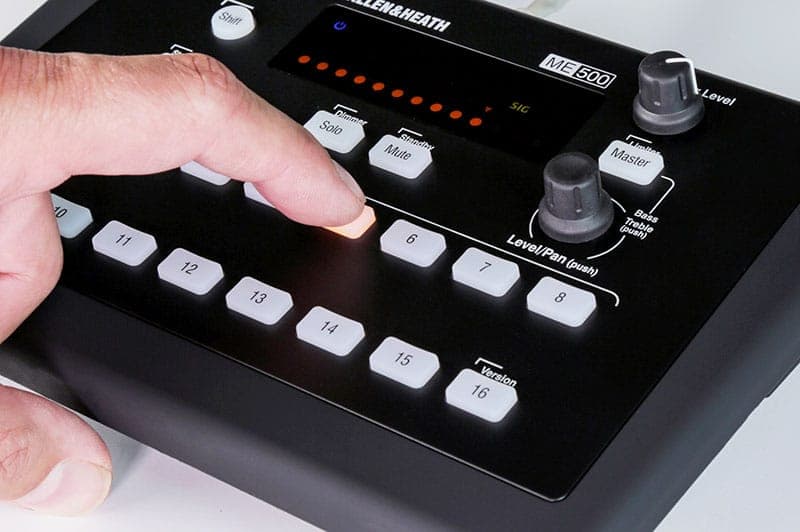
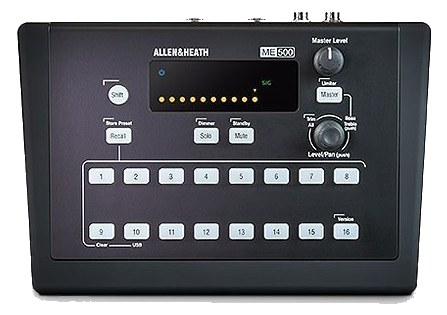
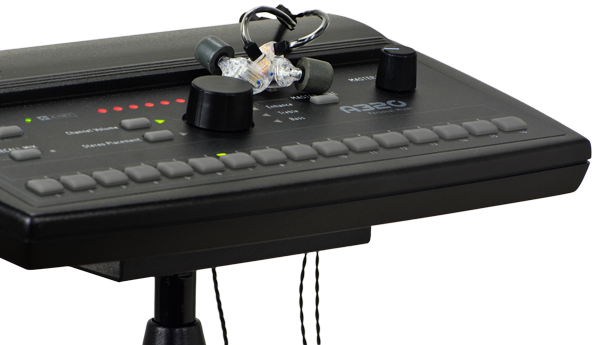
The Allen & Heath ME-500 is a compact personal mixer that pairs with A&H consoles via Monitor Mixer or M-Series mode. Sixteen stereo groups, sliders for level, and per-channel pan give performers full control of their monitor mix on stage. A common pickup for in-ear setups in churches and theaters running A&H consoles.
~$449Use retailer rows for current price and stock
01 · What it does—and what that changes in your rig.
Product overview
Start with the payoff, then work through how it functions, where it fits, and the details that change a real build.
The payoff
Personal Mixer decisions, organized around the whole rig.
The ME-500 is Allen & Heath's answer to the oldest monitor-world argument: musicians want control of their own mix, and monitor engineers want them to have exactly as much control as they can handle. Sixteen one-touch keys, each mapped to a channel or stereo group arriving over the Cat5Standard network cable grades. In an audio rig one cheap Cat5e run can replace a 48-channel copper snake; AES50 wants it shielded.snakeA multicore cable bundling many channels into one stage-to-console run. A sub-snake collects one corner of the stage into a drop box., with level and a master — enough agency for a performer to fix 'more me' themselves, not enough surface to destroy a mix mid-song.
Documented outputs
33 destination connections
Required cable runs
1RJ45
Rack space
Outside rackPlan a shelf, tray, or stage position
Photo: Allen & HeathOutside rack · 5W
Function
How it works in the path
It's happiest inside the A&H ecosystem, fed from an SQ or dLive over the ME-U hub or straight from a console's monitor busA path where multiple channels sum into one signal — mixes, groups, and mains are all buses. A 25-bus console can build 25 blends at once. structure, with the second RJ45 daisy-chaining to the next unit down the line — one Cat5Standard network cable grades. In an audio rig one cheap Cat5e run can replace a 48-channel copper snake; AES50 wants it shielded. run threading a whole stage of them. The stereo quarter-inch outputs drive wired ears or a wedgeA floor monitor speaker angled up at the performer — the thing IEMs replace, and the thing you fall back on when they die. amp directly, and when fed from an ME-U hub the same Cat5 that carries audio carries power, which is one less wall-wart per performer to lose.
Best fit
Where it earns its place in the system
For rig planning the choice is usually ME-500 versus the bigger ME-1, or versus Behringer's P16 system on mixed-brand rigs. The ME-500's sixteen keys cover a band's worth of stemsSub-mixes of a session grouped by instrument (drums, keys, vocals) — how playback rigs run tracks with live control over each group. cleanly; if your performers genuinely mix — EQ, pans, per-channel rides — the ME-1's screen and 40 sources justify the step up.
In the rack
Details worth deciding before load-in.
Feed from an ME-U hub for power-over-Cat5Standard network cable grades. In an audio rig one cheap Cat5e run can replace a 48-channel copper snake; AES50 wants it shielded. — no local supplies taped under mic stands.
Daisy-chain the second RJ45 to the next mixer; home-run only where a chain failure would take out multiple performers.
Send stemsSub-mixes of a session grouped by instrument (drums, keys, vocals) — how playback rigs run tracks with live control over each group., not raw channels — sixteen well-chosen groups beat sixteen arbitrary inputs.
02 · Know the whole path before you buy.
Signal path
Learn the route as a block diagram: source, product function, transport, and destination. Select any block to see what enters, what changes, and what leaves.
Interactive block diagramAuto-looping · hover, focus, or tap to hold a stage
Port-type signalProduct functionSystem boundary
Follow one signal from source to destination
Each block answers the same three questions: what arrives, what changes here, and what leaves.
01 · Source · selected
RJ45
RJ45
RJ45 + ¼-inch TRS
01 · Source
1 documented input
RJ45
Arrives as
1 documented input
Connector
RJ45
Signal
digital audio
03 · What this product asks of the rest of the system.
Compatibility
Treat connector names as the start of the check—not the answer. These are the boundaries that determine a complete working path.
Best fit · Personal Mixer
Use it as personal mixer tracked outside rack rails; follow the manufacturer’s mounting and form-factor guidance.
Plan the companion path
Complete the path with upstream and downstream gear that matches connector, direction, signal type, protocol, and wiring standard.
Protocol boundary
This product declares SLINK; matching plugs alone do not make other protocols compatible.
04 · Every connector, grouped by job.
I/O ports
Switch the product view and the documented port inventory updates with it—hardware and data stay side by side.
Every connector, grouped by job.
Switch panels to keep the hardware view and the documented port list in sync.
Front panelRear panel
All documented ports for Allen & Heath ME-500 Personal Mixer
Port
Panel
Connector
Direction
Signal
Channels
Cat5e In
rear
RJ45
input
digital audio
—
Cat5e Thru
rear
RJ45
output
digital audio
—
Headphone Out (1/4")
rear
¼-inch TRS
output
analog audio
—
Line Out (1/4")
rear
¼-inch TRS
output
analog audio
—
Showing 4 of 4 documented physical ports.
05 · Compare the decision, not just the price.
Alternatives
The rows are organized around fit, power, I/O, and system role so a cheaper unit cannot hide a more expensive workflow.
ME-500The Allen & Heath ME-500 is a compact personal mixer that pairs with A&H consoles via Monitor Mixer or M-Series mode. Sixteen stereo groups, sliders for level, and per-channel pan give performers full control of their monitor mix on stage. A common pickup for in-ear setups in churches and theaters running A&H consoles.View gear →
A320The Aviom A320 is a 16-channel personal mixer using Aviom's proprietary A-Net protocol, offering musicians hands-on control of their monitor mix. It has been a staple in worship and theater environments for years and works with any console that has an Aviom output card or a standalone A-Net distribution hub. The build quality and tactile controls make it feel more professional than budget alternatives.View gear →
P16-MThe Behringer P16-M gives each musician independent control over their 16-channel monitor mix via Ultranet digital audio over a single Cat5 cable. It is the most affordable personal mixing solution available and integrates directly with Behringer/Midas X32 and M32 consoles. Ideal for smaller acts and worship environments where musicians want to dial in their own IEM mix without relying on the engineer.View gear →
06 · Resolve the questions that can change the purchase or build plan.
Planning questions
Short, source-backed answers surface rack fit, power, cabling, and connection details before they become surprises.
Where does the Allen & Heath ME-500 Personal Mixer live in a complete rig?
The catalog assigns it no rack units. Builder tracks it as non-rack gear; follow the manufacturer’s mounting, case, and form-factor guidance.
How much power does the Allen & Heath ME-500 Personal Mixer draw?
Typical draw is 5W and documented maximum draw is 8W.
What connections does the Allen & Heath ME-500 Personal Mixer have?
4 documented physical ports, including Cat5e In, Cat5e Thru, Headphone Out (1/4"), Line Out (1/4").
07 · See this gear inside a complete system plan.
Builder preview
Builder keeps non-rack gear in the same bill of materials, budget, dependency, and connection plan as the rack-mounted system around it.Open in Builder