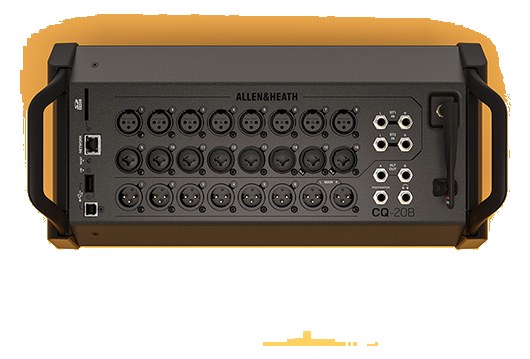
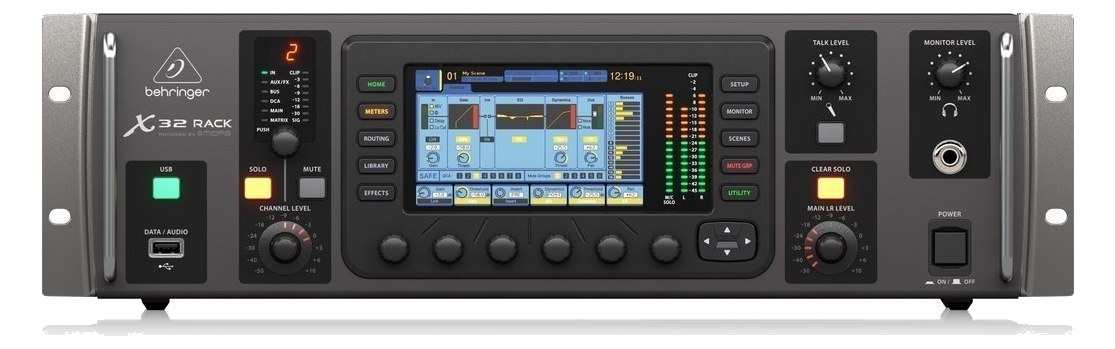
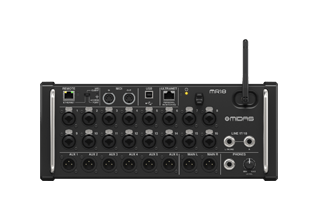
The Allen & Heath CQ-20B squeezes 96kHz mixing, sixteen preamps, onboard SD multitrack, and Wi-Fi/Bluetooth control into a compact box that racks in 2U with its kit. Gain assistant and auto-mixing make it the current favorite for self-mixed IEM bands who want A&H sound without an engineer. The modern answer to the XR18 generation.
~$1,000Use retailer rows for current price and stock
01 · What it does—and what that changes in your rig.
Product overview
Start with the payoff, then work through how it functions, where it fits, and the details that change a real build.
The payoff
Digital Mixer decisions, organized around the whole rig.
The CQ-20B is Allen & Heath's answer to the self-sufficient touring band: a 2UThe standard slice of rack height: 1U = 1.75″. A 3U box takes three slices; half-rack gear pairs two units side by side in one. rackmount digital mixer with sixteen combo preampsThe gain stage that lifts a mic’s tiny signal up to line level — the first thing a signal hits, and a big part of how a console sounds., six analog outputs, and onboard Wi-Fi and Bluetooth control — no engineer required at front of houseFront Of House — the main mix the audience hears, and the console position out in the room where it gets mixed.. It slots into an IEMIn-Ear Monitor — earpieces that replace floor wedges, feeding each player their own mix. The reason this whole rack exists. rack or a compact playback rig and covers the role of stage-box, mixer, and monitor send all in one box. The 96 kHz sample rateHow many times per second audio is measured when digitized — 48 kHz is the live standard; 96 kHz measures twice as often. is a real differentiator at this price point and this size, and the SD multitrack recording means you can capture every show without a dedicated interface or laptop.
Documented outputs
1111 destination connections
Documented inputs
22Based on documented inputs
Rack space
3UBuilder checks available rail space
Photo: Allen & Heath3U · 40W
Function
How it works in the path
In practice, sixteen preampsThe gain stage that lifts a mic’s tiny signal up to line level — the first thing a signal hits, and a big part of how a console sounds. handle a typical four- to six-piece band with inputs left over for talkbackThe engineer’s mic into the performers’ ears or monitors — talk to the band without leaving the console., a click feed, or a playback source. The six XLRThe standard 3-pin locking connector for mics and balanced line signals — pin 1 is the shield, pins 2 and 3 carry the balanced pair. outputs — main L/R plus outputs 3–6 — give you a stereo house feed and up to four discrete monitor or IEMIn-Ear Monitor — earpieces that replace floor wedges, feeding each player their own mix. The reason this whole rack exists. mixes, which is enough for most self-mixed setups without an additional distribution amp if you're running personal mixers or in-ear packs close to the rack. At 40 W nominal draw and 4.5 kg, it won't stress a small power conditionerFilters venue AC, clamps surges, and gives the rack one tidy inlet. Not a voltage regulator and not a battery — just cleaner power. or a two-person carry. The USB-B port opens 24×22 I/O to a DAWDigital Audio Workstation — the recording and playback software (Logic, Ableton Live, Pro Tools) at the center of a computer rig., so a laptop backup track integration is straightforward.
Best fit
Where it earns its place in the rack
Pick the CQ-20B if you're building a compact IEMIn-Ear Monitor — earpieces that replace floor wedges, feeding each player their own mix. The reason this whole rack exists. rig for a band that self-mixes via the A&H CQ app, or if you need a clean, low-footprint FOHFront Of House — the main mix the audience hears, and the console position out in the room where it gets mixed.-and-monitors solution for smaller venues where running a separate stage boxThe I/O endpoint on stage: mics plug in there and one digital line (AES50, Dante) carries everything to the console. The snake, digitized. and console isn't practical. Skip it if your show demands more than four independent monitor mixes, if you need onboard hardware compression on every channel at mix time without relying on DSPDigital Signal Processing — the number-crunching that does EQ, compression, and effects inside a box. More DSP means more processing at once. routing, or if your crew expects a traditional console surface. Bands stepping up from an XR18 will feel immediately at home; the workflow is cleaner and the preampsThe gain stage that lifts a mic’s tiny signal up to line level — the first thing a signal hits, and a big part of how a console sounds. are a meaningful step forward.
In the rack
Details worth deciding before load-in.
Route outputs 3–6 as your IEMIn-Ear Monitor — earpieces that replace floor wedges, feeding each player their own mix. The reason this whole rack exists. mixes and reserve the main L/R for the house feed — this keeps your gainHow much the preamp amplifies the incoming signal. Too low and you’re hunting through hiss; too high and peaks clip. structure clean and lets you lock the main output level without affecting monitor sends.
Format your SD card in the unit before the first show, not at home, so the CQ-20B's file system expectations are met and multitrack record arms without surprises at soundcheck.
If Wi-Fi is congested at the venue, connect the RJ45 port to a dedicated gigabit switch and run the CQ app over wired Ethernet to a tablet on a long cable — you get the same remote control without fighting the RFRadio Frequency — the wireless part of wireless. RF planning is why big rigs scan, coordinate, and combine antennas instead of hoping. environment.
At only 300 mm deep, the CQ-20B will likely sit shallower than the rest of your rack's gear; use a rack shelf or rear support rail to avoid stress on the rack earsThe flanges that bolt gear to the rack rails. Desktop boxes without them need a shelf, tray, or drawer to live in the case. during transport.
02 · Know the whole path before you buy.
Signal path
Learn the route as a block diagram: source, product function, transport, and destination. Select any block to see what enters, what changes, and what leaves.
Interactive block diagramAuto-looping · hover, focus, or tap to hold a stage
Port-type signalProduct functionSystem boundary
Follow one signal from source to destination
Each block answers the same three questions: what arrives, what changes here, and what leaves.
01 · Source · selected
XLR female + XLR/TRS combo
RJ45
XLR male + ¼-inch TRS
01 · Source
22 documented inputs
XLR female + XLR/TRS combo
Arrives as
22 documented inputs
Connector
XLR female + XLR/TRS combo
Signal
analog audio
03 · What this product asks of the rest of the system.
Compatibility
Treat connector names as the start of the check—not the answer. These are the boundaries that determine a complete working path.
Best fit · Digital Mixer
Use it when 3U and 154 mm of depth fit the case.
Plan the companion path
Complete the path with upstream and downstream gear that matches connector, direction, signal type, protocol, and wiring standard.
Connector boundary
Documented connectors: XLR female, XLR/TRS combo, XLR male, ¼-inch TRS. Match connector, direction, and signal type—not shape alone.
04 · Every connector, grouped by job.
I/O ports
Switch the product view and the documented port inventory updates with it—hardware and data stay side by side.
Every connector, grouped by job.
Switch panels to keep the hardware view and the documented port list in sync.
Front panelRear panel
All documented ports for Allen & Heath CQ-20B
Port
Panel
Connector
Direction
Signal
Channels
INPUT 1
front
XLR female
input
analog audio
—
INPUT 2
front
XLR female
input
analog audio
—
INPUT 3
front
XLR female
input
analog audio
—
INPUT 4
front
XLR female
input
analog audio
—
INPUT 5
front
XLR female
input
analog audio
—
INPUT 6
front
XLR female
input
analog audio
—
INPUT 7
front
XLR female
input
analog audio
—
INPUT 8
front
XLR female
input
analog audio
—
INPUT 9
front
XLR/TRS combo
input
analog audio
—
INPUT 10
front
XLR/TRS combo
input
analog audio
—
INPUT 11
front
XLR/TRS combo
input
analog audio
—
INPUT 12
front
XLR/TRS combo
input
analog audio
—
INPUT 13
front
XLR/TRS combo
input
analog audio
—
INPUT 14
front
XLR/TRS combo
input
analog audio
—
INPUT 15
front
XLR/TRS combo
input
analog audio
—
INPUT 16
front
XLR/TRS combo
input
analog audio
—
MAIN L
front
XLR male
output
analog audio
—
MAIN R
front
XLR male
output
analog audio
—
OUTPUT 3
front
XLR male
output
analog audio
—
OUTPUT 4
front
XLR male
output
analog audio
—
OUTPUT 5
front
XLR male
output
analog audio
—
OUTPUT 6
front
XLR male
output
analog audio
—
PHONES
front
¼-inch TRS
output
analog audio
—
USB-B
front
usb b
bidirectional
data
—
NETWORK
front
RJ45
bidirectional
data
—
AC MAINS IN
rear
IEC C14
input
power
—
ALT OUT L
front
¼-inch TRS
output
analog audio
—
ALT OUT R
front
¼-inch TRS
output
analog audio
—
FOOTSWITCH
front
¼-inch TRS
input
analog audio
—
OUTPUT 1
front
XLR male
output
analog audio
—
OUTPUT 2
front
XLR male
output
analog audio
—
ST1 IN L
front
¼-inch TRS
input
analog audio
—
ST1 IN R
front
¼-inch TRS
input
analog audio
—
ST2 IN L
front
¼-inch TRS
input
analog audio
—
ST2 IN R
front
¼-inch TRS
input
analog audio
—
USB-A
front
usb a
bidirectional
data
—
Showing 36 of 36 documented physical ports. Scroll to review the remaining rows.
05 · Compare the decision, not just the price.
Alternatives
The rows are organized around fit, power, I/O, and system role so a cheaper unit cannot hide a more expensive workflow.
CQ-20BThe Allen & Heath CQ-20B squeezes 96kHz mixing, sixteen preamps, onboard SD multitrack, and Wi-Fi/Bluetooth control into a compact box that racks in 2U with its kit. Gain assistant and auto-mixing make it the current favorite for self-mixed IEM bands who want A&H sound without an engineer. The modern answer to the XR18 generation.View gear →
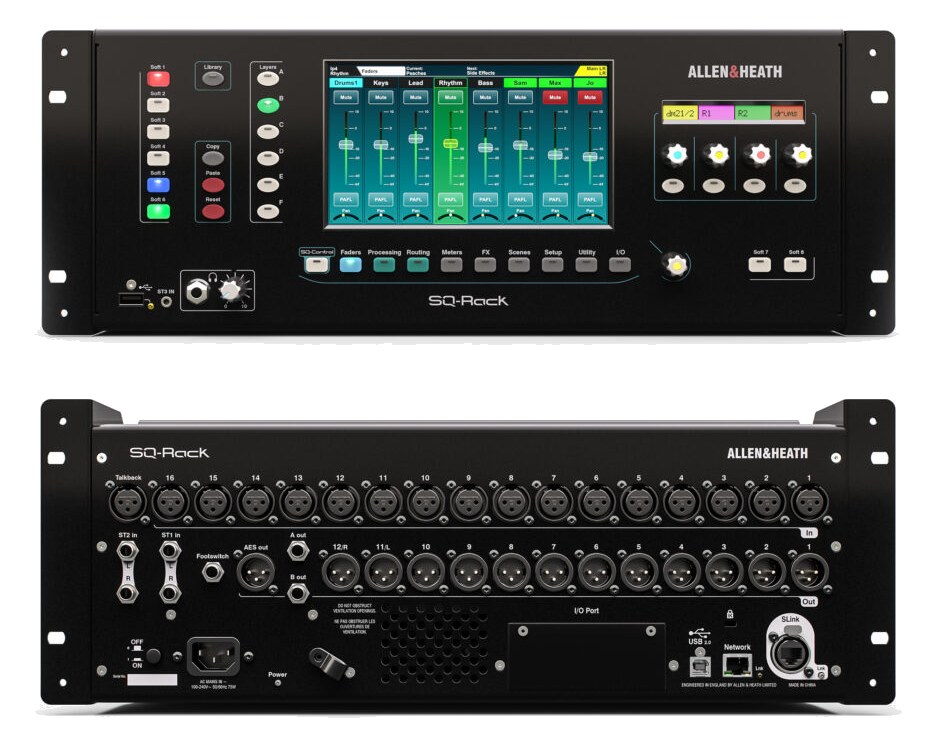
SQ-RackThe Allen & Heath SQ-Rack puts the full 48-channel SQ processing core in a rack format: sixteen local preamps, SLink for remote stage boxes, and an option-card slot for Dante, Waves, or MADI. It mixes monitors from SQ-MixPad with the same XCVI engine as the SQ-5/6/7 desks. The 2024+ answer for pro IEM racks that outgrew tablet-mixer land.View gear →
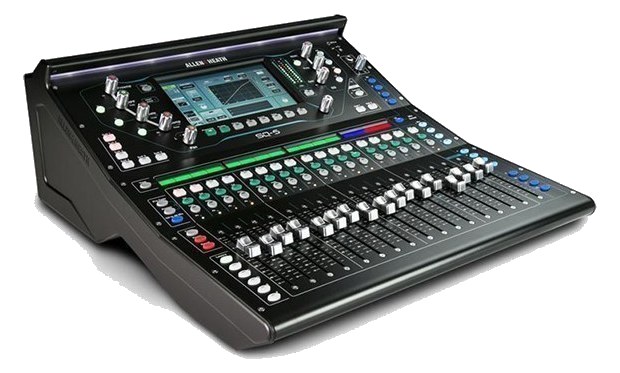
SQ-5The Allen & Heath SQ-5 is a professional-grade digital mixer with 48 channels, 36 buses, and an intuitive touchscreen interface that handles complex IEM mixing workflows with ease. Its SLink digital audio bus supports up to 128 channels of I/O expansion via remote stage boxes, and built-in DEEP processing provides high-quality dynamics and effects. While it requires a shelf to rack-mount, its processing power and sound quality put it a tier above budget rack mixers.View gear →
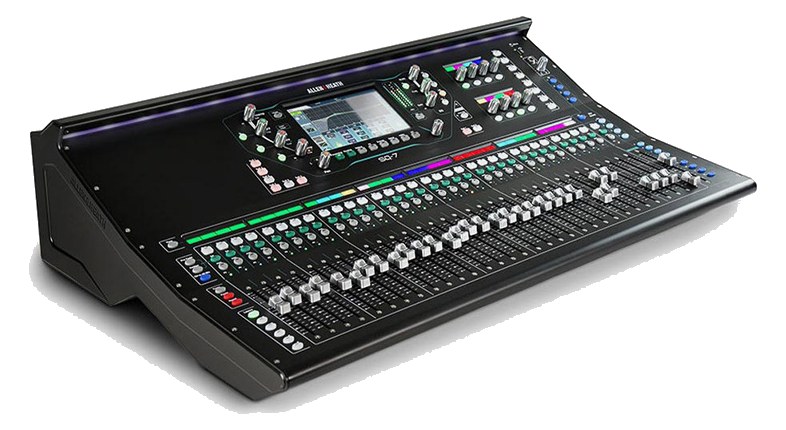
SQ-7The Allen & Heath SQ-7 is the largest of the SQ-series consoles, with 32 motorized faders and the same 48-channel mix engine as its smaller siblings. SLink lets it connect to a wide range of A&H stage boxes (DX168, GX series) over a single shielded Cat5e per link. A staple in regional theaters, churches, and small touring rigs.View gear →
Placement is only the start. Builder checks space · depth · weight, power headroom, dependencies, and compatible signal paths around this exact catalog item.Open in Builder