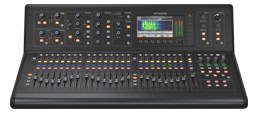
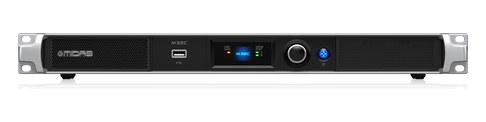
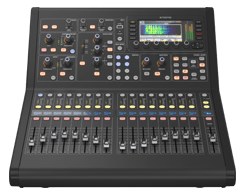
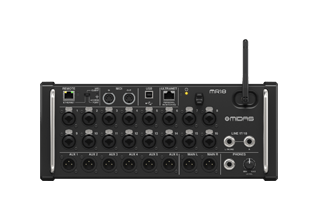
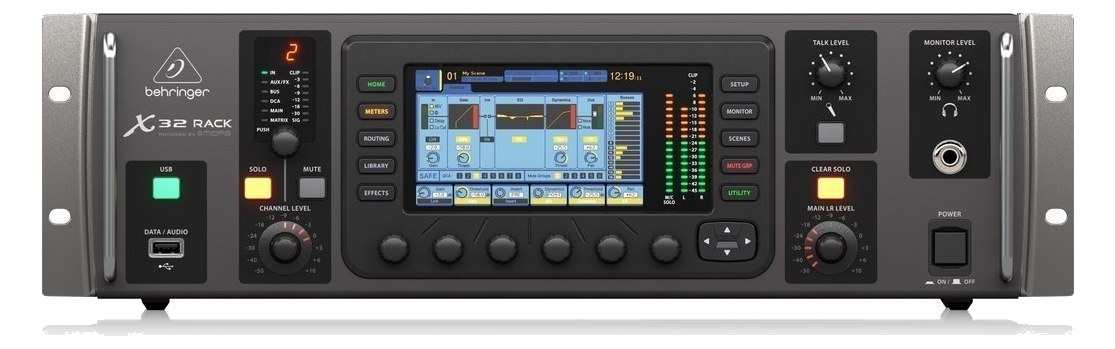
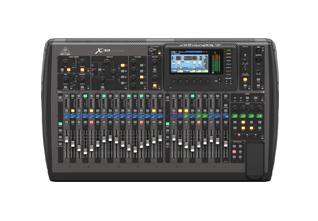
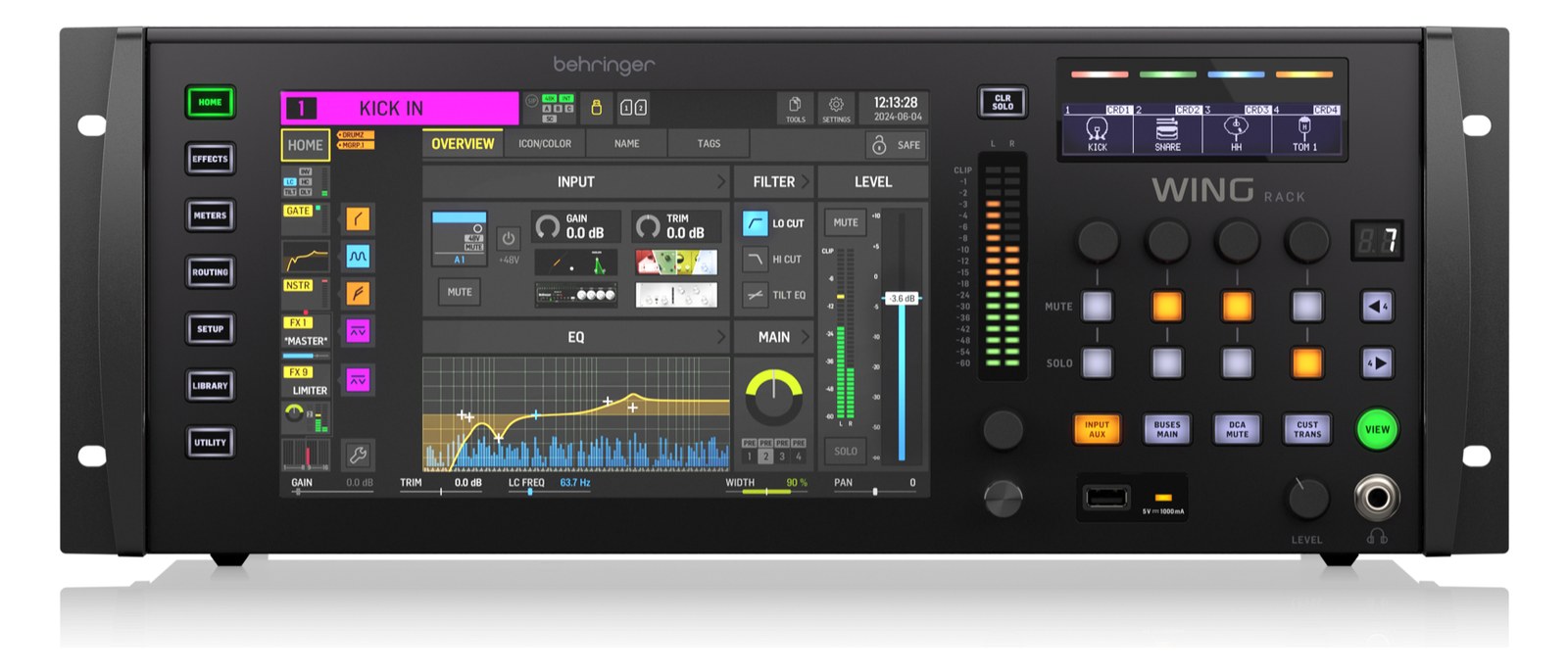
The Midas M32 Live is the full-size, 32-fader M-class console with all of the I/O on board: 32 Midas mic preamps, 16 XLR outputs, three AES50 ports for stage-box trunks, and an Ultranet feed for P-16 personal mixers. Triple AES50 means a single console can host three DL or S-series stage boxes simultaneously — enough channels to put preamps in three locations of a complex stage. The Live variant trims the studio-leaning M32 features in favor of road-ready faders and connectors.
~$4,499Use retailer rows for current price and stock
01 · What it does—and what that changes in your rig.
Product overview
Start with the payoff, then work through how it functions, where it fits, and the details that change a real build.
The payoff
Digital Mixer decisions, organized around the whole rig.
The M32 Live is a full-size touring console that functions equally well at FOHFront Of House — the main mix the audience hears, and the console position out in the room where it gets mixed. or at a monitor position, and that dual-role flexibility is a big part of why it's become so common on club and theater stages. You get 32 Midas mic preampsThe gain stage that lifts a mic’s tiny signal up to line level — the first thing a signal hits, and a big part of how a console sounds. and 16 analog XLRThe standard 3-pin locking connector for mics and balanced line signals — pin 1 is the shield, pins 2 and 3 carry the balanced pair. outputs on the frame itself, before a single stage boxThe I/O endpoint on stage: mics plug in there and one digital line (AES50, Dante) carries everything to the console. The snake, digitized. enters the picture. Add the three AES50The Behringer/Midas console-to-stage-box link: 48 channels each way over one shielded Cat5e cable, with near-zero latency. ports and the UltranetBehringer’s personal-monitoring link: 16 channels down a Cat5 cable to P16 mixers, so players dial their own ears without using console outputs. output for Behringer P-16 personal mixers, and the console becomes the hub of a genuinely large distributed audio system without needing an external router or patch bayA panel of front-facing jacks wired to everything behind it — re-route any signal with a short cable instead of climbing behind the rack. to knit it together.
Documented outputs
1919 destination connections
Documented inputs
34Based on documented inputs
Rack space
Outside rackPlan a shelf, tray, or stage position
Midas product panelOutside rack · 120W
Function
How it works in the path
Three AES50The Behringer/Midas console-to-stage-box link: 48 channels each way over one shielded Cat5e cable, with near-zero latency. ports is the specification that separates the M32 Live from a lot of its competition. Each port carries 48 channels bidirectionally, so you can run a stage boxThe I/O endpoint on stage: mics plug in there and one digital line (AES50, Dante) carries everything to the console. The snake, digitized. at the drum riser, another at the front of the stage, and a third at a remote broadcast or broadcast split location — all from one Cat5eStandard network cable grades. In an audio rig one cheap Cat5e run can replace a 48-channel copper snake; AES50 wants it shielded.trunkThe main multichannel run between stage and console — one fat multicore (or one Cat5e, these days) carrying everything at once. per location. At load-in that means fewer analog lines across the stage, faster patching, and a single saved show file that recalls your full gainHow much the preamp amplifies the incoming signal. Too low and you’re hunting through hiss; too high and peaks clip. and routing state. The 120-watt nominal draw is modest enough for a standard 20-amp circuit with room left over for a power conditionerFilters venue AC, clamps surges, and gives the rack one tidy inlet. Not a voltage regulator and not a battery — just cleaner power. and a laptop. At 21 kg it is a legitimate two-person carry in any coffin case with reasonable depth.
Best fit
Where it earns its place in the system
Pick the M32 Live if you are the primary engineer on a touring rig or a fixed installation where 32 inputs and a clean monitor splitFeeding one mic to two consoles at once (FOH + monitors, or a record rig) through a splitter — both get the identical source. are the daily ask. It pairs naturally with Midas and Behringer DL-series stage boxesThe I/O endpoint on stage: mics plug in there and one digital line (AES50, Dante) carries everything to the console. The snake, digitized. over AES50The Behringer/Midas console-to-stage-box link: 48 channels each way over one shielded Cat5e cable, with near-zero latency., and the P-16 UltranetBehringer’s personal-monitoring link: 16 channels down a Cat5 cable to P16 mixers, so players dial their own ears without using console outputs. port is a direct path to a personal monitor system without burning mix busA path where multiple channels sum into one signal — mixes, groups, and mains are all buses. A 25-bus console can build 25 blends at once. outputs. If you only need 16 inputs and the rig lives in a rack, the M32C rack-mount variant covers the same engine in a smaller footprint. If your show is genuinely small — a five-piece in a 200-cap room — the surface and the case are more console than the gig requires, and something lighter will serve you better.
In the rack
Details worth deciding before load-in.
Use AES50The Behringer/Midas console-to-stage-box link: 48 channels each way over one shielded Cat5e cable, with near-zero latency. A for your primary stage boxThe I/O endpoint on stage: mics plug in there and one digital line (AES50, Dante) carries everything to the console. The snake, digitized., AES50 B for a drum-riser or secondary input location, and hold AES50 C in reserve for a broadcast feed or a split to a secondary console — deciding this before load-in prevents hasty re-patching mid-show.
Save a show file with all inputs patched, channel names set, and outputs routed before doors; the M32 recalls gainHow much the preamp amplifies the incoming signal. Too low and you’re hunting through hiss; too high and peaks clip. settings including remote preampThe gain stage that lifts a mic’s tiny signal up to line level — the first thing a signal hits, and a big part of how a console sounds. gain on connected stage boxesThe I/O endpoint on stage: mics plug in there and one digital line (AES50, Dante) carries everything to the console. The snake, digitized., so your gain structure survives a reboot if the unexpected happens.
The UltranetBehringer’s personal-monitoring link: 16 channels down a Cat5 cable to P16 mixers, so players dial their own ears without using console outputs. output feeds up to 16 P-16 personal mixers daisy-chained on a single Cat5Standard network cable grades. In an audio rig one cheap Cat5e run can replace a 48-channel copper snake; AES50 wants it shielded. run — map the 16 Ultranet sends in your show file so musicians can self-mix without consuming mix busA path where multiple channels sum into one signal — mixes, groups, and mains are all buses. A 25-bus console can build 25 blends at once. outputs you need for wedgesA floor monitor speaker angled up at the performer — the thing IEMs replace, and the thing you fall back on when they die. or IEMIn-Ear Monitor — earpieces that replace floor wedges, feeding each player their own mix. The reason this whole rack exists. transmitters.
At 526 mm deep, confirm your road case or rack depth before you order — many shallow touring racks will not close with the M32 Live inside, and the rear XLRThe standard 3-pin locking connector for mics and balanced line signals — pin 1 is the shield, pins 2 and 3 carry the balanced pair.loomsSeveral cables bundled and run as one — keeps rack interconnects tidy and makes load-in one grab instead of eight. need clearance beyond the frame depth.
02 · Know the whole path before you buy.
Signal path
Learn the route as a block diagram: source, product function, transport, and destination. Select any block to see what enters, what changes, and what leaves.
Interactive block diagramAuto-looping · hover, focus, or tap to hold a stage
Port-type signalProduct functionSystem boundary
Follow one signal from source to destination
Each block answers the same three questions: what arrives, what changes here, and what leaves.
01 · Source · selected
XLR female + aes3 xlr
etherCON + RJ45
XLR male + RJ45
01 · Source
34 documented inputs
XLR female + aes3 xlr
Arrives as
34 documented inputs
Connector
XLR female + aes3 xlr
Signal
analog audio
03 · What this product asks of the rest of the system.
Compatibility
Treat connector names as the start of the check—not the answer. These are the boundaries that determine a complete working path.
Best fit · Digital Mixer
Use it as digital mixer tracked outside rack rails; follow the manufacturer’s mounting and form-factor guidance.
Plan the companion path
Complete the path with upstream and downstream gear that matches connector, direction, signal type, protocol, and wiring standard.
Protocol boundary
This product declares AES50, ULTRANET; matching plugs alone do not make other protocols compatible.
04 · Every connector, grouped by job.
I/O ports
Switch the product view and the documented port inventory updates with it—hardware and data stay side by side.
Every connector, grouped by job.
Switch panels to keep the hardware view and the documented port list in sync.
Front panelRear panel
All documented ports for Midas M32 Live Digital Console
Port
Panel
Connector
Direction
Signal
Channels
Mic In 1
rear
XLR female
input
analog audio
—
Mic In 2
rear
XLR female
input
analog audio
—
Mic In 3
rear
XLR female
input
analog audio
—
Mic In 4
rear
XLR female
input
analog audio
—
Mic In 5
rear
XLR female
input
analog audio
—
Mic In 6
rear
XLR female
input
analog audio
—
Mic In 7
rear
XLR female
input
analog audio
—
Mic In 8
rear
XLR female
input
analog audio
—
Mic In 9
rear
XLR female
input
analog audio
—
Mic In 10
rear
XLR female
input
analog audio
—
Mic In 11
rear
XLR female
input
analog audio
—
Mic In 12
rear
XLR female
input
analog audio
—
Mic In 13
rear
XLR female
input
analog audio
—
Mic In 14
rear
XLR female
input
analog audio
—
Mic In 15
rear
XLR female
input
analog audio
—
Mic In 16
rear
XLR female
input
analog audio
—
Mic In 17
rear
XLR female
input
analog audio
—
Mic In 18
rear
XLR female
input
analog audio
—
Mic In 19
rear
XLR female
input
analog audio
—
Mic In 20
rear
XLR female
input
analog audio
—
Mic In 21
rear
XLR female
input
analog audio
—
Mic In 22
rear
XLR female
input
analog audio
—
Mic In 23
rear
XLR female
input
analog audio
—
Mic In 24
rear
XLR female
input
analog audio
—
Mic In 25
rear
XLR female
input
analog audio
—
Mic In 26
rear
XLR female
input
analog audio
—
Mic In 27
rear
XLR female
input
analog audio
—
Mic In 28
rear
XLR female
input
analog audio
—
Mic In 29
rear
XLR female
input
analog audio
—
Mic In 30
rear
XLR female
input
analog audio
—
Mic In 31
rear
XLR female
input
analog audio
—
Mic In 32
rear
XLR female
input
analog audio
—
XLR Out 1
rear
XLR male
output
analog audio
—
XLR Out 2
rear
XLR male
output
analog audio
—
XLR Out 3
rear
XLR male
output
analog audio
—
XLR Out 4
rear
XLR male
output
analog audio
—
XLR Out 5
rear
XLR male
output
analog audio
—
XLR Out 6
rear
XLR male
output
analog audio
—
XLR Out 7
rear
XLR male
output
analog audio
—
XLR Out 8
rear
XLR male
output
analog audio
—
XLR Out 9
rear
XLR male
output
analog audio
—
XLR Out 10
rear
XLR male
output
analog audio
—
XLR Out 11
rear
XLR male
output
analog audio
—
XLR Out 12
rear
XLR male
output
analog audio
—
XLR Out 13
rear
XLR male
output
analog audio
—
XLR Out 14
rear
XLR male
output
analog audio
—
XLR Out 15
rear
XLR male
output
analog audio
—
XLR Out 16
rear
XLR male
output
analog audio
—
AES50 A
rear
etherCON
bidirectional
digital audio
48
AES50 B
rear
etherCON
bidirectional
digital audio
48
AES50 C
rear
etherCON
bidirectional
digital audio
48
Ultranet (P-16)
rear
RJ45
output
digital audio
16
AES3 In
rear
aes3 xlr
input
digital audio
—
AES3 Out
rear
aes3 xlr
output
digital audio
—
USB Recording
rear
usb b
bidirectional
data
—
Ethernet (control)
rear
RJ45
bidirectional
data
—
Headphones
rear
¼-inch TRS
output
analog audio
—
Power (IEC)
rear
IEC C14
input
power
—
Showing 58 of 58 documented physical ports. Scroll to review the remaining rows.
05 · Compare the decision, not just the price.
Alternatives
The rows are organized around fit, power, I/O, and system role so a cheaper unit cannot hide a more expensive workflow.
M32 LiveThe Midas M32 Live is the full-size, 32-fader M-class console with all of the I/O on board: 32 Midas mic preamps, 16 XLR outputs, three AES50 ports for stage-box trunks, and an Ultranet feed for P-16 personal mixers. Triple AES50 means a single console can host three DL or S-series stage boxes simultaneously — enough channels to put preamps in three locations of a complex stage. The Live variant trims the studio-leaning M32 features in favor of road-ready faders and connectors.View gear →
M32CThe Midas M32C packs the full 40-channel M32 processing engine into 1U with no local preamps: all I/O arrives over AES50 from DL-series stage boxes, making it the densest way to put M32 mixing in a rack. For IEM rigs it pairs with a DL16/DL32 on stage and an iPad for control. Requested by users; the most compact door into the M32 ecosystem.View gear →
M32R LiveThe Midas M32R Live is the rack-mountable, 16-fader sibling of the flagship M32 console. It brings 16 fully-featured Midas mic preamps, a 40-input mix engine, and two AES50 ports that let you hang Midas DL-series or Behringer S-series stage boxes off a single shielded Cat5e per link — up to 48 channels over one cable. If the rig has a DL16/DL32 or S16/S32 at the stage, the AES50 trunk is the connection back to this console; local XLR inputs on the console itself are reserved for last-minute stage-side patches.View gear →
MR18The Midas MR18 is essentially a premium version of the Behringer XR18 with upgraded Midas preamps and build quality, fitting an 18-input mixer into a tabletop stagebox chassis about three rack-spaces tall. The chassis is not a 19" panel — in a rig it gets secured with a rack-ear adapter kit or a shelf, or lives loose on the stage floor. Tablet-controlled via WiFi, it eliminates the need for a physical control surface. It is a strong choice for compact IEM rigs where musicians control their own mixes from personal devices and the engineer manages the show from a tablet at FOH.View gear →
06 · Resolve the questions that can change the purchase or build plan.
Planning questions
Short, source-backed answers surface rack fit, power, cabling, and connection details before they become surprises.
Where does the Midas M32 Live Digital Console live in a complete rig?
The catalog assigns it no rack units. Builder tracks it as non-rack gear; follow the manufacturer’s mounting, case, and form-factor guidance.
How much power does the Midas M32 Live Digital Console draw?
Typical draw is 120W and documented maximum draw is 150W.
What connections does the Midas M32 Live Digital Console have?
58 documented physical ports, including Mic In 1, Mic In 2, Mic In 3, Mic In 4, Mic In 5, Mic In 6.
07 · See this gear inside a complete system plan.
Builder preview
Builder keeps non-rack gear in the same bill of materials, budget, dependency, and connection plan as the rack-mounted system around it.Open in Builder