
Midas M32C Rack Mixer
Midas·Model M32C·midas-m32c
Photos
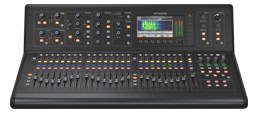
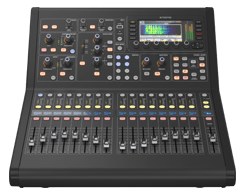
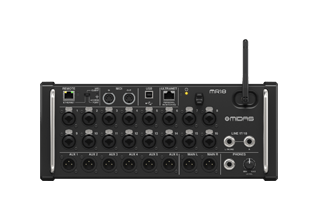
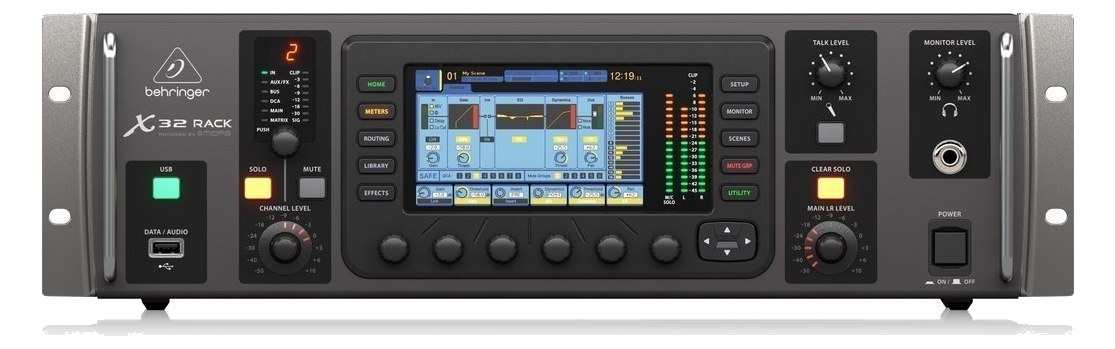
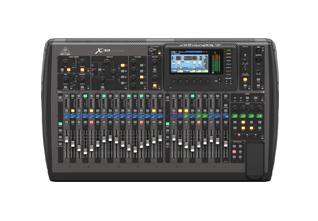
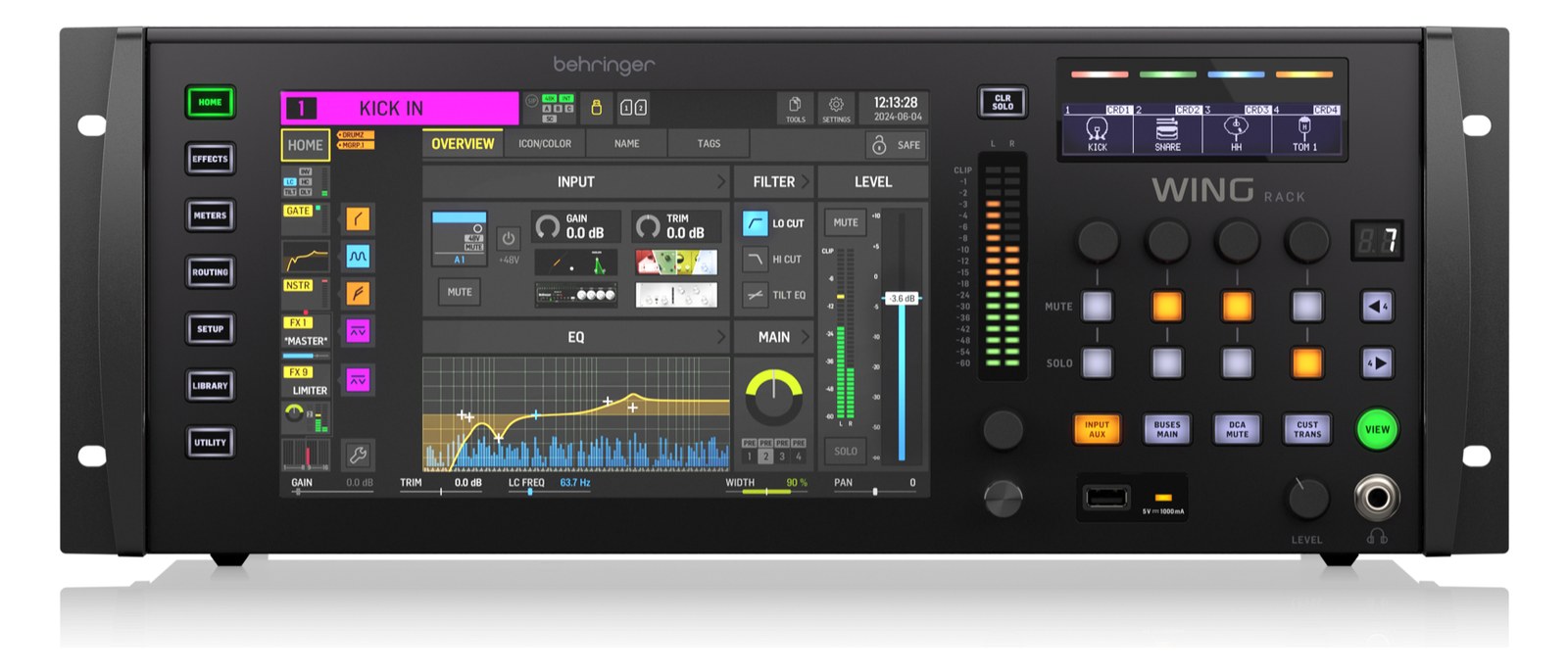
Manufacturer product photography — the drawn faceplate above stays true to panel layout; these show the hardware itself.
About the Midas M32C
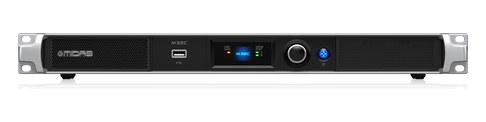
The Midas M32C packs the full 40-channel M32 processing engine into 1UThe standard slice of rack height: 1U = 1.75″. A 3U box takes three slices; half-rack gear pairs two units side by side in one. with no local preampsThe gain stage that lifts a mic’s tiny signal up to line level — the first thing a signal hits, and a big part of how a console sounds.: all I/O arrives over AES50The Behringer/Midas console-to-stage-box link: 48 channels each way over one shielded Cat5e cable, with near-zero latency. from DL-series stage boxesThe I/O endpoint on stage: mics plug in there and one digital line (AES50, Dante) carries everything to the console. The snake, digitized., making it the densest way to put M32 mixing in a rack. For IEMIn-Ear Monitor — earpieces that replace floor wedges, feeding each player their own mix. The reason this whole rack exists. rigs it pairs with a DL16/DL32 on stage and an iPad for control. Requested by users; the most compact door into the M32 ecosystem.
The M32C is what happens when you delete everything from an M32 except the part IEMIn-Ear Monitor — earpieces that replace floor wedges, feeding each player their own mix. The reason this whole rack exists. rigs actually use: the 40-channel, 25-bus processing engine. No preampsThe gain stage that lifts a mic’s tiny signal up to line level — the first thing a signal hits, and a big part of how a console sounds., no faders, no screen — 1UThe standard slice of rack height: 1U = 1.75″. A 3U box takes three slices; half-rack gear pairs two units side by side in one. of pure mix brain that expects every input to arrive over AES50The Behringer/Midas console-to-stage-box link: 48 channels each way over one shielded Cat5e cable, with near-zero latency. from DL-series (or S/SD-series) stage boxesThe I/O endpoint on stage: mics plug in there and one digital line (AES50, Dante) carries everything to the console. The snake, digitized. and every control gesture to come from an editor, a tablet, or a MIDI surface.
That deletion is the point. A monitor rack built around the M32C plus a DL16 does the same job as an X32 Rack plus stage boxThe I/O endpoint on stage: mics plug in there and one digital line (AES50, Dante) carries everything to the console. The snake, digitized. while saving 2UThe standard slice of rack height: 1U = 1.75″. A 3U box takes three slices; half-rack gear pairs two units side by side in one., and the AES50The Behringer/Midas console-to-stage-box link: 48 channels each way over one shielded Cat5e cable, with near-zero latency. topology means the copper between stage and rack is one shielded Cat5eStandard network cable grades. In an audio rig one cheap Cat5e run can replace a 48-channel copper snake; AES50 wants it shielded. run carrying 48 channels each way. The UltranetBehringer’s personal-monitoring link: 16 channels down a Cat5 cable to P16 mixers, so players dial their own ears without using console outputs. port still feeds 16 channels to P16-family personal mixers, the USB-B port is a 32×32 interface for virtual soundcheckPlaying a recorded show back through the console as if the band were on stage — dial in mixes before anyone plugs in., and the RJ45 control port is where X32-Edit or Mixing Station lives. MIDI in/out covers scene recall from playback rigs — a real workflow for timecodeA clock signal (SMPTE) shared between systems so playback, lights, and video all chase the same position in the song.-driven shows.
Know what you're giving up: with no local I/O beyond the digital ports, a preampThe gain stage that lifts a mic’s tiny signal up to line level — the first thing a signal hits, and a big part of how a console sounds. failure diagnosis, a talkbackThe engineer’s mic into the performers’ ears or monitors — talk to the band without leaving the console. mic, or a quick RCA input all require the stage boxThe I/O endpoint on stage: mics plug in there and one digital line (AES50, Dante) carries everything to the console. The snake, digitized.. If your rack regularly absorbs surprise local sources, the X32 Rack's sixteen XLRsThe standard 3-pin locking connector for mics and balanced line signals — pin 1 is the shield, pins 2 and 3 carry the balanced pair. argue for themselves. If everything reaches you over the snakeA multicore cable bundling many channels into one stage-to-console run. A sub-snake collects one corner of the stage into a drop box. anyway, the M32C is the denser, quieter, better-sounding-per-rack-unit choice.
In the rack
- Pair with a DL16/DL32 (or S16/SD16) — the M32C has zero local preampsThe gain stage that lifts a mic’s tiny signal up to line level — the first thing a signal hits, and a big part of how a console sounds. by design.
- One Cat5eStandard network cable grades. In an audio rig one cheap Cat5e run can replace a 48-channel copper snake; AES50 wants it shielded. AES50The Behringer/Midas console-to-stage-box link: 48 channels each way over one shielded Cat5e cable, with near-zero latency. run carries the whole stage both directions; keep a tested spare in the case lid.
- Scene changes over MIDI from the playback computer make song-based monitor snapshots hands-free.
- Control lives on the network — carry a hardwired laptop path for when venue Wi-Fi betrays you.
40-ch M32 brain in 1UThe standard slice of rack height: 1U = 1.75″. A 3U box takes three slices; half-rack gear pairs two units side by side in one. — no preampsThe gain stage that lifts a mic’s tiny signal up to line level — the first thing a signal hits, and a big part of how a console sounds., pair with DL-series stage boxesThe I/O endpoint on stage: mics plug in there and one digital line (AES50, Dante) carries everything to the console. The snake, digitized..
I/O Ports (8)
| Port | Connector | Direction | Signal | Channels |
|---|---|---|---|---|
| AES50 A | ETHERCON | bidirectional | digital audio | 48 |
| AES50 B | ETHERCON | bidirectional | digital audio | 48 |
| Ultranet Out | ETHERCON | output | digital audio | 16 |
| USB (32x32) | USB B | bidirectional | data | — |
| Ethernet Remote | RJ45 | bidirectional | data | — |
| MIDI In | MIDI DIN5 | input | data | — |
| MIDI Out | MIDI DIN5 | output | data | — |
- Power (IEC C14)
Deciding between two?
Rack space, watts, weight and every connector, side by side.
Related gear


Related articles
Guides from our library that cover planning around digital mixer gear.
A walking tour of the signal path from microphone to in-ear monitor, with what every box in the rack actually does to the audio along the way.
Why sealed IEMs make you feel disconnected from the room — and exactly how to put the audience back into your mix with one or two well-placed mics.
Step-by-step: linking aux buses into stereo pairs, pre-fader vs post-fader, routing buses to Ultranet vs physical XLRs vs AES50, and adding a bus-level limiter.
A practical comparison of the three audio-over-network protocols you’ll encounter in a rack rig, with guidance on when each one is the right pick.