
Midas M32R Live Digital Console
Midas·Model M32R Live·midas-m32r-live
Photos
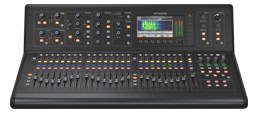
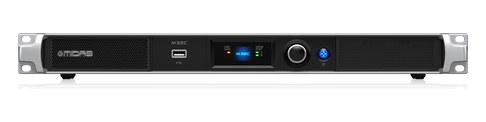
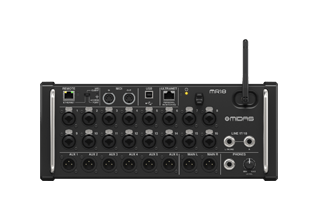
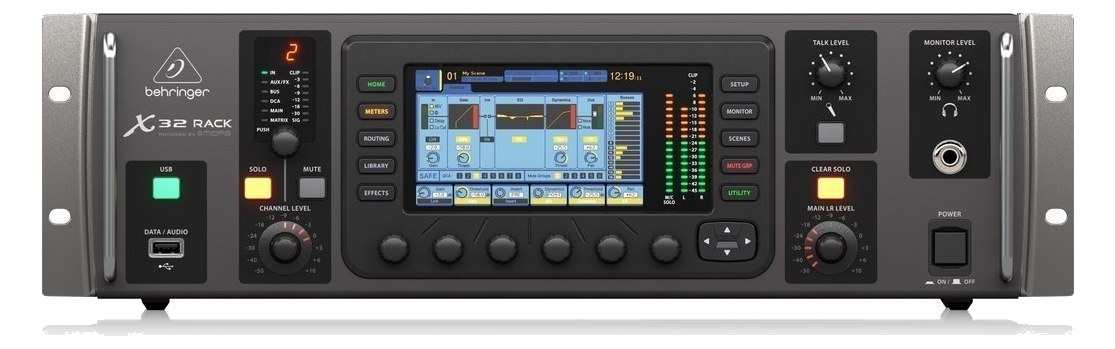
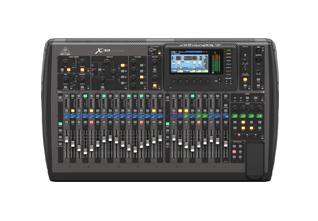
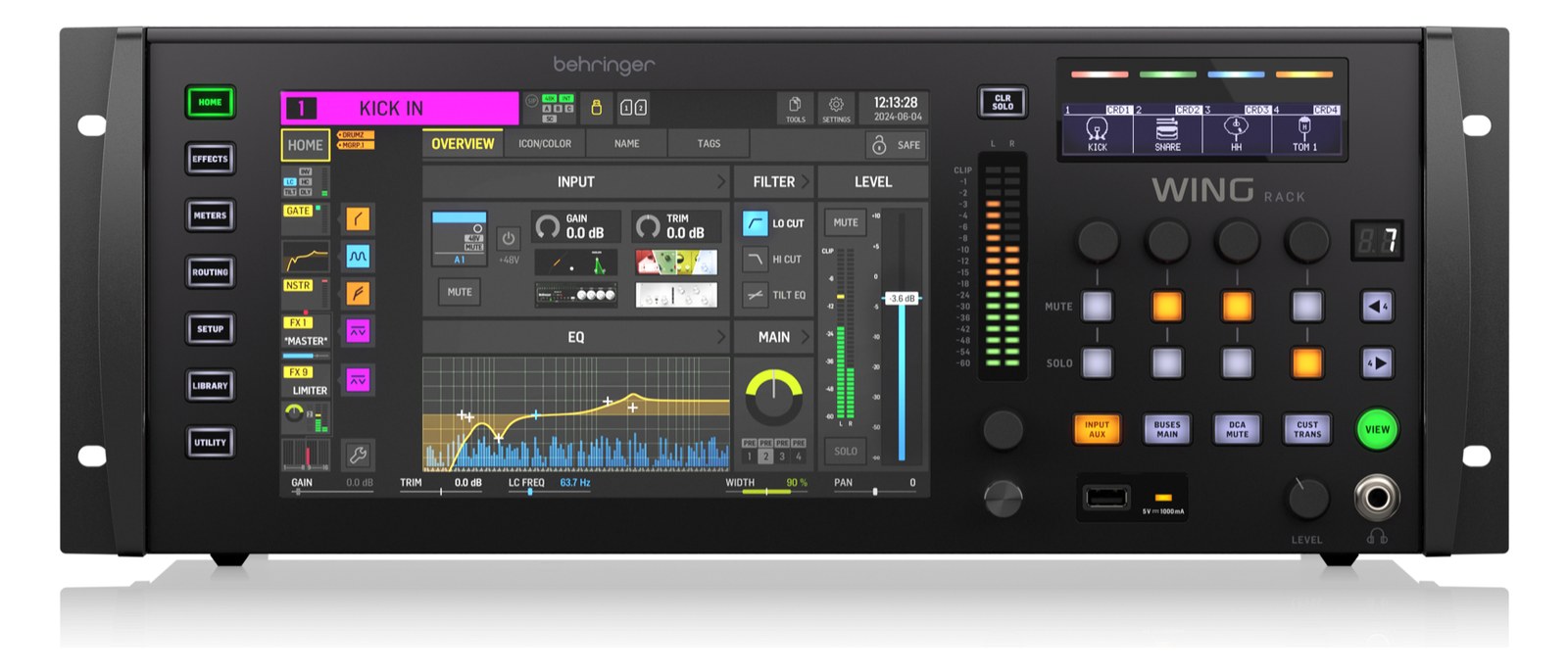
Manufacturer product photography — the drawn faceplate above stays true to panel layout; these show the hardware itself.
About the Midas M32R Live
The Midas M32R Live is the rack-mountable, 16-fader sibling of the flagship M32 console. It brings 16 fully-featured Midas mic preampsThe gain stage that lifts a mic’s tiny signal up to line level — the first thing a signal hits, and a big part of how a console sounds., a 40-input mix engine, and two AES50The Behringer/Midas console-to-stage-box link: 48 channels each way over one shielded Cat5e cable, with near-zero latency. ports that let you hang Midas DL-series or Behringer S-series stage boxesThe I/O endpoint on stage: mics plug in there and one digital line (AES50, Dante) carries everything to the console. The snake, digitized. off a single shielded Cat5eStandard network cable grades. In an audio rig one cheap Cat5e run can replace a 48-channel copper snake; AES50 wants it shielded. per link — up to 48 channels over one cable. If the rig has a DL16/DL32 or S16/S32 at the stage, the AES50 trunkThe main multichannel run between stage and console — one fat multicore (or one Cat5e, these days) carrying everything at once. is the connection back to this console; local XLRThe standard 3-pin locking connector for mics and balanced line signals — pin 1 is the shield, pins 2 and 3 carry the balanced pair. inputs on the console itself are reserved for last-minute stage-side patches.
The M32R Live is what happens when you strip the M32 console down to its engine and bolt it into a rack. You lose the standalone fader surface but keep everything that matters: 40 inputs through the mix engine, 16 local Midas preampsThe gain stage that lifts a mic’s tiny signal up to line level — the first thing a signal hits, and a big part of how a console sounds., 16 local XLRThe standard 3-pin locking connector for mics and balanced line signals — pin 1 is the shield, pins 2 and 3 carry the balanced pair. outputs, and the full M32 routing architecture. In a monitor rig or a compact FOHFront Of House — the main mix the audience hears, and the console position out in the room where it gets mixed. rack, this is the brain — the thing that takes every mic and instrument on stage, processes it, and sends shaped mixes out to IEMIn-Ear Monitor — earpieces that replace floor wedges, feeding each player their own mix. The reason this whole rack exists. transmitters, wedgeA floor monitor speaker angled up at the performer — the thing IEMs replace, and the thing you fall back on when they die. amps, or the PA. Its 4UThe standard slice of rack height: 1U = 1.75″. A 3U box takes three slices; half-rack gear pairs two units side by side in one. footprint and native rackmount ears make it a clean fit in a standard road case without adapters or workarounds.
In practice, the two AES50The Behringer/Midas console-to-stage-box link: 48 channels each way over one shielded Cat5e cable, with near-zero latency. ports are the reason this console belongs in a rack-based workflow. Each port carries 48 channels bidirectionally over a single shielded Cat5eStandard network cable grades. In an audio rig one cheap Cat5e run can replace a 48-channel copper snake; AES50 wants it shielded., so a DL32 or S32 stage boxThe I/O endpoint on stage: mics plug in there and one digital line (AES50, Dante) carries everything to the console. The snake, digitized. at the drum riser and a DL16 at a guitar station can both home-run to this rack with two cables total. The 16 local XLRsThe standard 3-pin locking connector for mics and balanced line signals — pin 1 is the shield, pins 2 and 3 carry the balanced pair. are better thought of as a convenience patch panel — handy for a last-minute direct box or a talkbackThe engineer’s mic into the performers’ ears or monitors — talk to the band without leaving the console. mic at mix position — not your primary input infrastructure. At 100W nominal draw with a 130W ceiling, it sits comfortably on a single 15A circuit even sharing a conditioner with wireless receivers and a laptop power brick.
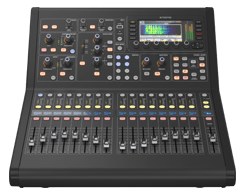
This console belongs in your rack if you want a single, capable mix engine with deep processing, solid preampsThe gain stage that lifts a mic’s tiny signal up to line level — the first thing a signal hits, and a big part of how a console sounds., and reliable AES50The Behringer/Midas console-to-stage-box link: 48 channels each way over one shielded Cat5e cable, with near-zero latency. networking — and you're comfortable doing all your work through a touchscreen or a tablet running M32-Edit over Ethernet. It does not belong in your rack if your crew expects a hands-on fader surface at the console itself; you'll need to budget for a DL351 or a separate X-Touch controller alongside it, or reconsider the full M32. Engineers already in the Midas/Behringer AES50 ecosystem will integrate this immediately; engineers coming from a DanteThe most common audio-over-network standard: dozens of channels of uncompressed digital audio down one ordinary Ethernet cable between Dante boxes.-native world should account for the additional conversion step.
In the rack
- Run AES50The Behringer/Midas console-to-stage-box link: 48 channels each way over one shielded Cat5e cable, with near-zero latency. A as your primary stage-box trunkThe main multichannel run between stage and console — one fat multicore (or one Cat5e, these days) carrying everything at once. and patch AES50 B to a second stage boxThe I/O endpoint on stage: mics plug in there and one digital line (AES50, Dante) carries everything to the console. The snake, digitized. or leave it as a warm spare with a pre-made cable coiled inside the rack lid — swapping a Cat5eStandard network cable grades. In an audio rig one cheap Cat5e run can replace a 48-channel copper snake; AES50 wants it shielded. in a dark wing beats troubleshooting a split signal chain mid-set.
- Bring a dedicated laptop or tablet mounted in the rack or on a gooseneck arm; without a physical fader surface, M32-Edit over the Ethernet control port is your primary interface during soundcheck, so that connection needs to be stable and always-on.
- Set your rack depth expectation early — the M32R Live is 400mm deep, so shallow rental cases will not close with the rear XLRThe standard 3-pin locking connector for mics and balanced line signals — pin 1 is the shield, pins 2 and 3 carry the balanced pair. loomSeveral cables bundled and run as one — keeps rack interconnects tidy and makes load-in one grab instead of eight. dressed. Measure your case interior before load-in, not at load-in.
- Label the local XLRThe standard 3-pin locking connector for mics and balanced line signals — pin 1 is the shield, pins 2 and 3 carry the balanced pair. inputs with their show-day purpose during pre-production and leave that label on the rack panel; under pressure it is easy to forget which of the 16 locals is the talkbackThe engineer’s mic into the performers’ ears or monitors — talk to the band without leaving the console. feed versus the commsProduction intercom — the wired or wireless party line connecting FOH, monitors, stage managers, and lighting during a show. return versus the spare.
40-input digital console with 16 Midas preampsThe gain stage that lifts a mic’s tiny signal up to line level — the first thing a signal hits, and a big part of how a console sounds. + dual AES50The Behringer/Midas console-to-stage-box link: 48 channels each way over one shielded Cat5e cable, with near-zero latency.. Rack-mountable.
I/O Ports (30)
| Port | Connector | Direction | Signal | Channels |
|---|---|---|---|---|
| Local In 1 | XLR FEMALE | input | analog audio | — |
| Local In 2 | XLR FEMALE | input | analog audio | — |
| Local In 3 | XLR FEMALE | input | analog audio | — |
| Local In 4 | XLR FEMALE | input | analog audio | — |
| Local In 5 | XLR FEMALE | input | analog audio | — |
| Local In 6 | XLR FEMALE | input | analog audio | — |
| Local In 7 | XLR FEMALE | input | analog audio | — |
| Local In 8 | XLR FEMALE | input | analog audio | — |
| Local In 9 | XLR FEMALE | input | analog audio | — |
| Local In 10 | XLR FEMALE | input | analog audio | — |
| Local In 11 | XLR FEMALE | input | analog audio | — |
| Local In 12 | XLR FEMALE | input | analog audio | — |
| Local In 13 | XLR FEMALE | input | analog audio | — |
| Local In 14 | XLR FEMALE | input | analog audio | — |
| Local In 15 | XLR FEMALE | input | analog audio | — |
| Local In 16 | XLR FEMALE | input | analog audio | — |
| Local Out 1 | XLR MALE | output | analog audio | — |
| Local Out 2 | XLR MALE | output | analog audio | — |
| Local Out 3 | XLR MALE | output | analog audio | — |
| Local Out 4 | XLR MALE | output | analog audio | — |
| Local Out 5 | XLR MALE | output | analog audio | — |
| Local Out 6 | XLR MALE | output | analog audio | — |
| Local Out 7 | XLR MALE | output | analog audio | — |
| Local Out 8 | XLR MALE | output | analog audio | — |
| AES50 A | ETHERCON | bidirectional | digital audio | 48 |
| AES50 B (redundant) | ETHERCON | bidirectional | digital audio | 48 |
| AES3 Out | AES3 XLR | output | digital audio | — |
| USB (recording) | USB B | bidirectional | data | — |
| Ethernet (control) | RJ45 | bidirectional | data | — |
- Power (IEC) (IEC C14)
Deciding between two?
Rack space, watts, weight and every connector, side by side.
Related gear


Community rigs using this gear (2)
Browse all rigs →Related articles
Guides from our library that cover planning around digital mixer gear.
A walking tour of the signal path from microphone to in-ear monitor, with what every box in the rack actually does to the audio along the way.
Why sealed IEMs make you feel disconnected from the room — and exactly how to put the audience back into your mix with one or two well-placed mics.
Step-by-step: linking aux buses into stereo pairs, pre-fader vs post-fader, routing buses to Ultranet vs physical XLRs vs AES50, and adding a bus-level limiter.
A practical comparison of the three audio-over-network protocols you’ll encounter in a rack rig, with guidance on when each one is the right pick.