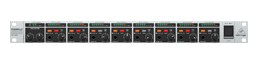
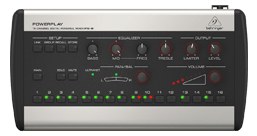
The Behringer Powerplay HA8000 is an 8-channel rack-mount headphone amp at a budget price point. Each channel has its own input + level + headphone output, plus a stereo main bus that all channels can mix in. Common pickup for tracking sessions, broadcast facilities, and anywhere you need to feed many pairs of headphones from one console output.
~$219Use retailer rows for current price and stock
01 · What it does—and what that changes in your rig.
Product overview
Start with the payoff, then work through how it functions, where it fits, and the details that change a real build.
The payoff
Headphone Amp decisions, organized around the whole rig.
The HA8000 is a straightforward answer to a common problem: you have one stereo mix coming off a console and you need to get it into eight pairs of headphones, each at its own volume. In a live rig it shows up most often in playback or IEMIn-Ear Monitor — earpieces that replace floor wedges, feeding each player their own mix. The reason this whole rack exists.-adjacent setups where click and cue feeds need to reach a drummer, a music director, and a handful of other players who aren't on wireless. Each of the eight channels takes its own dedicated 1/4" TRSTip-Ring-Sleeve — a 1/4″ jack with three contacts carrying a balanced signal or a stereo pair. A guitar plug with one extra ring. input, but every channel can also blend in the stereo main busA path where multiple channels sum into one signal — mixes, groups, and mains are all buses. A 25-bus console can build 25 blends at once. — so you can send a shared house mix to the main in and feed individual trims or alternate cues per channel.
Documented outputs
88 destination connections
Documented inputs
11Based on documented inputs
Rack space
1UBuilder checks available rail space
Behringer product panel1U · 25W
Function
How it works in the path
At 1UThe standard slice of rack height: 1U = 1.75″. A 3U box takes three slices; half-rack gear pairs two units side by side in one. and 220mm deep, this fits cleanly into a shallow utility rack without fighting for space. The 25W nominal draw is low enough that it won't push a modest power conditionerFilters venue AC, clamps surges, and gives the rack one tidy inlet. Not a voltage regulator and not a battery — just cleaner power., and the IECThe standard three-prong appliance power inlet on rack gear — the kettle lead. C13/C14 in spec-sheet speak. inlet means standard rack power cables work without adapters. All connections are 1/4" TRSTip-Ring-Sleeve — a 1/4″ jack with three contacts carrying a balanced signal or a stereo pair. A guitar plug with one extra ring. on both input and output sides — there's no XLRThe standard 3-pin locking connector for mics and balanced line signals — pin 1 is the shield, pins 2 and 3 carry the balanced pair., no combo jack, no breakoutA cable that splits one multichannel connector (like a DB25) into individual plugs — the octopus that turns 8 channels into 8 XLRs. — so plan your patch accordingly. If your console's cue outputs are on XLR, budget for adapters or a short TRS loomSeveral cables bundled and run as one — keeps rack interconnects tidy and makes load-in one grab instead of eight. before load-in, because that's not a problem you want to solve at downbeat.
Best fit
Where it earns its place in the rack
This unit earns its place in a rehearsal facility, a house-of-worship monitor rack, a theater pit, or any install where eight discrete headphone feeds need to come out of one box and cost is a real constraint. At $219 it's hard to argue against for utility work. Where it isn't the right call: a touring IEMIn-Ear Monitor — earpieces that replace floor wedges, feeding each player their own mix. The reason this whole rack exists. rack where your artists need individual mix control, latencyThe delay between sound entering and leaving a digital system. IEM rigs fight to keep the whole chain down to a few milliseconds. parity with digital systems, or the confidence that comes from a unit with a known service history on the road. For that, look at something like the Aviom or Hear Technologies personal monitor family instead. The HA8000 is a workhorse tool, not a performance-critical one.
In the rack
Details worth deciding before load-in.
If you're feeding all eight channels from the same stereo source, use the Main In and leave the individual channel inputs empty — then each user trims their own level without you touching the patch.
All outputs are front-panel 1/4" jacks, which means eight headphone cables hanging off the face of the rack. Use a short cable tie bar or Velcro loop anchored to the rack rail below the unit to keep that cable mass from stressing the jacks over time.
The individual channel inputs override or supplement the main busA path where multiple channels sum into one signal — mixes, groups, and mains are all buses. A 25-bus console can build 25 blends at once. per channel — confirm which behavior you want before soundcheck, because a feed left floating on an unused channel input can introduce noise if the source end isn't properly terminated.
If your console cue or auxAn auxiliary mix output — each aux is its own independent blend of the channels, typically one per monitor mix or effects send. outputs are XLRThe standard 3-pin locking connector for mics and balanced line signals — pin 1 is the shield, pins 2 and 3 carry the balanced pair., run a pair of XLR-to-TRSTip-Ring-Sleeve — a 1/4″ jack with three contacts carrying a balanced signal or a stereo pair. A guitar plug with one extra ring. adapters permanently soldered and labeled before the unit goes into the rack — removing the adapter problem from show day entirely.
02 · Know the whole path before you buy.
Signal path
Learn the route as a block diagram: source, product function, transport, and destination. Select any block to see what enters, what changes, and what leaves.
Interactive block diagramAuto-looping · hover, focus, or tap to hold a stage
Port-type signalProduct functionSystem boundary
Follow one signal from source to destination
Each block answers the same three questions: what arrives, what changes here, and what leaves.
01 · Source · selected
¼-inch TRS + IEC C14
¼-inch TRS
01 · Source
11 documented inputs
¼-inch TRS + IEC C14
Arrives as
11 documented inputs
Connector
¼-inch TRS + IEC C14
Signal
analog audio
03 · What this product asks of the rest of the system.
Compatibility
Treat connector names as the start of the check—not the answer. These are the boundaries that determine a complete working path.
Best fit · Headphone Amp
Use it when 1U and 149 mm of depth fit the case.
Plan the companion path
Complete the path with upstream and downstream gear that matches connector, direction, signal type, protocol, and wiring standard.
Connector boundary
Documented connectors: ¼-inch TRS, IEC C14. Match connector, direction, and signal type—not shape alone.
04 · Every connector, grouped by job.
I/O ports
Switch the product view and the documented port inventory updates with it—hardware and data stay side by side.
Every connector, grouped by job.
Switch panels to keep the hardware view and the documented port list in sync.
Front panelRear panel
All documented ports for Behringer Powerplay HA8000 Headphone Amp
Port
Panel
Connector
Direction
Signal
Channels
Main In L (1/4")
rear
¼-inch TRS
input
analog audio
—
Main In R (1/4")
rear
¼-inch TRS
input
analog audio
—
Ch 1 In (1/4")
rear
¼-inch TRS
input
analog audio
—
Ch 2 In (1/4")
rear
¼-inch TRS
input
analog audio
—
Ch 3 In (1/4")
rear
¼-inch TRS
input
analog audio
—
Ch 4 In (1/4")
rear
¼-inch TRS
input
analog audio
—
Ch 5 In (1/4")
rear
¼-inch TRS
input
analog audio
—
Ch 6 In (1/4")
rear
¼-inch TRS
input
analog audio
—
Ch 7 In (1/4")
rear
¼-inch TRS
input
analog audio
—
Ch 8 In (1/4")
rear
¼-inch TRS
input
analog audio
—
Phones 1 (1/4")
rear
¼-inch TRS
output
analog audio
—
Phones 2 (1/4")
rear
¼-inch TRS
output
analog audio
—
Phones 3 (1/4")
rear
¼-inch TRS
output
analog audio
—
Phones 4 (1/4")
rear
¼-inch TRS
output
analog audio
—
Phones 5 (1/4")
rear
¼-inch TRS
output
analog audio
—
Phones 6 (1/4")
rear
¼-inch TRS
output
analog audio
—
Phones 7 (1/4")
rear
¼-inch TRS
output
analog audio
—
Phones 8 (1/4")
rear
¼-inch TRS
output
analog audio
—
Power (IEC)
rear
IEC C14
input
power
—
Showing 19 of 19 documented physical ports. Scroll to review the remaining rows.
05 · Compare the decision, not just the price.
Alternatives
The rows are organized around fit, power, I/O, and system role so a cheaper unit cannot hide a more expensive workflow.
HA8000The Behringer Powerplay HA8000 is an 8-channel rack-mount headphone amp at a budget price point. Each channel has its own input + level + headphone output, plus a stereo main bus that all channels can mix in. Common pickup for tracking sessions, broadcast facilities, and anywhere you need to feed many pairs of headphones from one console output.View gear →
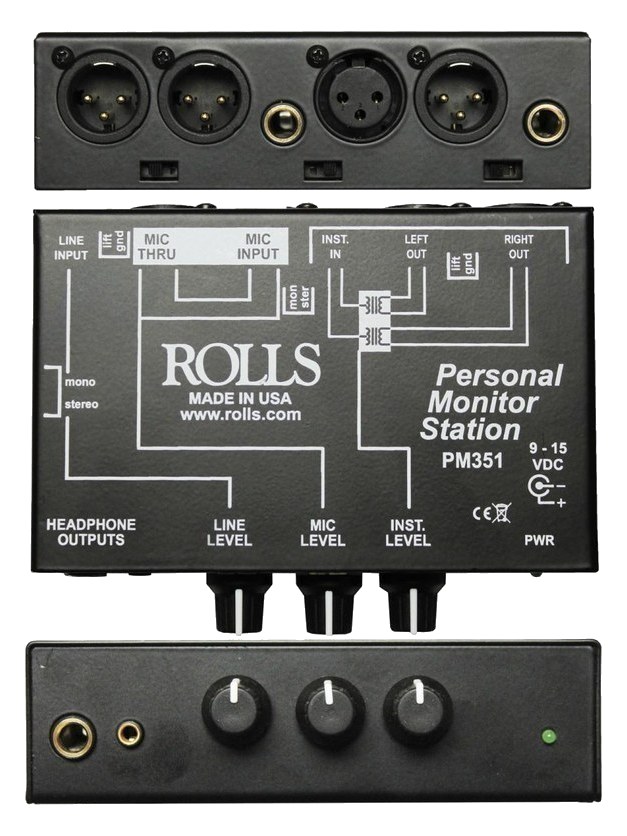
PM351The Rolls PM351 is a simple belt-clip personal monitor mixer that lets a musician blend up to three audio sources into their headphone or IEM mix. It is commonly used to add an ambient mic feed or click track alongside a stereo monitor mix, giving performers a basic but effective way to customize what they hear. At this price point, it is the most affordable way to give a musician personal mix control.View gear →
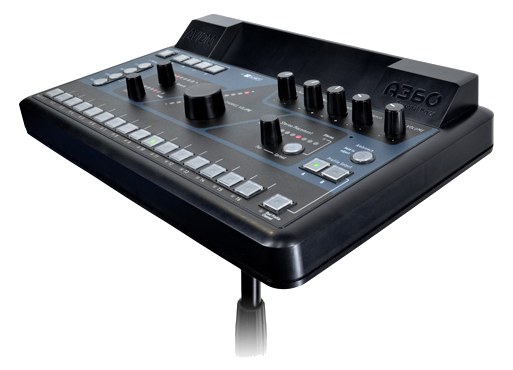
A360The Aviom A360 is a professional 36-channel personal mixer that gives musicians extensive control over their monitor mix with dedicated per-channel volume, pan, tone, and grouping. Its Pro16e networking carries all 36 channels over a single Cat5 cable, keeping stage wiring clean. This is a significant step up from basic personal mixers and is well-suited for demanding musicians who want studio-grade mix control on stage.View gear →
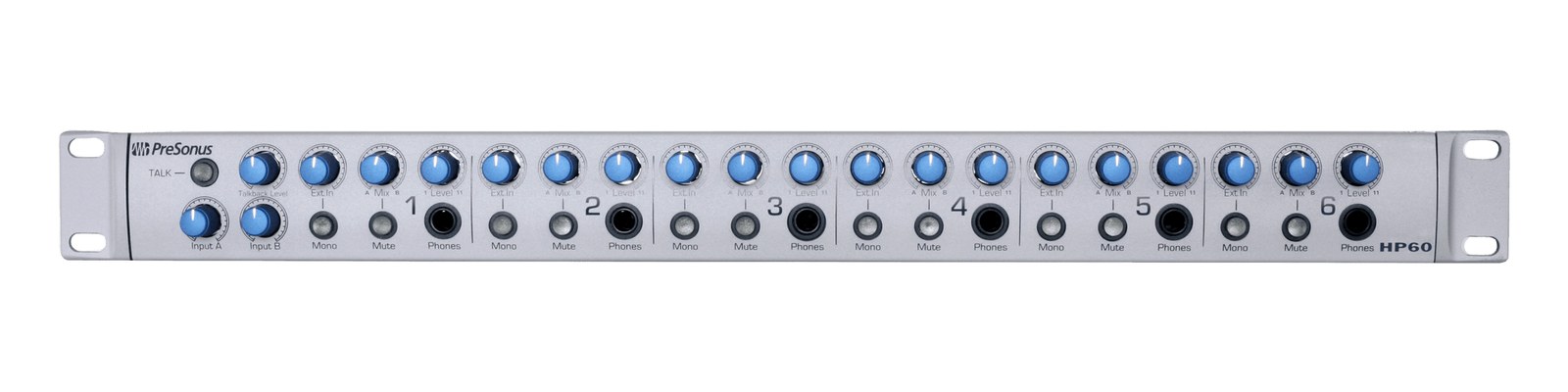
Hear Back Mix HubThe Hear Back Mix Hub is a rack-mount distribution hub that takes eight channels of analog audio via DB25 and distributes them to multiple personal mixer stations over Cat5 cabling. Each musician gets their own Hear Back mixer to create a custom blend, while the hub handles the conversion and distribution from a single 1U rack space. It is a cost-effective personal monitoring solution that scales well for bands of up to eight musicians.View gear →
06 · Resolve the questions that can change the purchase or build plan.
Planning questions
Short, source-backed answers surface rack fit, power, cabling, and connection details before they become surprises.
How will the Behringer Powerplay HA8000 Headphone Amp affect rack fit and case depth?
It occupies 1U. Its documented depth is 149 mm.
How much power does the Behringer Powerplay HA8000 Headphone Amp draw?
Typical draw is 25W and documented maximum draw is 35W.
What connections does the Behringer Powerplay HA8000 Headphone Amp have?
19 documented physical ports, including Main In L (1/4"), Main In R (1/4"), Ch 1 In (1/4"), Ch 2 In (1/4"), Ch 3 In (1/4"), Ch 4 In (1/4").
07 · See this unit inside a real rack plan.
Builder preview
Placement is only the start. Builder checks space · depth · weight, power headroom, dependencies, and compatible signal paths around this exact catalog item.Open in Builder