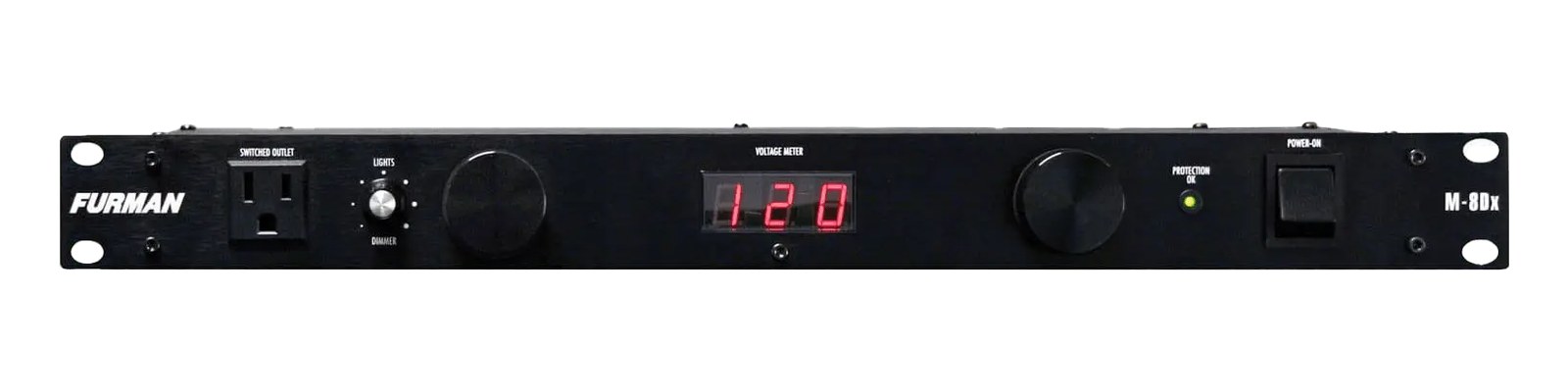
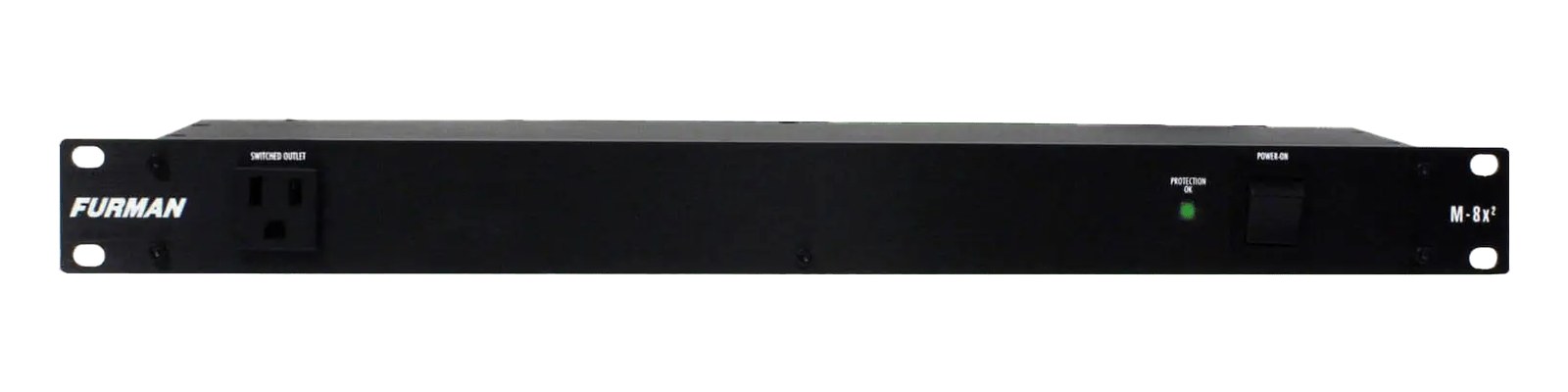
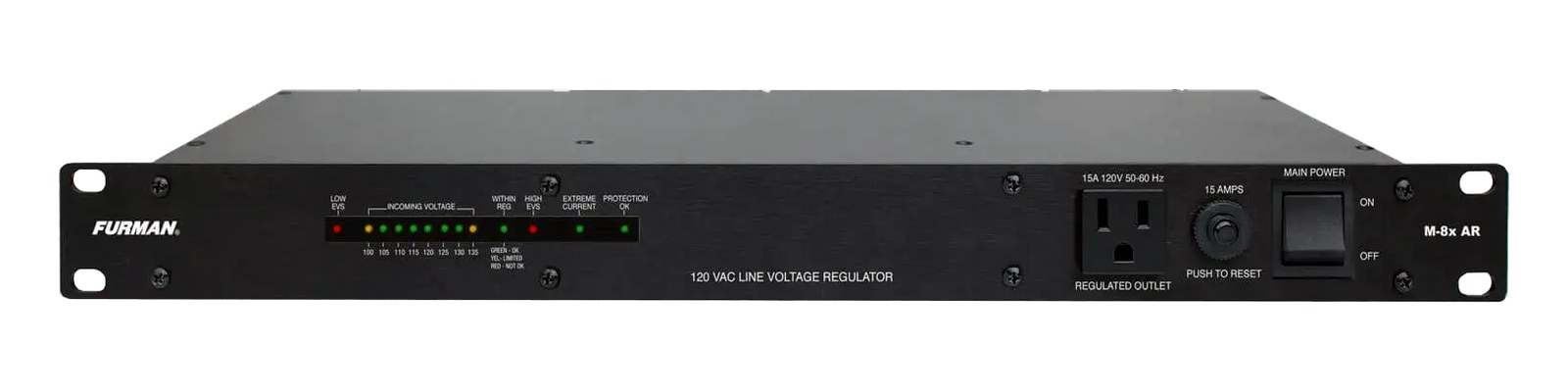
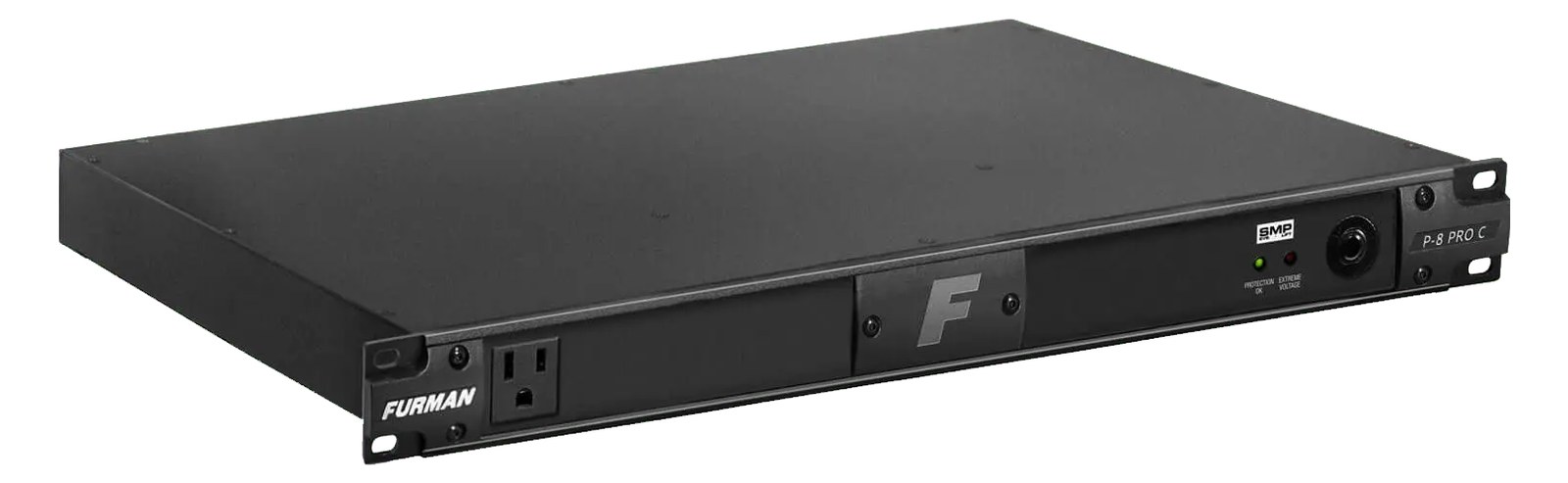
The Furman M-8Dx offers basic power conditioning with the added benefit of a front-panel digital voltmeter that lets you verify incoming power quality at a glance. Nine rear outlets provide plenty of connection points for a moderately loaded rack, and the slim design keeps your budget in check. It is the bare-minimum power conditioner for anyone who wants at least some visibility into their power situation on stage.
UnverifiedPower requirement is not verified in the catalog
Catalog estimate
~$149Use retailer rows for current price and stock
01 · What it does—and what that changes in your rig.
Product overview
Start with the payoff, then work through how it functions, where it fits, and the details that change a real build.
The payoff
Power Conditioner decisions, organized around the whole rig.
The M-8Dx is Furman's entry-level answer to a question every rack builder faces: do you trust the wall blindly, or do you put something between your gear and whatever the venue is handing you? It sits at the bottom of Furman's rackmount line and makes no pretense of being more than it is — a filtered distribution strip with a front-panel digital voltmeter. That voltmeter is the real reason to choose it over a plain power strip. At load-in, before you flip a single switch on your audio gear, you can read the incoming voltage and make an informed decision about whether to proceed.
Documented outputs
99 destination connections
Documented inputs
1Based on documented inputs
Rack space
1UBuilder checks available rail space
Furman product panel1U · Unverified
Function
How it works in the path
Nine outlets total — eight on the rear, one on the front — cover a reasonably loaded IEMIn-Ear Monitor — earpieces that replace floor wedges, feeding each player their own mix. The reason this whole rack exists. or playback rig without forcing you to daisy-chain power strips, which is exactly the habit this unit is meant to break. The 15A rating is standard single-circuit territory, so count your draw before you load it up; a transmitter rack with four or five IEM units plus a laptop, switch, and splitter will get close quickly. The 210mm depth is shallow enough to fit in most touring shallow racks without fight, and at 2.5kg it won't unbalance a lightweight build. What it does not do: it will not regulate a sagging brownout, and it is not a UPSUninterruptible Power Supply — a battery that rides the rig through brownouts and generator hiccups so computers never reboot mid-song.. Filtering here is surge and noise suppression, not voltage correction.
Best fit
Where it earns its place in the rack
This is the right call for a monitor engineer or playback operator who wants basic protection and power visibility without spending real money on a unit that will outlive several rig changes. It earns its 1UThe standard slice of rack height: 1U = 1.75″. A 3U box takes three slices; half-rack gear pairs two units side by side in one. in a club-touring IEMIn-Ear Monitor — earpieces that replace floor wedges, feeding each player their own mix. The reason this whole rack exists. rack, a rehearsal rig, or as a secondary conditioner in a larger case where a premium unit already handles the main draw. If you're working in venues with consistently questionable power — older theatres, outdoor festivals on generator — step up to a unit with Series Multi-Stage Protection and a higher surge rating. And if you need to know your rig will survive a full brownout, you need a voltage regulatorActively holds the output at a steady 120 V while venue power sags or spikes — a step beyond filtering, one short of a battery., not this.
In the rack
Details worth deciding before load-in.
Mount it at the top of the rack so the digital voltmeter is readable from standing height at load-in — check incoming voltage before powering anything else.
Use the front outlet for a laptop or phone charger that gets connected and disconnected every show, keeping rear outlets reserved for gear that stays wired.
Tally your worst-case wattage draw from every device in the rack before committing to this unit — 15A at 120V gives you roughly 1800W, and IEMIn-Ear Monitor — earpieces that replace floor wedges, feeding each player their own mix. The reason this whole rack exists. transmitter bricks add up faster than expected.
If you're on a shared stage circuit with lighting or backlineThe band’s on-stage instrument gear — amps, drums, keys. What a venue or festival sometimes supplies so you can travel light., plug a cheap outlet tester into one of the rear outlets before load-in to confirm ground integrity — the voltmeter shows voltage, not wiring faults.
02 · Know the whole path before you buy.
Signal path
Learn the route as a block diagram: source, product function, transport, and destination. Select any block to see what enters, what changes, and what leaves.
Interactive block diagramAuto-looping · hover, focus, or tap to hold a stage
Port-type signalProduct functionSystem boundary
Follow one signal from source to destination
Each block answers the same three questions: what arrives, what changes here, and what leaves.
01 · Source · selected
nema 5 15
nema 5 15
01 · Source
1 documented input
nema 5 15
Arrives as
1 documented input
Connector
nema 5 15
Signal
power
03 · What this product asks of the rest of the system.
Compatibility
Treat connector names as the start of the check—not the answer. These are the boundaries that determine a complete working path.
Best fit · Power Conditioner
Use it when 1U and 190.5 mm of depth fit the case.
Plan the companion path
Complete the path with upstream and downstream gear that matches connector, direction, signal type, protocol, and wiring standard.
Connector boundary
Documented connectors: nema 5 15. Match connector, direction, and signal type—not shape alone.
04 · Every connector, grouped by job.
I/O ports
Switch the product view and the documented port inventory updates with it—hardware and data stay side by side.
Every connector, grouped by job.
Switch panels to keep the hardware view and the documented port list in sync.
Front panelRear panel
All documented ports for Furman M-8Dx Power Conditioner
Port
Panel
Connector
Direction
Signal
Channels
LINE CORD
rear
nema 5 15
input
power
—
OUTLET 1
rear
nema 5 15
output
power
—
OUTLET 2
rear
nema 5 15
output
power
—
OUTLET 3
rear
nema 5 15
output
power
—
OUTLET 4
rear
nema 5 15
output
power
—
OUTLET 5
rear
nema 5 15
output
power
—
OUTLET 6
rear
nema 5 15
output
power
—
OUTLET 7
rear
nema 5 15
output
power
—
OUTLET 8
rear
nema 5 15
output
power
—
FRONT OUTLET
front
nema 5 15
output
power
—
Showing 10 of 10 documented physical ports.
05 · Compare the decision, not just the price.
Alternatives
The rows are organized around fit, power, I/O, and system role so a cheaper unit cannot hide a more expensive workflow.
M-8DxThe Furman M-8Dx offers basic power conditioning with the added benefit of a front-panel digital voltmeter that lets you verify incoming power quality at a glance. Nine rear outlets provide plenty of connection points for a moderately loaded rack, and the slim design keeps your budget in check. It is the bare-minimum power conditioner for anyone who wants at least some visibility into their power situation on stage.View gear →
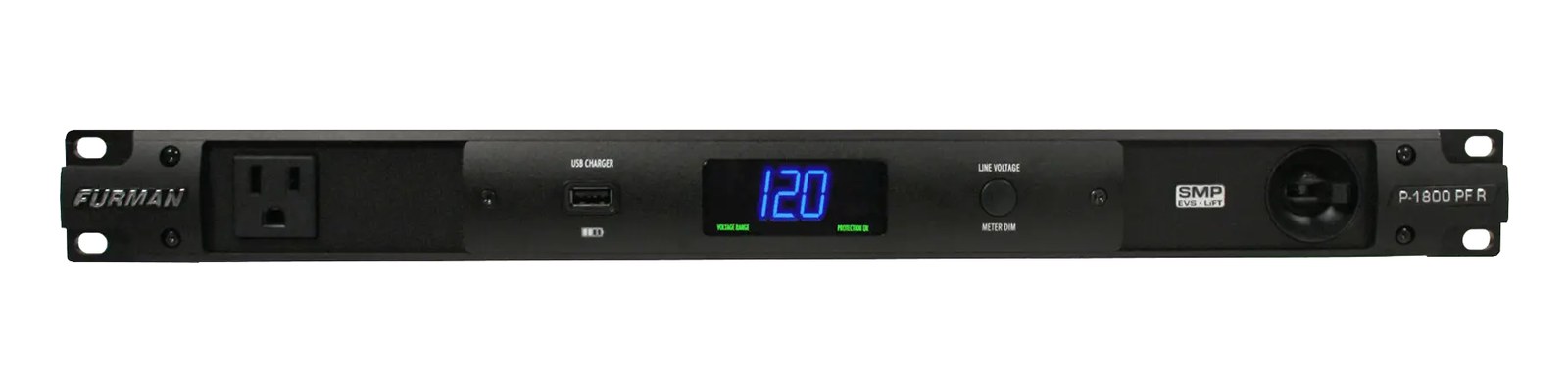
P-1800 PF RThe P-1800 PF R is Furman's premium power conditioner with Series Multi-Stage Protection (SMP) and Linear Filtering Technology (LiFT) that dramatically reduces AC noise reaching your gear. It provides a noticeably quieter noise floor compared to basic power strips, which matters when running sensitive playback interfaces and IEM transmitters. The investment over a basic conditioner is worth it for rigs where audio quality and equipment protection are priorities.View gear →
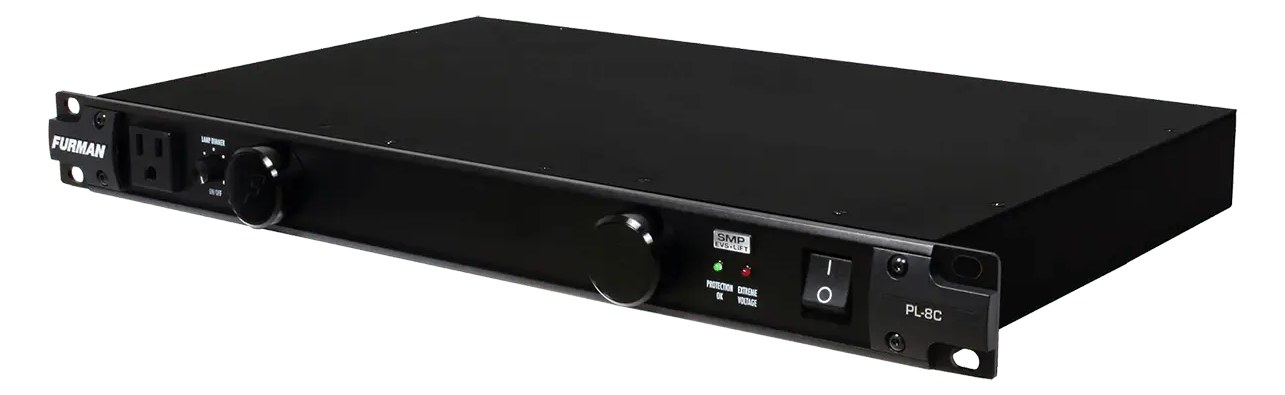
PL-8CThe Furman PL-8C is a no-frills power conditioner with pull-out rack lights that is a staple in live audio racks of all sizes. It provides basic surge protection and noise filtering for your gear while the integrated lights make it easy to work on your rack in dark stage-side environments. At this price point, it is the most practical way to add power conditioning and rack illumination to a budget build.View gear →
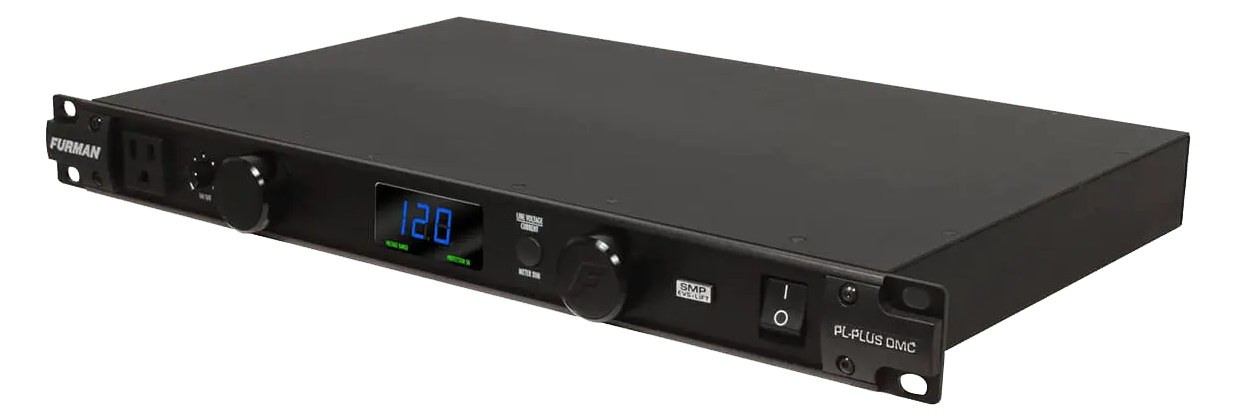
PL-Plus DMCThe Furman PL-Plus DMC is a rack staple that cleans up your AC power while giving you real-time voltage and current monitoring via its front panel meters. The pull-out rack lights are genuinely useful for dark stage-side setups, and the linear filtering protects sensitive audio and digital gear from power line noise. A smart first-piece-in for any IEM or playback rack build.View gear →
06 · Resolve the questions that can change the purchase or build plan.
Planning questions
Short, source-backed answers surface rack fit, power, cabling, and connection details before they become surprises.
How will the Furman M-8Dx Power Conditioner affect rack fit and case depth?
It occupies 1U. Its documented depth is 190.5 mm.
How much power does the Furman M-8Dx Power Conditioner draw?
Its power requirement is not yet verified in the catalog.
What connections does the Furman M-8Dx Power Conditioner have?
10 documented physical ports, including LINE CORD, OUTLET 1, OUTLET 2, OUTLET 3, OUTLET 4, OUTLET 5.
07 · See this unit inside a real rack plan.
Builder preview
Placement is only the start. Builder checks space · depth · weight, power headroom, dependencies, and compatible signal paths around this exact catalog item.Open in Builder