

Neutrik NYPD1 Patch Bay
Neutrik·Model NYPD1·neutrik-nypd1
About the Neutrik NYPD1
The Neutrik NYPD1 is a blank 1UThe standard slice of rack height: 1U = 1.75″. A 3U box takes three slices; half-rack gear pairs two units side by side in one. panel that accepts any Neutrik D-series chassis connectors, letting you build a fully custom patch panel with exactly the connector types your rig needs. Mix and match XLRThe standard 3-pin locking connector for mics and balanced line signals — pin 1 is the shield, pins 2 and 3 carry the balanced pair., etherCONAn Ethernet plug inside a rugged XLR-style locking shell — tour-grade network connections that can’t be yanked loose., USB, HDMI, BNCThe twist-lock coax connector used for word clock and antenna runs — it locks, so it can’t be pulled out mid-show., or any other D-series connector in whatever combination suits your workflow. This is the professional approach to building a custom I/O panel for rigs with non-standard connector requirements.
The NYPD1 is a blank 1UThe standard slice of rack height: 1U = 1.75″. A 3U box takes three slices; half-rack gear pairs two units side by side in one. steel panel punched to accept Neutrik's D-series chassis connectors — nothing more, nothing less. You populate it yourself with whatever combination of XLRThe standard 3-pin locking connector for mics and balanced line signals — pin 1 is the shield, pins 2 and 3 carry the balanced pair., etherCONAn Ethernet plug inside a rugged XLR-style locking shell — tour-grade network connections that can’t be yanked loose., opticalCON, BNCThe twist-lock coax connector used for word clock and antenna runs — it locks, so it can’t be pulled out mid-show., USB, HDMI, or other D-series inserts your rig actually demands. That makes it less a product and more a platform: a disciplined way to build a custom I/O face on the front or rear of a rack instead of wrestling with zip-tied pigtailsA cable that splits one multichannel connector (like a DB25) into individual plugs — the octopus that turns 8 channels into 8 XLRs. or mismatched bulkhead adapters screwed into blank panels. At $59 for the shell before connectors, it's the foundation, not the finished thing.
In practice, the NYPD1 solves the cable-management problem that shows up the moment your rig mixes signal types — say, analog sends alongside a danteThe most common audio-over-network standard: dozens of channels of uncompressed digital audio down one ordinary Ethernet cable between Dante boxes. network drop and a video feed to a confidence monitor. One panel, labeled cleanly, with every connector locked in via Neutrik's bayonet or screw retention, means load-in is a plug-and-go operation rather than a flashlight-in-mouth hunt through the back of the rack. The 100mm depth is shallow enough to fit in most touring racks without fighting rear rails, and at 1.2kg fully empty it won't upset your rack's balance even heavily populated.
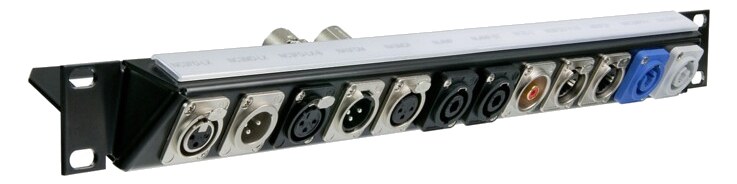
This is the right call if you're building a dedicated touring or install rig with a fixed, known I/O list — IEMIn-Ear Monitor — earpieces that replace floor wedges, feeding each player their own mix. The reason this whole rack exists. systems with a mix of analog and network connections, playback rigs that need USB and word clockThe shared heartbeat keeping every digital box sampling in lockstep. One device leads, the rest follow — or you get clicks and pops. alongside audio, or any rack where a pigtailA cable that splits one multichannel connector (like a DB25) into individual plugs — the octopus that turns 8 channels into 8 XLRs. tail is an embarrassment rather than a solution. If your I/O needs change show to show, a conventional pre-wired patch bayA panel of front-facing jacks wired to everything behind it — re-route any signal with a short cable instead of climbing behind the rack. or a simple TTTiny Telephone — the slim bantam plug pro patch bays use to fit 48+ points into a single rack space. bay will serve you better. And budget realistically: the NYPD1 shell is $59, but a fully loaded panel with six to eight quality D-series inserts will run you several times that before you're done.
In the rack
- Plan your connector layout on paper before ordering inserts — D-series cutouts are fixed spacing, and squeezing a wide HDMI insert next to a bulky etherCONAn Ethernet plug inside a rugged XLR-style locking shell — tour-grade network connections that can’t be yanked loose. can leave you one slot short of what you need.
- Use the rear-facing position for permanent tie-lines and the front for anything that gets touched at every show; the NYPD1 works equally well in either orientation.
- Label each insert with a P-touch or engraved label before the panel goes in the rack — retrofitting labels in a packed rack is a pain, and an unlabeled custom panel is useless to anyone covering your show.
- If you're mixing signal types on one panel, group by type (audio left, network center, video right) so a sub or FOHFront Of House — the main mix the audience hears, and the console position out in the room where it gets mixed. engineer can find the right connector without reading every label under pressure.
Empty 1UThe standard slice of rack height: 1U = 1.75″. A 3U box takes three slices; half-rack gear pairs two units side by side in one. D-series patch panel — accepts Neutrik D-series connectors.
I/O Ports (0)
No ports.
Related gear

Related articles
Guides from our library that cover planning around patch bay gear.

