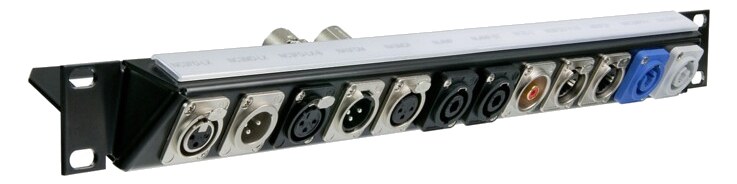
A 32-port 2U feedthrough panel — enough stage patches to 1:1 map every input of a 32-channel stage box (DL32 / S32 / Rio3224). In practice users colour-code and tape-label each port to the instrument / mic it carries ("KICK", "SNARE", "MATT VOX"), turning the front face into a rig-specific stage plot.
~$599Use retailer rows for current price and stock
01 · What it does—and what that changes in your rig.
Product overview
Start with the payoff, then work through how it functions, where it fits, and the details that change a real build.
The payoff
Patch Bay decisions, organized around the whole rig.
The NYS-SPP-32 is exactly what it looks like: a 2UThe standard slice of rack height: 1U = 1.75″. A 3U box takes three slices; half-rack gear pairs two units side by side in one. panel of 32 Neutrik feedthrough XLRThe standard 3-pin locking connector for mics and balanced line signals — pin 1 is the shield, pins 2 and 3 carry the balanced pair. connectors with nothing in between. No active circuitry, no transformersA magnetic coupling that passes audio between two windings with no wire contact — isolates splits and kills ground-loop hum, no power needed., no power draw — signal goes in one side and comes straight out the other. Its job is to give every cable coming off a 32-channel stage boxThe I/O endpoint on stage: mics plug in there and one digital line (AES50, Dante) carries everything to the console. The snake, digitized. a clean, labeled home at the rack face, turning what would otherwise be a tangle of fanoutA cable that splits one multichannel connector (like a DB25) into individual plugs — the octopus that turns 8 channels into 8 XLRs. cables at the back of your rack into a front-panel patch field you can actually work with during a show. At 60mm deep, it barely intrudes into the rack at all.
Documented outputs
00 destination connections
Documented inputs
0Based on documented inputs
Rack space
2UBuilder checks available rail space
Neutrik product panel2U · 0W
Function
How it works in the path
Thirty-two ports maps perfectly to a full DL32, S32, or Rio3224-D2 stage boxThe I/O endpoint on stage: mics plug in there and one digital line (AES50, Dante) carries everything to the console. The snake, digitized. — one connector per channel, no compromises. Because these are Neutrik feedthroughs, the locking mechanism and contact quality are the same you'd expect from any Neutrik chassis connector, which matters when a local stagehand is yanking cables in a hurry at load-in. The panel draws zero watts and weighs 2.3kg fully unpopulated, so it won't stress your rack's weight budget. What it will do is add a complete layer of wiring behind the panel — plan for that depth behind the rack before you commit the position.
Best fit
Where it earns its place in the rack
This panel earns its place in any analog or hybrid rig where you're running a full 32-channel stage boxThe I/O endpoint on stage: mics plug in there and one digital line (AES50, Dante) carries everything to the console. The snake, digitized. and want a reliable, repeatable front-panel interface — monitor worldThe side-stage domain of the monitor engineer — console, IEM racks, and everything feeding the band’s ears instead of the audience. rigs especially benefit, since the engineer needs to swap and re-patch quickly between changeovers. If your inputs are predominantly networked via DanteThe most common audio-over-network standard: dozens of channels of uncompressed digital audio down one ordinary Ethernet cable between Dante boxes. or AVBAudio Video Bridging — open network audio (MOTU, PreSonus) where the switch reserves bandwidth so streams can’t glitch. Milan is its pro profile. and you're only landing a handful of analog lines, 32 ports is overkill and a smaller 8- or 16-port panel will serve you better. Likewise, if you need normallingA patch bay default path: the top jack feeds the bottom with nothing plugged in. Inserting a cable breaks (full) or taps (half) that path. or attenuation between points, a true patchbayA panel of front-facing jacks wired to everything behind it — re-route any signal with a short cable instead of climbing behind the rack. replaces this — the NYS-SPP-32 is a feedthrough, not a signal router.
In the rack
Details worth deciding before load-in.
Label every port before the first show using laminated tape flags or a label printer — front-face labels should match your stage plot exactly (instrument name, not just a channel number) so a sub engineer can work the rack without a handoff.
Run your fanoutA cable that splits one multichannel connector (like a DB25) into individual plugs — the octopus that turns 8 channels into 8 XLRs. cables from the stage boxThe I/O endpoint on stage: mics plug in there and one digital line (AES50, Dante) carries everything to the console. The snake, digitized. to the rear connectors during pre-rig with the panel pulled slightly forward on its rack earsThe flanges that bolt gear to the rack rails. Desktop boxes without them need a shelf, tray, or drawer to live in the case.; at 60mm deep it's tight work in a dense rack and you want slack to solder or terminate without fighting the frame.
Color-code by signal group — vocals one color, drums another, commsProduction intercom — the wired or wireless party line connecting FOH, monitors, stage managers, and lighting during a show. a third — using colored cable boots or colored heat-shrink on the rear tails. At a dark monitor worldThe side-stage domain of the monitor engineer — console, IEM racks, and everything feeding the band’s ears instead of the audience. position this distinction is faster to read than any label.
Position this panel immediately adjacent to the stage-box input on your console or interface so the patch path is as short as possible; excess cable looped behind the rack is a noise and strain-relief liability on a touring rig.
02 · Know the whole path before you buy.
Signal path
Learn the route as a block diagram: source, product function, transport, and destination. Select any block to see what enters, what changes, and what leaves.
Interactive block diagramAuto-looping · hover, focus, or tap to hold a stage
Port-type signalProduct functionSystem boundary
Follow one signal from source to destination
Each block answers the same three questions: what arrives, what changes here, and what leaves.
01 · Connection · selected
XLR female
01 · Connection
32 bidirectional connections
XLR female
Connection
32 bidirectional ports
Connector
XLR female
Signal
analog audio
03 · What this product asks of the rest of the system.
Compatibility
Treat connector names as the start of the check—not the answer. These are the boundaries that determine a complete working path.
Best fit · Patch Bay
Use it when 2U and 60 mm of depth fit the case.
Plan the companion path
Complete the path with upstream and downstream gear that matches connector, direction, signal type, protocol, and wiring standard.
Connector boundary
Documented connectors: XLR female. Match connector, direction, and signal type—not shape alone.
04 · Every connector, grouped by job.
I/O ports
Switch the product view and the documented port inventory updates with it—hardware and data stay side by side.
Every connector, grouped by job.
Switch panels to keep the hardware view and the documented port list in sync.
Front panelRear panel
All documented ports for Neutrik 32-Port XLR Pass-Thru Panel
Port
Panel
Connector
Direction
Signal
Channels
Stage Patch 1
rear
XLR female
bidirectional
analog audio
—
Stage Patch 2
rear
XLR female
bidirectional
analog audio
—
Stage Patch 3
rear
XLR female
bidirectional
analog audio
—
Stage Patch 4
rear
XLR female
bidirectional
analog audio
—
Stage Patch 5
rear
XLR female
bidirectional
analog audio
—
Stage Patch 6
rear
XLR female
bidirectional
analog audio
—
Stage Patch 7
rear
XLR female
bidirectional
analog audio
—
Stage Patch 8
rear
XLR female
bidirectional
analog audio
—
Stage Patch 9
rear
XLR female
bidirectional
analog audio
—
Stage Patch 10
rear
XLR female
bidirectional
analog audio
—
Stage Patch 11
rear
XLR female
bidirectional
analog audio
—
Stage Patch 12
rear
XLR female
bidirectional
analog audio
—
Stage Patch 13
rear
XLR female
bidirectional
analog audio
—
Stage Patch 14
rear
XLR female
bidirectional
analog audio
—
Stage Patch 15
rear
XLR female
bidirectional
analog audio
—
Stage Patch 16
rear
XLR female
bidirectional
analog audio
—
Stage Patch 17
rear
XLR female
bidirectional
analog audio
—
Stage Patch 18
rear
XLR female
bidirectional
analog audio
—
Stage Patch 19
rear
XLR female
bidirectional
analog audio
—
Stage Patch 20
rear
XLR female
bidirectional
analog audio
—
Stage Patch 21
rear
XLR female
bidirectional
analog audio
—
Stage Patch 22
rear
XLR female
bidirectional
analog audio
—
Stage Patch 23
rear
XLR female
bidirectional
analog audio
—
Stage Patch 24
rear
XLR female
bidirectional
analog audio
—
Stage Patch 25
rear
XLR female
bidirectional
analog audio
—
Stage Patch 26
rear
XLR female
bidirectional
analog audio
—
Stage Patch 27
rear
XLR female
bidirectional
analog audio
—
Stage Patch 28
rear
XLR female
bidirectional
analog audio
—
Stage Patch 29
rear
XLR female
bidirectional
analog audio
—
Stage Patch 30
rear
XLR female
bidirectional
analog audio
—
Stage Patch 31
rear
XLR female
bidirectional
analog audio
—
Stage Patch 32
rear
XLR female
bidirectional
analog audio
—
Showing 32 of 32 documented physical ports. Scroll to review the remaining rows.
05 · Compare the decision, not just the price.
Alternatives
The rows are organized around fit, power, I/O, and system role so a cheaper unit cannot hide a more expensive workflow.
NYS-SPP-32A 32-port 2U feedthrough panel — enough stage patches to 1:1 map every input of a 32-channel stage box (DL32 / S32 / Rio3224). In practice users colour-code and tape-label each port to the instrument / mic it carries ("KICK", "SNARE", "MATT VOX"), turning the front face into a rig-specific stage plot.View gear →
NZP1RU-12The Neutrik NZP1RU-12 provides a clean row of 12 XLR pass-throughs from front to rear panel, making it easy to present organized connections on the back of your rack while keeping the front accessible for patching. Neutrik connectors ensure reliable, road-worthy connections. This is essential infrastructure for any touring rack where you want quick, repeatable hookups at each venue.View gear →
NYS-SPP-16A purely passive 1U rack panel with 16 Neutrik feedthrough XLR connectors — one side on the rack face (labeled stage patch points), the other inside the rack (pre-wired to the stage box). Used to keep stage-box connectors protected inside the rack while giving crew easy, labeled XLR access on the rack face. Colored tape or dust caps on each port identify the role ("M GTR 4", "B VOX", "Song Trax 2") — per-instance port rename on these ports turns the panel into a rig-specific stage map.View gear →
NYS-SPP-24The 24-port sibling of the 16-port panel. Two rows of twelve Neutrik feedthroughs on a 2U face, giving enough stage patches for a full-band rig with room to spare for playback tracks and comms. Pair with a 32-input stage box (DL32 / S32 / Rio3224) and tape-label each port to make the rig self-documenting at load-in.View gear →
Placement is only the start. Builder checks space · depth · weight, power headroom, dependencies, and compatible signal paths around this exact catalog item.Open in Builder