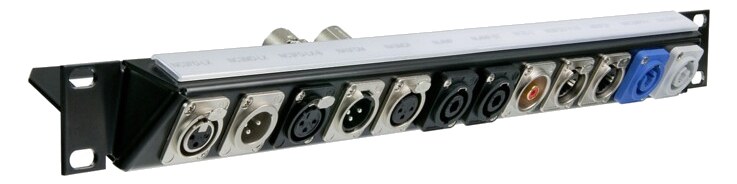
The Switchcraft MMVP is a professional-grade TT (bantam) patch bay offering 48 patch points in a single rack unit. The normalled configuration means signals pass straight through until you patch over them, which is perfect for establishing default signal routing in your rack while maintaining the flexibility to re-route on the fly. A staple in studio and broadcast installations that also works well in complex playback rigs.
~$249Use retailer rows for current price and stock
01 · What it does—and what that changes in your rig.
Product overview
Start with the payoff, then work through how it functions, where it fits, and the details that change a real build.
The payoff
Patch Bay decisions, organized around the whole rig.
The Switchcraft MMVP is a 48-point TTTiny Telephone — the slim bantam plug pro patch bays use to fit 48+ points into a single rack space. (bantam) patch bayA panel of front-facing jacks wired to everything behind it — re-route any signal with a short cable instead of climbing behind the rack. in a single rack unitThe standard slice of rack height: 1U = 1.75″. A 3U box takes three slices; half-rack gear pairs two units side by side in one. — the kind of piece that turns a collection of gear into an actual system. Its job is simple in concept and indispensable in practice: it gives you a central place to establish and override signal routing without touching the gear itself. In a complex playback rig or a dense IEMIn-Ear Monitor — earpieces that replace floor wedges, feeding each player their own mix. The reason this whole rack exists. rack with multiple consoles, virtual soundchecksPlaying a recorded show back through the console as if the band were on stage — dial in mixes before anyone plugs in., and backup sources, having all your analog connections terminate in one normalledA patch bay default path: the top jack feeds the bottom with nothing plugged in. Inserting a cable breaks (full) or taps (half) that path. bay means you can change routing mid-show with a single patch cord rather than crawling behind the rack.
Documented outputs
00 destination connections
Documented inputs
0Based on documented inputs
Rack space
1UBuilder checks available rail space
Switchcraft product panel1U · 0W
Function
How it works in the path
The normalledA patch bay default path: the top jack feeds the bottom with nothing plugged in. Inserting a cable breaks (full) or taps (half) that path. configuration is the key operational detail here. In normal operation, top-row signals pass straight through to the corresponding bottom-row destinations — your default routing is always active without a cable plugged in. Insert a TTTiny Telephone — the slim bantam plug pro patch bays use to fit 48+ points into a single rack space. patch cord into either jack and you break the normal, redirecting signal on the fly. At 90mm deep and 1.3kg, this bay is genuinely shallow and light, which matters when you're stacking it into a road case with tight rear-cable clearance. It draws zero power, so it adds nothing to your PDU load and needs no rack space planning beyond the single U.
Best fit
Where it earns its place in the rack
The MMVP is the right call if you're running a rig complex enough to need analog routing flexibility — think multi-source playback rigs, hybrid console setups, or any situation where your default signal path might need to change between acts without a re-patch at the gear. It is not the right call if your entire rig runs on a single digital snakeA multicore cable bundling many channels into one stage-to-console run. A sub-snake collects one corner of the stage into a drop box. or if all your routing lives inside a console or DAWDigital Audio Workstation — the recording and playback software (Logic, Ableton Live, Pro Tools) at the center of a computer rig.. And be clear: TTTiny Telephone — the slim bantam plug pro patch bays use to fit 48+ points into a single rack space. format requires TT patch cords and TT-terminated tails off your gear — if your rack is already built around quarter-inch TRSTip-Ring-Sleeve — a 1/4″ jack with three contacts carrying a balanced signal or a stereo pair. A guitar plug with one extra ring. infrastructure, you'll be fighting the format from day one.
In the rack
Details worth deciding before load-in.
Label both rows of the bay before the rig goes on the road — use consistent color-coded TTTiny Telephone — the slim bantam plug pro patch bays use to fit 48+ points into a single rack space. cords (e.g., red for sends, black for returns) so anyone touching the bay mid-show can read it without a legend.
At 90mm depth, rear cable dressing is tight but manageable — use right-angle TTTiny Telephone — the slim bantam plug pro patch bays use to fit 48+ points into a single rack space. connectors on your loomSeveral cables bundled and run as one — keeps rack interconnects tidy and makes load-in one grab instead of eight. if you're working inside a shallow pull-out drawer or a lid-load case with limited rear clearance.
Map the normal path on paper first: top row is typically your sources, bottom row your destinations. Committing to a consistent convention across the whole rig means a substitute tech can troubleshoot the bay without calling you.
Place it near the middle of the rack vertically if possible — TTTiny Telephone — the slim bantam plug pro patch bays use to fit 48+ points into a single rack space. patch cords are short by nature, and positioning the bay closer to the gear it serves reduces the chance of a cord pulling a jack loose during a fast changeover.
02 · Know the whole path before you buy.
Signal path
Learn the route as a block diagram: source, product function, transport, and destination. Select any block to see what enters, what changes, and what leaves.
Interactive block diagramAuto-looping · hover, focus, or tap to hold a stage
Port-type signalProduct functionSystem boundary
Follow one signal from source to destination
Each block answers the same three questions: what arrives, what changes here, and what leaves.
01 · Connection · selected
¼-inch TRS
01 · Connection
2 bidirectional connections
¼-inch TRS
Connection
2 bidirectional ports
Connector
¼-inch TRS
Signal
analog audio
03 · What this product asks of the rest of the system.
Compatibility
Treat connector names as the start of the check—not the answer. These are the boundaries that determine a complete working path.
Best fit · Patch Bay
Use it when 1U and 90 mm of depth fit the case.
Plan the companion path
Complete the path with upstream and downstream gear that matches connector, direction, signal type, protocol, and wiring standard.
Connector boundary
Documented connectors: ¼-inch TRS. Match connector, direction, and signal type—not shape alone.
04 · Every connector, grouped by job.
I/O ports
Switch the product view and the documented port inventory updates with it—hardware and data stay side by side.
Every connector, grouped by job.
Switch panels to keep the hardware view and the documented port list in sync.
Front panelRear panel
All documented ports for Switchcraft MMVP TRS Patch Bay
Port
Panel
Connector
Direction
Signal
Channels
Top Row 1-24 (TT)
rear
¼-inch TRS
bidirectional
analog audio
24
Bottom Row 1-24 (TT)
rear
¼-inch TRS
bidirectional
analog audio
24
Showing 2 of 2 documented physical ports.
05 · Compare the decision, not just the price.
Alternatives
The rows are organized around fit, power, I/O, and system role so a cheaper unit cannot hide a more expensive workflow.
MMVPThe Switchcraft MMVP is a professional-grade TT (bantam) patch bay offering 48 patch points in a single rack unit. The normalled configuration means signals pass straight through until you patch over them, which is perfect for establishing default signal routing in your rack while maintaining the flexibility to re-route on the fly. A staple in studio and broadcast installations that also works well in complex playback rigs.View gear →
R196-D25NFThe Redco R196 breakout panel converts a single DB25 connector on the rear into eight individual XLR connections on the front, which is essential when interfacing DB25-equipped gear like the Apollo x16 or RedNet A16R with standard XLR cables. It eliminates the need for bulky DB25 fan-out snakes dangling from the back of your rack. One panel per DB25 port keeps your wiring tidy and professional.View gear →
06 · Resolve the questions that can change the purchase or build plan.
Planning questions
Short, source-backed answers surface rack fit, power, cabling, and connection details before they become surprises.
How will the Switchcraft MMVP TRS Patch Bay affect rack fit and case depth?
It occupies 1U. Its documented depth is 90 mm.
How much power does the Switchcraft MMVP TRS Patch Bay draw?
It is verified passive and requires no AC power.
What connections does the Switchcraft MMVP TRS Patch Bay have?
2 documented physical ports, including Top Row 1-24 (TT), Bottom Row 1-24 (TT).
07 · See this unit inside a real rack plan.
Builder preview
Placement is only the start. Builder checks space · depth · weight, power headroom, dependencies, and compatible signal paths around this exact catalog item.Open in Builder