

Neutrik 24-Port XLR Pass-Thru Panel
Neutrik·Model NYS-SPP-24·neutrik-xlr-panel-24
About the Neutrik NYS-SPP-24
The 24-port sibling of the 16-port panel. Two rows of twelve Neutrik feedthroughs on a 2UThe standard slice of rack height: 1U = 1.75″. A 3U box takes three slices; half-rack gear pairs two units side by side in one. face, giving enough stage patches for a full-band rig with room to spare for playback tracks and commsProduction intercom — the wired or wireless party line connecting FOH, monitors, stage managers, and lighting during a show.. Pair with a 32-input stage boxThe I/O endpoint on stage: mics plug in there and one digital line (AES50, Dante) carries everything to the console. The snake, digitized. (DL32 / S32 / Rio3224) and tape-label each port to make the rig self-documenting at load-in.
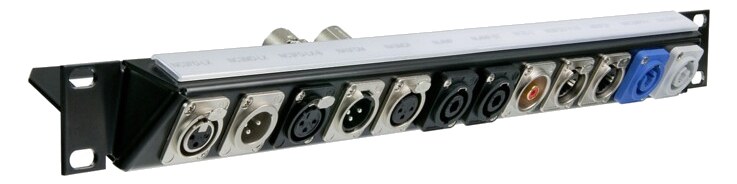
The NYS-SPP-24 is a 2UThe standard slice of rack height: 1U = 1.75″. A 3U box takes three slices; half-rack gear pairs two units side by side in one. pass-through panel — nothing more, nothing less. Twenty-four Neutrik feedthrough XLRsThe standard 3-pin locking connector for mics and balanced line signals — pin 1 is the shield, pins 2 and 3 carry the balanced pair., female on both faces, wired straight through with no active circuitry, no power draw, no conversion happening inside the box. Its job is to give your rack a single, organized termination point where the stage snakeA multicore cable bundling many channels into one stage-to-console run. A sub-snake collects one corner of the stage into a drop box. meets your gear, so you're not chasing loose cables through the back of the rack at every load-in. For a full-band IEMIn-Ear Monitor — earpieces that replace floor wedges, feeding each player their own mix. The reason this whole rack exists. rig or a playback setup that also handles commsProduction intercom — the wired or wireless party line connecting FOH, monitors, stage managers, and lighting during a show. and click distribution, 24 ports is a genuinely useful number.
At 60mm deep and 1.8kg, this panel fits comfortably in a shallow touring rack without fighting for depth against your wireless gear or IEMIn-Ear Monitor — earpieces that replace floor wedges, feeding each player their own mix. The reason this whole rack exists. transmitters. Because it's purely passive, it sits anywhere in the rack without thermal or power-sequencing concerns. The practical math: 24 ports covers a typical six- or seven-piece band input list plus a handful of sends back to stage — mix busA path where multiple channels sum into one signal — mixes, groups, and mains are all buses. A 25-bus console can build 25 blends at once. outputs to floor wedgesA floor monitor speaker angled up at the performer — the thing IEMs replace, and the thing you fall back on when they die., click to drummer, talk-back return — with a few ports left over for playback stemsSub-mixes of a session grouped by instrument (drums, keys, vocals) — how playback rigs run tracks with live control over each group. or a commsProduction intercom — the wired or wireless party line connecting FOH, monitors, stage managers, and lighting during a show. channel. That headroomThe margin between your normal level and where things clip — headroom is what absorbs the snare hit you didn’t see coming. matters when production adds a track the morning of show.
This panel belongs in a rig where analog signal routing between the stage boxThe I/O endpoint on stage: mics plug in there and one digital line (AES50, Dante) carries everything to the console. The snake, digitized. and rack gear needs to be clean, repeatable, and immediately readable by anyone walking up to the rack. If your rig is already fully networked with a single Cat6Standard network cable grades. In an audio rig one cheap Cat5e run can replace a 48-channel copper snake; AES50 wants it shielded. snakeA multicore cable bundling many channels into one stage-to-console run. A sub-snake collects one corner of the stage into a drop box. and no analog splits, you don't need it. If you're running fewer than sixteen inputs and outputs combined, the 16-port sibling saves you a rack unitThe standard slice of rack height: 1U = 1.75″. A 3U box takes three slices; half-rack gear pairs two units side by side in one.. But if you're on a full-band tour or corporate show where a local stagehand needs to patch into your system without your supervision, the NYS-SPP-24 is the thing that makes that safe.
In the rack
- Tape-label every port on both front and rear faces during your pre-production cable build — not at the venue. A labelmaker legend like 'IN 01 / Kick' on the front and the corresponding stage-box channel on the rear turns this panel into a self-documenting patch sheet that any local crew can follow.
- Position it at the bottom of the rack so stage snakeA multicore cable bundling many channels into one stage-to-console run. A sub-snake collects one corner of the stage into a drop box. cables drop naturally into it without straining connectors or creating tension loops that work loose over a run of shows.
- Pair rear-side cable runs with 90-degree XLRThe standard 3-pin locking connector for mics and balanced line signals — pin 1 is the shield, pins 2 and 3 carry the balanced pair. adapters if your rack depth is tight — the panel is only 60mm deep, but a straight plug plus cable can easily add another 80–100mm behind it.
- Reserve two or three ports explicitly for spares during your initial layout, labeled 'SPARE' on both faces. On a long run, you'll burn one of those the night a channel goes down and you need to re-route around a failed preampThe gain stage that lifts a mic’s tiny signal up to line level — the first thing a signal hits, and a big part of how a console sounds. input without rebuilding the patch during soundcheck.
2UThe standard slice of rack height: 1U = 1.75″. A 3U box takes three slices; half-rack gear pairs two units side by side in one. rack panel with 24 Neutrik feedthrough XLRThe standard 3-pin locking connector for mics and balanced line signals — pin 1 is the shield, pins 2 and 3 carry the balanced pair. connectors.
I/O Ports (24)
| Port | Connector | Direction | Signal | Channels |
|---|---|---|---|---|
| Stage Patch 1 | XLR FEMALE | bidirectional | analog audio | — |
| Stage Patch 2 | XLR FEMALE | bidirectional | analog audio | — |
| Stage Patch 3 | XLR FEMALE | bidirectional | analog audio | — |
| Stage Patch 4 | XLR FEMALE | bidirectional | analog audio | — |
| Stage Patch 5 | XLR FEMALE | bidirectional | analog audio | — |
| Stage Patch 6 | XLR FEMALE | bidirectional | analog audio | — |
| Stage Patch 7 | XLR FEMALE | bidirectional | analog audio | — |
| Stage Patch 8 | XLR FEMALE | bidirectional | analog audio | — |
| Stage Patch 9 | XLR FEMALE | bidirectional | analog audio | — |
| Stage Patch 10 | XLR FEMALE | bidirectional | analog audio | — |
| Stage Patch 11 | XLR FEMALE | bidirectional | analog audio | — |
| Stage Patch 12 | XLR FEMALE | bidirectional | analog audio | — |
| Stage Patch 13 | XLR FEMALE | bidirectional | analog audio | — |
| Stage Patch 14 | XLR FEMALE | bidirectional | analog audio | — |
| Stage Patch 15 | XLR FEMALE | bidirectional | analog audio | — |
| Stage Patch 16 | XLR FEMALE | bidirectional | analog audio | — |
| Stage Patch 17 | XLR FEMALE | bidirectional | analog audio | — |
| Stage Patch 18 | XLR FEMALE | bidirectional | analog audio | — |
| Stage Patch 19 | XLR FEMALE | bidirectional | analog audio | — |
| Stage Patch 20 | XLR FEMALE | bidirectional | analog audio | — |
| Stage Patch 21 | XLR FEMALE | bidirectional | analog audio | — |
| Stage Patch 22 | XLR FEMALE | bidirectional | analog audio | — |
| Stage Patch 23 | XLR FEMALE | bidirectional | analog audio | — |
| Stage Patch 24 | XLR FEMALE | bidirectional | analog audio | — |
Deciding between two?
Rack space, watts, weight and every connector, side by side.
Related gear

Related articles
Guides from our library that cover planning around patch bay gear.

