

Neutrik NZP1RU-12 XLR Patch Panel
Neutrik·Model NZP1RU-12·neutrik-nzp1ru-12
Photos
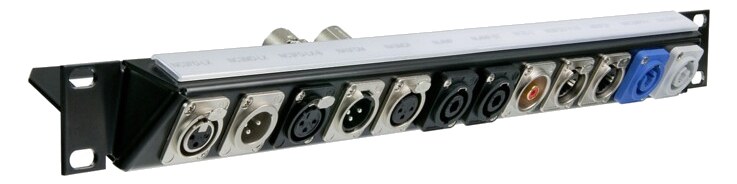
Manufacturer product photography — the drawn faceplate above stays true to panel layout; these show the hardware itself.
About the Neutrik NZP1RU-12
The Neutrik NZP1RU-12 provides a clean row of 12 XLRThe standard 3-pin locking connector for mics and balanced line signals — pin 1 is the shield, pins 2 and 3 carry the balanced pair. pass-throughs from front to rear panel, making it easy to present organized connections on the back of your rack while keeping the front accessible for patching. Neutrik connectors ensure reliable, road-worthy connections. This is essential infrastructure for any touring rack where you want quick, repeatable hookups at each venue.
The NZP1RU-12 is infrastructure, not a feature — it's the panel that turns the back of your rack from a tangle of cables plugged directly into gear into a single, organized presentation point. Twelve XLRThe standard 3-pin locking connector for mics and balanced line signals — pin 1 is the shield, pins 2 and 3 carry the balanced pair. female jacks on the front pass straight through to twelve on the rear, all in a single rack unitThe standard slice of rack height: 1U = 1.75″. A 3U box takes three slices; half-rack gear pairs two units side by side in one. at just 50mm deep. At every venue, the house snakeA multicore cable bundling many channels into one stage-to-console run. A sub-snake collects one corner of the stage into a drop box., your personal sends, and your IEMIn-Ear Monitor — earpieces that replace floor wedges, feeding each player their own mix. The reason this whole rack exists. returns all land in the same numbered jacks in the same order. That repeatability is what you're actually buying.
Fifty millimeters of depth means this panel lives comfortably even in a shallow road case without fighting for space behind your wireless gear or personal mixers. At 0.9 kg it adds almost nothing to your carry weight. Because it's purely passive — no power draw whatsoever — it contributes zero noise and introduces no failure mode beyond a bent pin. The Neutrik connectors are the same chassis-mount hardware found across professional touring infrastructure, so latch engagement and pin contact are consistent and reliable through hundreds of plug cycles. Twelve channels covers a typical IEMIn-Ear Monitor — earpieces that replace floor wedges, feeding each player their own mix. The reason this whole rack exists. rig cleanly: stereo mix outputs, a few aux sendsAn auxiliary mix output — each aux is its own independent blend of the channels, typically one per monitor mix or effects send., commsProduction intercom — the wired or wireless party line connecting FOH, monitors, stage managers, and lighting during a show., and click — all terminated at the rear without crawling behind the rack mid-show.
This panel belongs in any touring or fly-date rack where your cabling changes venue to venue but your internal signal flow doesn't. If your rig stays in a fixed install, the patch panel solves a problem you don't really have. If you're running more than twelve analog connections regularly, you'll want a second unit or a higher-count alternative — there's no expandability here, just a clean twelve. Engineers who run mostly digital snakesA multicore cable bundling many channels into one stage-to-console run. A sub-snake collects one corner of the stage into a drop box. and only a handful of analog handoffs may find twelve more than enough; engineers on large broadcast or festival rigs with dense analog I/O may find it a starting point rather than a complete solution.
In the rack
- Label both front and rear jacks with the same numbering scheme before the first show — a P-touch or Dymo label on each port eliminates mispatches at load-in when someone else is plugging in the snakeA multicore cable bundling many channels into one stage-to-console run. A sub-snake collects one corner of the stage into a drop box..
- Use the rear connections as your permanent internal wiring and the front as your venue-facing patch points; coil and secure the rear pigtailsA cable that splits one multichannel connector (like a DB25) into individual plugs — the octopus that turns 8 channels into 8 XLRs. so they never need to move again after initial rack build.
- At 50mm deep, this panel can sit in the very top or bottom unit of a shallow case without protruding — keep it away from the middle of the rack where depth competition with power supplies or wireless receivers is highest.
- Run a short female-to-female XLRThe standard 3-pin locking connector for mics and balanced line signals — pin 1 is the shield, pins 2 and 3 carry the balanced pair. turnaround on any unused front jacks during shows to protect the pins and signal that the channel is intentionally dark, not a patching mistake.
12x XLRThe standard 3-pin locking connector for mics and balanced line signals — pin 1 is the shield, pins 2 and 3 carry the balanced pair. feed-through patch panel (front to rear).
I/O Ports (12)
| Port | Connector | Direction | Signal | Channels |
|---|---|---|---|---|
| XLR 1 | XLR FEMALE | bidirectional | analog audio | — |
| XLR 2 | XLR FEMALE | bidirectional | analog audio | — |
| XLR 3 | XLR FEMALE | bidirectional | analog audio | — |
| XLR 4 | XLR FEMALE | bidirectional | analog audio | — |
| XLR 5 | XLR FEMALE | bidirectional | analog audio | — |
| XLR 6 | XLR FEMALE | bidirectional | analog audio | — |
| XLR 7 | XLR FEMALE | bidirectional | analog audio | — |
| XLR 8 | XLR FEMALE | bidirectional | analog audio | — |
| XLR 9 | XLR FEMALE | bidirectional | analog audio | — |
| XLR 10 | XLR FEMALE | bidirectional | analog audio | — |
| XLR 11 | XLR FEMALE | bidirectional | analog audio | — |
| XLR 12 | XLR FEMALE | bidirectional | analog audio | — |
Deciding between two?
Rack space, watts, weight and every connector, side by side.
Related gear
Related articles
Guides from our library that cover planning around patch bay gear.

