
QSC PLD4.5 Touring Amplifier
QSC·Model PLD4.5·qsc-pld4-5
About the QSC PLD4.5
The QSC PLD4.5 is a workhorse four-channel touring amplifier with FlexAmp — assignable power across channels so 4 × 1125W or 1 × 4500W are all valid configurations. Onboard DSPDigital Signal Processing — the number-crunching that does EQ, compression, and effects inside a box. More DSP means more processing at once. handles crossoverSplits audio into frequency bands so each speaker only gets what it can handle — lows to the subs, highs to the horns., EQ, limiterA compressor with a hard ceiling: nothing gets past the level you set. In an IEM rig it’s hearing protection as much as tone., and delay; remote control over Ethernet keeps the amp room manageable from FOHFront Of House — the main mix the audience hears, and the console position out in the room where it gets mixed.. Used heavily on regional touring and corporate AV — popular for monitor amp racks and sub arrays where flexible channel grouping pays for itself.
The PLD4.5 is QSC's answer to the question every monitor engineer eventually asks: how do you put serious power and speaker management into a two-rack-unit box without compromising either? Four discrete analog XLRThe standard 3-pin locking connector for mics and balanced line signals — pin 1 is the shield, pins 2 and 3 carry the balanced pair. inputs feed four independent channels, each with its own Speakon output, and the onboard DSPDigital Signal Processing — the number-crunching that does EQ, compression, and effects inside a box. More DSP means more processing at once. covers crossoverSplits audio into frequency bands so each speaker only gets what it can handle — lows to the subs, highs to the horns., parametric EQAn EQ where you dial the exact frequency, width, and cut or boost — surgical control next to a graphic’s fixed sliders., limiting, and delay — meaning you can leave a separate processor out of the chain entirely for many monitor applications. The FlexAmp architecture is the headline feature: total power across the four channels is a shared 4500W pool, so you can run four equal wedgeA floor monitor speaker angled up at the performer — the thing IEMs replace, and the thing you fall back on when they die. channels, collapse to a bridged sub pair, or mix the two within the same chassis.
At load-in, the Ethernet port is where this amp earns its keep. Remote control means you can verify gainHow much the preamp amplifies the incoming signal. Too low and you’re hunting through hiss; too high and peaks clip. structure, check limiterA compressor with a hard ceiling: nothing gets past the level you set. In an IEM rig it’s hearing protection as much as tone. thresholds, and mute individual channels from FOHFront Of House — the main mix the audience hears, and the console position out in the room where it gets mixed. without walking the stage — critical when your monitor racks are buried in a drum riser or behind a line array. The 600W idle draw is civilized for a four-channel touring amp; the 4500W peak draw means you need to plan your distroOne pair of antennas feeding many receivers through an amplified splitter — replaces the forest of whips and keeps RF levels consistent. honestly and not share a 20A circuit with anything else that breathes. At 14.5 kg and 482 mm deep, it fits most standard touring racks but will challenge a shallow road case — measure before you commit.
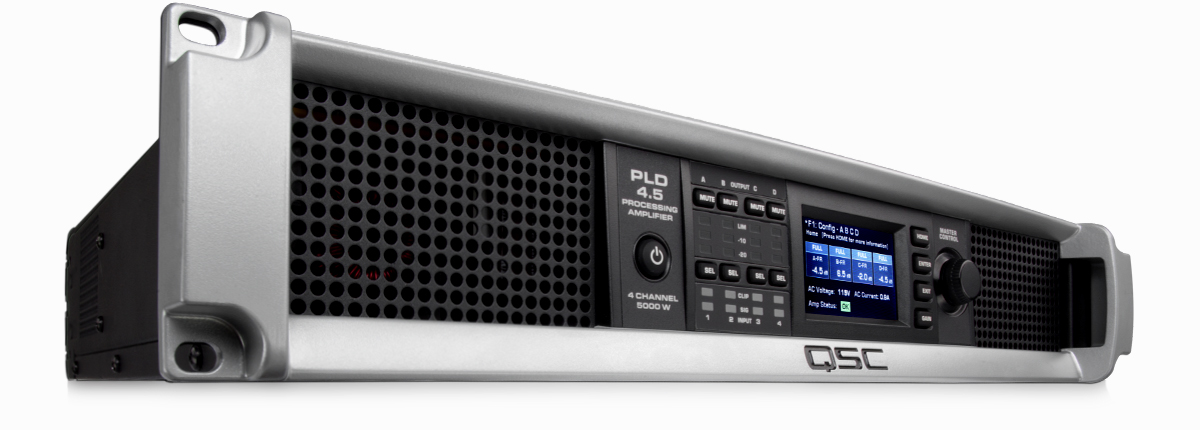
If you're building a dedicated monitor amp rack for a regional or corporate touring rig and want DSPDigital Signal Processing — the number-crunching that does EQ, compression, and effects inside a box. More DSP means more processing at once., flexible power routing, and remote control consolidated into two rack unitsThe standard slice of rack height: 1U = 1.75″. A 3U box takes three slices; half-rack gear pairs two units side by side in one., this is a strong fit. It also makes sense as a sub-amp where bridged pairs and independent high-pass outputs on the remaining channels let one box handle full bottom-end duties. Where it's overkill: studio monitoring rigs, fixed install where the budget doesn't justify the touring-grade cost, or rigs where you already have a robust external DSP speaker controller and don't need the onboard processing. In those cases a simpler, cheaper four-channel amp likely serves better.
In the rack
- Plan your power distroOne pair of antennas feeding many receivers through an amplified splitter — replaces the forest of whips and keeps RF levels consistent. before racking: 4500W peak means this amp needs its own dedicated 20A circuit — don't share with consoles, drives, or RFRadio Frequency — the wireless part of wireless. RF planning is why big rigs scan, coordinate, and combine antennas instead of hoping. gear.
- Use the Ethernet control during soundcheck to set per-channel limitersA compressor with a hard ceiling: nothing gets past the level you set. In an IEM rig it’s hearing protection as much as tone. matched to your wedgeA floor monitor speaker angled up at the performer — the thing IEMs replace, and the thing you fall back on when they die. or sub drivers, then lock the front panel so gainHow much the preamp amplifies the incoming signal. Too low and you’re hunting through hiss; too high and peaks clip. can't be bumped during the show.
- When bridging two channels for a sub pair, use the remaining two channels for stage sidefills — FlexAmp lets you run that configuration cleanly without wasting headroomThe margin between your normal level and where things clip — headroom is what absorbs the snare hit you didn’t see coming. on unused channels.
- At 482 mm depth, verify your road case interior depth before building the rack — some standard 22U tour cases run closer to 460 mm usable depth and will require a deeper case or front/rear offset rails.
Four-channel 4500W touring amp. FlexAmp power assignment + onboard DSPDigital Signal Processing — the number-crunching that does EQ, compression, and effects inside a box. More DSP means more processing at once..
I/O Ports (10)
| Port | Connector | Direction | Signal | Channels |
|---|---|---|---|---|
| Input A (XLR) | XLR FEMALE | input | analog audio | — |
| Input B (XLR) | XLR FEMALE | input | analog audio | — |
| Input C (XLR) | XLR FEMALE | input | analog audio | — |
| Input D (XLR) | XLR FEMALE | input | analog audio | — |
| Speaker Out A (Speakon) | XLR FEMALE | output | analog audio | — |
| Speaker Out B (Speakon) | XLR FEMALE | output | analog audio | — |
| Speaker Out C (Speakon) | XLR FEMALE | output | analog audio | — |
| Speaker Out D (Speakon) | XLR FEMALE | output | analog audio | — |
| Ethernet (control) | RJ45 | bidirectional | data | — |
- Power (POWERCON) (POWERCON)
Related gear


Related articles
Guides from our library that cover planning around power amplifier gear.