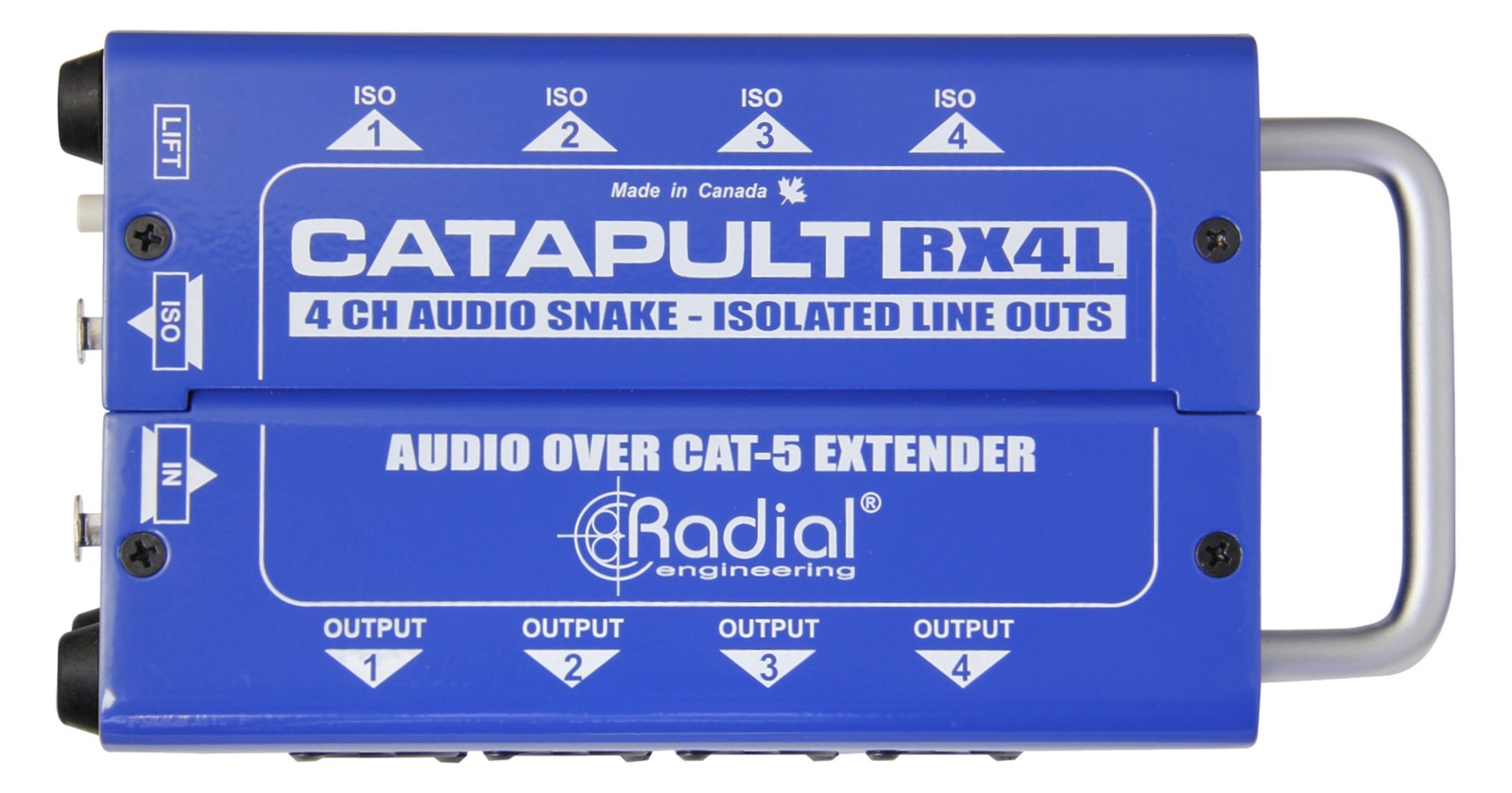
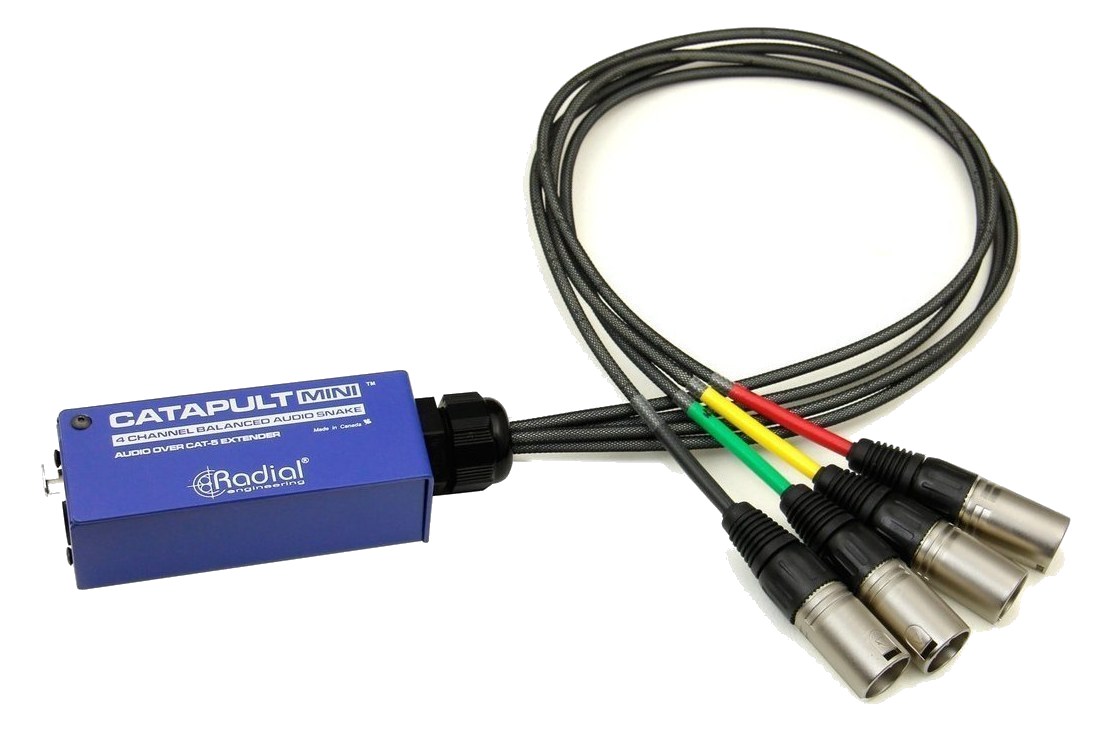
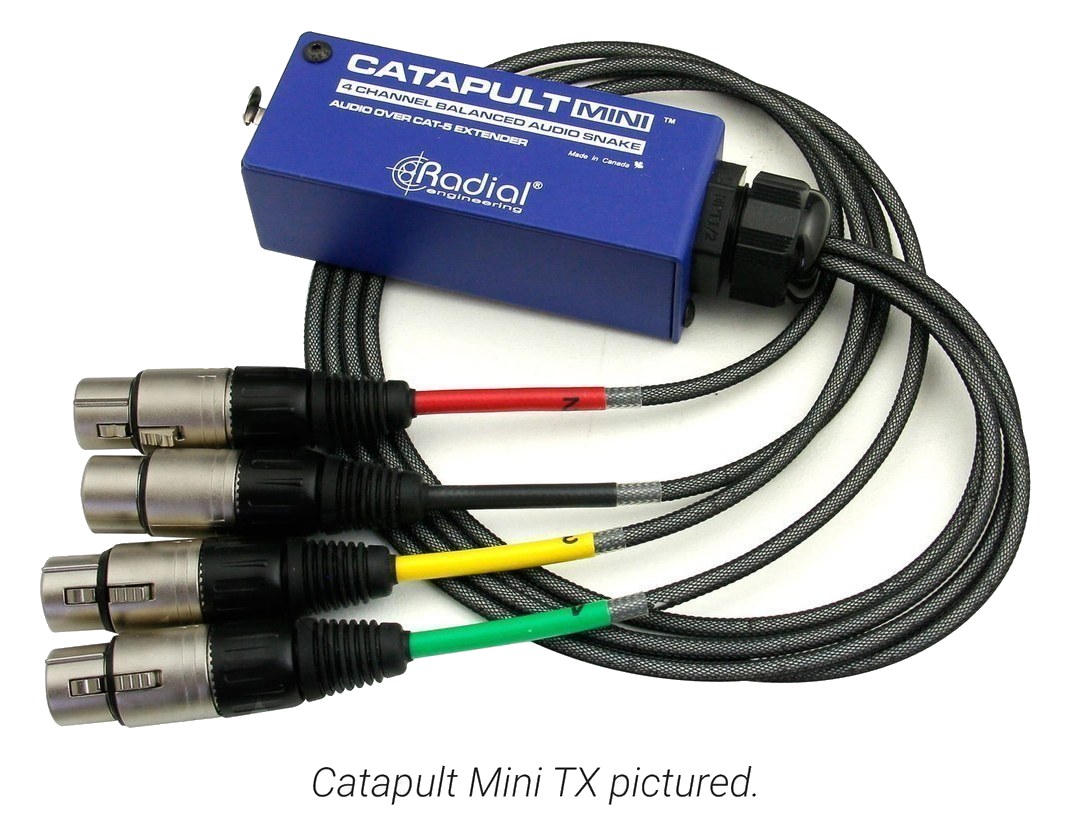
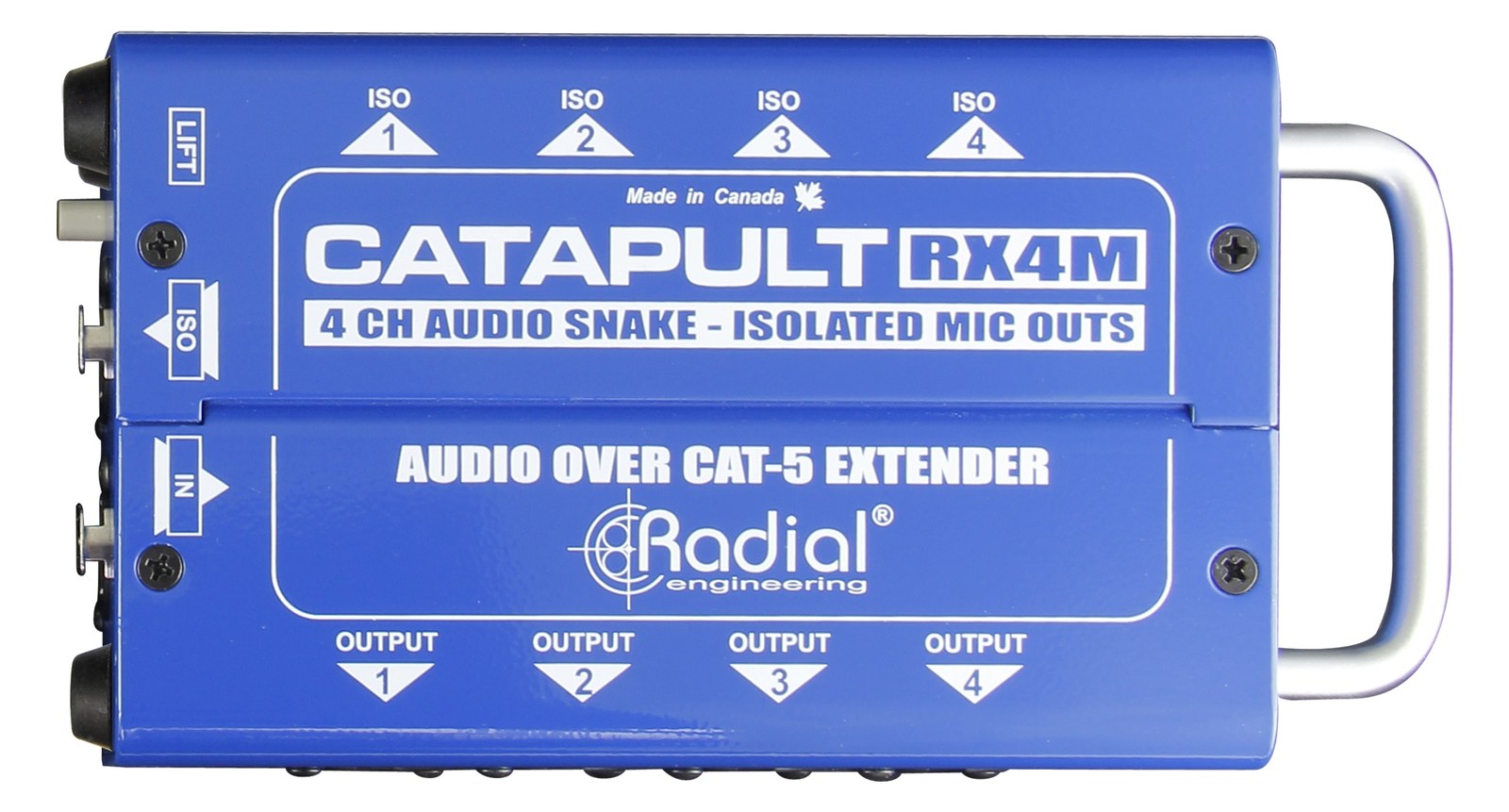
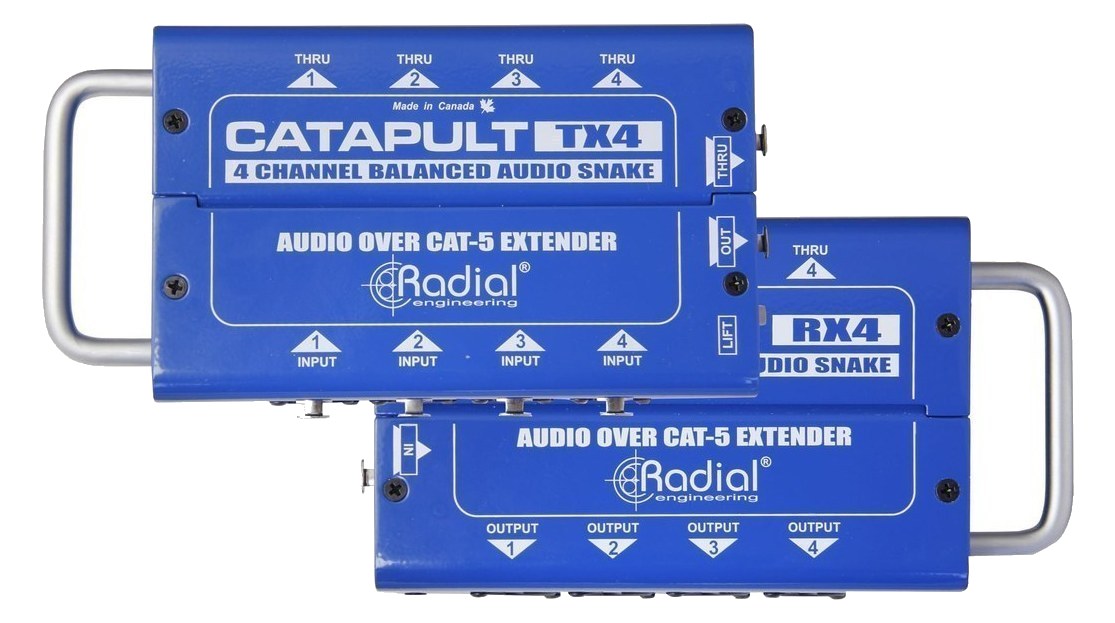
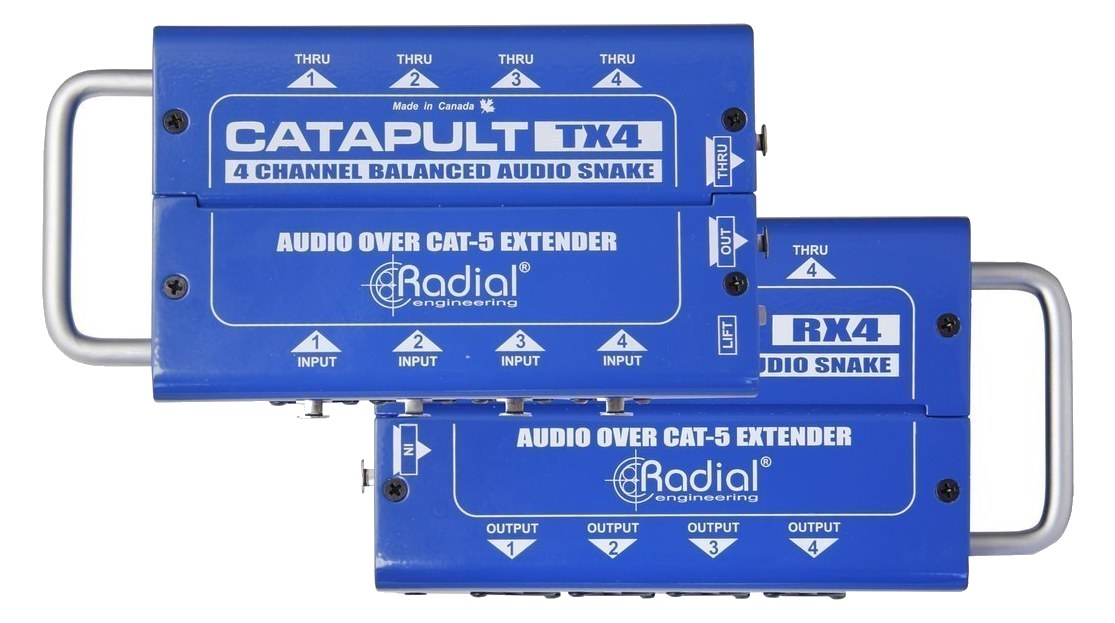
The Radial Catapult RX4L is the isolated receive end of the Cat5 snake system, with line-level transformers on each of its four XLR outputs to break ground loops between rack and stage power. Use it where the receiving rig is on a different circuit than the send end — amp racks, distributed playback zones, or a broadcast truck. Pairs with any Catapult transmit module over a single shielded Cat5 run.
UnverifiedPower requirement is not verified in the catalog
Catalog estimate
~$300Current listings stay in the price tracker
01 · What it does—and what that changes in your rig.
Product overview
Start with the payoff, then work through how it functions, where it fits, and the details that change a real build.
The payoff
4 channels. 1 cable runs. Outside rack.
The Catapult RX4L is the receive end of Radial's Cat5Standard network cable grades. In an audio rig one cheap Cat5e run can replace a 48-channel copper snake; AES50 wants it shielded. analog snakeA multicore cable bundling many channels into one stage-to-console run. A sub-snake collects one corner of the stage into a drop box. system — the box that lives in your rack and hands you back four transformer-isolatedA magnetic coupling that passes audio between two windings with no wire contact — isolates splits and kills ground-loop hum, no power needed., line-levelThe strong signal that runs between pieces of gear (about a volt) — hotter than mic level, far below speaker level.XLRThe standard 3-pin locking connector for mics and balanced line signals — pin 1 is the shield, pins 2 and 3 carry the balanced pair. outputs from a single Cat5 cable run. It draws no power, racks without consuming a rack unitThe standard slice of rack height: 1U = 1.75″. A 3U box takes three slices; half-rack gear pairs two units side by side in one. in the traditional sense, and weighs under two kilograms, so it disappears into a rig almost without argument. Its job is simple and specific: take whatever the paired Catapult transmit module is sending down the Cat5 and deliver it cleanly, with galvanic isolation between the send end and the receive end. That isolation is the whole point.
Signal channels
4Balanced analog paths end to end
Cable runs
14 channels per Cat cable
Rack space
Outside rackPlan a shelf, tray, or stage position
Radial product panelOutside rack · Unverified
Function
How it works in the path
In practice, the transformer isolationA magnetic coupling that passes audio between two windings with no wire contact — isolates splits and kills ground-loop hum, no power needed. means that when your IEMIn-Ear Monitor — earpieces that replace floor wedges, feeding each player their own mix. The reason this whole rack exists. rack is on house power and the stage source is on generator — or a broadcast truck is pulling feeds from your console — the ground loopHum from gear seeing two ground paths at slightly different voltage — the classic buzz when two racks share audio and power. that would otherwise inject hum into every channel gets broken before it reaches your mix. The four XLRThe standard 3-pin locking connector for mics and balanced line signals — pin 1 is the shield, pins 2 and 3 carry the balanced pair. male outputs come out at line levelThe strong signal that runs between pieces of gear (about a volt) — hotter than mic level, far below speaker level., so they feed directly into the inputs of a personal monitor mixer, a playback interface, or a distribution amp without any level trimming. The Cat5Standard network cable grades. In an audio rig one cheap Cat5e run can replace a 48-channel copper snake; AES50 wants it shielded. run itself can stretch a meaningful distance without signal degradation, which matters when the stage and rack are genuinely far apart. No power draw also means no entry on your power budget and no heat in the rack.
Best fit
Where it earns its place in the system
Pick the RX4L if you're running a Catapult transmit module at the other end and your rack lives on a different circuit — that describes most working IEMIn-Ear Monitor — earpieces that replace floor wedges, feeding each player their own mix. The reason this whole rack exists. rigs, amp racks, and any situation where a broadcast or recording feed is in the chain. If you only need two channels, Radial makes smaller Catapult variants worth considering. If you need more than four, you'll be stacking multiple units or looking at a larger analog snakeA multicore cable bundling many channels into one stage-to-console run. A sub-snake collects one corner of the stage into a drop box. system entirely. This is also not a digital snake and carries no clocking, redundancyA second copy of anything critical — supply, computer, network path — already running so one failure can’t stop the show., or network management — if your system has already moved to DanteThe most common audio-over-network standard: dozens of channels of uncompressed digital audio down one ordinary Ethernet cable between Dante boxes. or MADIA pro digital format carrying 64 channels on one coax or optical cable. Point-to-point — one sender, one receiver, no network required. for its main snake, the RX4L fills a different, more targeted role for isolated analog feeds rather than replacing that infrastructure.
In the rack
Details worth deciding before load-in.
Velcro or rack-panel mount the RX4L directly adjacent to whatever it's feeding — keeping the XLRThe standard 3-pin locking connector for mics and balanced line signals — pin 1 is the shield, pins 2 and 3 carry the balanced pair. jumpers short reduces the chance of reintroducing noise after the isolation transformerA magnetic coupling that passes audio between two windings with no wire contact — isolates splits and kills ground-loop hum, no power needed. has already done its work.
Label the Cat5Standard network cable grades. In an audio rig one cheap Cat5e run can replace a 48-channel copper snake; AES50 wants it shielded. input end and the rack end of your run with the same tag at load-in; Cat5 cables are indistinguishable from network cable at a glance, and the wrong patch in a hurry costs time.
Because the unit draws zero power, it can share a rack shelf or be secured in a utility space without any concern for heat buildup or outlet placement — use that flexibility to position it closest to the gear it feeds.
If you're getting hum through the outputs despite the isolation, check that the Cat5Standard network cable grades. In an audio rig one cheap Cat5e run can replace a 48-channel copper snake; AES50 wants it shielded. run is shielded and that the shield is terminated correctly at the transmit end — the RX4L's transformersA magnetic coupling that passes audio between two windings with no wire contact — isolates splits and kills ground-loop hum, no power needed. isolate ground, but a poorly shielded cable can still pick up interference along the run.
02 · Know the whole path before you buy.
Signal path
Learn the route as a block diagram: source, product function, transport, and destination. Select any block to see what enters, what changes, and what leaves.
Interactive block diagramAuto-looping · hover, focus, or tap to hold a stage
Port-type signalProduct functionSystem boundary
Follow one signal from source to destination
Each block answers the same three questions: what arrives, what changes here, and what leaves.
01 · Source · selected
1 bank · 4 ch each
Analog over Cat cable
4 × XLR male
01 · Source
Compatible analog-snake transmitter
The matching send end accepts separate analog sources and assigns them to repeatable cable banks.
Required
Compatible transmitter or breakout
Groups
4 source channels
Verify
Matching bank labels
03 · What this product asks of the rest of the system.
Compatibility
Treat connector names as the start of the check—not the answer. These are the boundaries that determine a complete working path.
Best fit · Analog Snake
Use it as analog snake tracked outside rack rails; follow the manufacturer’s mounting and form-factor guidance.
Plan the companion path
Complete both ends with a compatible sender, receiver, or breakout. Match connector, channel wiring, direction, and shielded-cable requirements.
Connector boundary
Documented connectors: RJ45, XLR male. Match connector, direction, and signal type—not shape alone.
04 · Every connector, grouped by job.
I/O ports
Switch the product view and the documented port inventory updates with it—hardware and data stay side by side.
Every connector, grouped by job.
Switch panels to keep the hardware view and the documented port list in sync.
Front panelRear panel
All documented ports for Radial Catapult RX4L
Port
Panel
Connector
Direction
Signal
Channels
Cat5 In
rear
RJ45
input
analog audio
—
ISO Out 1
rear
XLR male
output
analog audio
—
ISO Out 2
rear
XLR male
output
analog audio
—
ISO Out 3
rear
XLR male
output
analog audio
—
ISO Out 4
rear
XLR male
output
analog audio
—
Showing 5 of 5 documented physical ports.
05 · Compare the decision, not just the price.
Alternatives
The rows are organized around fit, power, I/O, and system role so a cheaper unit cannot hide a more expensive workflow.
Catapult RX4LThe Radial Catapult RX4L is the isolated receive end of the Cat5 snake system, with line-level transformers on each of its four XLR outputs to break ground loops between rack and stage power. Use it where the receiving rig is on a different circuit than the send end — amp racks, distributed playback zones, or a broadcast truck. Pairs with any Catapult transmit module over a single shielded Cat5 run.View gear →
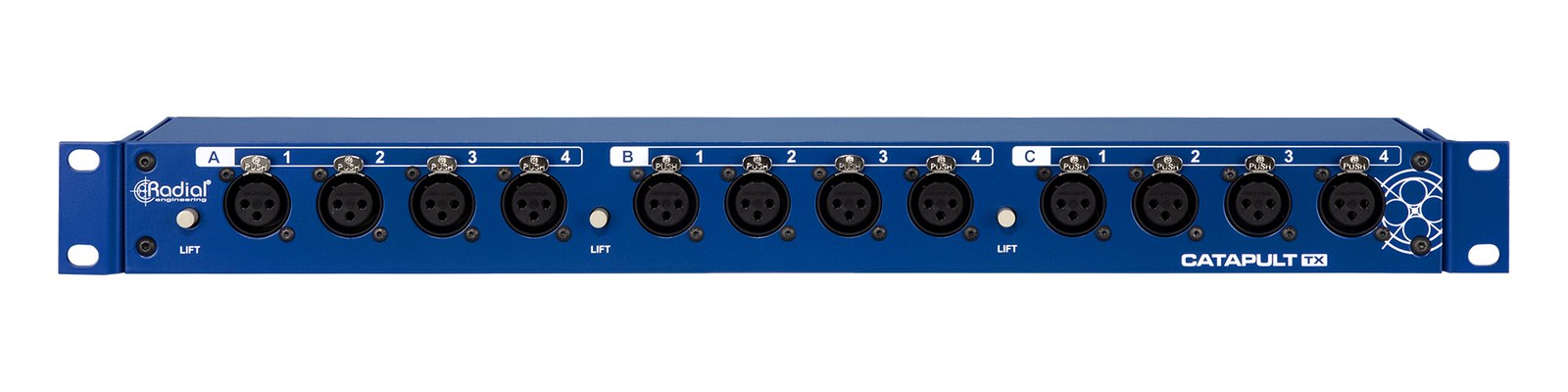
Catapult Rack TXThe Radial Catapult Rack TX is the send-end partner to the Catapult Rack RX: a 1U rack-mount transmitter that takes 12 XLR inputs and sends them over three Cat 5/6 cables (four channels per cable). Drop one in your FOH, monitor, or playback rack and run Cat 5/6 to the stage end for a complete transformer-isolated 12-channel analog snake — dramatically lighter and cheaper than a traditional copper multicore. Passive, no power required.View gear →
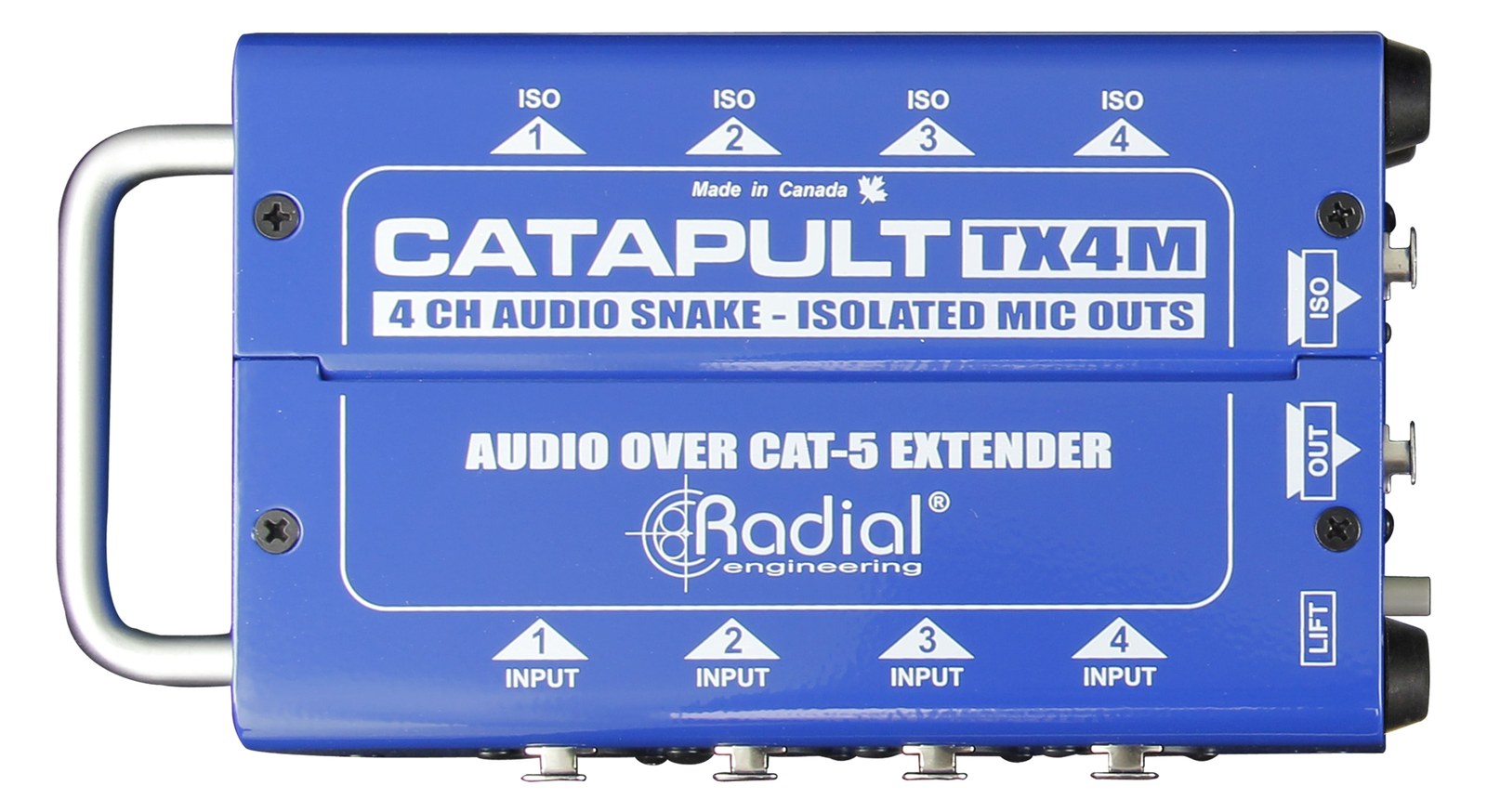
Catapult TX4MThe Radial Catapult TX4M is the mic-optimized isolated transmit module of the Catapult family, providing ground-lifted audio transmission over Cat5 cable. The isolation transformers eliminate ground loop hum that can occur when connecting audio between different locations on stage, making this the professional choice for permanent installations and touring rigs. Pair it with a Catapult RX at the receive end for a complete isolated analog snake.View gear →
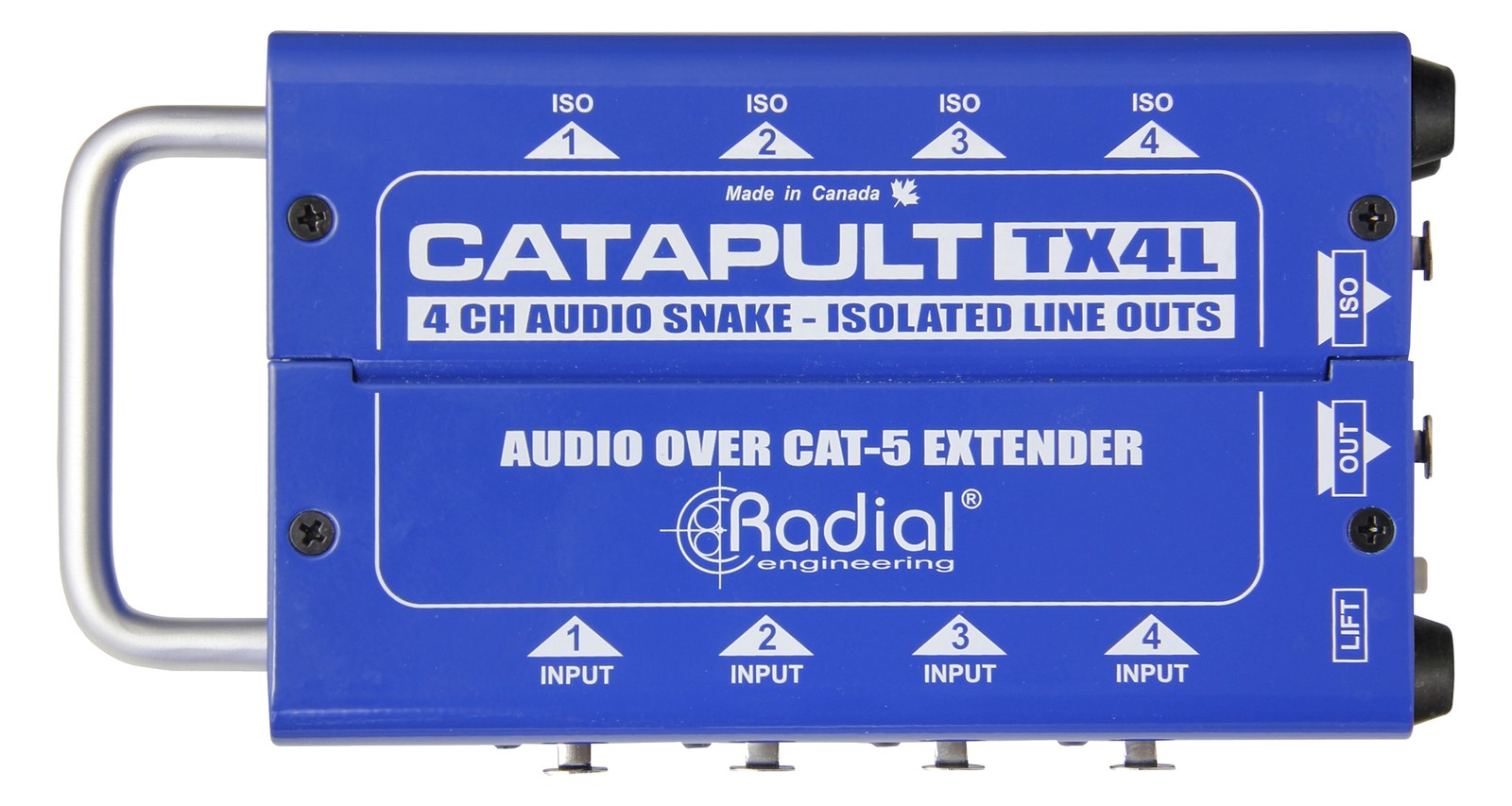
Catapult TX4LThe Radial Catapult TX4L adds line-level isolation transformers to the Cat5 snake system, letting you split playback tracks or console outputs to two destinations with the isolated side immune to ground loops. It is built for playback rigs feeding both FOH and a broadcast or recording split, where hum from tied grounds is the classic failure. Works with any Catapult receive module over one shielded Cat5 run.View gear →
06 · Resolve the questions that can change the purchase or build plan.
Planning questions
Short, source-backed answers surface rack fit, power, cabling, and connection details before they become surprises.
Where does the Radial Catapult RX4L live in a complete rig?
The catalog assigns it no rack units. Builder tracks it as non-rack gear; follow the manufacturer’s mounting, case, and form-factor guidance.
How much power does the Radial Catapult RX4L draw?
Its power requirement is not yet verified in the catalog.
What connections does the Radial Catapult RX4L have?
5 documented physical ports, including Cat5 In, ISO Out 1, ISO Out 2, ISO Out 3, ISO Out 4.
07 · See this gear inside a complete system plan.
Builder preview
Builder keeps non-rack gear in the same bill of materials, budget, dependency, and connection plan as the rack-mounted system around it.Open in Builder