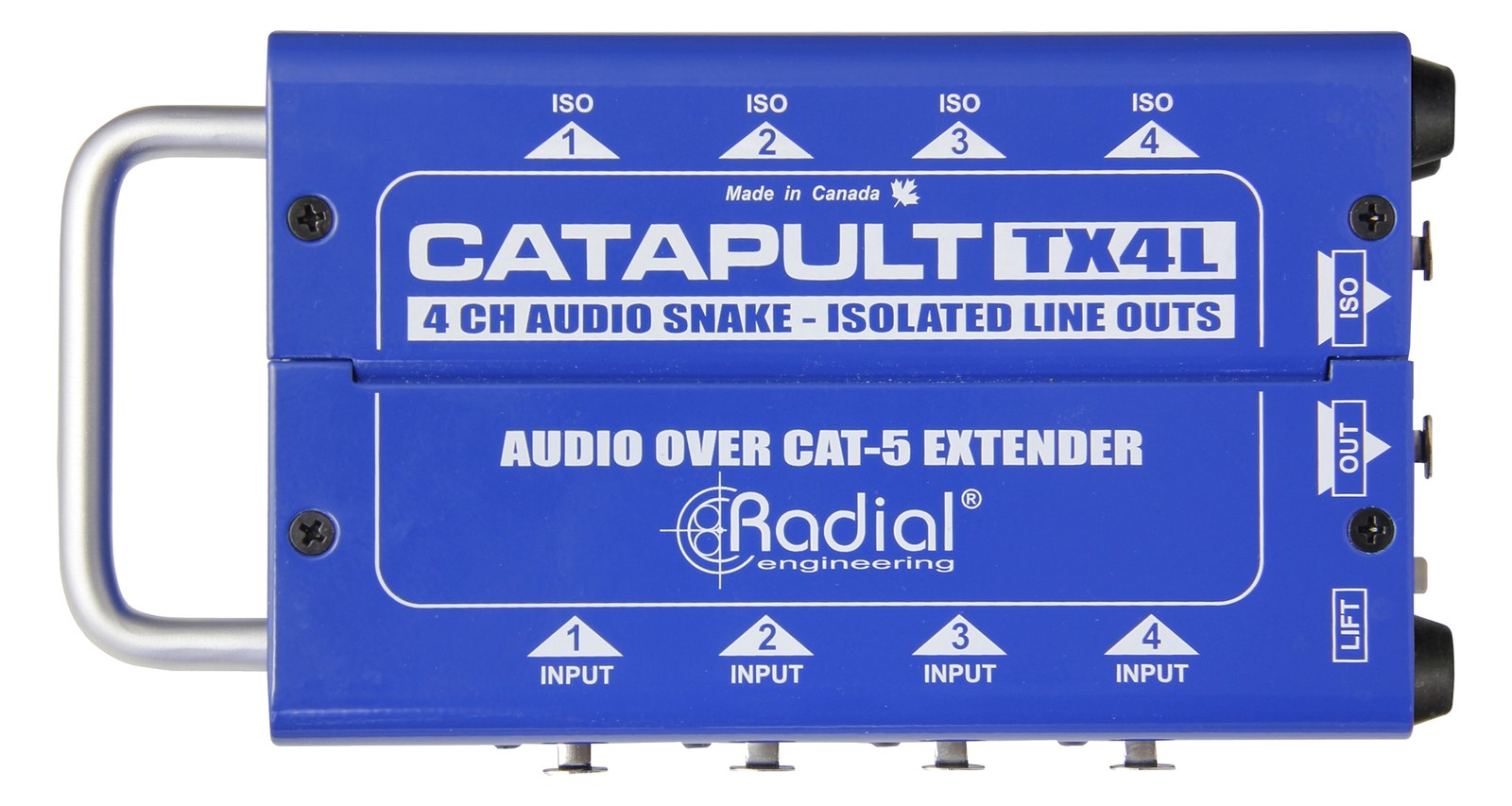
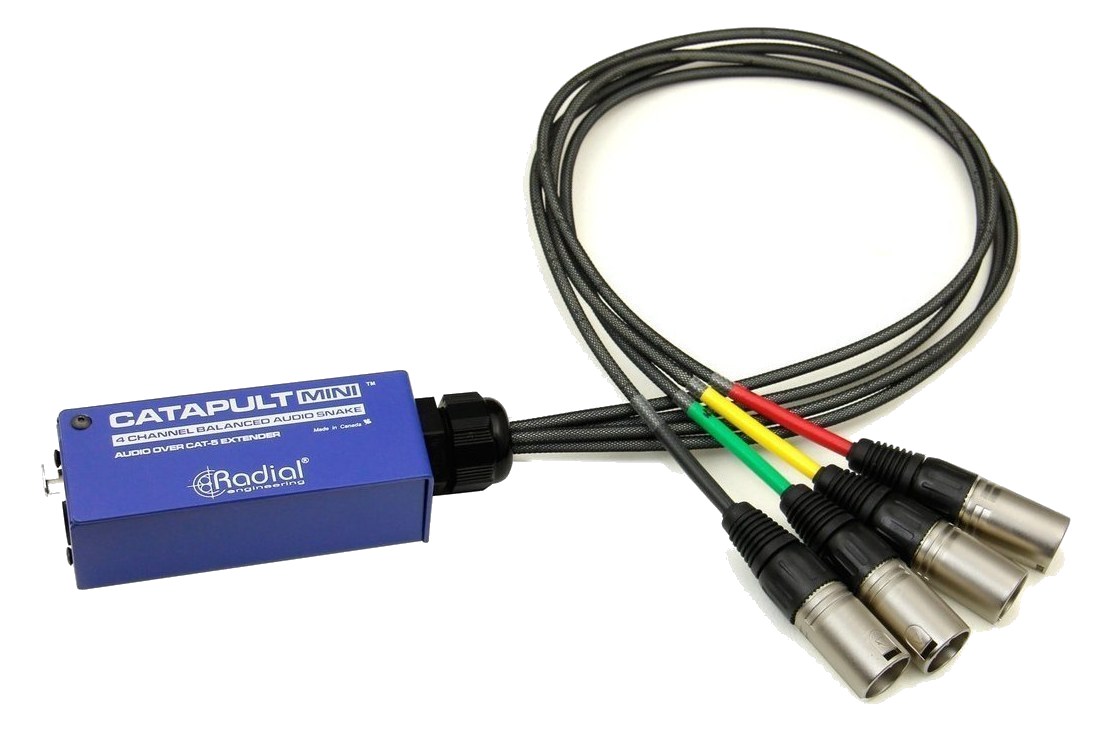
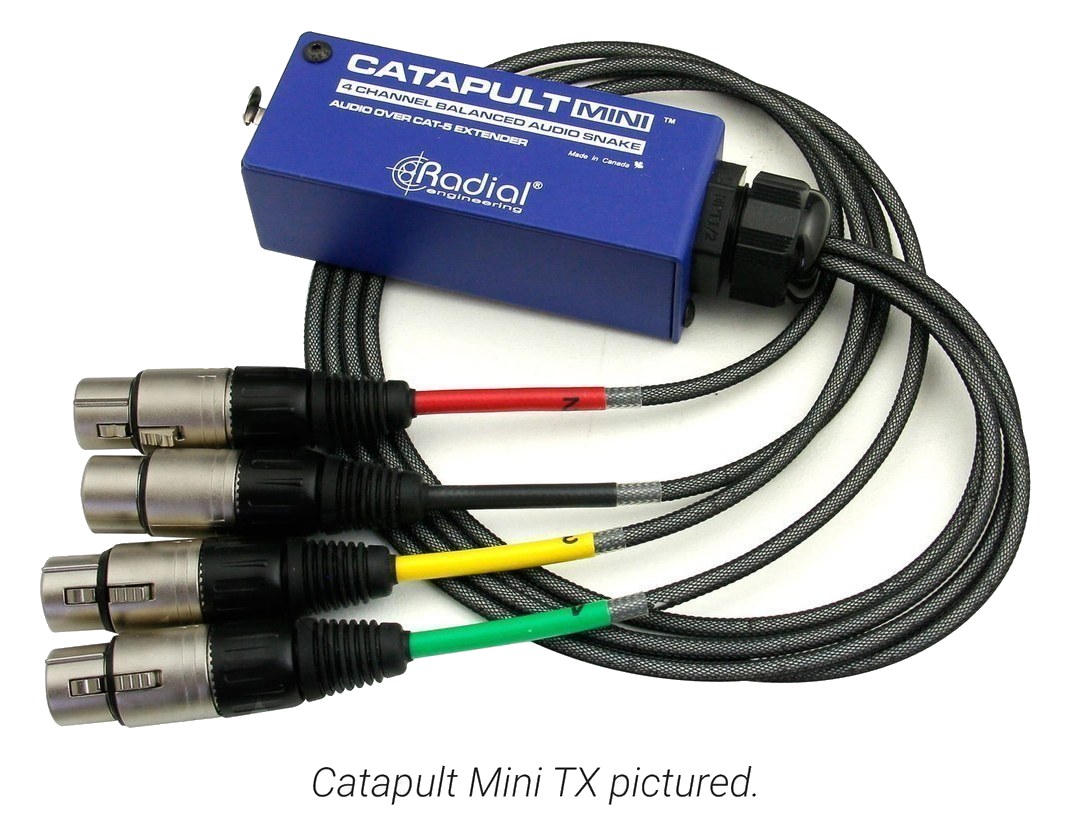
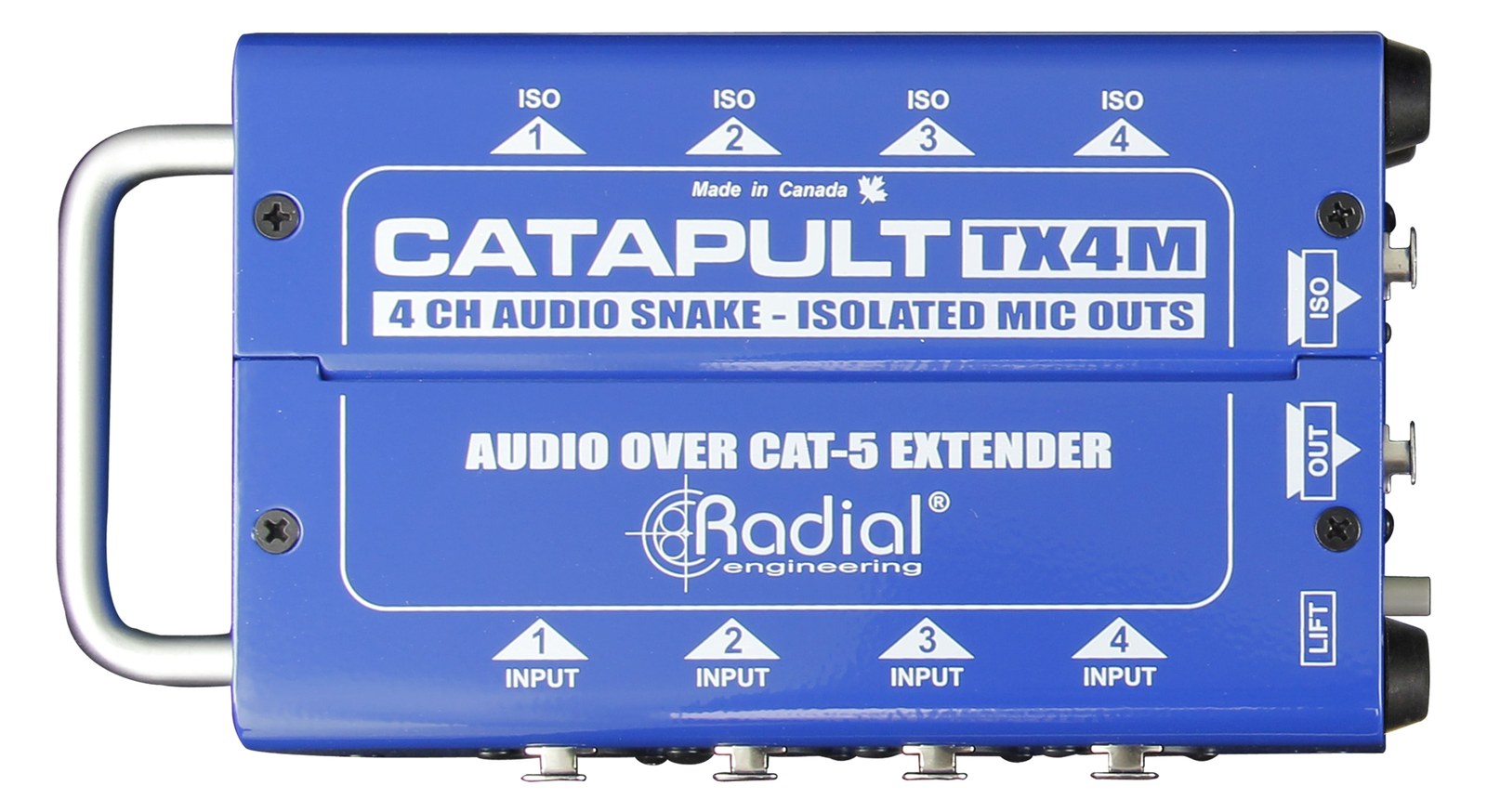
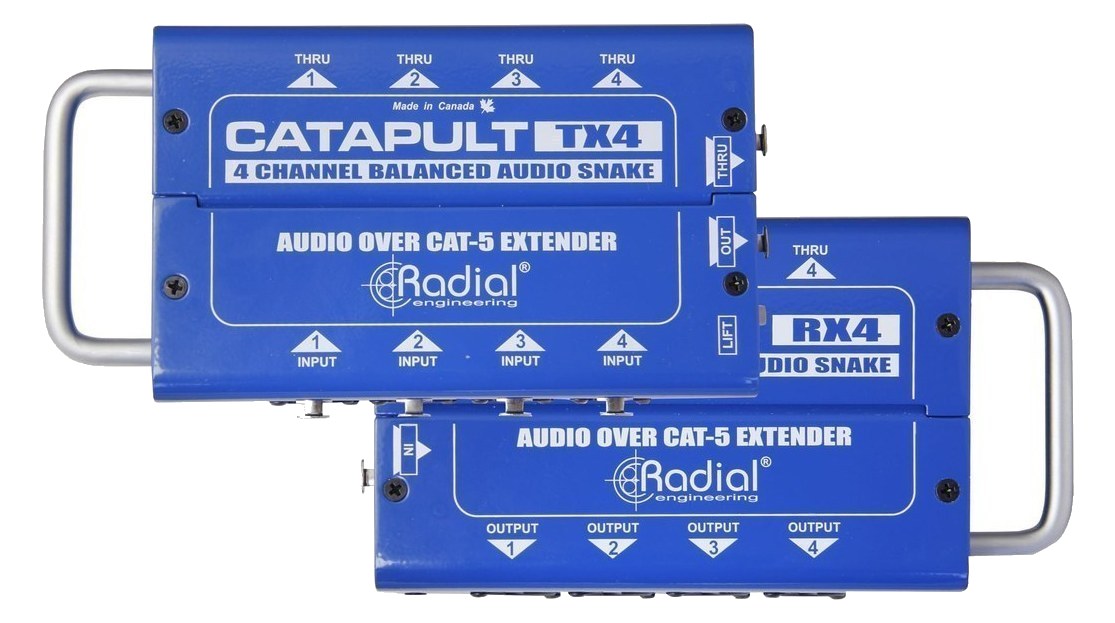
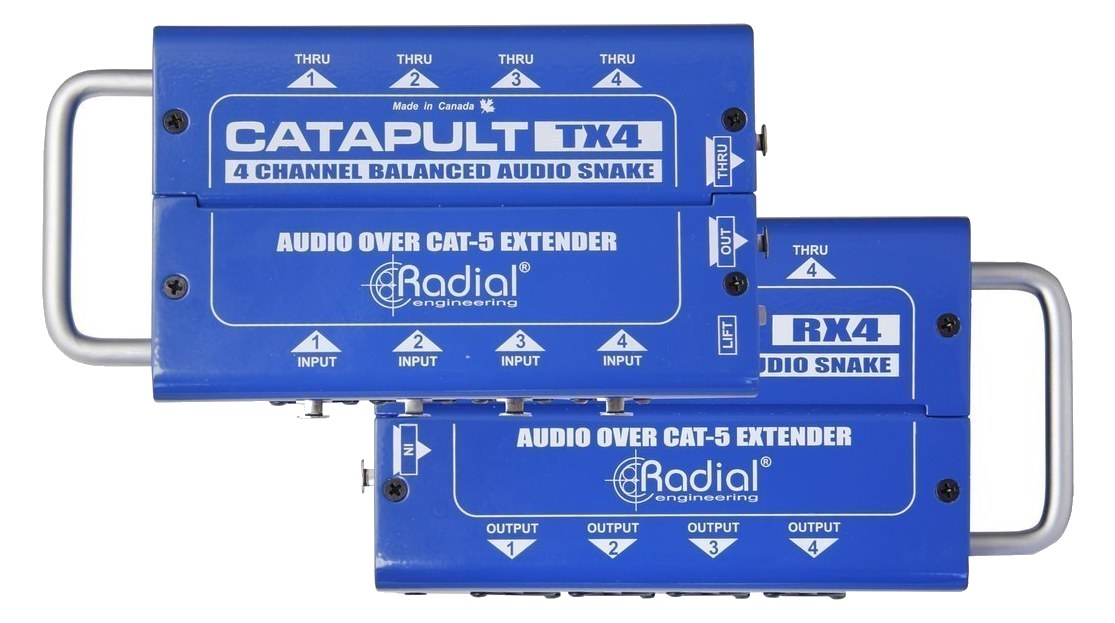
The Radial Catapult TX4L adds line-level isolation transformers to the Cat5 snake system, letting you split playback tracks or console outputs to two destinations with the isolated side immune to ground loops. It is built for playback rigs feeding both FOH and a broadcast or recording split, where hum from tied grounds is the classic failure. Works with any Catapult receive module over one shielded Cat5 run.
UnverifiedPower requirement is not verified in the catalog
Catalog estimate
~$300Current listings stay in the price tracker
01 · What it does—and what that changes in your rig.
Product overview
Start with the payoff, then work through how it functions, where it fits, and the details that change a real build.
The payoff
8 channels. 1 cable runs. Outside rack.
The Catapult TX4L is the transmit end of Radial's Cat5Standard network cable grades. In an audio rig one cheap Cat5e run can replace a 48-channel copper snake; AES50 wants it shielded. analog snakeA multicore cable bundling many channels into one stage-to-console run. A sub-snake collects one corner of the stage into a drop box. system, purpose-built for running four channels of line-levelThe strong signal that runs between pieces of gear (about a volt) — hotter than mic level, far below speaker level. audio down a single shielded Cat5 cable to a matching receive module. It sits at the source — typically your playback rig or console output — and does two things simultaneously: it sends all four channels down the Cat5 run to wherever the RJ45 lands, and it provides four transformer-isolatedA magnetic coupling that passes audio between two windings with no wire contact — isolates splits and kills ground-loop hum, no power needed.XLRThe standard 3-pin locking connector for mics and balanced line signals — pin 1 is the shield, pins 2 and 3 carry the balanced pair. outputs locally. That local ISO split is the reason you reach for the TX4L specifically rather than a simpler Catapult transmitter. The transformer breaks the ground path, and that's the whole point.
Signal channels
8Balanced analog paths end to end
Cable runs
18 channels per Cat cable
Rack space
Outside rackPlan a shelf, tray, or stage position
Radial product panelOutside rack · Unverified
Function
How it works in the path
Passive and unpowered, the TX4L draws nothing from your rack's power strip and adds 1.8 kg to your case weight — both non-issues. The isolation transformersA magnetic coupling that passes audio between two windings with no wire contact — isolates splits and kills ground-loop hum, no power needed. on the output side mean that when your playback rig's ground ties to a broadcast truck sitting on a different ground reference, the hum that would otherwise ride your split simply doesn't appear. On the Cat5Standard network cable grades. In an audio rig one cheap Cat5e run can replace a 48-channel copper snake; AES50 wants it shielded. side, you're trusting the cable run to carry analog audio, so use shielded Cat5e or Cat6 and keep it away from power cable bundles. The system is passive end-to-end, so there's no active circuitry to fail mid-show — what you load in is what you get all night.
Best fit
Where it earns its place in the system
This box belongs in a playback rig that feeds two destinations: FOHFront Of House — the main mix the audience hears, and the console position out in the room where it gets mixed. and a broadcast, recording, or IEMIn-Ear Monitor — earpieces that replace floor wedges, feeding each player their own mix. The reason this whole rack exists.-world split where ground relationships are unpredictable. If you're only sending to one place and grounds are controlled, a standard Catapult TX without isolation costs less and makes sense. If you're running monitors-world with a standalone console that shares ground cleanly with FOH, same story. But the moment a broadcast truck or a recording interface from a different power leg enters the picture, the TX4L earns its keep immediately. It's not a general-purpose DIDirect Injection box — converts an instrument’s unbalanced signal to a balanced mic-level XLR so it can run long cables without noise. box — it's a specific solution for a specific and recurring live-audio headache.
In the rack
Details worth deciding before load-in.
Pair the TX4L only with a compatible Radial Catapult receive module — the Cat5Standard network cable grades. In an audio rig one cheap Cat5e run can replace a 48-channel copper snake; AES50 wants it shielded. carries analog audio in Radial's proprietary pin arrangement, not standard Ethernet signals, so patching it into a network switch or generic breakoutA cable that splits one multichannel connector (like a DB25) into individual plugs — the octopus that turns 8 channels into 8 XLRs. will not work.
Use the transformer-isolatedA magnetic coupling that passes audio between two windings with no wire contact — isolates splits and kills ground-loop hum, no power needed.XLRThe standard 3-pin locking connector for mics and balanced line signals — pin 1 is the shield, pins 2 and 3 carry the balanced pair. outputs for the destination most likely to have a ground problem — broadcast truck, recording interface, or anything on a separate power feed — and let the Cat5Standard network cable grades. In an audio rig one cheap Cat5e run can replace a 48-channel copper snake; AES50 wants it shielded. run carry the signal to the other destination.
Label your Cat5Standard network cable grades. In an audio rig one cheap Cat5e run can replace a 48-channel copper snake; AES50 wants it shielded. cable at both ends at load-in; a single unmarked Cat5 on a busy stage floor looks identical to a network or intercom run, and pulling the wrong cable during a set change is a real risk.
Because the unit is passive with no depth listed, confirm your rack drawer or shelf depth before the gig — mount it on a half-rackThe standard slice of rack height: 1U = 1.75″. A 3U box takes three slices; half-rack gear pairs two units side by side in one. shelf or recessed panel and secure the XLRThe standard 3-pin locking connector for mics and balanced line signals — pin 1 is the shield, pins 2 and 3 carry the balanced pair.loomsSeveral cables bundled and run as one — keeps rack interconnects tidy and makes load-in one grab instead of eight. so strain on the connectors doesn't shift the unit mid-show.
02 · Know the whole path before you buy.
Signal path
Learn the route as a block diagram: source, product function, transport, and destination. Select any block to see what enters, what changes, and what leaves.
Interactive block diagramAuto-looping · hover, focus, or tap to hold a stage
Port-type signalProduct functionSystem boundary
Follow one signal from source to destination
Each block answers the same three questions: what arrives, what changes here, and what leaves.
01 · Source handoff · selected
4 × XLR female
1 bank · 4 ch each
Analog over Cat cable
01 · Source handoff
Console, split, or playback outputs
4 balanced analog channels enter as separate lines before any cable grouping happens.
Arrives as
4 analog channels
Connector
XLR female
Direction
Into this product
03 · What this product asks of the rest of the system.
Compatibility
Treat connector names as the start of the check—not the answer. These are the boundaries that determine a complete working path.
Best fit · Analog Snake
Use it as analog snake tracked outside rack rails; follow the manufacturer’s mounting and form-factor guidance.
Plan the companion path
Complete both ends with a compatible sender, receiver, or breakout. Match connector, channel wiring, direction, and shielded-cable requirements.
Connector boundary
Documented connectors: XLR female, XLR male, RJ45. Match connector, direction, and signal type—not shape alone.
04 · Every connector, grouped by job.
I/O ports
Switch the product view and the documented port inventory updates with it—hardware and data stay side by side.
Every connector, grouped by job.
Switch panels to keep the hardware view and the documented port list in sync.
Front panelRear panel
All documented ports for Radial Catapult TX4L
Port
Panel
Connector
Direction
Signal
Channels
XLR In 1
rear
XLR female
input
analog audio
—
XLR In 2
rear
XLR female
input
analog audio
—
XLR In 3
rear
XLR female
input
analog audio
—
XLR In 4
rear
XLR female
input
analog audio
—
ISO Out 1
rear
XLR male
output
analog audio
—
ISO Out 2
rear
XLR male
output
analog audio
—
ISO Out 3
rear
XLR male
output
analog audio
—
ISO Out 4
rear
XLR male
output
analog audio
—
Cat5 Out
rear
RJ45
output
analog audio
—
Showing 9 of 9 documented physical ports.
05 · Compare the decision, not just the price.
Alternatives
The rows are organized around fit, power, I/O, and system role so a cheaper unit cannot hide a more expensive workflow.
Catapult TX4LThe Radial Catapult TX4L adds line-level isolation transformers to the Cat5 snake system, letting you split playback tracks or console outputs to two destinations with the isolated side immune to ground loops. It is built for playback rigs feeding both FOH and a broadcast or recording split, where hum from tied grounds is the classic failure. Works with any Catapult receive module over one shielded Cat5 run.View gear →
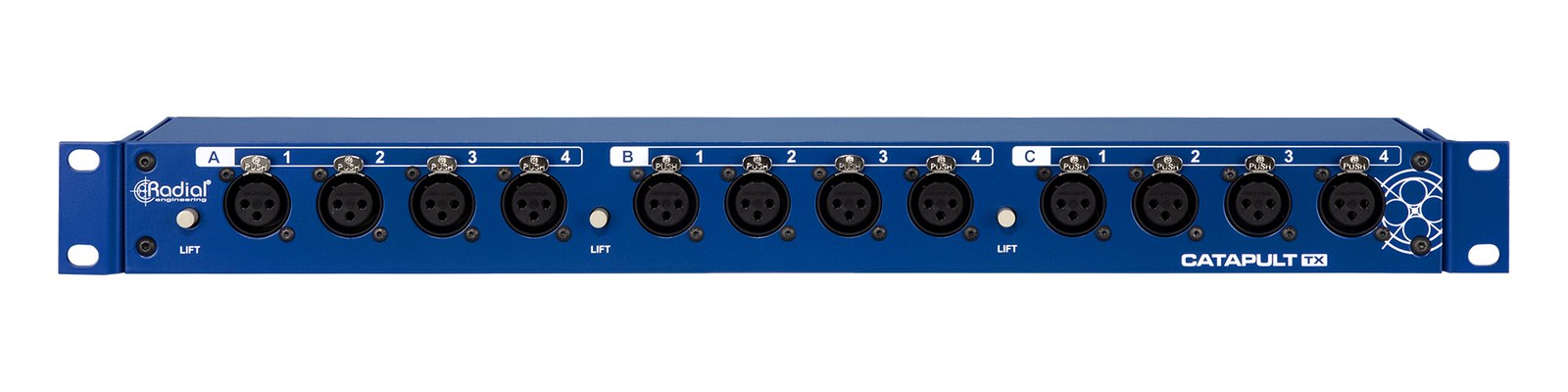
Catapult Rack TXThe Radial Catapult Rack TX is the send-end partner to the Catapult Rack RX: a 1U rack-mount transmitter that takes 12 XLR inputs and sends them over three Cat 5/6 cables (four channels per cable). Drop one in your FOH, monitor, or playback rack and run Cat 5/6 to the stage end for a complete transformer-isolated 12-channel analog snake — dramatically lighter and cheaper than a traditional copper multicore. Passive, no power required.View gear →
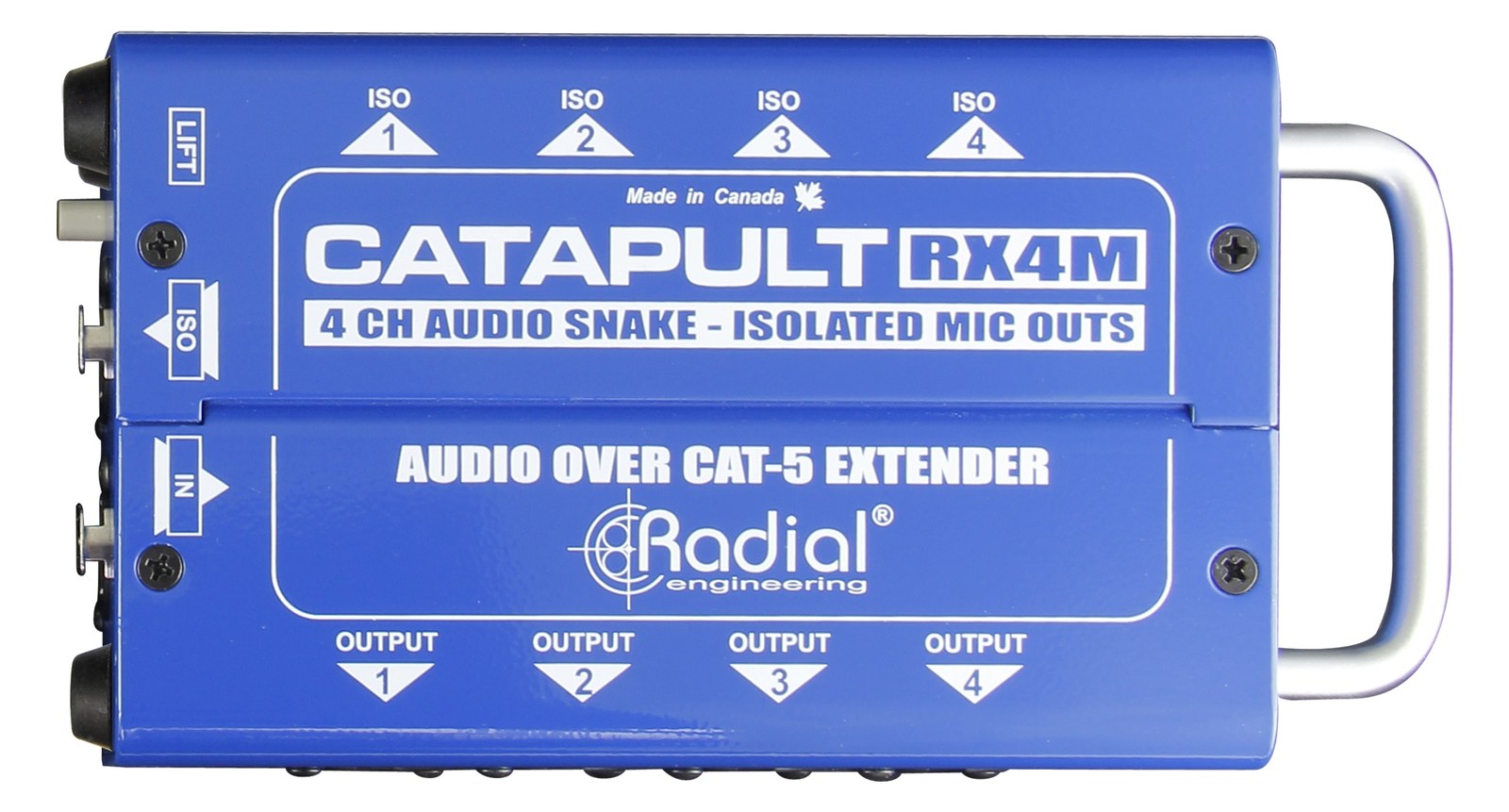
Catapult RX4MThe Radial Catapult RX4M is the mic-optimized isolated receive module of the Catapult family, adding transformer isolation on each channel to prevent ground loops and hum when connecting equipment from different power sources. This isolation is critical in professional live sound where your rack and the stage equipment may be on different electrical circuits. The transformers also provide an additional layer of signal protection for your audio gear.View gear →
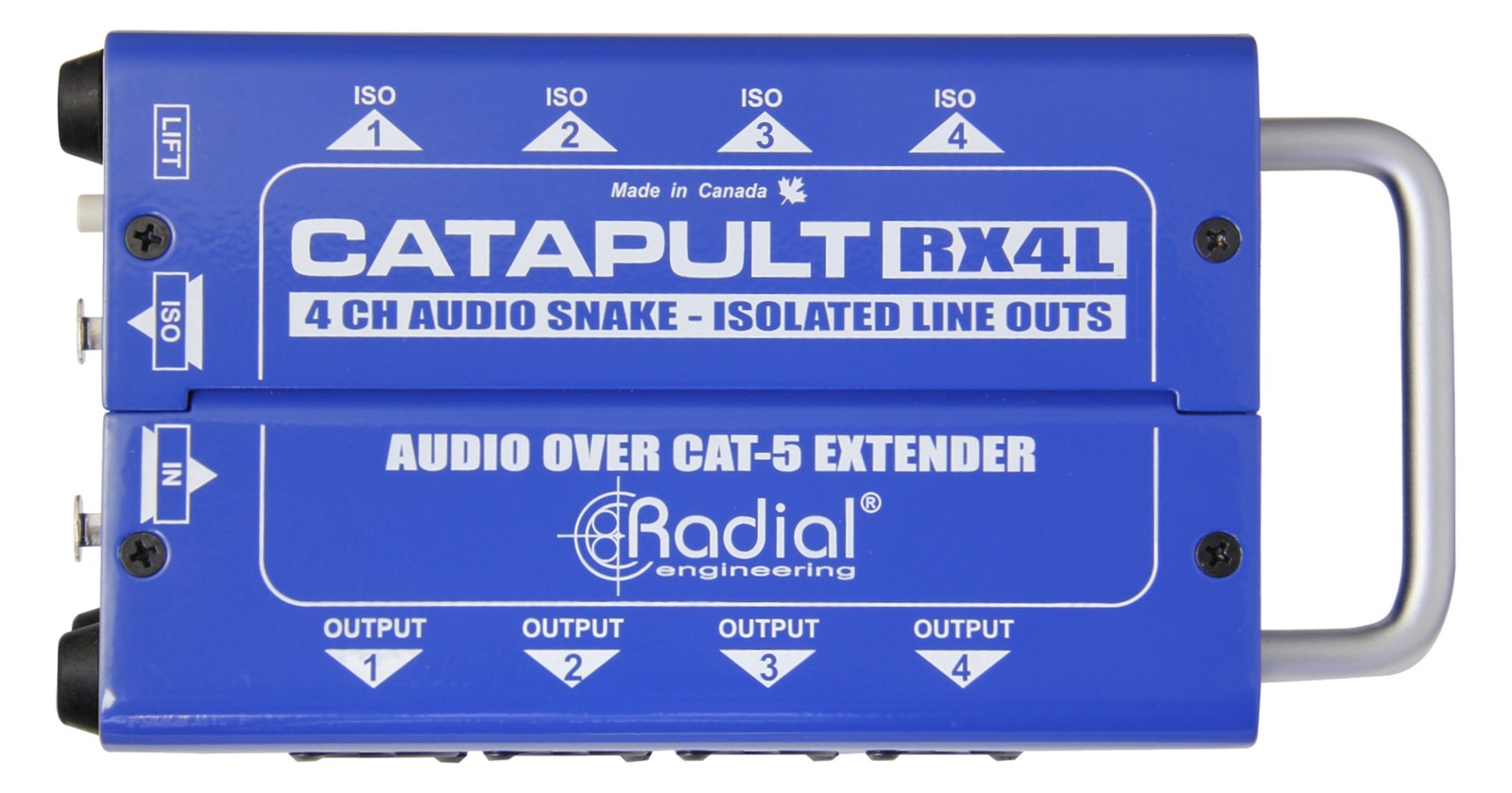
Catapult RX4LThe Radial Catapult RX4L is the isolated receive end of the Cat5 snake system, with line-level transformers on each of its four XLR outputs to break ground loops between rack and stage power. Use it where the receiving rig is on a different circuit than the send end — amp racks, distributed playback zones, or a broadcast truck. Pairs with any Catapult transmit module over a single shielded Cat5 run.View gear →
06 · Resolve the questions that can change the purchase or build plan.
Planning questions
Short, source-backed answers surface rack fit, power, cabling, and connection details before they become surprises.
Where does the Radial Catapult TX4L live in a complete rig?
The catalog assigns it no rack units. Builder tracks it as non-rack gear; follow the manufacturer’s mounting, case, and form-factor guidance.
How much power does the Radial Catapult TX4L draw?
Its power requirement is not yet verified in the catalog.
What connections does the Radial Catapult TX4L have?
9 documented physical ports, including XLR In 1, XLR In 2, XLR In 3, XLR In 4, ISO Out 1, ISO Out 2.
07 · See this gear inside a complete system plan.
Builder preview
Builder keeps non-rack gear in the same bill of materials, budget, dependency, and connection plan as the rack-mounted system around it.Open in Builder