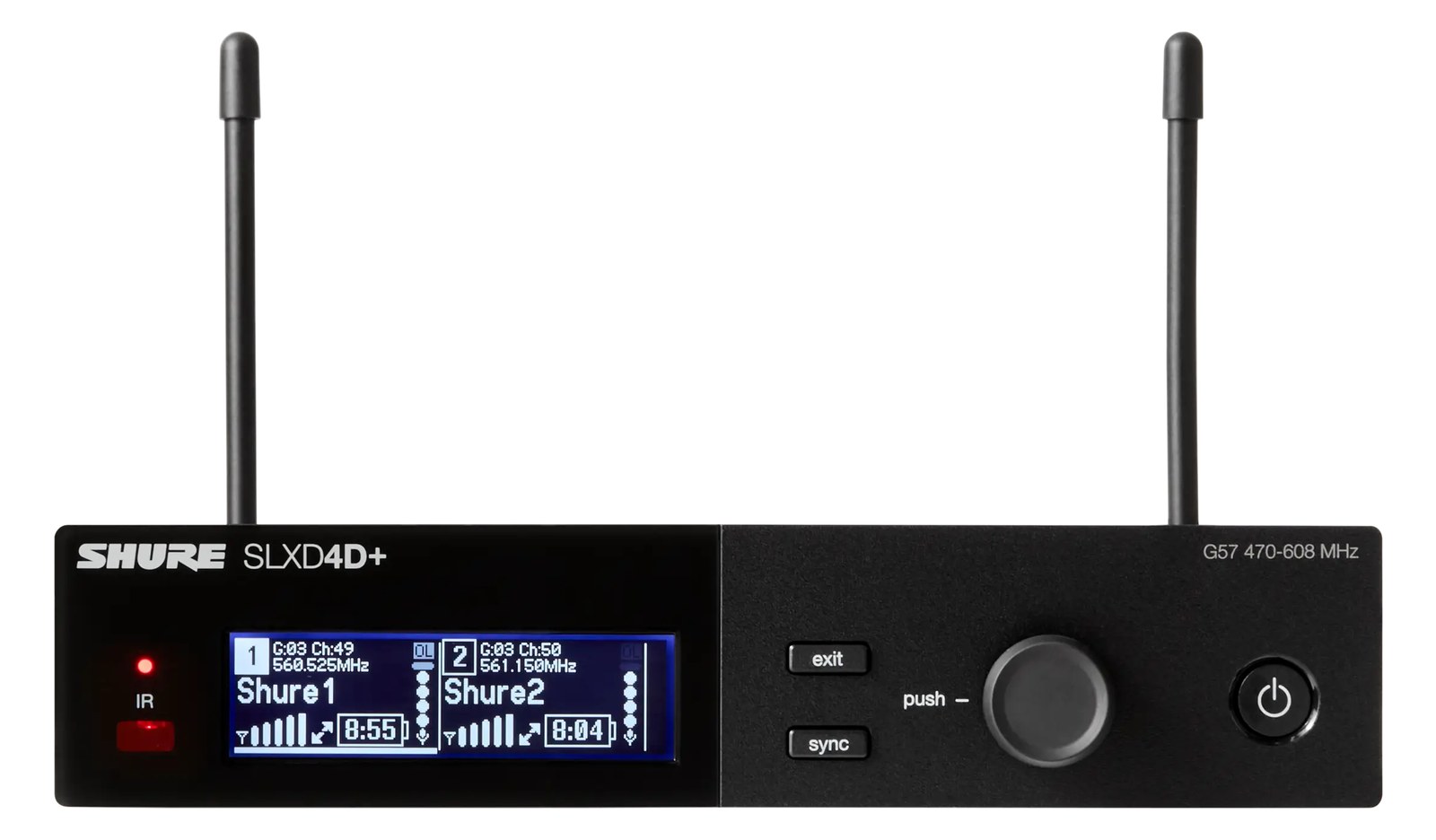
The Shure SLXD4D is a dual-channel digital wireless receiver that hits the sweet spot for theaters, regional touring, and houses of worship that want better-than-analog wireless without the touring-grade price of the ULXD line. 24-bit digital signal, AES-256 encryption, and rechargeable battery support out of the box.
~$1,499Use retailer rows for current price and stock
01 · What it does—and what that changes in your rig.
Product overview
Start with the payoff, then work through how it functions, where it fits, and the details that change a real build.
The payoff
Wireless Mic decisions, organized around the whole rig.
The SLXD4D is Shure's answer to a very specific question: what do you put in the rack when analog wireless isn't good enough anymore but a full ULXD deployment is out of budget? Two channels of 24-bit digital audio in a single rack unitThe standard slice of rack height: 1U = 1.75″. A 3U box takes three slices; half-rack gear pairs two units side by side in one., with AES-256 encryption and compatibility with Shure's rechargeable battery ecosystem. It lives in the mid-tier of Shure's wireless lineup — above the BLX and SLX analog systems, below the ULXD and Axient Digital — and that positioning is genuinely useful rather than just a marketing bracket. For regional touring, installed theater rigs, and larger houses of worship running two to four channels of wireless, this is often the most sensible place to land.
Documented outputs
44 destination connections
Documented inputs
3Based on documented inputs
Rack space
1UBuilder checks available rail space
Photo: Shure1U · 25W
Function
How it works in the path
A single IECThe standard three-prong appliance power inlet on rack gear — the kettle lead. C13/C14 in spec-sheet speak. feed handles both channels at up to 35 watts, which is easy on your power strip math. The two BNCThe twist-lock coax connector used for word clock and antenna runs — it locks, so it can’t be pulled out mid-show. antenna inputs mean you're running true diversityA receiver with two antennas and two radio sections that continuously picks the stronger one — the difference between a dropout and a show. per receiver, but both channels share that antenna pair — plan your antenna placement and any active distribution accordingly if you're stacking multiple SLXD4Ds. The Ethernet port enables Shure Wireless WorkbenchShure’s free RF-management software — scans the airwaves, calculates compatible frequencies, and monitors every receiver from a laptop. control and monitoring, which matters at show time when you want frequency coordinationCalculating a set of wireless frequencies that won’t interfere with each other or local TV — the homework behind a clean RF night. and battery status visible from FOHFront Of House — the main mix the audience hears, and the console position out in the room where it gets mixed. or the monitor position without walking the stage. XLRThe standard 3-pin locking connector for mics and balanced line signals — pin 1 is the shield, pins 2 and 3 carry the balanced pair. outputs are male, so standard snakeA multicore cable bundling many channels into one stage-to-console run. A sub-snake collects one corner of the stage into a drop box. tails and patch cable go straight in without adapters. At 305mm depth, it fits most standard road cases without grief.
Best fit
Where it earns its place in the rack
Pick the SLXD4D if you're running two channels of wireless and want digital audio quality, network-based monitoring, and rechargeable battery support without financing a touring-grade system. It's well-suited to fixed installs that also travel — theater companies doing regional runs, worship rigs that double as production rentals. Where it's not the right call: if you need more than two channels and rack space is tight, a pair of SLXD4Ds burns two full rack unitsThe standard slice of rack height: 1U = 1.75″. A 3U box takes three slices; half-rack gear pairs two units side by side in one. whereas the ULXD4Q gives you four channels in the same footprint. And if your venue has a genuinely dense RFRadio Frequency — the wireless part of wireless. RF planning is why big rigs scan, coordinate, and combine antennas instead of hoping. environment — arenas, large convention spaces with multiple systems — the Axient Digital line's ShowLink and adaptive frequency capability is worth the jump.
Shure SLXD4D Dual Receiver — three-quarter view with antennasPhoto: Shure
In the rack
Details worth deciding before load-in.
Run an active antenna distributionOne pair of antennas feeding many receivers through an amplified splitter — replaces the forest of whips and keeps RF levels consistent. system like the Shure UA845SWB when stacking two or more SLXD4Ds — it lets all receivers share a single optimized antenna pair rather than fighting for position across six BNCThe twist-lock coax connector used for word clock and antenna runs — it locks, so it can’t be pulled out mid-show. inputs.
Plug the Ethernet port into your show network on day one, not as an afterthought — Wireless WorkbenchShure’s free RF-management software — scans the airwaves, calculates compatible frequencies, and monitors every receiver from a laptop.'s battery countdown and RFRadio Frequency — the wireless part of wireless. RF planning is why big rigs scan, coordinate, and combine antennas instead of hoping. scan are genuinely useful at soundcheck and save you the stage walk to check transmitter status mid-show.
Label your XLRThe standard 3-pin locking connector for mics and balanced line signals — pin 1 is the shield, pins 2 and 3 carry the balanced pair. outputs at the rear panel with the transmitter assignment before the cable run, not after — both channels exit from the same box and swapped channels at the patch bayA panel of front-facing jacks wired to everything behind it — re-route any signal with a short cable instead of climbing behind the rack. are a fast way to put the wrong mic into the wrong channel strip.
If you're using Shure's rechargeable batteries, stage the SB903 charger in the rack build and confirm charge state the night before, not at load-in — the SLXD4D will report battery percentage over Workbench but you need cells in the charger the night prior to guarantee a full show runtime.
02 · Know the whole path before you buy.
Signal path
Learn the route as a block diagram: source, product function, transport, and destination. Select any block to see what enters, what changes, and what leaves.
Interactive block diagramAuto-looping · hover, focus, or tap to hold a stage
Port-type signalProduct functionSystem boundary
Follow one signal from source to destination
Each block answers the same three questions: what arrives, what changes here, and what leaves.
01 · Source · selected
bnc + dc barrel
RJ45
XLR male + ¼-inch TS
01 · Source
3 documented inputs
bnc + dc barrel
Arrives as
3 documented inputs
Connector
bnc + dc barrel
Signal
antenna
03 · What this product asks of the rest of the system.
Compatibility
Treat connector names as the start of the check—not the answer. These are the boundaries that determine a complete working path.
Best fit · Wireless Mic
Use it when 1U and 152 mm of depth fit the case.
Plan the companion path
Complete the path with upstream and downstream gear that matches connector, direction, signal type, protocol, and wiring standard.
Connector boundary
Documented connectors: bnc, XLR male, ¼-inch TS, RJ45. Match connector, direction, and signal type—not shape alone.
04 · Every connector, grouped by job.
I/O ports
Switch the product view and the documented port inventory updates with it—hardware and data stay side by side.
Every connector, grouped by job.
Switch panels to keep the hardware view and the documented port list in sync.
Front panelRear panel
All documented ports for Shure SLXD4D Dual Receiver
Port
Panel
Connector
Direction
Signal
Channels
Antenna A (BNC)
rear
bnc
input
antenna
—
Antenna B (BNC)
rear
bnc
input
antenna
—
Audio Out 1 (XLR)
rear
XLR male
output
analog audio
—
Audio Out 2 (XLR)
rear
XLR male
output
analog audio
—
Ch 1 Inst/Aux (TS)
rear
¼-inch TS
output
analog audio
—
Ch 2 Inst/Aux (TS)
rear
¼-inch TS
output
analog audio
—
Ethernet (control)
rear
RJ45
bidirectional
data
—
DC In (15V)
rear
dc barrel
input
power
—
Showing 8 of 8 documented physical ports.
05 · Compare the decision, not just the price.
Alternatives
The rows are organized around fit, power, I/O, and system role so a cheaper unit cannot hide a more expensive workflow.
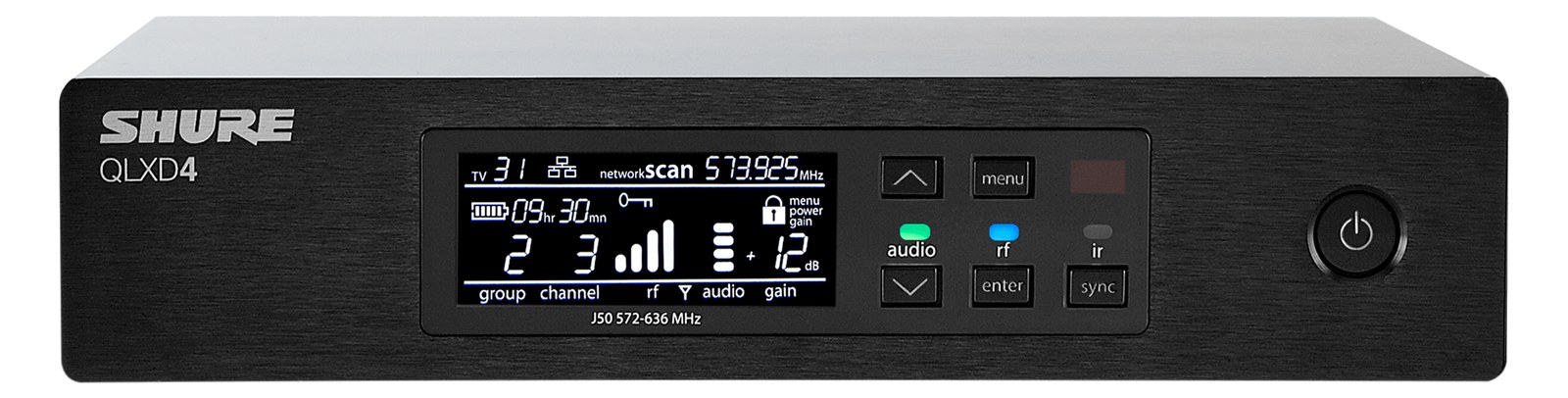
SLXD4DThe Shure SLXD4D is a dual-channel digital wireless receiver that hits the sweet spot for theaters, regional touring, and houses of worship that want better-than-analog wireless without the touring-grade price of the ULXD line. 24-bit digital signal, AES-256 encryption, and rechargeable battery support out of the box.View gear →
QLXD4The Shure QLXD4 is the half-rack, single-channel sibling to the ULXD4 line — same Shure digital audio quality, but one channel at a time and no native Dante. Popular on house-of-worship and mid-scale theatre rigs where analog outputs to a stage-box channel are the norm. Pair two in a 1U shelf for a dual-receiver half-width fit.View gear →
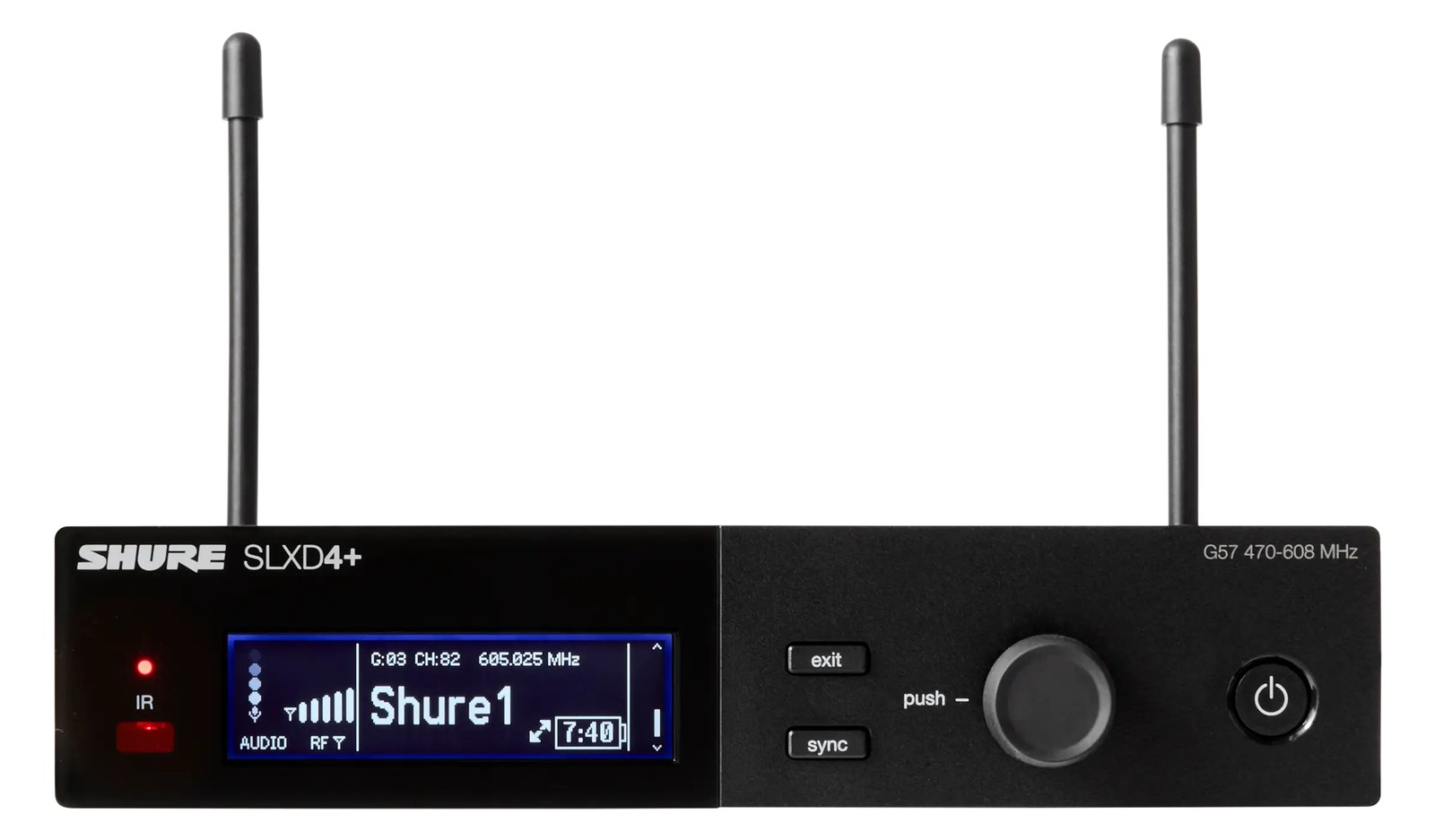
SLXD4The Shure SLXD4 is an entry-level digital wireless receiver that delivers surprisingly good audio quality for its price, with digital transmission that eliminates the companding artifacts of older analog wireless systems. Its half-rack size means you can pair two in a single rack space for cost-effective multi-channel wireless mic deployments. A great starting point for acts that need reliable wireless microphones without the investment of the ULX-D or Axient platforms.View gear →
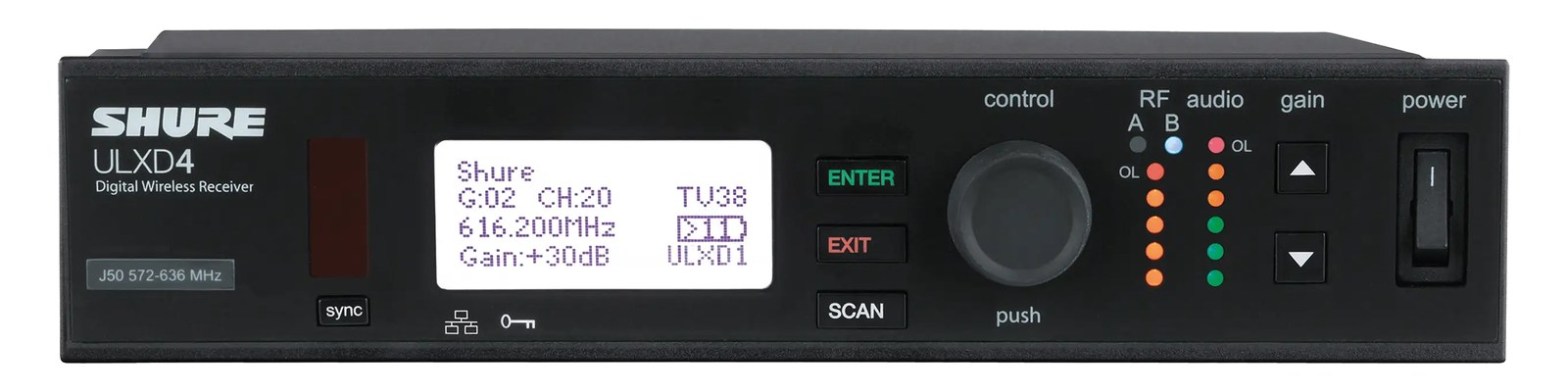
ULXD4The ULXD4 wireless mic receiver delivers professional 24-bit digital audio with AES-256 encryption for secure wireless transmission in corporate and broadcast environments. Its Ethernet port enables networked monitoring and control via Shure's Wireless Workbench software, which is essential for managing multiple channels at scale. The half-rack form factor and robust RF performance make it a workhorse for mid-to-upper-tier touring and installed sound applications.View gear →
06 · Resolve the questions that can change the purchase or build plan.
Planning questions
Short, source-backed answers surface rack fit, power, cabling, and connection details before they become surprises.
How will the Shure SLXD4D Dual Receiver affect rack fit and case depth?
It occupies 1U. Its documented depth is 152 mm.
How much power does the Shure SLXD4D Dual Receiver draw?
Typical draw is 25W and documented maximum draw is 35W.
What connections does the Shure SLXD4D Dual Receiver have?
8 documented physical ports, including Antenna A (BNC), Antenna B (BNC), Audio Out 1 (XLR), Audio Out 2 (XLR), Ch 1 Inst/Aux (TS), Ch 2 Inst/Aux (TS).
07 · See this unit inside a real rack plan.
Builder preview
Placement is only the start. Builder checks space · depth · weight, power headroom, dependencies, and compatible signal paths around this exact catalog item.Open in Builder