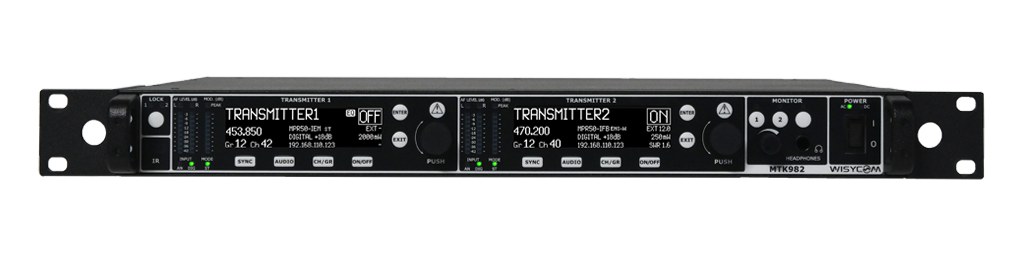
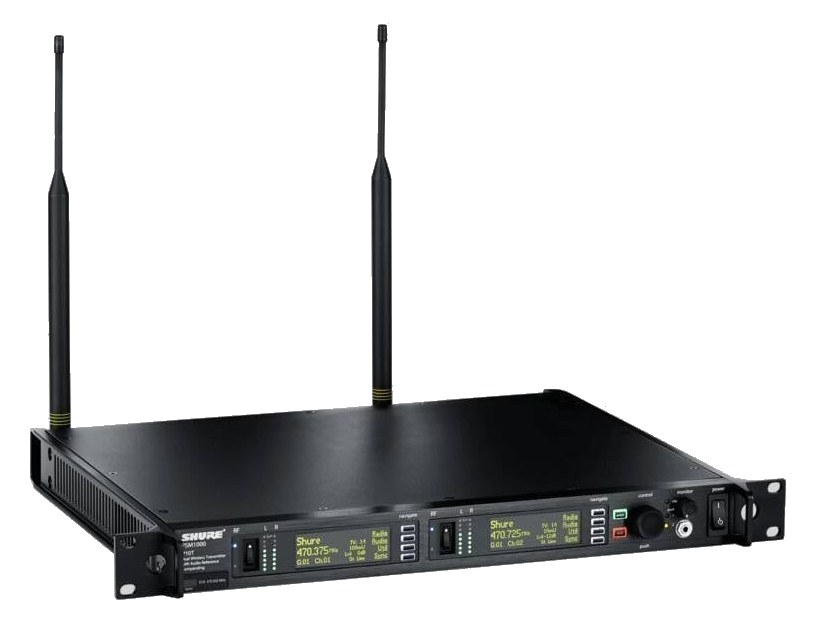
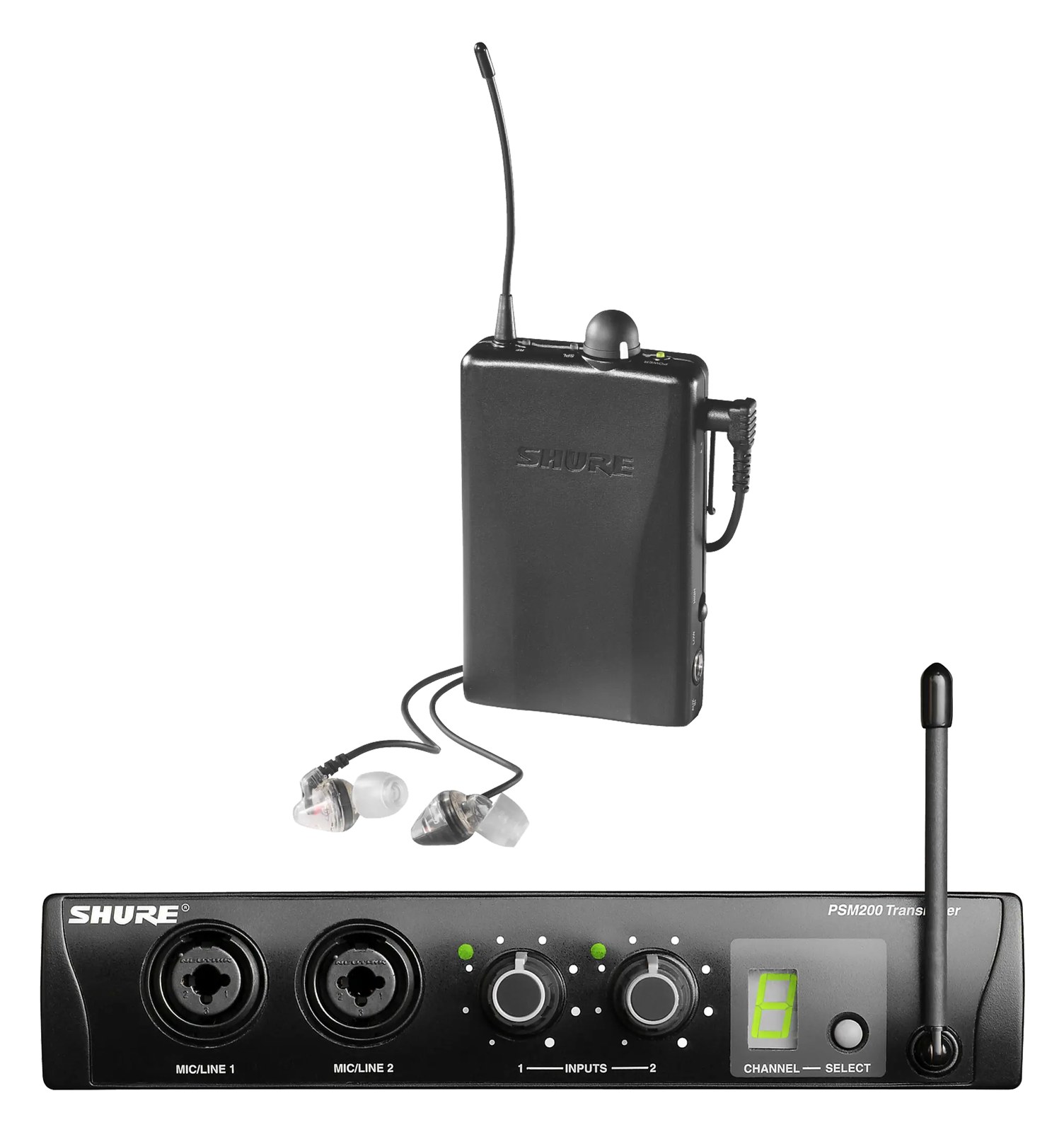
The Wisycom MTK982 succeeds the MTK952 as the broadcast-grade dual IEM/IFB transmitter: two stereo channels tunable across 230 MHz of spectrum with up to two watts of output for long-throw applications. Film, broadcast, and top-tier touring rigs run it where frequency agility across borders is the job. Dealer-channel pricing; found by the gear-fit auditor succession check.
~$6,500Use retailer rows for current price and stock
01 · What it does—and what that changes in your rig.
Product overview
Start with the payoff, then work through how it functions, where it fits, and the details that change a real build.
The payoff
IEM Transmitter decisions, organized around the whole rig.
The MTK982 is Wisycom's current broadcast-grade dual IEMIn-Ear Monitor — earpieces that replace floor wedges, feeding each player their own mix. The reason this whole rack exists. transmitter — two independent stereo transmit channels in a single rack unitThe standard slice of rack height: 1U = 1.75″. A 3U box takes three slices; half-rack gear pairs two units side by side in one., tunable across a 230 MHz swath of spectrum somewhere in the 470–700 MHz range. That wideband tuning range is the headline: on an international tour or a broadcast production moving between regulatory environments, you are not buying a new transmitter at the border, you are retuning in the hotel room the night before. It succeeds the MTK952 and carries the same reputation for the kind of frequency discipline and RFRadio Frequency — the wireless part of wireless. RF planning is why big rigs scan, coordinate, and combine antennas instead of hoping. output that film sound mixers and top-end touring monitor engineers rely on when the room is hostile and the stakes are high.
Documented outputs
22 destination connections
Documented inputs
2Based on documented inputs
Rack space
1UBuilder checks available rail space
Photo: Wisycom1U · 30W
Function
How it works in the path
Two watts of RFRadio Frequency — the wireless part of wireless. RF planning is why big rigs scan, coordinate, and combine antennas instead of hoping. output is a serious number. Most touring IEMIn-Ear Monitor — earpieces that replace floor wedges, feeding each player their own mix. The reason this whole rack exists. transmitters sit in the 50–100 mW range; the MTK982 can push considerably harder when the application demands it — a large stadium stage, a broadcast truck parked far from the talent, an IFBInterruptible FoldBack — a broadcast-style ear feed where a director can talk over the program audio when needed. feed to a distant camera operator. The four combo XLRThe standard 3-pin locking connector for mics and balanced line signals — pin 1 is the shield, pins 2 and 3 carry the balanced pair./TRSTip-Ring-Sleeve — a 1/4″ jack with three contacts carrying a balanced signal or a stereo pair. A guitar plug with one extra ring. analog inputs and the four-channel DanteThe most common audio-over-network standard: dozens of channels of uncompressed digital audio down one ordinary Ethernet cable between Dante boxes. port mean you can feed this unit from either a digital network or an analog console without an additional interface, which simplifies the rack considerably. The separate control RJ45 keeps management traffic off the Dante port. Power draw sits at 30W typical, 40W max — modest enough that it won't stress a standard conditioner but worth accounting for if you're stacking several.
Best fit
Where it earns its place in the rack
If you're running a top-tier touring IEMIn-Ear Monitor — earpieces that replace floor wedges, feeding each player their own mix. The reason this whole rack exists. rig, broadcast show, or any multi-country production where frequency coordinationCalculating a set of wireless frequencies that won’t interfere with each other or local TV — the homework behind a clean RF night. across regulatory zones is a genuine operational requirement, the MTK982 earns its place and its price. If you're running a regional club tour, a house-of-worship rig, or even a solid mid-level festival where you'll stay inside one country's band plan, the $6,500 price tag buys capabilities you will almost certainly never use — a Shure or Sennheiser dual transmitter in the same U-space will do the job at a fraction of the cost. This is a tool for people whose RFRadio Frequency — the wireless part of wireless. RF planning is why big rigs scan, coordinate, and combine antennas instead of hoping. problems are genuinely harder than average.
In the rack
Details worth deciding before load-in.
Route your DanteThe most common audio-over-network standard: dozens of channels of uncompressed digital audio down one ordinary Ethernet cable between Dante boxes. feed into the MTK982 and keep the analog combo inputs as a verified backup — patch them from your console's direct outs so a network hiccup never kills a performer's ears mid-show.
With up to 2W available, confirm with your RFRadio Frequency — the wireless part of wireless. RF planning is why big rigs scan, coordinate, and combine antennas instead of hoping. coordinator that you're operating at an output level that won't stomp adjacent frequencies in a dense wireless environment; more power is not always the right answer in a crowded festival rack.
The control RJ45 is a real workflow asset — connect it to Wisycom's RFCentral or a compatible network manager so you can monitor both transmit channels, tweak frequencies, and check pilot tone status from FOHFront Of House — the main mix the audience hears, and the console position out in the room where it gets mixed. without touching the rack.
At 240 mm deep, the MTK982 is shallower than many comparable broadcast transmitters, but measure your rack's usable depth including cable bend radius at the BNCThe twist-lock coax connector used for word clock and antenna runs — it locks, so it can’t be pulled out mid-show. antenna outputs before you finalize placement — those RFRadio Frequency — the wireless part of wireless. RF planning is why big rigs scan, coordinate, and combine antennas instead of hoping. runs need clean routing to your antenna distributionOne pair of antennas feeding many receivers through an amplified splitter — replaces the forest of whips and keeps RF levels consistent..
02 · Know the whole path before you buy.
Signal path
Learn the route as a block diagram: source, product function, transport, and destination. Select any block to see what enters, what changes, and what leaves.
Interactive block diagramAuto-looping · hover, focus, or tap to hold a stage
Port-type signalProduct functionSystem boundary
Follow one signal from source to destination
Each block answers the same three questions: what arrives, what changes here, and what leaves.
01 · Source · selected
XLR/TRS combo + IEC C14
etherCON + RJ45
bnc
01 · Source
2 documented inputs
XLR/TRS combo + IEC C14
Arrives as
2 documented inputs
Connector
XLR/TRS combo + IEC C14
Signal
analog audio
03 · What this product asks of the rest of the system.
Compatibility
Treat connector names as the start of the check—not the answer. These are the boundaries that determine a complete working path.
Best fit · IEM Transmitter
Use it when 1U and 240 mm of depth fit the case.
Plan the companion path
Complete the path with upstream and downstream gear that matches connector, direction, signal type, protocol, and wiring standard.
Protocol boundary
This product declares DANTE; matching plugs alone do not make other protocols compatible.
04 · Every connector, grouped by job.
I/O ports
Switch the product view and the documented port inventory updates with it—hardware and data stay side by side.
Every connector, grouped by job.
Switch panels to keep the hardware view and the documented port list in sync.
Front panelRear panel
All documented ports for Wisycom MTK982 Dual Wideband TX
Port
Panel
Connector
Direction
Signal
Channels
Analog In 1-4
rear
XLR/TRS combo
input
analog audio
4
Dante
rear
etherCON
bidirectional
digital audio
4
RF Out 1
rear
bnc
output
antenna
—
RF Out 2
rear
bnc
output
antenna
—
Control
rear
RJ45
bidirectional
data
—
Power
rear
IEC C14
input
power
—
Showing 6 of 6 documented physical ports.
05 · Compare the decision, not just the price.
Alternatives
The rows are organized around fit, power, I/O, and system role so a cheaper unit cannot hide a more expensive workflow.
MTK982The Wisycom MTK982 succeeds the MTK952 as the broadcast-grade dual IEM/IFB transmitter: two stereo channels tunable across 230 MHz of spectrum with up to two watts of output for long-throw applications. Film, broadcast, and top-tier touring rigs run it where frequency agility across borders is the job. Dealer-channel pricing; found by the gear-fit auditor succession check.View gear →
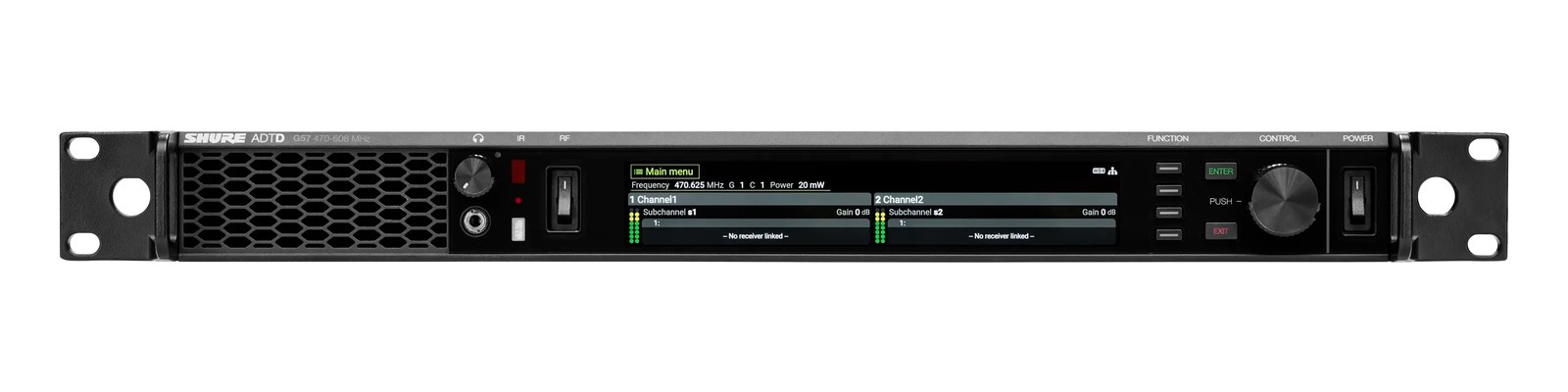
ADTDThe Shure ADTD is the dual-channel transmitter of the Axient Digital PSM platform: two stereo IEM channels of wideband digital RF with Dante and analog inputs, networked control, and the spectral efficiency that lets big shows stack channels where analog PSM could not. It is the direct successor tier to the PSM1000 and the unit users requested by name. Pair with ADXR bodypacks and an antenna combiner.View gear →
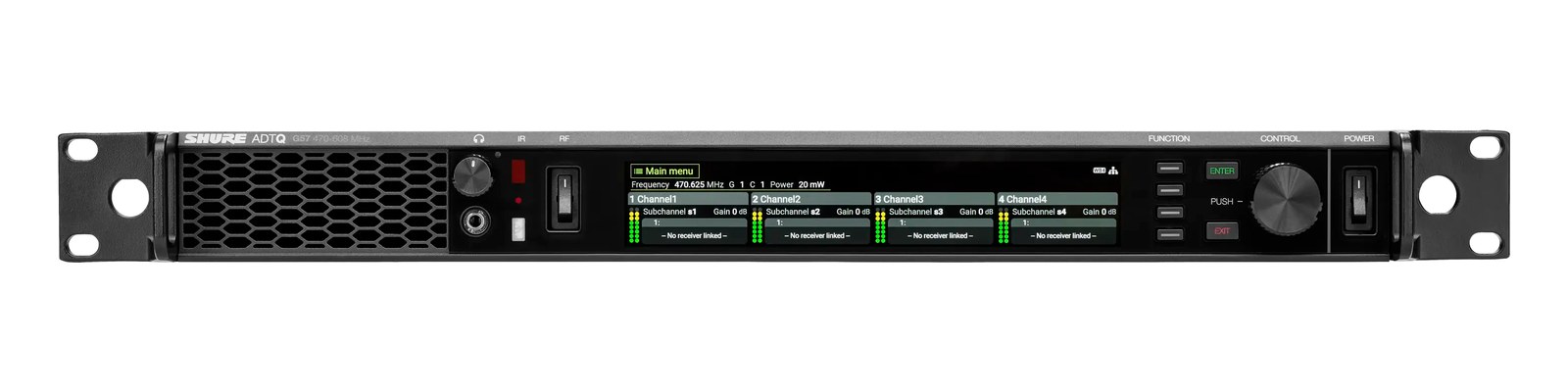
ADTQThe Shure ADTQ packs four stereo channels of Axient Digital PSM into a single rack space - the densest IEM transmission Shure makes. Wideband digital RF, Dante and analog inputs per channel, and Wireless Workbench control make it the monitor-world backbone for arena-scale channel counts. One ADTQ replaces a full rack of analog transmitters plus their combiner losses.View gear →
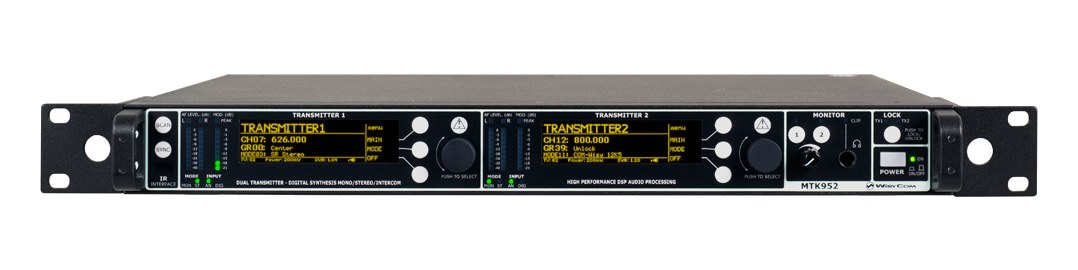
MTK952The Wisycom MTK952 is a premium IEM transmitter favored on top-tier tours and broadcast productions where RF performance is paramount. Its wideband tuning range simplifies frequency coordination in dense RF environments, and AES3 digital input eliminates the need for D/A conversion in all-digital signal chains. If budget allows, this is one of the most capable IEM transmitters on the market.View gear →
06 · Resolve the questions that can change the purchase or build plan.
Planning questions
Short, source-backed answers surface rack fit, power, cabling, and connection details before they become surprises.
How will the Wisycom MTK982 Dual Wideband TX affect rack fit and case depth?
It occupies 1U. Its documented depth is 240 mm.
How much power does the Wisycom MTK982 Dual Wideband TX draw?
Typical draw is 30W and documented maximum draw is 40W.
What connections does the Wisycom MTK982 Dual Wideband TX have?
6 documented physical ports, including Analog In 1-4, Dante, RF Out 1, RF Out 2, Control, Power.
07 · See this unit inside a real rack plan.
Builder preview
Placement is only the start. Builder checks space · depth · weight, power headroom, dependencies, and compatible signal paths around this exact catalog item.Open in Builder