
Behringer SD16 Stage Box
Behringer·Model SD16·behringer-sd16
Photos
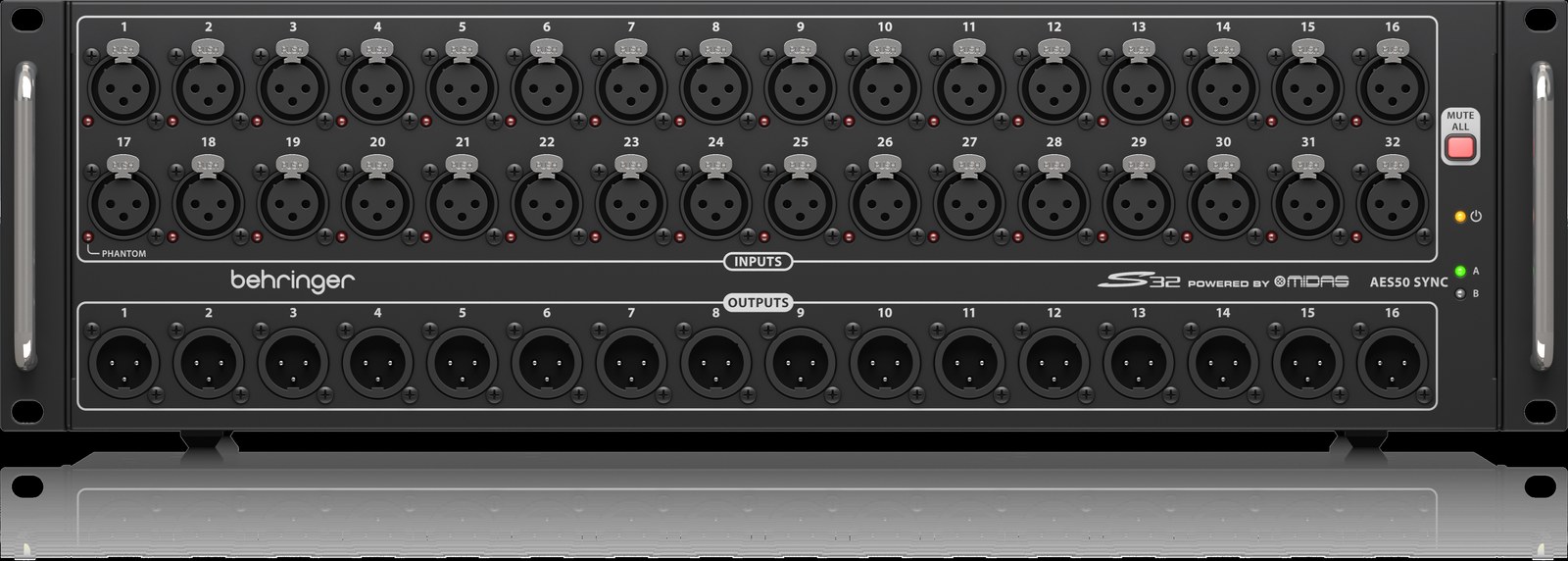
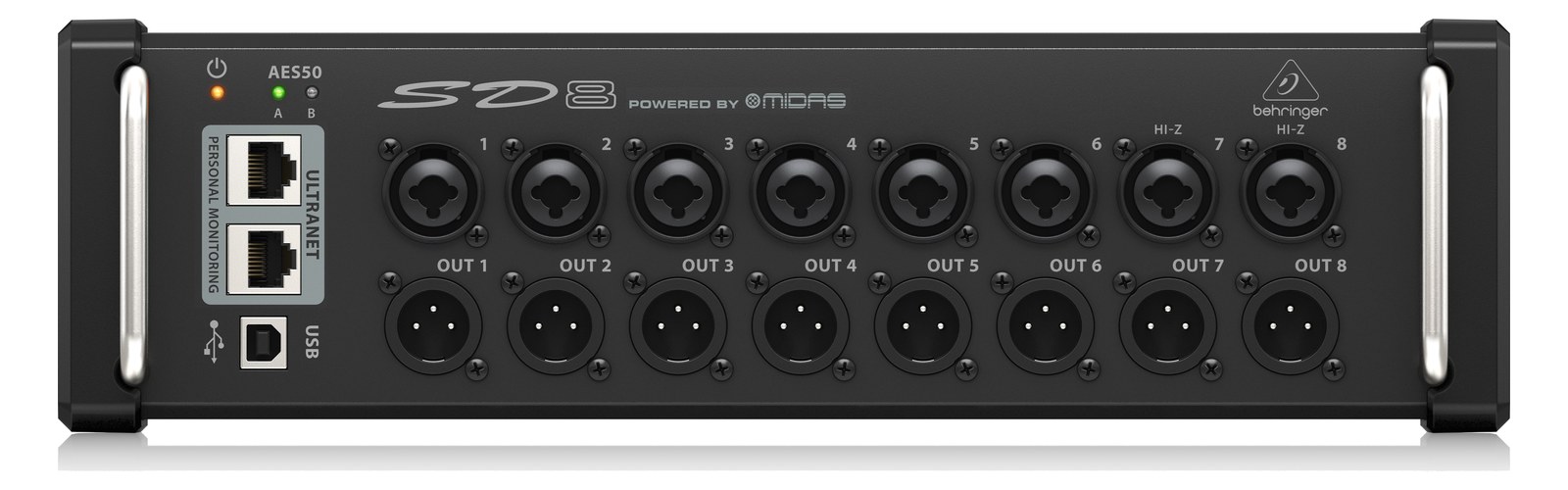
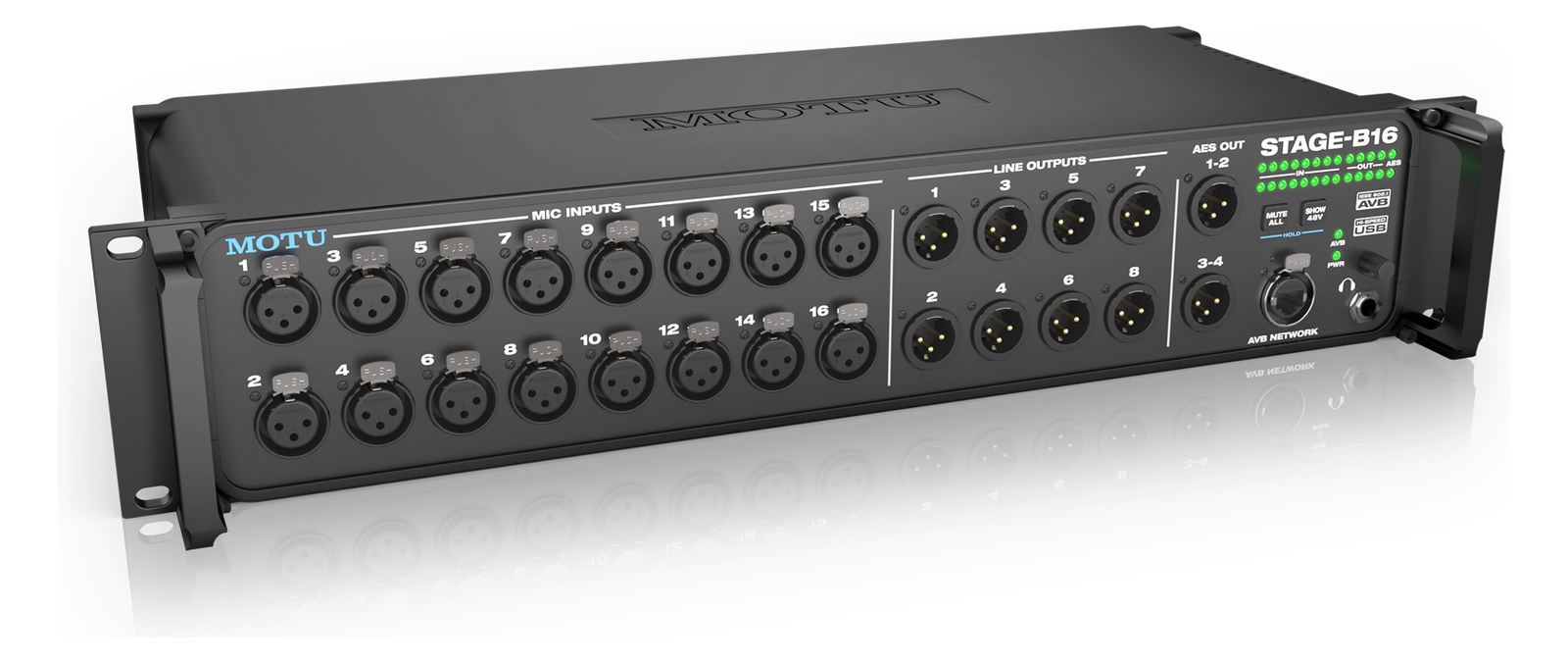
Manufacturer product photography — the drawn faceplate above stays true to panel layout; these show the hardware itself.
About the Behringer SD16
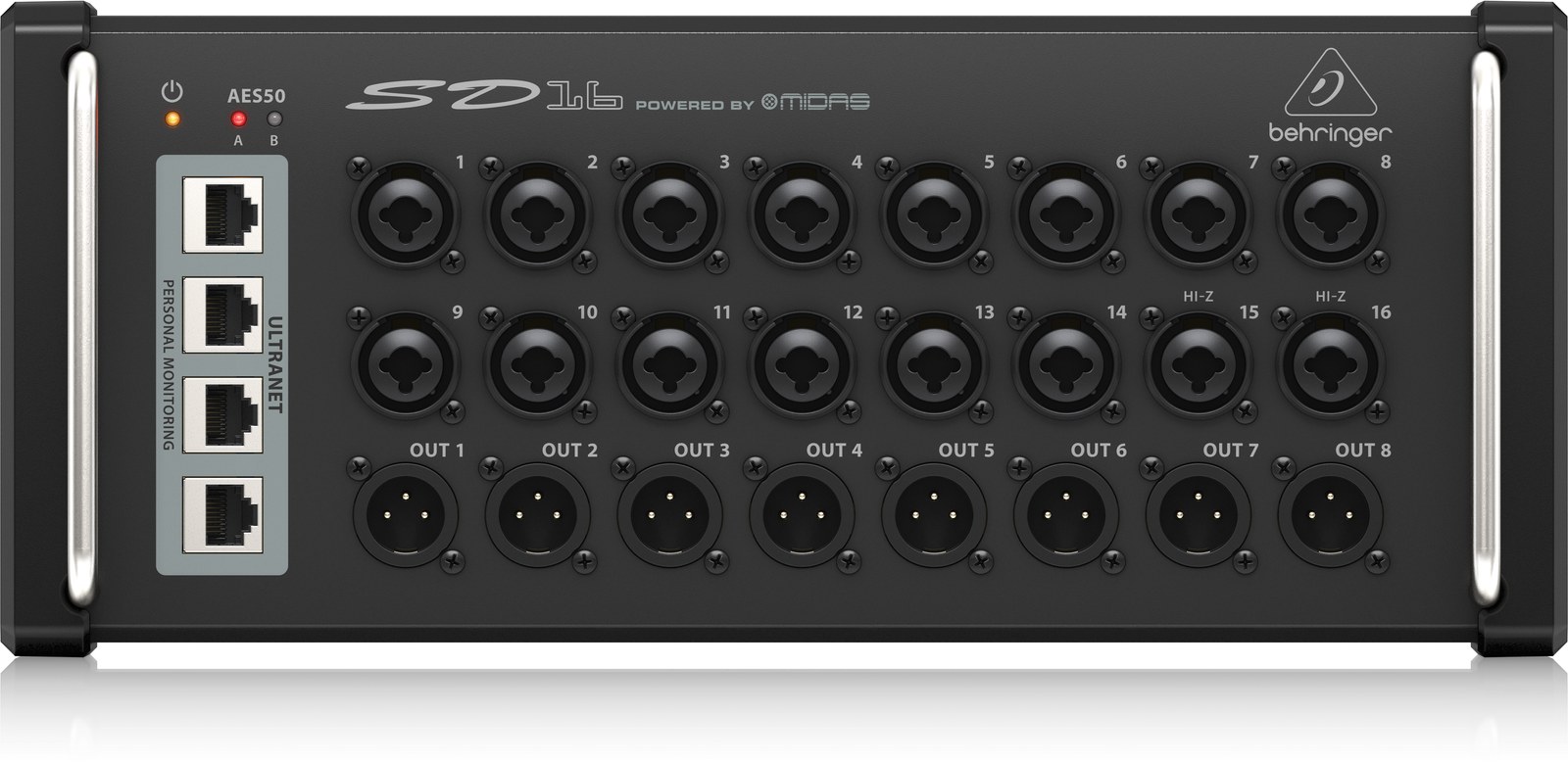
The Behringer SD16 is a budget-friendly 16-input, 8-output AES50The Behringer/Midas console-to-stage-box link: 48 channels each way over one shielded Cat5e cable, with near-zero latency. stage boxThe I/O endpoint on stage: mics plug in there and one digital line (AES50, Dante) carries everything to the console. The snake, digitized. compatible with Behringer X32 and Midas M32 consoles. Daisy-chains to additional SD16s for larger channel counts. The default pickup when a budget X32 / M32R rig needs more inputs at the stage.
The SD16 is the native stage boxThe I/O endpoint on stage: mics plug in there and one digital line (AES50, Dante) carries everything to the console. The snake, digitized. for the X32 and M32 family — it sits on or near the stage, collects up to 16 mic-levelThe tiny signal straight out of a microphone — roughly a thousandth of line level. It needs a preamp before anything else touches it. sources, sends them back to the console over a single EtherConAn Ethernet plug inside a rugged XLR-style locking shell — tour-grade network connections that can’t be yanked loose. cable via AES50The Behringer/Midas console-to-stage-box link: 48 channels each way over one shielded Cat5e cable, with near-zero latency., and returns 8 line-levelThe strong signal that runs between pieces of gear (about a volt) — hotter than mic level, far below speaker level. outputs to feed wedgesA floor monitor speaker angled up at the performer — the thing IEMs replace, and the thing you fall back on when they die., IEMIn-Ear Monitor — earpieces that replace floor wedges, feeding each player their own mix. The reason this whole rack exists. transmitters, or amp racks. It occupies 3UThe standard slice of rack height: 1U = 1.75″. A 3U box takes three slices; half-rack gear pairs two units side by side in one. in a rack and draws a modest 55 watts nominal. If you're already committed to the X32 or M32 ecosystem, this is the expected answer to getting inputs off the stage and down the snakeA multicore cable bundling many channels into one stage-to-console run. A sub-snake collects one corner of the stage into a drop box. without running 16 individual analog lines.
The two AES50The Behringer/Midas console-to-stage-box link: 48 channels each way over one shielded Cat5e cable, with near-zero latency. ports are the most important thing on the back panel. Port A is your primary link to the console; Port B is labeled redundantA second copy of anything critical — supply, computer, network path — already running so one failure can’t stop the show., which means you can daisy-chain a second SD16 and double your stage-side capacity to 32 inputs and 16 outputs without touching the console configuration — the M32 and X32 see both boxes natively. At 6 kg and 320 mm deep, it fits a shallow road rack without drama. The 8 XLRThe standard 3-pin locking connector for mics and balanced line signals — pin 1 is the shield, pins 2 and 3 carry the balanced pair. line outputs are real-world enough for most monitor rigs: four IEMIn-Ear Monitor — earpieces that replace floor wedges, feeding each player their own mix. The reason this whole rack exists. transmitters plus a couple of wedgeA floor monitor speaker angled up at the performer — the thing IEMs replace, and the thing you fall back on when they die. sends covers a typical small-to-mid production.
Pick the SD16 if your console is an X32, M32, or M32R and your budget is the primary constraint — at $509, nothing purpose-built in this category competes on price within the ecosystem. Where it gives ground is outside that ecosystem: AES50The Behringer/Midas console-to-stage-box link: 48 channels each way over one shielded Cat5e cable, with near-zero latency. is not DanteThe most common audio-over-network standard: dozens of channels of uncompressed digital audio down one ordinary Ethernet cable between Dante boxes., not MADIA pro digital format carrying 64 channels on one coax or optical cable. Point-to-point — one sender, one receiver, no network required., not MilanAudio Video Bridging — open network audio (MOTU, PreSonus) where the switch reserves bandwidth so streams can’t glitch. Milan is its pro profile., so if your console speaks anything else, this box sits out entirely. Engineers on touring rigs that may hot-swap consoles mid-run, or who need dante network integration, should look at a more protocol-flexible stage boxThe I/O endpoint on stage: mics plug in there and one digital line (AES50, Dante) carries everything to the console. The snake, digitized. and treat the cost delta as an insurance premium.
In the rack
- When daisy-chaining a second SD16 via AES50The Behringer/Midas console-to-stage-box link: 48 channels each way over one shielded Cat5e cable, with near-zero latency. B, physically label both boxes and their cables at load-in — 'SD16-A / AES50 to console' and 'SD16-B / AES50 to SD16-A' — so the next engineer doesn't spend twenty minutes tracing a silent chain during soundcheck.
- The 8 line outputs return from the console's output busA path where multiple channels sum into one signal — mixes, groups, and mains are all buses. A 25-bus console can build 25 blends at once. assignments, not automatically from inputs — confirm your X32/M32 routing template maps the correct buses to SD16 outputs before doors, or your IEMIn-Ear Monitor — earpieces that replace floor wedges, feeding each player their own mix. The reason this whole rack exists. mixes will be silent at the wrong moment.
- Power this box from the same distroOne pair of antennas feeding many receivers through an amplified splitter — replaces the forest of whips and keeps RF levels consistent. as your console if possible; AES50The Behringer/Midas console-to-stage-box link: 48 channels each way over one shielded Cat5e cable, with near-zero latency. can tolerate cable runs up to 100 meters, but clock stability benefits from both ends of the link sharing a common ground reference.
- At 320 mm depth, the SD16 fits most standard shallow stage racks, but verify your rack's internal depth before the gig — some DJ-style cases run closer to 280 mm and will leave the IECThe standard three-prong appliance power inlet on rack gear — the kettle lead. C13/C14 in spec-sheet speak. inlet hanging off the rear rail.
16-in / 8-out AES50The Behringer/Midas console-to-stage-box link: 48 channels each way over one shielded Cat5e cable, with near-zero latency. stage boxThe I/O endpoint on stage: mics plug in there and one digital line (AES50, Dante) carries everything to the console. The snake, digitized..
I/O Ports (27)
| Port | Connector | Direction | Signal | Channels |
|---|---|---|---|---|
| Mic In 1 | XLR FEMALE | input | analog audio | — |
| Mic In 2 | XLR FEMALE | input | analog audio | — |
| Mic In 3 | XLR FEMALE | input | analog audio | — |
| Mic In 4 | XLR FEMALE | input | analog audio | — |
| Mic In 5 | XLR FEMALE | input | analog audio | — |
| Mic In 6 | XLR FEMALE | input | analog audio | — |
| Mic In 7 | XLR FEMALE | input | analog audio | — |
| Mic In 8 | XLR FEMALE | input | analog audio | — |
| Mic In 9 | XLR FEMALE | input | analog audio | — |
| Mic In 10 | XLR FEMALE | input | analog audio | — |
| Mic In 11 | XLR FEMALE | input | analog audio | — |
| Mic In 12 | XLR FEMALE | input | analog audio | — |
| Mic In 13 | XLR FEMALE | input | analog audio | — |
| Mic In 14 | XLR FEMALE | input | analog audio | — |
| Mic In 15 | XLR FEMALE | input | analog audio | — |
| Mic In 16 | XLR FEMALE | input | analog audio | — |
| Line Out 1 | XLR MALE | output | analog audio | — |
| Line Out 2 | XLR MALE | output | analog audio | — |
| Line Out 3 | XLR MALE | output | analog audio | — |
| Line Out 4 | XLR MALE | output | analog audio | — |
| Line Out 5 | XLR MALE | output | analog audio | — |
| Line Out 6 | XLR MALE | output | analog audio | — |
| Line Out 7 | XLR MALE | output | analog audio | — |
| Line Out 8 | XLR MALE | output | analog audio | — |
| AES50 A | ETHERCON | bidirectional | digital audio | 48 |
| AES50 B (redundant) | ETHERCON | bidirectional | digital audio | 48 |
- Power (IEC) (IEC C14)
Deciding between two?
Rack space, watts, weight and every connector, side by side.
Related gear


Community rigs using this gear (1)
Browse all rigs →Related articles
Guides from our library that cover planning around stage box gear.
A walking tour of the signal path from microphone to in-ear monitor, with what every box in the rack actually does to the audio along the way.
A plain-English guide to writing the input list, stage plot, and patch sheet that house engineers want — without the jargon, with examples, and with a free way to generate one.
Step-by-step: linking aux buses into stereo pairs, pre-fader vs post-fader, routing buses to Ultranet vs physical XLRs vs AES50, and adding a bus-level limiter.
A practical comparison of the three audio-over-network protocols you’ll encounter in a rack rig, with guidance on when each one is the right pick.