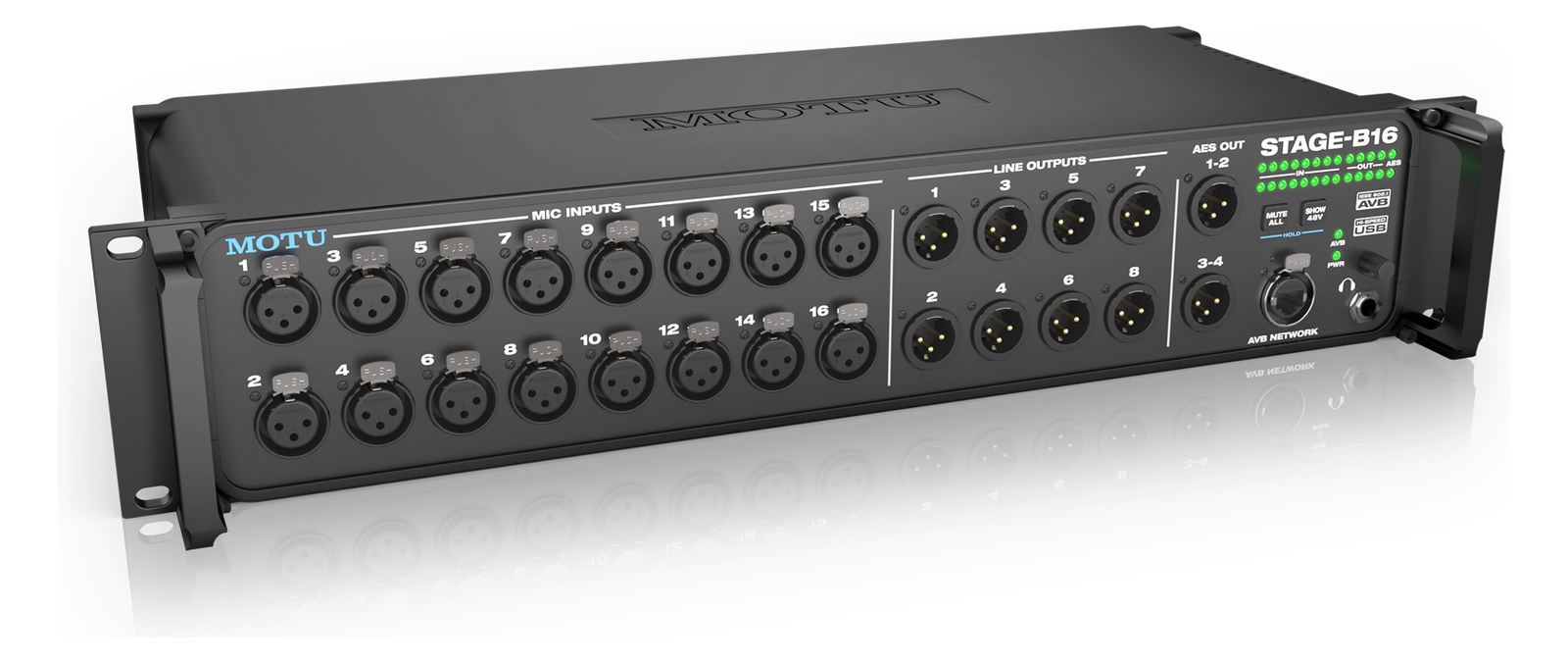
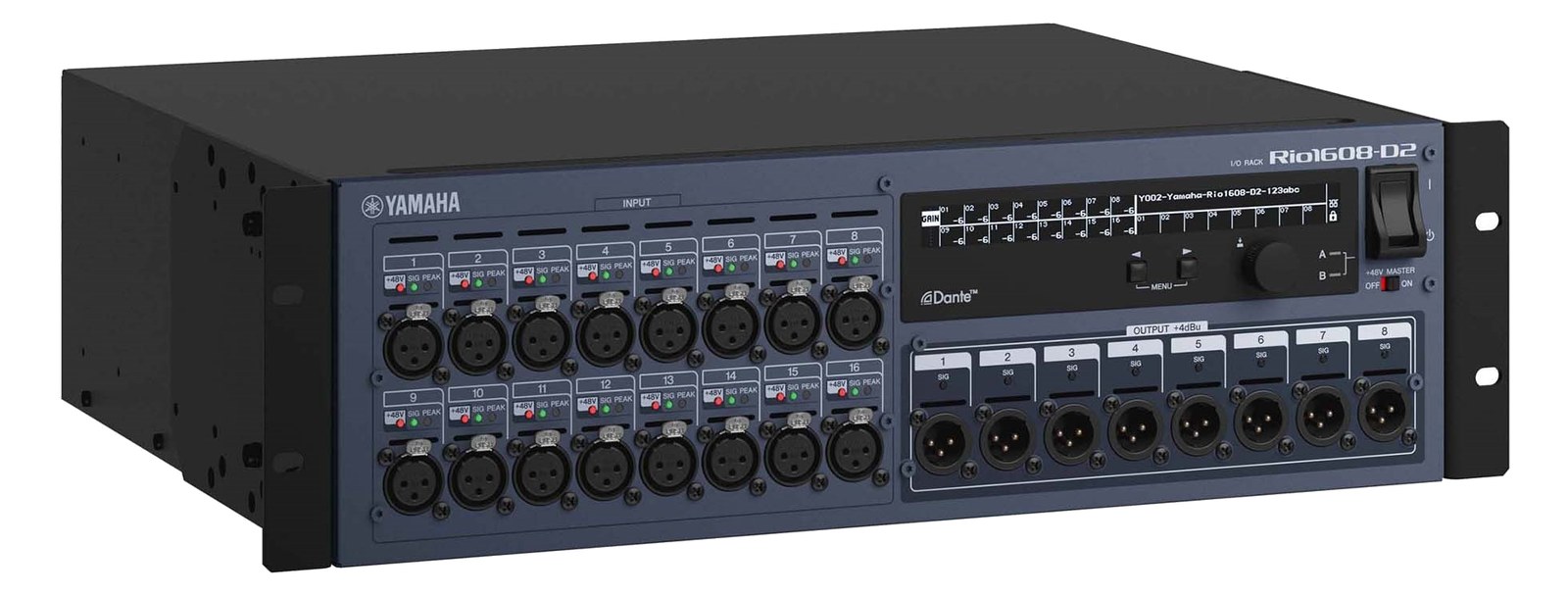
The Behringer S16 is the budget AES50 stage box paired with X32-series consoles. Sixteen Midas-designed preamps at the stage and eight XLR returns, all multiplexed onto one shielded Cat5e — two AES50 ports allow redundancy or daisy-chaining to a second S16 for 32 inputs from a single console port. A mainstay of IEM rigs where the stage-to-rack run would otherwise need a 16-pair analog snake.
~$579Use retailer rows for current price and stock
01 · What it does—and what that changes in your rig.
Product overview
Start with the payoff, then work through how it functions, where it fits, and the details that change a real build.
The payoff
Stage Box decisions, organized around the whole rig.
The Behringer S16 is the stage-end half of a digital snakeA multicore cable bundling many channels into one stage-to-console run. A sub-snake collects one corner of the stage into a drop box. — it sits in a stage rack, collects analog sources from the stage floor, and ships everything to a Behringer or Klark Teknik X32-family console over a single shielded Cat5eStandard network cable grades. In an audio rig one cheap Cat5e run can replace a 48-channel copper snake; AES50 wants it shielded. cable terminated in EtherConAn Ethernet plug inside a rugged XLR-style locking shell — tour-grade network connections that can’t be yanked loose.. Sixteen XLRThe standard 3-pin locking connector for mics and balanced line signals — pin 1 is the shield, pins 2 and 3 carry the balanced pair. inputs with Midas-designed preampsThe gain stage that lifts a mic’s tiny signal up to line level — the first thing a signal hits, and a big part of how a console sounds. handle your full input list, and eight XLR outputs bring console-routed signals back to the stage for wedgesA floor monitor speaker angled up at the performer — the thing IEMs replace, and the thing you fall back on when they die., side-fills, or anything else that needs a local analog feed. For IEMIn-Ear Monitor — earpieces that replace floor wedges, feeding each player their own mix. The reason this whole rack exists. rigs specifically, it replaces what would otherwise be a heavy, expensive multi-pair analog snake run across a long stage-to-rack distance.
Documented outputs
1313 destination connections
Documented inputs
18Based on documented inputs
Rack space
2UBuilder checks available rail space
Behringer product panel2U · 22W
Function
How it works in the path
At load-in, the math is simple: one Cat5eStandard network cable grades. In an audio rig one cheap Cat5e run can replace a 48-channel copper snake; AES50 wants it shielded. run replaces up to 16 channels of analog snakeA multicore cable bundling many channels into one stage-to-console run. A sub-snake collects one corner of the stage into a drop box., and the second AES50The Behringer/Midas console-to-stage-box link: 48 channels each way over one shielded Cat5e cable, with near-zero latency. port gives you a real option — either a redundantA second copy of anything critical — supply, computer, network path — already running so one failure can’t stop the show. path back to the console or a daisy-chain to a second S16 for 32 inputs total without touching a second console AES50 port. Power draw sits at 22 watts nominal and tops at 30, so it's easy on your rack's power budget. The 184mm depth and 4.8kg weight are honest stage-rack numbers — not ultralight, but it won't punish a shallow utility rack either. PreampThe gain stage that lifts a mic’s tiny signal up to line level — the first thing a signal hits, and a big part of how a console sounds.gainHow much the preamp amplifies the incoming signal. Too low and you’re hunting through hiss; too high and peaks clip. is set remotely from the console, which means no one is tweaking knobs on the box mid-show.
Best fit
Where it earns its place in the rack
If you're running an X32, X32 Rack, or X32 Compact as your console core, the S16 is the obvious, lowest-friction stage boxThe I/O endpoint on stage: mics plug in there and one digital line (AES50, Dante) carries everything to the console. The snake, digitized. choice — the AES50The Behringer/Midas console-to-stage-box link: 48 channels each way over one shielded Cat5e cable, with near-zero latency. integration is native and setup is minimal. It is not an open-protocol DanteThe most common audio-over-network standard: dozens of channels of uncompressed digital audio down one ordinary Ethernet cable between Dante boxes. or AVBAudio Video Bridging — open network audio (MOTU, PreSonus) where the switch reserves bandwidth so streams can’t glitch. Milan is its pro profile. device, so if your console ecosystem lives outside the X32 family, look elsewhere. The eight outputs are enough for most IEMIn-Ear Monitor — earpieces that replace floor wedges, feeding each player their own mix. The reason this whole rack exists. monitor rigs sending mixes to side-fills or local wedgesA floor monitor speaker angled up at the performer — the thing IEMs replace, and the thing you fall back on when they die., but if you need more analog returns at the stage — say, a dense festival monitor worldThe side-stage domain of the monitor engineer — console, IEM racks, and everything feeding the band’s ears instead of the audience. — you'll want to daisy-chain a second unit or reconsider your architecture before committing to this box.
In the rack
Details worth deciding before load-in.
Run the Cat5eStandard network cable grades. In an audio rig one cheap Cat5e run can replace a 48-channel copper snake; AES50 wants it shielded. inside a protective sleeve or tape it to your power cable — a kicked connector at the stage end ends your show, and EtherConAn Ethernet plug inside a rugged XLR-style locking shell — tour-grade network connections that can’t be yanked loose. locks help but don't replace strain relief.
Use AES50The Behringer/Midas console-to-stage-box link: 48 channels each way over one shielded Cat5e cable, with near-zero latency. Port B as a true redundantA second copy of anything critical — supply, computer, network path — already running so one failure can’t stop the show. path if your console supports it; pre-configure the failoverThe automatic switch to the backup when the primary dies — good failover is seamless enough that the audience never knows. at soundcheck, not during a dropoutA brief audio gap when the radio link fails — the thing diversity, distros, and coordination all exist to prevent..
When daisy-chaining two S16s, label input channels 1–16 on the first box and 17–32 on the second with colored tape before doors — on a dark stage, counting unlabeled XLRsThe standard 3-pin locking connector for mics and balanced line signals — pin 1 is the shield, pins 2 and 3 carry the balanced pair. under pressure is a losing game.
PreampThe gain stage that lifts a mic’s tiny signal up to line level — the first thing a signal hits, and a big part of how a console sounds.gainHow much the preamp amplifies the incoming signal. Too low and you’re hunting through hiss; too high and peaks clip. lives in the console, not on the box — build a default scene with conservative gain settings saved to the console before every show so you're never starting from zero on a new stage.
02 · Know the whole path before you buy.
Signal path
Learn the route as a block diagram: source, product function, transport, and destination. Select any block to see what enters, what changes, and what leaves.
Interactive block diagramAuto-looping · hover, focus, or tap to hold a stage
Port-type signalProduct functionSystem boundary
Follow one signal from source to destination
Each block answers the same three questions: what arrives, what changes here, and what leaves.
01 · Source · selected
XLR female + midi din5
etherCON + RJ45
XLR male + ¼-inch TRS
01 · Source
18 documented inputs
XLR female + midi din5
Arrives as
18 documented inputs
Connector
XLR female + midi din5
Signal
analog audio
03 · What this product asks of the rest of the system.
Compatibility
Treat connector names as the start of the check—not the answer. These are the boundaries that determine a complete working path.
Best fit · Stage Box
Use it when 2U and 225 mm of depth fit the case.
Plan the companion path
Complete the path with upstream and downstream gear that matches connector, direction, signal type, protocol, and wiring standard.
Protocol boundary
This product declares AES50, ULTRANET; matching plugs alone do not make other protocols compatible.
04 · Every connector, grouped by job.
I/O ports
Switch the product view and the documented port inventory updates with it—hardware and data stay side by side.
Every connector, grouped by job.
Switch panels to keep the hardware view and the documented port list in sync.
Front panelRear panel
All documented ports for Behringer S16 Digital Stage Box
Port
Panel
Connector
Direction
Signal
Channels
Stage In 1
front
XLR female
input
analog audio
—
Stage In 2
front
XLR female
input
analog audio
—
Stage In 3
front
XLR female
input
analog audio
—
Stage In 4
front
XLR female
input
analog audio
—
Stage In 5
front
XLR female
input
analog audio
—
Stage In 6
front
XLR female
input
analog audio
—
Stage In 7
front
XLR female
input
analog audio
—
Stage In 8
front
XLR female
input
analog audio
—
Stage In 9
front
XLR female
input
analog audio
—
Stage In 10
front
XLR female
input
analog audio
—
Stage In 11
front
XLR female
input
analog audio
—
Stage In 12
front
XLR female
input
analog audio
—
Stage In 13
front
XLR female
input
analog audio
—
Stage In 14
front
XLR female
input
analog audio
—
Stage In 15
front
XLR female
input
analog audio
—
Stage In 16
front
XLR female
input
analog audio
—
Stage Out 1
front
XLR male
output
analog audio
—
Stage Out 2
front
XLR male
output
analog audio
—
Stage Out 3
front
XLR male
output
analog audio
—
Stage Out 4
front
XLR male
output
analog audio
—
Stage Out 5
front
XLR male
output
analog audio
—
Stage Out 6
front
XLR male
output
analog audio
—
Stage Out 7
front
XLR male
output
analog audio
—
Stage Out 8
front
XLR male
output
analog audio
—
Headphones (front)
front
¼-inch TRS
output
analog audio
—
AES50 A
rear
etherCON
bidirectional
digital audio
48
AES50 B (redundant)
rear
etherCON
bidirectional
digital audio
48
Ultranet (P-16)
rear
RJ45
output
digital audio
16
ADAT Out A
rear
toslink
output
digital audio
8
ADAT Out B
rear
toslink
output
digital audio
8
MIDI In
rear
midi din5
input
data
—
MIDI Out
rear
midi din5
output
data
—
USB-B (firmware)
rear
usb b
bidirectional
data
—
Power (IEC)
rear
IEC C14
input
power
—
Showing 34 of 34 documented physical ports. Scroll to review the remaining rows.
05 · Compare the decision, not just the price.
Alternatives
The rows are organized around fit, power, I/O, and system role so a cheaper unit cannot hide a more expensive workflow.
S16The Behringer S16 is the budget AES50 stage box paired with X32-series consoles. Sixteen Midas-designed preamps at the stage and eight XLR returns, all multiplexed onto one shielded Cat5e — two AES50 ports allow redundancy or daisy-chaining to a second S16 for 32 inputs from a single console port. A mainstay of IEM rigs where the stage-to-rack run would otherwise need a 16-pair analog snake.View gear →
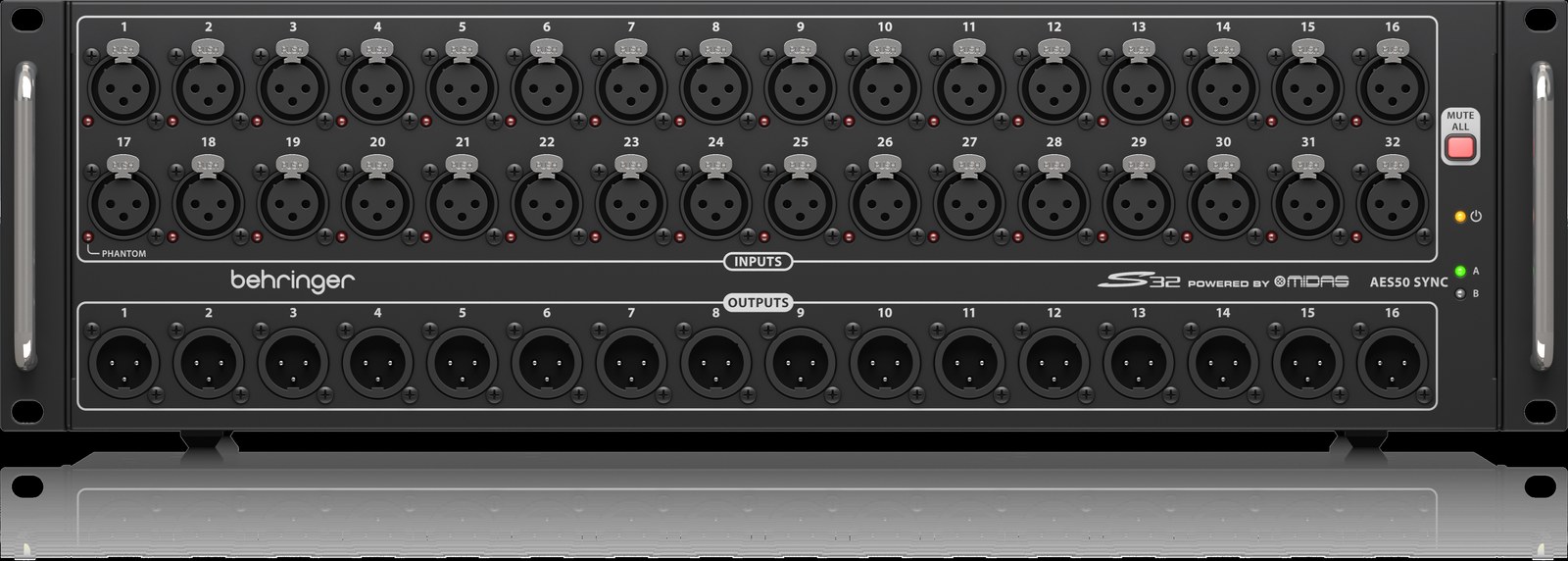
S32The Behringer S32 brings 32 Midas-designed preamps to the stage and carries every channel — plus 16 returns — back to the console on a single AES50 link over shielded Cat5e. Two AES50 ports for primary + redundant operation. The go-to mate for X32 Rack and Wing Rack when the rig needs full-band mic channels without a pair of 24-pair analog snakes coiled in the truck.View gear →
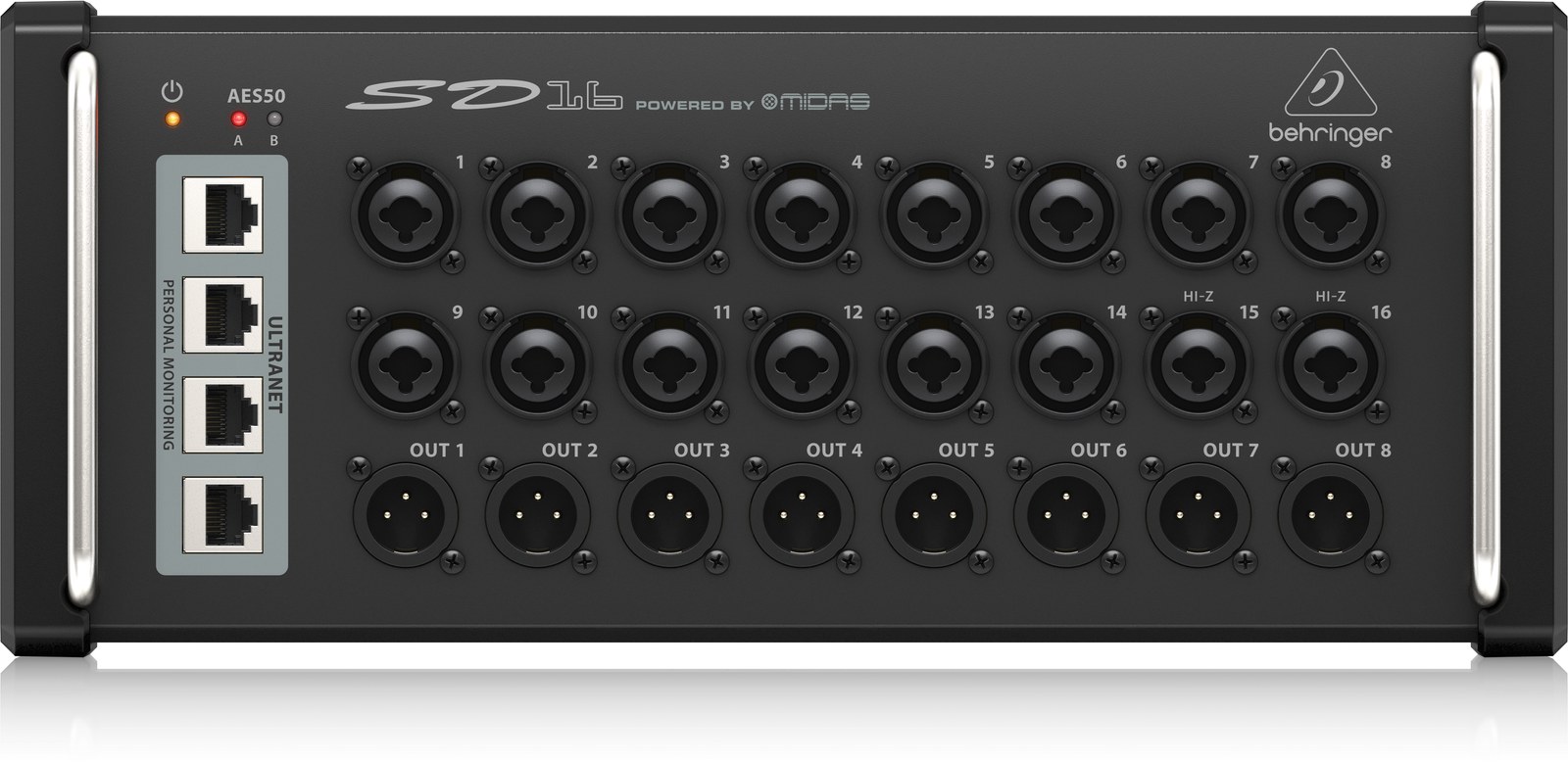
SD16The Behringer SD16 is a budget-friendly 16-input, 8-output AES50 stage box compatible with Behringer X32 and Midas M32 consoles. Daisy-chains to additional SD16s for larger channel counts. The default pickup when a budget X32 / M32R rig needs more inputs at the stage.View gear →
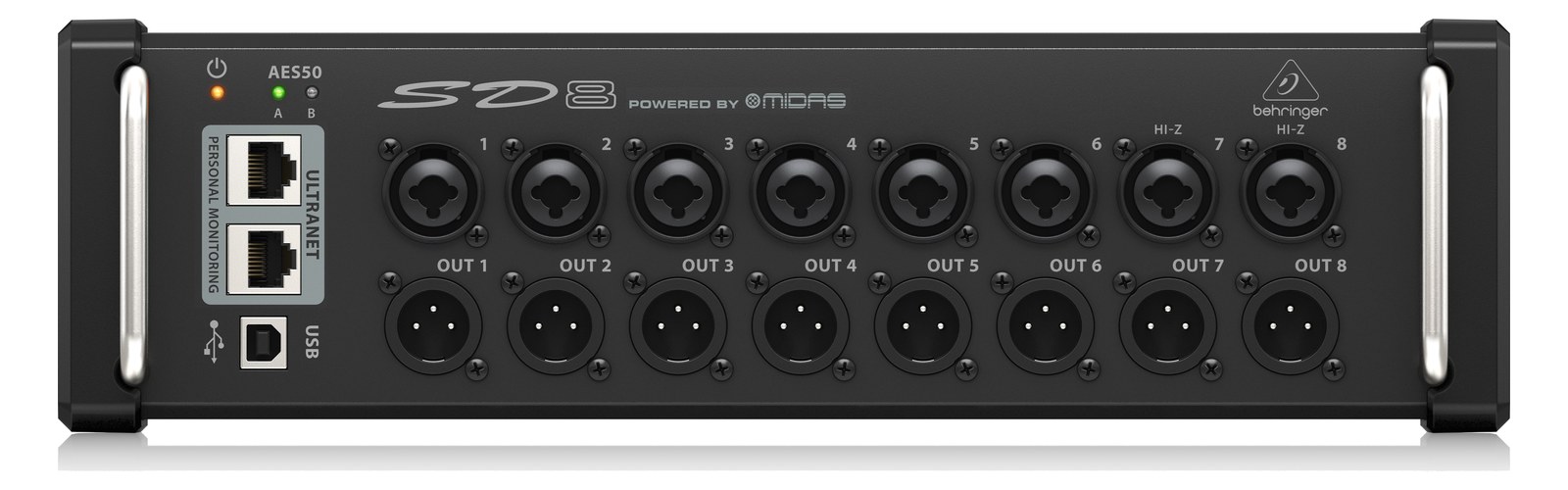
SD8The Behringer SD8 puts eight remote-controlled Midas-designed preamps and eight returns on an AES50 run, in a compact chassis that lives on stage or in a drop rack. For X32/WING rigs it is the cheapest way to add an eight-channel drop without a full S16. Chains with other SD/S boxes over the second AES50 port.View gear →
06 · Resolve the questions that can change the purchase or build plan.
Planning questions
Short, source-backed answers surface rack fit, power, cabling, and connection details before they become surprises.
How will the Behringer S16 Digital Stage Box affect rack fit and case depth?
It occupies 2U. Its documented depth is 225 mm.
How much power does the Behringer S16 Digital Stage Box draw?
Typical draw is 22W and documented maximum draw is 30W.
What connections does the Behringer S16 Digital Stage Box have?
34 documented physical ports, including Stage In 1, Stage In 2, Stage In 3, Stage In 4, Stage In 5, Stage In 6.
07 · See this unit inside a real rack plan.
Builder preview
Placement is only the start. Builder checks space · depth · weight, power headroom, dependencies, and compatible signal paths around this exact catalog item.Open in Builder