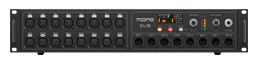
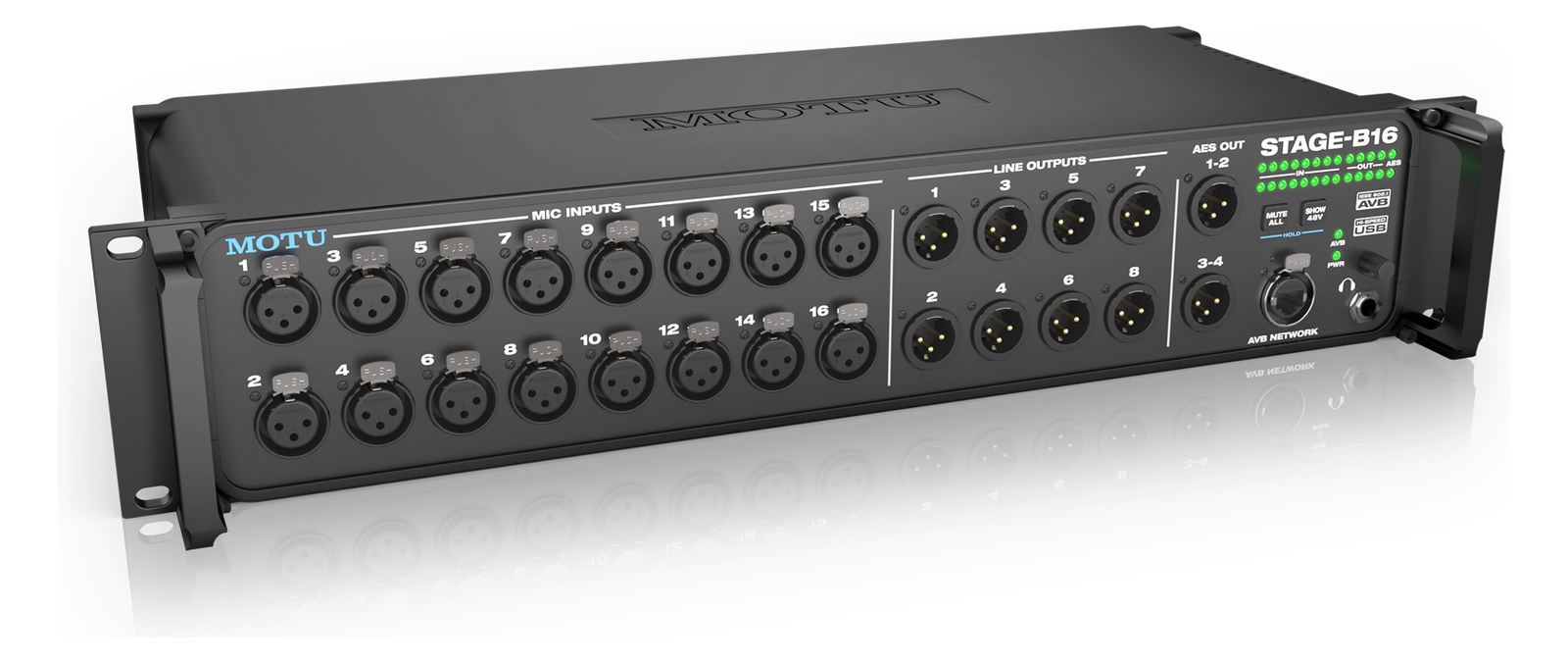
The Midas DL16 puts 16 Midas mic preamps at the stage and hauls every channel back to the console over a single shielded Cat5e using AES50 — replacing sixteen XLR runs with one cable. Pairs with Midas M32/M32R and Behringer X32/Wing consoles. Two AES50 ports allow primary + redundant links for mission-critical shows. Network-only: there is no analog multicore back to FOH; all signal flow lives on the AES50 trunk.
~$1,039Use retailer rows for current price and stock
01 · What it does—and what that changes in your rig.
Product overview
Start with the payoff, then work through how it functions, where it fits, and the details that change a real build.
The payoff
Stage Box decisions, organized around the whole rig.
The DL16 is the stage-end of your digital snakeA multicore cable bundling many channels into one stage-to-console run. A sub-snake collects one corner of the stage into a drop box. — a 3UThe standard slice of rack height: 1U = 1.75″. A 3U box takes three slices; half-rack gear pairs two units side by side in one. box that sits in your stage rack, collects up to 16 mic or line sources through genuine Midas preampsThe gain stage that lifts a mic’s tiny signal up to line level — the first thing a signal hits, and a big part of how a console sounds., and ships everything back to the console over a single shielded Cat5eStandard network cable grades. In an audio rig one cheap Cat5e run can replace a 48-channel copper snake; AES50 wants it shielded. cable via AES50The Behringer/Midas console-to-stage-box link: 48 channels each way over one shielded Cat5e cable, with near-zero latency.. That one cable replaces sixteen individual XLRThe standard 3-pin locking connector for mics and balanced line signals — pin 1 is the shield, pins 2 and 3 carry the balanced pair. runs, which changes load-in logistics entirely. The 8 analog outputs on the back let you return console mixes to stage — wedgeA floor monitor speaker angled up at the performer — the thing IEMs replace, and the thing you fall back on when they die. feeds, amp racks, or local foldback sends — without running additional cable. It pairs natively with the Midas M32 and M32R, and integrates equally well with the Behringer X32 and Wing family, all of which speak AES50 natively.
Documented outputs
1313 destination connections
Documented inputs
18Based on documented inputs
Rack space
2UBuilder checks available rail space
Midas product panel2U · 25W
Function
How it works in the path
At load-in, the DL16 earns its keep fast: one Cat5eStandard network cable grades. In an audio rig one cheap Cat5e run can replace a 48-channel copper snake; AES50 wants it shielded.trunkThe main multichannel run between stage and console — one fat multicore (or one Cat5e, these days) carrying everything at once. to FOHFront Of House — the main mix the audience hears, and the console position out in the room where it gets mixed. or your monitor position, and you're done with the analog run. The second AES50The Behringer/Midas console-to-stage-box link: 48 channels each way over one shielded Cat5e cable, with near-zero latency. port isn't a bonus — it's a redundantA second copy of anything critical — supply, computer, network path — already running so one failure can’t stop the show. link, so on a mission-critical show you can have a backup path already live before doors open. Power draw is modest at 25W typical, spiking to 35W, so it won't stress a standard IECThe standard three-prong appliance power inlet on rack gear — the kettle lead. C13/C14 in spec-sheet speak. outlet or eat meaningful rack power budget. At 6.1 kg and 249mm deep, it's not a featherweight, but it's built to live on a stage floor rack or a riser under the drum kit. What it is not: there is no analog multicore option here. If the AES50 link goes down and you have no redundant path patched in, you have no signal. Plan accordingly.
Best fit
Where it earns its place in the rack
Pick the DL16 if you're running an M32, M32R, X32, or Wing and want Midas-grade preampsThe gain stage that lifts a mic’s tiny signal up to line level — the first thing a signal hits, and a big part of how a console sounds. at the stage without the cost of a larger box. For a band with 12–16 inputs and 4–6 monitor mixes, this is a clean, purpose-fit solution. If you need more than 16 inputs at the stage, you'll need a second DL16 or a step up to the DL32. If your console doesn't speak AES50The Behringer/Midas console-to-stage-box link: 48 channels each way over one shielded Cat5e cable, with near-zero latency., the DL16 is simply incompatible — it has no DanteThe most common audio-over-network standard: dozens of channels of uncompressed digital audio down one ordinary Ethernet cable between Dante boxes., no MADIA pro digital format carrying 64 channels on one coax or optical cable. Point-to-point — one sender, one receiver, no network required., no analog multicore fallback. It also won't work as a standalone audio interface or connect to a computer directly.
In the rack
Details worth deciding before load-in.
Run shielded Cat5eStandard network cable grades. In an audio rig one cheap Cat5e run can replace a 48-channel copper snake; AES50 wants it shielded. — not standard patch cable — for your AES50The Behringer/Midas console-to-stage-box link: 48 channels each way over one shielded Cat5e cable, with near-zero latency.trunkThe main multichannel run between stage and console — one fat multicore (or one Cat5e, these days) carrying everything at once.. AES50 is spec'd for shielded cable, and on longer runs or stages with heavy RFRadio Frequency — the wireless part of wireless. RF planning is why big rigs scan, coordinate, and combine antennas instead of hoping., unshielded cable is the first thing to cause unexplained dropoutsA brief audio gap when the radio link fails — the thing diversity, distros, and coordination all exist to prevent..
Use both AES50The Behringer/Midas console-to-stage-box link: 48 channels each way over one shielded Cat5e cable, with near-zero latency. ports on every important show. Patch AES50 A as your primary and AES50 B as the redundantA second copy of anything critical — supply, computer, network path — already running so one failure can’t stop the show. link at the console; the M32 and X32 families handle automatic failoverThe automatic switch to the backup when the primary dies — good failover is seamless enough that the audience never knows.. This takes two minutes at setup and has saved shows.
Reserve the 8 analog outputs thoughtfully — they're your only returns to stage. Map your most critical mixes first: lead vocal IEMIn-Ear Monitor — earpieces that replace floor wedges, feeding each player their own mix. The reason this whole rack exists. mix, drummer's wedgeA floor monitor speaker angled up at the performer — the thing IEMs replace, and the thing you fall back on when they die., or a local PA feed. Don't burn outputs on sources you can route another way.
If you're stacking two DL16s for a larger input count, daisy-chain AES50The Behringer/Midas console-to-stage-box link: 48 channels each way over one shielded Cat5e cable, with near-zero latency. B of the first unit to AES50 A of the second before connecting to the console — this is the standard cascading topology for these units on Midas and Behringer consoles.
02 · Know the whole path before you buy.
Signal path
Learn the route as a block diagram: source, product function, transport, and destination. Select any block to see what enters, what changes, and what leaves.
Interactive block diagramAuto-looping · hover, focus, or tap to hold a stage
Port-type signalProduct functionSystem boundary
Follow one signal from source to destination
Each block answers the same three questions: what arrives, what changes here, and what leaves.
01 · Source · selected
XLR female + midi din5
etherCON + RJ45
XLR male + ¼-inch TRS
01 · Source
18 documented inputs
XLR female + midi din5
Arrives as
18 documented inputs
Connector
XLR female + midi din5
Signal
analog audio
03 · What this product asks of the rest of the system.
Compatibility
Treat connector names as the start of the check—not the answer. These are the boundaries that determine a complete working path.
Best fit · Stage Box
Use it when 2U and 225 mm of depth fit the case.
Plan the companion path
Complete the path with upstream and downstream gear that matches connector, direction, signal type, protocol, and wiring standard.
Protocol boundary
This product declares AES50, ULTRANET; matching plugs alone do not make other protocols compatible.
04 · Every connector, grouped by job.
I/O ports
Switch the product view and the documented port inventory updates with it—hardware and data stay side by side.
Every connector, grouped by job.
Switch panels to keep the hardware view and the documented port list in sync.
Front panelRear panel
All documented ports for Midas DL16 Digital Stage Box
Port
Panel
Connector
Direction
Signal
Channels
Stage In 1
front
XLR female
input
analog audio
—
Stage In 2
front
XLR female
input
analog audio
—
Stage In 3
front
XLR female
input
analog audio
—
Stage In 4
front
XLR female
input
analog audio
—
Stage In 5
front
XLR female
input
analog audio
—
Stage In 6
front
XLR female
input
analog audio
—
Stage In 7
front
XLR female
input
analog audio
—
Stage In 8
front
XLR female
input
analog audio
—
Stage In 9
front
XLR female
input
analog audio
—
Stage In 10
front
XLR female
input
analog audio
—
Stage In 11
front
XLR female
input
analog audio
—
Stage In 12
front
XLR female
input
analog audio
—
Stage In 13
front
XLR female
input
analog audio
—
Stage In 14
front
XLR female
input
analog audio
—
Stage In 15
front
XLR female
input
analog audio
—
Stage In 16
front
XLR female
input
analog audio
—
Stage Out 1
front
XLR male
output
analog audio
—
Stage Out 2
front
XLR male
output
analog audio
—
Stage Out 3
front
XLR male
output
analog audio
—
Stage Out 4
front
XLR male
output
analog audio
—
Stage Out 5
front
XLR male
output
analog audio
—
Stage Out 6
front
XLR male
output
analog audio
—
Stage Out 7
front
XLR male
output
analog audio
—
Stage Out 8
front
XLR male
output
analog audio
—
Headphones (front)
front
¼-inch TRS
output
analog audio
—
AES50 A
rear
etherCON
bidirectional
digital audio
48
AES50 B (redundant)
rear
etherCON
bidirectional
digital audio
48
Ultranet (P-16)
rear
RJ45
output
digital audio
16
ADAT Out A
rear
toslink
output
digital audio
8
ADAT Out B
rear
toslink
output
digital audio
8
MIDI In
rear
midi din5
input
data
—
MIDI Out
rear
midi din5
output
data
—
USB-B (firmware)
rear
usb b
bidirectional
data
—
Power (IEC)
rear
IEC C14
input
power
—
Showing 34 of 34 documented physical ports. Scroll to review the remaining rows.
05 · Compare the decision, not just the price.
Alternatives
The rows are organized around fit, power, I/O, and system role so a cheaper unit cannot hide a more expensive workflow.
DL16The Midas DL16 puts 16 Midas mic preamps at the stage and hauls every channel back to the console over a single shielded Cat5e using AES50 — replacing sixteen XLR runs with one cable. Pairs with Midas M32/M32R and Behringer X32/Wing consoles. Two AES50 ports allow primary + redundant links for mission-critical shows. Network-only: there is no analog multicore back to FOH; all signal flow lives on the AES50 trunk.View gear →
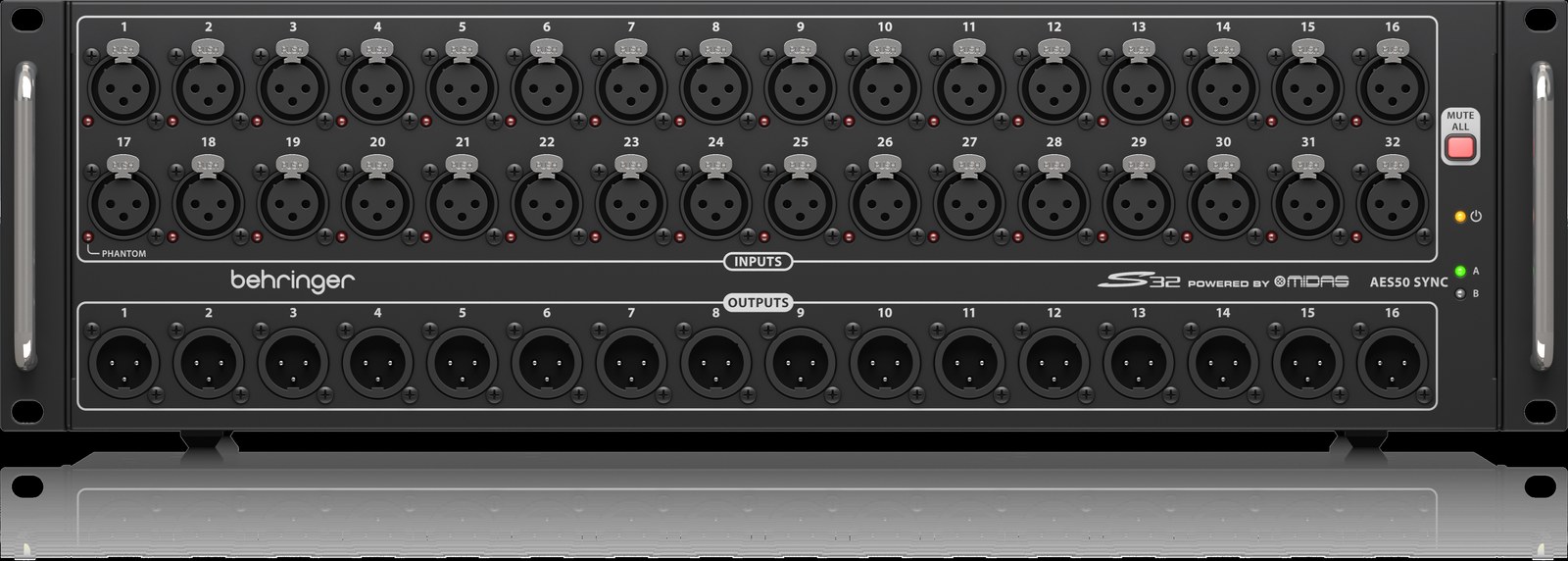
DL251The Midas DL251 is the top-of-line AES50 stage box — 48 Midas preamps and 16 XLR outputs, all multiplexed onto three AES50 links. Used on major tours where a single stage box needs to service a full band (drums + guitars + keys + vocals + playback) without cascading a second box. Pairs with M32/M32R and Wing consoles; requires an AES50 port with 48-channel capacity on the console side.View gear →
DL32The Midas DL32 is the big-brother stage box: 32 Midas preamps and 16 XLR outputs at the stage, all travelling back to the console on a single shielded Cat5e via AES50. Two AES50 ports allow primary + redundant links — at large venues with long stage-to-rack runs, losing one cable mid-show to a crew boot shouldn't take out monitors. Replaces a traditional 48-channel analog multicore with one Cat5e. Pairs with M32/M32R, X32, and Wing consoles.View gear →
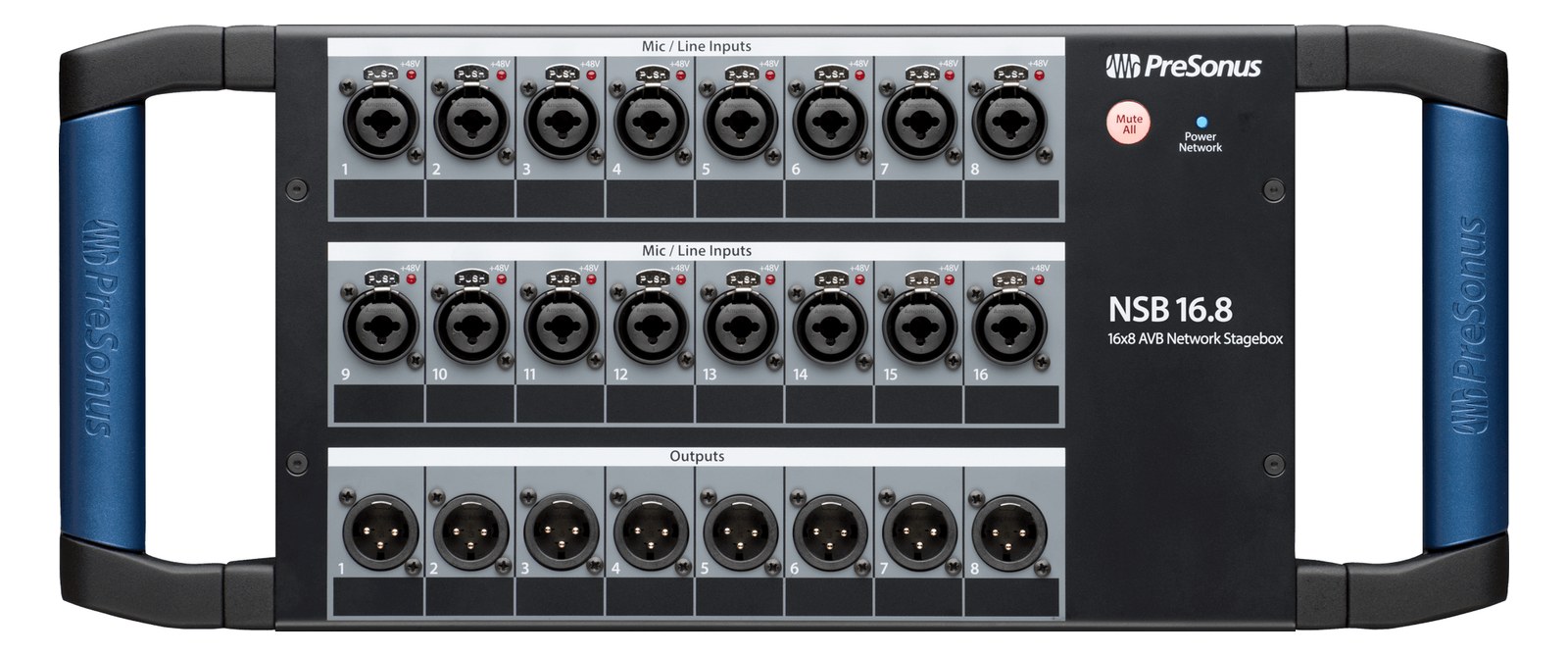
NSB16.8The PreSonus NSB16.8 is the AVB stage box for StudioLive Series III systems: sixteen recallable XMAX preamps and eight outs over a single Cat5 AVB run, with power-over-line convenience and stage-floor or rack mounting. Pairs directly with the R-series rack mixers for a networked monitor rig. Multiple boxes stack for larger input counts.View gear →
06 · Resolve the questions that can change the purchase or build plan.
Planning questions
Short, source-backed answers surface rack fit, power, cabling, and connection details before they become surprises.
How will the Midas DL16 Digital Stage Box affect rack fit and case depth?
It occupies 2U. Its documented depth is 225 mm.
How much power does the Midas DL16 Digital Stage Box draw?
Typical draw is 25W and documented maximum draw is 35W.
What connections does the Midas DL16 Digital Stage Box have?
34 documented physical ports, including Stage In 1, Stage In 2, Stage In 3, Stage In 4, Stage In 5, Stage In 6.
07 · See this unit inside a real rack plan.
Builder preview
Placement is only the start. Builder checks space · depth · weight, power headroom, dependencies, and compatible signal paths around this exact catalog item.Open in Builder