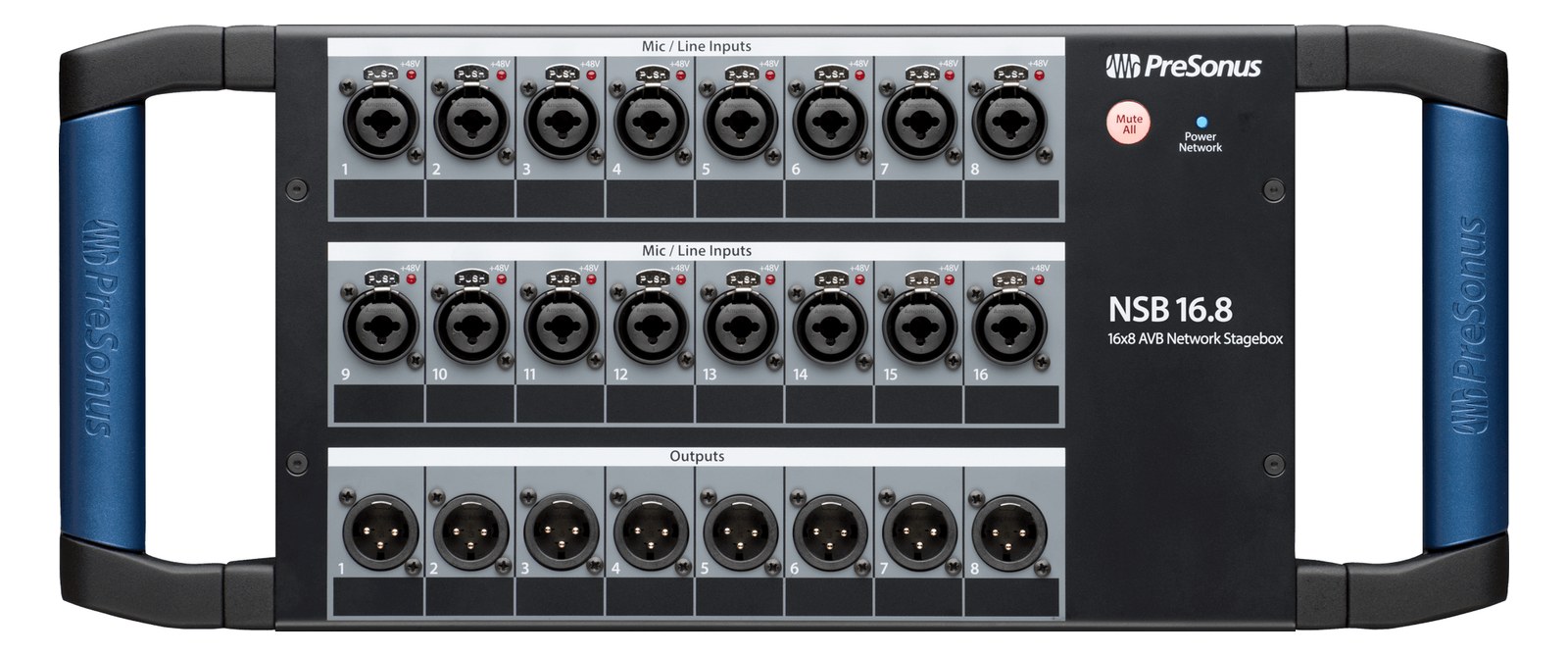
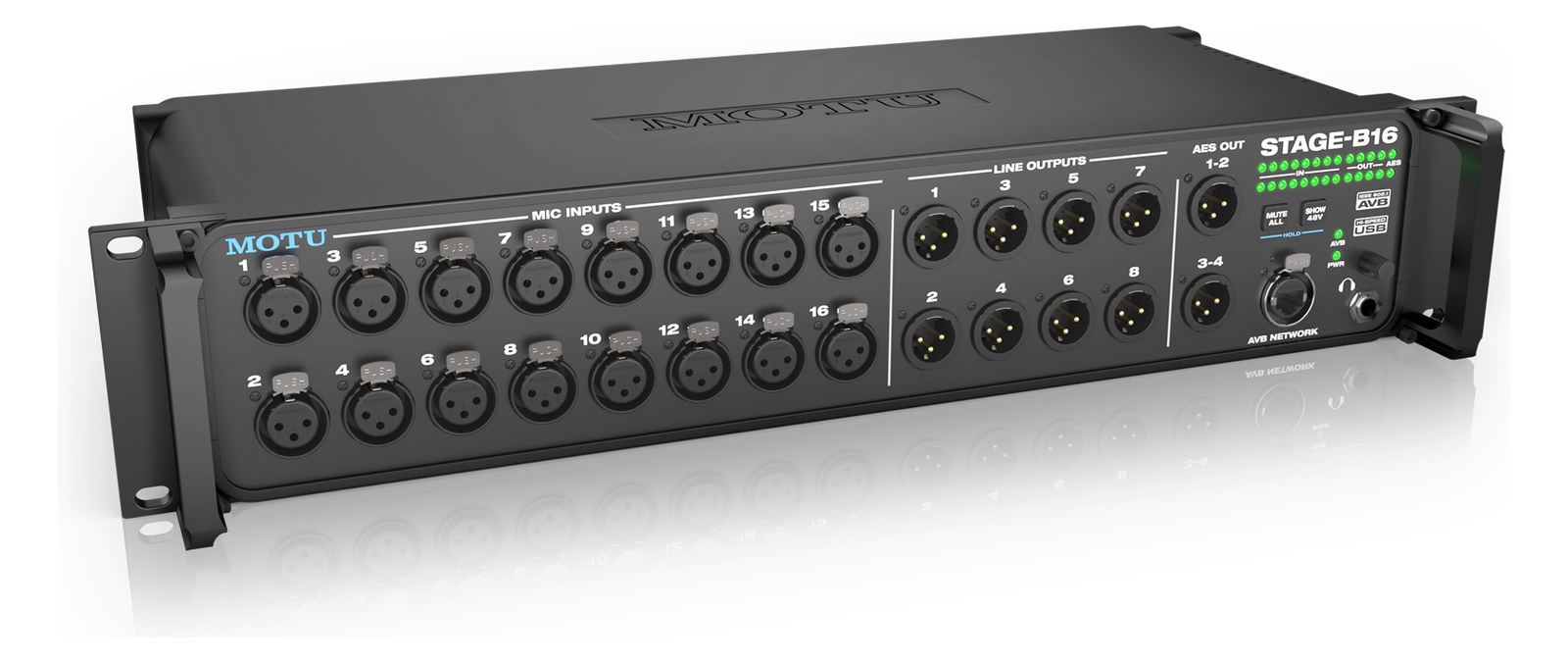
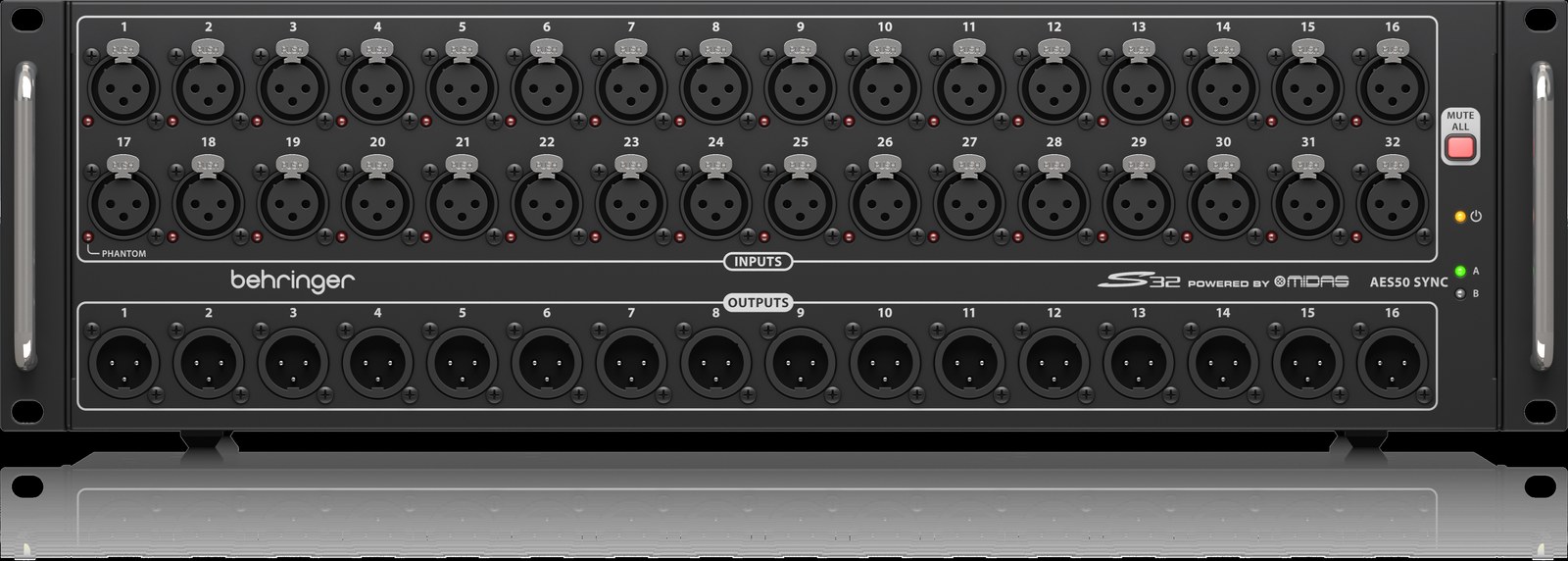
The PreSonus NSB16.8 is the AVB stage box for StudioLive Series III systems: sixteen recallable XMAX preamps and eight outs over a single Cat5 AVB run, with power-over-line convenience and stage-floor or rack mounting. Pairs directly with the R-series rack mixers for a networked monitor rig. Multiple boxes stack for larger input counts.
~$999Use retailer rows for current price and stock
01 · What it does—and what that changes in your rig.
Product overview
Start with the payoff, then work through how it functions, where it fits, and the details that change a real build.
The payoff
Stage Box decisions, organized around the whole rig.
The NSB16.8 is PreSonus's answer to getting your inputs off the stage floor and onto a network. It sits at the far end of a single Cat5Standard network cable grades. In an audio rig one cheap Cat5e run can replace a 48-channel copper snake; AES50 wants it shielded.AVBAudio Video Bridging — open network audio (MOTU, PreSonus) where the switch reserves bandwidth so streams can’t glitch. Milan is its pro profile. run and hands you sixteen recallable XMAX preampsThe gain stage that lifts a mic’s tiny signal up to line level — the first thing a signal hits, and a big part of how a console sounds. plus eight analog outputs — enough to feed a full band's worth of sources and return IEMIn-Ear Monitor — earpieces that replace floor wedges, feeding each player their own mix. The reason this whole rack exists. mixes or wedgeA floor monitor speaker angled up at the performer — the thing IEMs replace, and the thing you fall back on when they die. feeds without a separate analog snakeA multicore cable bundling many channels into one stage-to-console run. A sub-snake collects one corner of the stage into a drop box. anywhere in the signal path. In a StudioLive Series III ecosystem, particularly when paired with an R-series rack mixer, it functions as the remote I/O brain of the whole rig, and that single-cable discipline is the point.
Documented outputs
1One destination connection
Documented inputs
2Based on documented inputs
Rack space
2UBuilder checks available rail space
PreSonus product panel2U · 30W
Function
How it works in the path
In practice, 30 watts nominal draw in a 2UThe standard slice of rack height: 1U = 1.75″. A 3U box takes three slices; half-rack gear pairs two units side by side in one. chassis means it won't stress a small power conditionerFilters venue AC, clamps surges, and gives the rack one tidy inlet. Not a voltage regulator and not a battery — just cleaner power., and the shallow 250mm depth is genuinely stage-box friendly — it fits in a shallow utility rack without fighting you. The sixteen inputs cover most monitor worldThe side-stage domain of the monitor engineer — console, IEM racks, and everything feeding the band’s ears instead of the audience. scenarios outright, and the stackable AVBAudio Video Bridging — open network audio (MOTU, PreSonus) where the switch reserves bandwidth so streams can’t glitch. Milan is its pro profile. architecture means you can add a second unit later if the input count grows without rearchitecting your network. The eight analog outputs are real outs, useful for direct-drive wedgesA floor monitor speaker angled up at the performer — the thing IEMs replace, and the thing you fall back on when they die. or local hardware that doesn't live in the digital domain. What you are locked into is AVB and the StudioLive III ecosystem — there is no DanteThe most common audio-over-network standard: dozens of channels of uncompressed digital audio down one ordinary Ethernet cable between Dante boxes., no MADIA pro digital format carrying 64 channels on one coax or optical cable. Point-to-point — one sender, one receiver, no network required., no Waves mode.
Best fit
Where it earns its place in the rack
If you're already running a StudioLive Series III console or R-series rack mixer, this box is close to a foregone conclusion — the integration is tight, the preampThe gain stage that lifts a mic’s tiny signal up to line level — the first thing a signal hits, and a big part of how a console sounds. recall is genuinely useful at changeover-heavy shows, and the price sits at a reasonable point for what you get. If your rig centers on anything outside the PreSonus ecosystem — a Yamaha CL, a DiGiCo, an Allen & Heath dLive — walk away, because AVBAudio Video Bridging — open network audio (MOTU, PreSonus) where the switch reserves bandwidth so streams can’t glitch. Milan is its pro profile. compatibility outside StudioLive III is limited enough that you'd be fighting the rig all night. Similarly, if you need more than eight returns at stage level, plan for a second unit from the start rather than assuming you'll adapt.
In the rack
Details worth deciding before load-in.
Run your Cat5Standard network cable grades. In an audio rig one cheap Cat5e run can replace a 48-channel copper snake; AES50 wants it shielded. inside the same cable run as your IECThe standard three-prong appliance power inlet on rack gear — the kettle lead. C13/C14 in spec-sheet speak. power line and label both ends with the same tag — at load-in in a dark venue, knowing exactly which cable feeds this box saves real time.
Use the eight analog outputs for any in-ear transmitters or wedgeA floor monitor speaker angled up at the performer — the thing IEMs replace, and the thing you fall back on when they die. amps that live physically close to the stage boxThe I/O endpoint on stage: mics plug in there and one digital line (AES50, Dante) carries everything to the console. The snake, digitized.; it keeps those connections short and eliminates a secondary analog snakeA multicore cable bundling many channels into one stage-to-console run. A sub-snake collects one corner of the stage into a drop box. entirely.
If you're stacking two NSB16.8 units for a larger input count, assign them distinct AVBAudio Video Bridging — open network audio (MOTU, PreSonus) where the switch reserves bandwidth so streams can’t glitch. Milan is its pro profile. stream labels in UC Surface before the gig — generic default names will cause confusion during soundcheck when inputs aren't showing up where you expect.
PreampThe gain stage that lifts a mic’s tiny signal up to line level — the first thing a signal hits, and a big part of how a console sounds.gainHow much the preamp amplifies the incoming signal. Too low and you’re hunting through hiss; too high and peaks clip. is recallable per show, so build a saved scene for each recurring act in your calendar — walking into changeover with trim values already loaded is one of the few genuine time-savers this ecosystem offers.
02 · Know the whole path before you buy.
Signal path
Learn the route as a block diagram: source, product function, transport, and destination. Select any block to see what enters, what changes, and what leaves.
Interactive block diagramAuto-looping · hover, focus, or tap to hold a stage
Port-type signalProduct functionSystem boundary
Follow one signal from source to destination
Each block answers the same three questions: what arrives, what changes here, and what leaves.
01 · Source · selected
XLR female + IEC C14
etherCON
XLR male
01 · Source
2 documented inputs
XLR female + IEC C14
Arrives as
2 documented inputs
Connector
XLR female + IEC C14
Signal
analog audio
03 · What this product asks of the rest of the system.
Compatibility
Treat connector names as the start of the check—not the answer. These are the boundaries that determine a complete working path.
Best fit · Stage Box
Use it when 2U and 250 mm of depth fit the case.
Plan the companion path
Complete the path with upstream and downstream gear that matches connector, direction, signal type, protocol, and wiring standard.
Protocol boundary
This product declares AVB; matching plugs alone do not make other protocols compatible.
04 · Every connector, grouped by job.
I/O ports
Switch the product view and the documented port inventory updates with it—hardware and data stay side by side.
Every connector, grouped by job.
Switch panels to keep the hardware view and the documented port list in sync.
Front panelRear panel
All documented ports for PreSonus NSB16.8 Stage Box
Port
Panel
Connector
Direction
Signal
Channels
Mic In 1-16
rear
XLR female
input
analog audio
16
Out 1-8
rear
XLR male
output
analog audio
8
AVB Network
rear
etherCON
bidirectional
digital audio
24
Power
rear
IEC C14
input
power
—
Showing 4 of 4 documented physical ports.
05 · Compare the decision, not just the price.
Alternatives
The rows are organized around fit, power, I/O, and system role so a cheaper unit cannot hide a more expensive workflow.
NSB16.8The PreSonus NSB16.8 is the AVB stage box for StudioLive Series III systems: sixteen recallable XMAX preamps and eight outs over a single Cat5 AVB run, with power-over-line convenience and stage-floor or rack mounting. Pairs directly with the R-series rack mixers for a networked monitor rig. Multiple boxes stack for larger input counts.View gear →
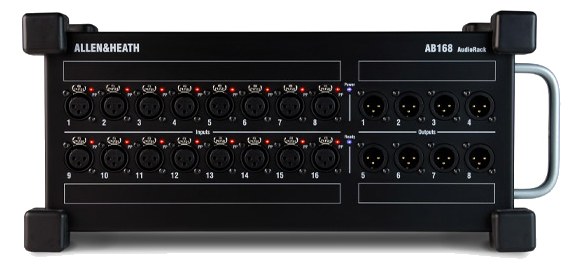
AB168The Allen & Heath AB168 puts sixteen preamps and eight outs on a dSNAKE Cat5 run for Qu, SQ, and Avantis systems. Rugged enough to sit on stage without a rack, rack-eared for permanent installs, and the affordable expansion path A&H rigs reach for first. Chains through an expander port for higher counts.View gear →
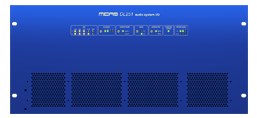
DL16The Midas DL16 puts 16 Midas mic preamps at the stage and hauls every channel back to the console over a single shielded Cat5e using AES50 — replacing sixteen XLR runs with one cable. Pairs with Midas M32/M32R and Behringer X32/Wing consoles. Two AES50 ports allow primary + redundant links for mission-critical shows. Network-only: there is no analog multicore back to FOH; all signal flow lives on the AES50 trunk.View gear →
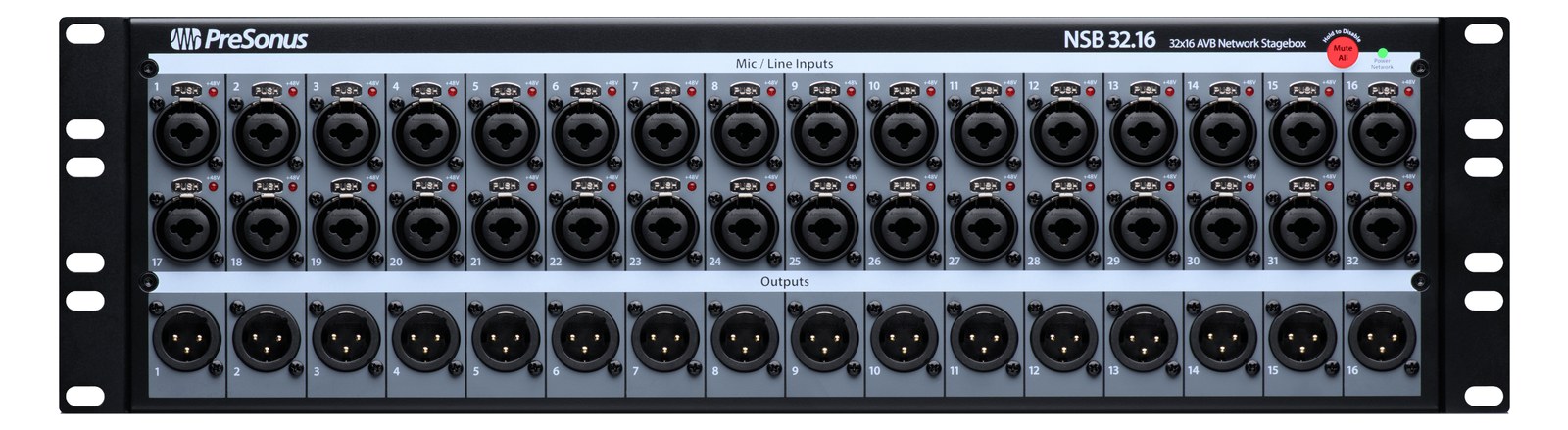
NSB32.16The PreSonus NSB32.16 scales the AVB stage box to thirty-two preamps and sixteen returns, feeding StudioLive Series III consoles and R-series rack mixers over one network run. It is the full-band snake replacement for AVB rigs, with recallable gains and mix-engineer-friendly monitoring workflows. Stacks with NSB16.8 units for even larger stages.View gear →
06 · Resolve the questions that can change the purchase or build plan.
Planning questions
Short, source-backed answers surface rack fit, power, cabling, and connection details before they become surprises.
How will the PreSonus NSB16.8 Stage Box affect rack fit and case depth?
It occupies 2U. Its documented depth is 250 mm.
How much power does the PreSonus NSB16.8 Stage Box draw?
Typical draw is 30W and documented maximum draw is 45W.
What connections does the PreSonus NSB16.8 Stage Box have?
4 documented physical ports, including Mic In 1-16, Out 1-8, AVB Network, Power.
07 · See this unit inside a real rack plan.
Builder preview
Placement is only the start. Builder checks space · depth · weight, power headroom, dependencies, and compatible signal paths around this exact catalog item.Open in Builder