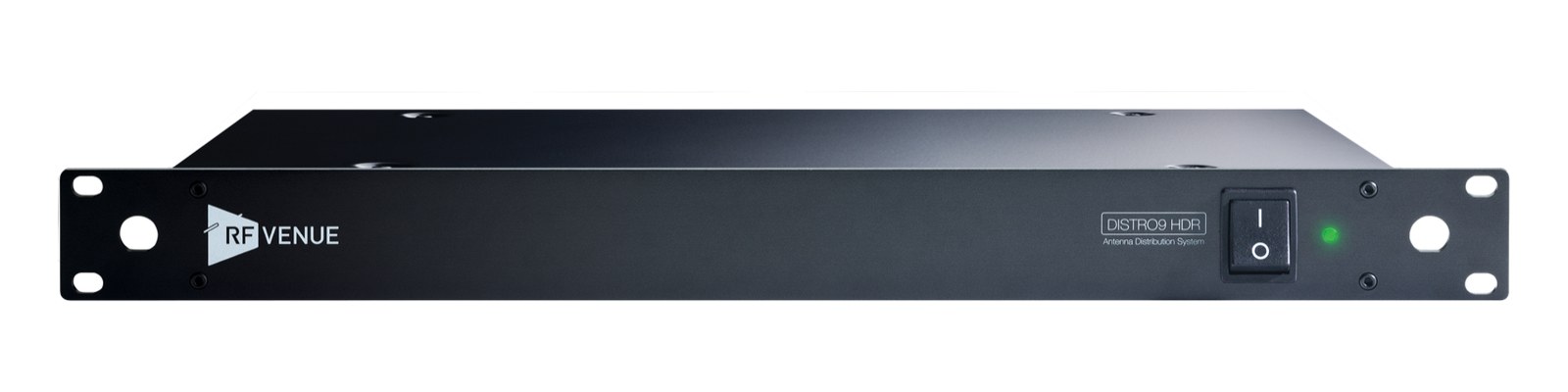
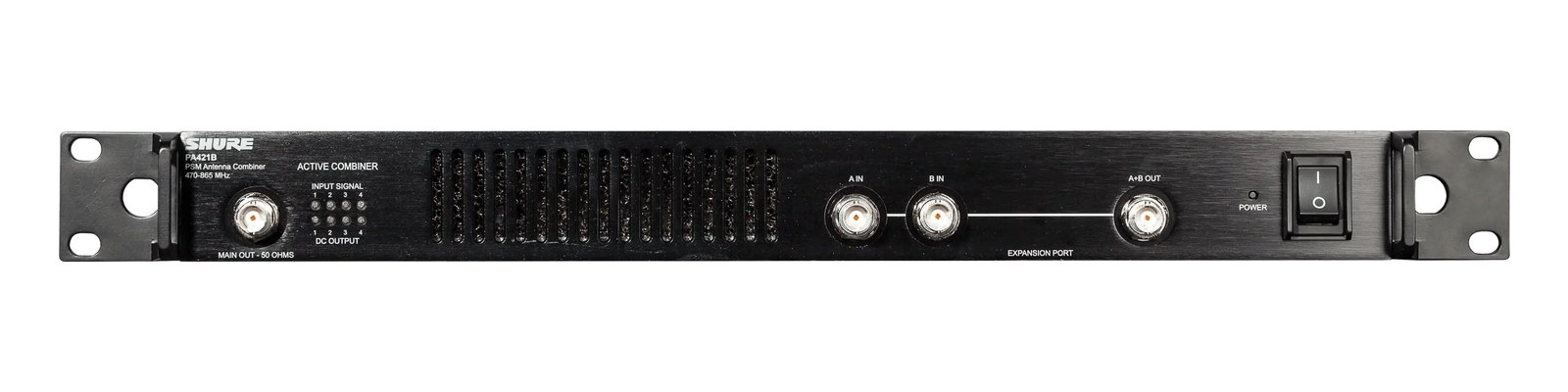
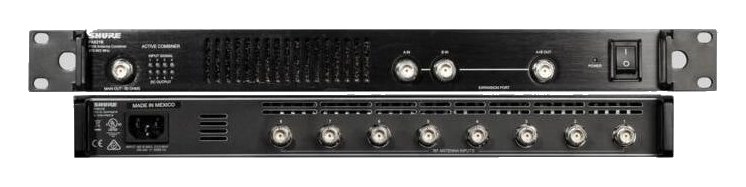
The DISTRO9 HDR is RF Venue's flagship antenna distribution system, offering nine outputs with exceptional dynamic range that handles dense wireless environments without intermodulation issues. Its cascadable design lets you daisy-chain multiple units for very large channel counts. Brand-agnostic and wideband, it works equally well with Shure, Sennheiser, or any other UHF wireless system in your IEM rack.
~$2,039Use retailer rows for current price and stock
01 · What it does—and what that changes in your rig.
Product overview
Start with the payoff, then work through how it functions, where it fits, and the details that change a real build.
The payoff
Antenna Distro decisions, organized around the whole rig.
The DISTRO9 HDR is RFRadio Frequency — the wireless part of wireless. RF planning is why big rigs scan, coordinate, and combine antennas instead of hoping. Venue's flagship antenna distroOne pair of antennas feeding many receivers through an amplified splitter — replaces the forest of whips and keeps RF levels consistent., and its job is straightforward: take two antenna inputs and split that signal cleanly across nine receiver outputs so every wireless receiver in the rack sees the same RF picture your antennas do. That's the core promise of any distro, but the HDR designation points at what separates this one — it's built around high dynamic rangeThe span between a device’s noise floor and its clipping point — the room between the quietest and loudest sounds it can pass. circuitry designed to stay clean when the RF environment gets ugly. For anyone running six or more channels of wireless in a single rack, running direct antenna cables to each receiver is both a cable management nightmare and an RF liability. A quality distro is the fix, and this is a serious one.
Documented outputs
99 destination connections
Documented inputs
3Based on documented inputs
Rack space
2UBuilder checks available rail space
RF Venue product panel2U · 25W
Function
How it works in the path
Nine outputs in 2UThe standard slice of rack height: 1U = 1.75″. A 3U box takes three slices; half-rack gear pairs two units side by side in one. at 25 watts means you can feed a full rack of receivers from two antenna runs without fighting for space or tripping breakers. The wideband design means you're not locked into a specific frequency band — run Shure on some outputs and Sennheiser on others from the same pair of antennas without compatibility headaches. The cascadable outputs are the other practical win: if you scale up to a festival rig with 20-plus channels, you can chain a second DISTRO9 HDR off the first rather than pulling new antenna cable or adding a second antenna position. At 260mm deep, it fits comfortably in standard road racks without crowding gear behind it.
Best fit
Where it earns its place in the rack
This unit belongs in a rig where the wireless count justifies it — think eight or more receivers, dense urban RFRadio Frequency — the wireless part of wireless. RF planning is why big rigs scan, coordinate, and combine antennas instead of hoping. environments, or productions where intermodulationIntermodulation — ghost frequencies created when transmitters mix in each other’s electronics. Why multi-channel wireless is calculated, not guessed. problems have bitten you before. If you're running a four-piece band with four IEMIn-Ear Monitor — earpieces that replace floor wedges, feeding each player their own mix. The reason this whole rack exists. packs and nothing else, the DISTRO9 HDR is more distroOne pair of antennas feeding many receivers through an amplified splitter — replaces the forest of whips and keeps RF levels consistent. than you need and the price reflects that. For a smaller system, a 4- or 6-output passive distro may be sufficient. But if you're building a touring IEM rack or a festival comp rig where the channel count climbs and the RF environment is unpredictable, the headroomThe margin between your normal level and where things clip — headroom is what absorbs the snare hit you didn’t see coming. this unit provides is exactly what keeps dropoutA brief audio gap when the radio link fails — the thing diversity, distros, and coordination all exist to prevent. calls off the show-day radio.
In the rack
Details worth deciding before load-in.
Position the DISTRO9 HDR near the top of the rack so the BNCThe twist-lock coax connector used for word clock and antenna runs — it locks, so it can’t be pulled out mid-show. outputs face the shortest possible cable run to the receivers below — clean, short coax runs matter as much as the distroOne pair of antennas feeding many receivers through an amplified splitter — replaces the forest of whips and keeps RF levels consistent. itself.
When cascading two units, use the designated cascade output rather than a standard receiver output; feeding a second distroOne pair of antennas feeding many receivers through an amplified splitter — replaces the forest of whips and keeps RF levels consistent. from a normal output consumes a port and may affect gainHow much the preamp amplifies the incoming signal. Too low and you’re hunting through hiss; too high and peaks clip. structure.
Label each BNCThe twist-lock coax connector used for word clock and antenna runs — it locks, so it can’t be pulled out mid-show. output at the distroOne pair of antennas feeding many receivers through an amplified splitter — replaces the forest of whips and keeps RF levels consistent. and at the receiver with matching numbers during load-in — nine identical BNC connections look the same at 2am and a swap will cost you a troubleshooting rabbit hole during soundcheck.
Even though the DISTRO9 HDR is brand-agnostic, verify that phantom powerThe +48 V a console sends up the mic cable to power condenser mics and active DI boxes — invisible to gear that doesn’t need it. or DC bias from any receiver's antenna port is blocked or handled correctly before connecting — some receivers expect to power a remote antenna preampThe gain stage that lifts a mic’s tiny signal up to line level — the first thing a signal hits, and a big part of how a console sounds. and that voltage shouldn't hit the distroOne pair of antennas feeding many receivers through an amplified splitter — replaces the forest of whips and keeps RF levels consistent.'s output stage.
02 · Know the whole path before you buy.
Signal path
Learn the route as a block diagram: source, product function, transport, and destination. Select any block to see what enters, what changes, and what leaves.
Interactive block diagramAuto-looping · hover, focus, or tap to hold a stage
Port-type signalProduct functionSystem boundary
Follow one signal from source to destination
Each block answers the same three questions: what arrives, what changes here, and what leaves.
01 · Source · selected
bnc + IEC C14
bnc
01 · Source
3 documented inputs
bnc + IEC C14
Arrives as
3 documented inputs
Connector
bnc + IEC C14
Signal
antenna
03 · What this product asks of the rest of the system.
Compatibility
Treat connector names as the start of the check—not the answer. These are the boundaries that determine a complete working path.
Best fit · Antenna Distro
Use it when 2U and 260 mm of depth fit the case.
Plan the companion path
Complete the path with upstream and downstream gear that matches connector, direction, signal type, protocol, and wiring standard.
Connector boundary
Documented connectors: bnc, IEC C14. Match connector, direction, and signal type—not shape alone.
04 · Every connector, grouped by job.
I/O ports
Switch the product view and the documented port inventory updates with it—hardware and data stay side by side.
Every connector, grouped by job.
Switch panels to keep the hardware view and the documented port list in sync.
Front panelRear panel
All documented ports for RF Venue DISTRO9 HDR Antenna Distro
Port
Panel
Connector
Direction
Signal
Channels
Antenna In A (BNC)
rear
bnc
input
antenna
—
Antenna In B (BNC)
rear
bnc
input
antenna
—
Out 1 (BNC)
rear
bnc
output
antenna
—
Out 2 (BNC)
rear
bnc
output
antenna
—
Out 3 (BNC)
rear
bnc
output
antenna
—
Out 4 (BNC)
rear
bnc
output
antenna
—
Out 5 (BNC)
rear
bnc
output
antenna
—
Out 6 (BNC)
rear
bnc
output
antenna
—
Out 7 (BNC)
rear
bnc
output
antenna
—
Out 8 (BNC)
rear
bnc
output
antenna
—
Out 9 (BNC)
rear
bnc
output
antenna
—
Power (IEC)
rear
IEC C14
input
power
—
Showing 12 of 12 documented physical ports. Scroll to review the remaining rows.
05 · Compare the decision, not just the price.
Alternatives
The rows are organized around fit, power, I/O, and system role so a cheaper unit cannot hide a more expensive workflow.
DISTRO9 HDRThe DISTRO9 HDR is RF Venue's flagship antenna distribution system, offering nine outputs with exceptional dynamic range that handles dense wireless environments without intermodulation issues. Its cascadable design lets you daisy-chain multiple units for very large channel counts. Brand-agnostic and wideband, it works equally well with Shure, Sennheiser, or any other UHF wireless system in your IEM rack.View gear →
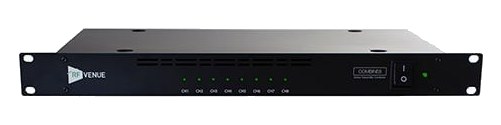
COMBINE8The COMBINE8 scales up RF Venue's passive combiner design to handle eight transmitter inputs, making it suitable for larger IEM rigs. Being brand-agnostic, it works with any wireless IEM system using BNC antenna connections. The full-rack form factor accommodates the eight-port layout while keeping wiring clean and organized.View gear →
MAT288The Wisycom MAT288 is a top-tier antenna matrix that combines and distributes RF for both IEM transmitters and wireless mic receivers simultaneously in a single rack unit. This dual-purpose design eliminates the need for separate combiner and splitter units, saving significant rack space on large touring rigs. It is a premium investment that pays off when you are managing complex RF environments with many wireless channels across IEM and mic systems.View gear →
06 · Resolve the questions that can change the purchase or build plan.
Planning questions
Short, source-backed answers surface rack fit, power, cabling, and connection details before they become surprises.
How will the RF Venue DISTRO9 HDR Antenna Distro affect rack fit and case depth?
It occupies 2U. Its documented depth is 260 mm.
How much power does the RF Venue DISTRO9 HDR Antenna Distro draw?
Typical draw is 25W and documented maximum draw is 30W.
What connections does the RF Venue DISTRO9 HDR Antenna Distro have?
12 documented physical ports, including Antenna In A (BNC), Antenna In B (BNC), Out 1 (BNC), Out 2 (BNC), Out 3 (BNC), Out 4 (BNC).
07 · See this unit inside a real rack plan.
Builder preview
Placement is only the start. Builder checks space · depth · weight, power headroom, dependencies, and compatible signal paths around this exact catalog item.Open in Builder