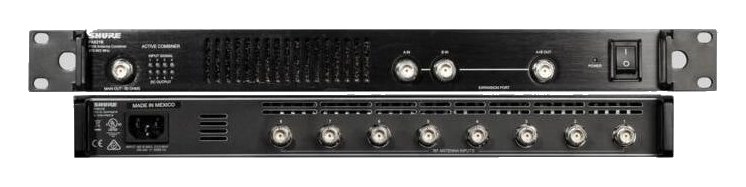
The Sennheiser EW-D ASA is the current-generation antenna splitter for Evolution Wireless Digital, feeding four EW-D or EW-DX receivers from one antenna pair and powering them over the included DC leads. It replaces the legacy ASA 1 and ASA 214 in new systems, and two units cascade for eight-channel racks. Sold as a kit with power supply and eight BNC interconnects.
~$699Use retailer rows for current price and stock
01 · What it does—and what that changes in your rig.
Product overview
Start with the payoff, then work through how it functions, where it fits, and the details that change a real build.
The payoff
Antenna Distro decisions, organized around the whole rig.
The EW-D ASA is the antenna distributionOne pair of antennas feeding many receivers through an amplified splitter — replaces the forest of whips and keeps RF levels consistent. hub that makes a multi-channel EW-D or EW-DX rack actually function as a system rather than a pile of individual receivers. Two antennas come in, and four buffered, amplified antenna pairs go out — one per receiver — while DC power travels out over the included leads so the receivers themselves don't need separate wall-wart supplies. If you're building any EW-D rig beyond a single channel, this unit isn't optional equipment; it's the backbone. It replaces the older ASA 1 and ASA 214 in current systems and ships as a complete kit with power supply and BNCThe twist-lock coax connector used for word clock and antenna runs — it locks, so it can’t be pulled out mid-show. cables.
Documented outputs
88 destination connections
Documented inputs
3Based on documented inputs
Rack space
1U · half-rackBuilder checks available rail space
Sennheiser product panel1U · half-rack · 8W
Function
How it works in the path
At half a rack unitThe standard slice of rack height: 1U = 1.75″. A 3U box takes three slices; half-rack gear pairs two units side by side in one. wide and 212 mm deep, the ASA sits easily alongside other half-rack gear without dominating your panel space. The 8 W typical / 12 W maximum draw is modest, but remember it's also bussing power to up to four receivers — factor that load conversation into your power conditionerFilters venue AC, clamps surges, and gives the rack one tidy inlet. Not a voltage regulator and not a battery — just cleaner power. planning rather than treating the ASA in isolation. The active splitting means you're not trading signal level for more outputs the way a passive splitter would; each of the four receiver outputs gets a proper driven signal. Two ASAs cascade cleanly to cover eight-channel racks, which is a realistic ceiling for many IEMIn-Ear Monitor — earpieces that replace floor wedges, feeding each player their own mix. The reason this whole rack exists. or vocal wireless setups.
Best fit
Where it earns its place in the rack
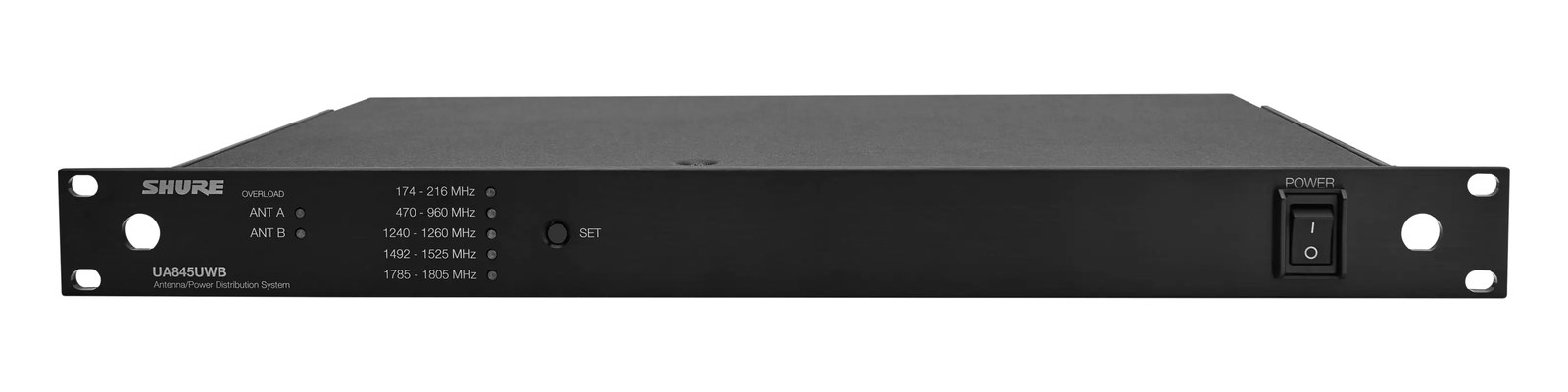
If your system is EW-D or EW-DX, this is simply the right tool — there's no meaningful debate. Where you should pause is if you're running a mixed-brand or mixed-generation rack: the ASA's DC power distribution is designed around EW-D receivers, and the RFRadio Frequency — the wireless part of wireless. RF planning is why big rigs scan, coordinate, and combine antennas instead of hoping. outputs are standard BNCThe twist-lock coax connector used for word clock and antenna runs — it locks, so it can’t be pulled out mid-show., but the power leads won't help non-Sennheiser gear. If you're already invested in a brand-agnostic active distroOne pair of antennas feeding many receivers through an amplified splitter — replaces the forest of whips and keeps RF levels consistent. like a Shure UA845 or a PA821, and you're adding just one or two EW-D channels to an existing rig, you may not need this at all — the EW-D receivers can run standalone. The ASA earns its place when EW-D is your primary or sole wireless platform.
In the rack
Details worth deciding before load-in.
Mount the ASA at the top of your wireless rack so the antenna inputs are as close as possible to where your BNCThe twist-lock coax connector used for word clock and antenna runs — it locks, so it can’t be pulled out mid-show.trunkThe main multichannel run between stage and console — one fat multicore (or one Cat5e, these days) carrying everything at once. cables enter — every extra foot of cable between the antenna and the active input is a place for signal to degrade before amplification.
Use the included BNCThe twist-lock coax connector used for word clock and antenna runs — it locks, so it can’t be pulled out mid-show. interconnects from ASA outputs to receiver inputs for the initial build, but label them at both ends on day one; in a full four-receiver rack the cable run gets dense and tracing a suspect connection mid-show is miserable.
If you're cascading two ASAs for an eight-channel rig, confirm your power conditionerFilters venue AC, clamps surges, and gives the rack one tidy inlet. Not a voltage regulator and not a battery — just cleaner power. has two available outlets and accounts for the combined worst-case draw of up to 24 W across both units before adding receiver draw on top.
Position your remote antennas before locking the rack location — the ASA centralizes your RFRadio Frequency — the wireless part of wireless. RF planning is why big rigs scan, coordinate, and combine antennas instead of hoping. infrastructure, which means a bad antenna placement decision affects all four receivers simultaneously, not just one.
02 · Know the whole path before you buy.
Signal path
Learn the route as a block diagram: source, product function, transport, and destination. Select any block to see what enters, what changes, and what leaves.
Interactive block diagramAuto-looping · hover, focus, or tap to hold a stage
Port-type signalProduct functionSystem boundary
Follow one signal from source to destination
Each block answers the same three questions: what arrives, what changes here, and what leaves.
01 · Source · selected
bnc + dc barrel
bnc
01 · Source
3 documented inputs
bnc + dc barrel
Arrives as
3 documented inputs
Connector
bnc + dc barrel
Signal
antenna
03 · What this product asks of the rest of the system.
Compatibility
Treat connector names as the start of the check—not the answer. These are the boundaries that determine a complete working path.
Best fit · Antenna Distro
Use it when 1U · half-rack and 212 mm of depth fit the case.
Plan the companion path
Complete the path with upstream and downstream gear that matches connector, direction, signal type, protocol, and wiring standard.
Connector boundary
Documented connectors: bnc, dc barrel. Match connector, direction, and signal type—not shape alone.
04 · Every connector, grouped by job.
I/O ports
Switch the product view and the documented port inventory updates with it—hardware and data stay side by side.
Every connector, grouped by job.
Switch panels to keep the hardware view and the documented port list in sync.
Front panelRear panel
All documented ports for Sennheiser EW-D ASA Antenna Splitter
Port
Panel
Connector
Direction
Signal
Channels
Antenna A In
rear
bnc
input
antenna
—
Antenna B In
rear
bnc
input
antenna
—
RX 1 A
rear
bnc
output
antenna
—
RX 1 B
rear
bnc
output
antenna
—
RX 2 A
rear
bnc
output
antenna
—
RX 2 B
rear
bnc
output
antenna
—
RX 3 A
rear
bnc
output
antenna
—
RX 3 B
rear
bnc
output
antenna
—
RX 4 A
rear
bnc
output
antenna
—
RX 4 B
rear
bnc
output
antenna
—
DC In (NT 12-35 CS)
rear
dc barrel
input
power
—
Showing 11 of 11 documented physical ports. Scroll to review the remaining rows.
05 · Compare the decision, not just the price.
Alternatives
The rows are organized around fit, power, I/O, and system role so a cheaper unit cannot hide a more expensive workflow.
EW-D ASAThe Sennheiser EW-D ASA is the current-generation antenna splitter for Evolution Wireless Digital, feeding four EW-D or EW-DX receivers from one antenna pair and powering them over the included DC leads. It replaces the legacy ASA 1 and ASA 214 in new systems, and two units cascade for eight-channel racks. Sold as a kit with power supply and eight BNC interconnects.View gear →
AC 41-USThe Sennheiser AC 41-US combines four IEM transmitter outputs onto one antenna, the standard move once an evolution wireless G4 monitor rack grows past two channels. Active gain stages make up the combining loss so the radiated power stays useful, and units cascade for larger systems. Half-rack chassis pairs with Sennheiser rack hardware.View gear →
ASA 1/NTThe ASA 1/NT is Sennheiser's higher-capacity antenna splitter with eight outputs per side and built-in Ethernet for remote monitoring via Sennheiser's Wireless Systems Manager software. It is purpose-built for larger Sennheiser wireless deployments where you need to monitor RF status and antenna performance from FOH or a network dashboard. The Ethernet connectivity is a significant step up from the ASA 214 for production teams that need visibility into their RF environment.View gear →
ASA 214The ASA 214 is Sennheiser's entry-level antenna distribution solution, designed specifically for their Evolution Wireless and 2000 series receivers. It provides four outputs per antenna with active gain compensation, making it the right choice when you are running multiple Sennheiser wireless channels from shared antennas. If you are in the Sennheiser ecosystem, this is simpler and more cost-effective than using a third-party distro.View gear →
06 · Resolve the questions that can change the purchase or build plan.
Planning questions
Short, source-backed answers surface rack fit, power, cabling, and connection details before they become surprises.
How will the Sennheiser EW-D ASA Antenna Splitter affect rack fit and case depth?
It occupies 1U · half-rack. Its documented depth is 212 mm.
How much power does the Sennheiser EW-D ASA Antenna Splitter draw?
Typical draw is 8W and documented maximum draw is 12W.
What connections does the Sennheiser EW-D ASA Antenna Splitter have?
11 documented physical ports, including Antenna A In, Antenna B In, RX 1 A, RX 1 B, RX 2 A, RX 2 B.
07 · See this unit inside a real rack plan.
Builder preview
Placement is only the start. Builder checks space · depth · weight, power headroom, dependencies, and compatible signal paths around this exact catalog item.Open in Builder