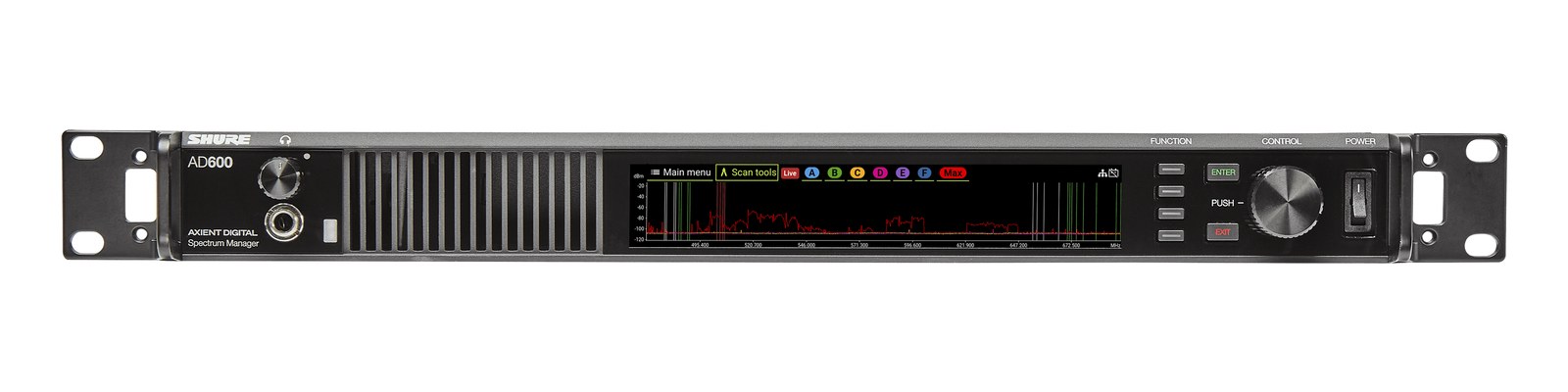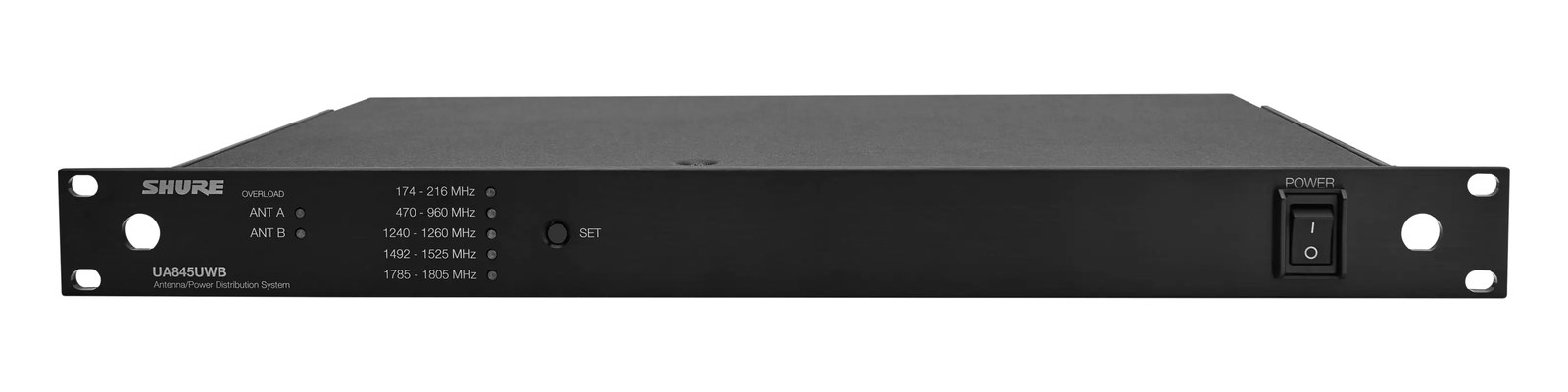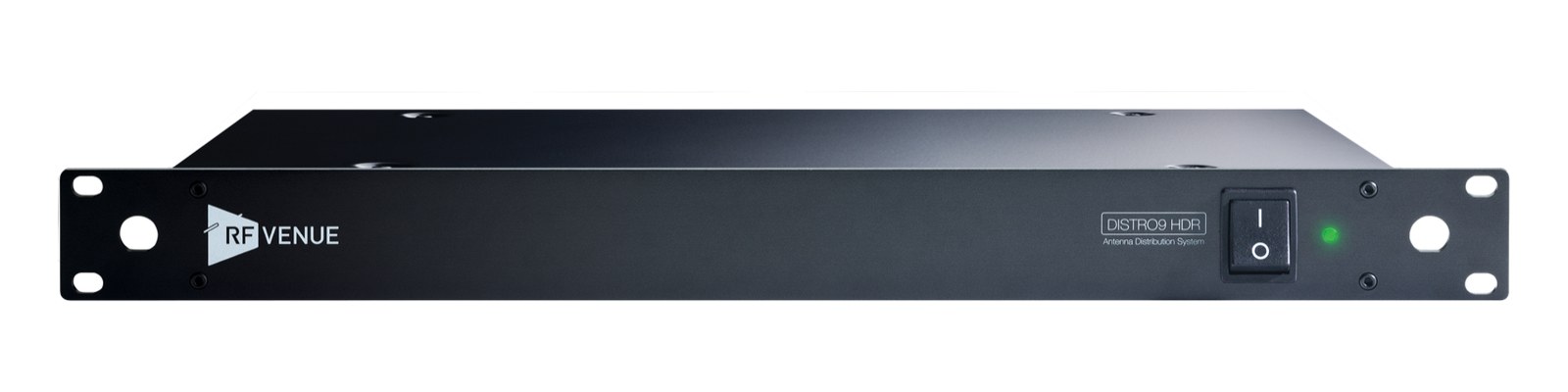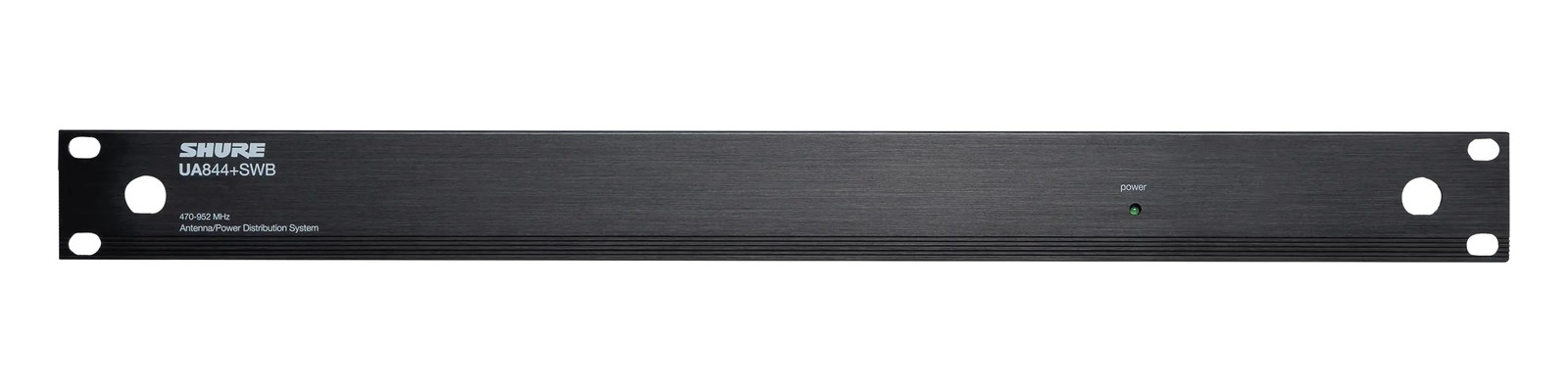

Shure AD616 Axient Antenna Distro
Shure·Model AD616·shure-ad616
Photos
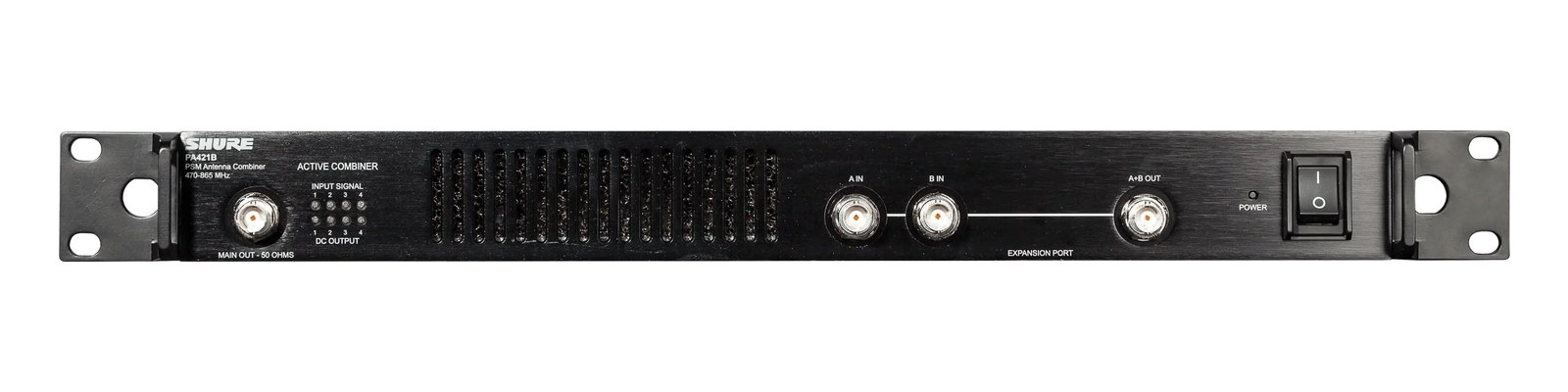
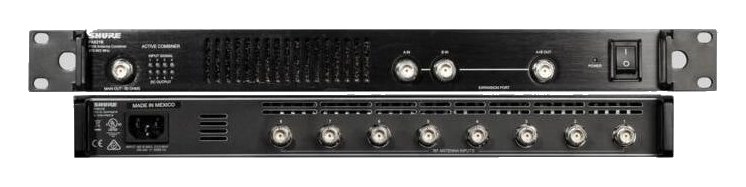
Manufacturer product photography — the drawn faceplate above stays true to panel layout; these show the hardware itself.
About the Shure AD616
The AD616 is purpose-built for Shure's Axient Digital wireless platform, providing six-way antenna distributionOne pair of antennas feeding many receivers through an amplified splitter — replaces the forest of whips and keeps RF levels consistent. with integrated ShowLink support for remote transmitter control. Cascadable outputs let you daisy-chain multiple units for very large Axient deployments. If you are running Axient Digital receivers in your rack, this is the native antenna distro that keeps everything in the Shure ecosystem with full remote management capability.
The AD616 is Shure's native antenna distributionOne pair of antennas feeding many receivers through an amplified splitter — replaces the forest of whips and keeps RF levels consistent. solution for Axient Digital deployments — two antenna inputs, six outputs per antenna path, all in a single rack unitThe standard slice of rack height: 1U = 1.75″. A 3U box takes three slices; half-rack gear pairs two units side by side in one.. Its job is simple in concept and critical in practice: take the signal from your remote antenna pair and split it cleanly to every Axient Digital receiver in the rack without degrading the RFRadio Frequency — the wireless part of wireless. RF planning is why big rigs scan, coordinate, and combine antennas instead of hoping.. The integrated ShowLink support is what separates this from a generic passive splitter — it passes the 2.4 GHz ShowLink signal that allows Axient transmitters to be managed remotely, which means gainHow much the preamp amplifies the incoming signal. Too low and you’re hunting through hiss; too high and peaks clip. adjustments, mute commands, and frequency changes can happen from the console without touching a pack.
Six outputs per path means the AD616 natively feeds up to six dual-channel receivers — twelve channels of wireless — from a single antenna pair before you need to cascade. The cascade outputs on both A and B paths let you chain a second AD616 downstream when the rig grows, so you're not rearchitecting your antenna topology mid-tour. At 15 watts nominal draw and 1UThe standard slice of rack height: 1U = 1.75″. A 3U box takes three slices; half-rack gear pairs two units side by side in one., the footprint cost is low. The 280mm depth is worth checking against shallow rack lids, but it's not unusually deep for an active distroOne pair of antennas feeding many receivers through an amplified splitter — replaces the forest of whips and keeps RF levels consistent.. Weight at 2.5 kg is a non-issue even in a full tour rack.
If your receivers are Axient Digital, this is the right distroOne pair of antennas feeding many receivers through an amplified splitter — replaces the forest of whips and keeps RF levels consistent. — full stop. The ShowLink integration alone justifies it over a third-party active splitter, and Shure's RFRadio Frequency — the wireless part of wireless. RF planning is why big rigs scan, coordinate, and combine antennas instead of hoping. gain stagingSetting sensible levels at every step of the chain so nothing clips and nothing drowns in hiss — the unglamorous secret to clean mixes. inside the unit is voiced for their own system. If you're running a mixed rack with Axient alongside QLX-D or ULX-D, you'll still need separate distro paths for those receivers, so plan accordingly. If your whole rig is ULX-D or a non-Shure system, the AD616 is the wrong tool — look at the UA844 for legacy Shure systems or a passive splitter for budget-constrained non-Axient builds. The price reflects professional touring infrastructure, not a utility buy.
In the rack
- Run your cascade output to a second AD616 rather than splitting a single output with a passive BNCThe twist-lock coax connector used for word clock and antenna runs — it locks, so it can’t be pulled out mid-show. T — passive splits after an active distroOne pair of antennas feeding many receivers through an amplified splitter — replaces the forest of whips and keeps RF levels consistent. bleed insertion loss and can create impedanceOpposition to signal flow, in ohms. Low-impedance IEMs are easier to drive loud; mismatches shift level and tone. mismatches that hurt range.
- Label your A and B paths at the BNCThe twist-lock coax connector used for word clock and antenna runs — it locks, so it can’t be pulled out mid-show. outputs before the show, not after — when you're tracing a dropoutA brief audio gap when the radio link fails — the thing diversity, distros, and coordination all exist to prevent. on a loud stage, knowing instantly which physical output feeds which receiver saves real time.
- Place the AD616 at the top of the receiver stack in the rack so the BNCThe twist-lock coax connector used for word clock and antenna runs — it locks, so it can’t be pulled out mid-show. runs to each receiver drop straight down, minimizing cable dress complexity and keeping RFRadio Frequency — the wireless part of wireless. RF planning is why big rigs scan, coordinate, and combine antennas instead of hoping. cable lengths as equal as practical.
- If you're using remote antennas on a long coax run, account for the cable loss before the AD616 input — the unit's internal gainHow much the preamp amplifies the incoming signal. Too low and you’re hunting through hiss; too high and peaks clip. is designed around a healthy signal arriving at the input, not to rescue an already-attenuated feed.
6-way active antenna distributionOne pair of antennas feeding many receivers through an amplified splitter — replaces the forest of whips and keeps RF levels consistent. for Axient Digital. ShowLink compatible with cascadable outputs.
I/O Ports (23)
| Port | Connector | Direction | Signal | Channels |
|---|---|---|---|---|
| Port A (BNC) | BNC | bidirectional | antenna | — |
| Port B (BNC) | BNC | bidirectional | antenna | — |
| Port C (BNC) | BNC | bidirectional | antenna | — |
| Port D (BNC) | BNC | bidirectional | antenna | — |
| Port E (BNC) | BNC | bidirectional | antenna | — |
| Port F (BNC) | BNC | bidirectional | antenna | — |
| Out A5 (retired — no such jack) | BNC | output | antenna | — |
| Out A6 (retired — no such jack) | BNC | output | antenna | — |
| Out B1 (retired — no such jack) | BNC | output | antenna | — |
| Out B2 (retired — no such jack) | BNC | output | antenna | — |
| Out B3 (retired — no such jack) | BNC | output | antenna | — |
| Out B4 (retired — no such jack) | BNC | output | antenna | — |
| Out B5 (retired — no such jack) | BNC | output | antenna | — |
| Out B6 (retired — no such jack) | BNC | output | antenna | — |
| Cascade A (retired — no such jack) | BNC | output | antenna | — |
| Cascade B (retired — no such jack) | BNC | output | antenna | — |
| Ctrl 1 (PoE) | RJ45 | bidirectional | data | — |
| Ctrl 2 (PoE) | RJ45 | bidirectional | data | — |
| Dante 1 | DANTE RJ45 | bidirectional | digital audio | — |
| Dante 2 | DANTE RJ45 | bidirectional | digital audio | — |
| USB-A | USB A | bidirectional | data | — |
- Power (IEC) (IEC C14)
- AC Loop Out (IEC) (IEC C14)
Deciding between two?
Rack space, watts, weight and every connector, side by side.
Related gear


Related articles
Guides from our library that cover planning around antenna distro gear.
What an IEM rig actually is, the components that go into one, and how to plan your first one without overspending or blowing a circuit.
Why your wireless mics and IEMs need a frequency plan, what intermodulation means in practice, and how to coordinate channels for a clean show.
When you need a combiner vs a distro, active vs passive, cable choice and length math, and how to scale a 4-pack rig into an 8 or 12-pack without intermod nightmares.
How to build an IEM rack: choosing case size and depth, ordering gear by weight and heat, power sequencing rules, wiring practice, and a pre-show checklist.