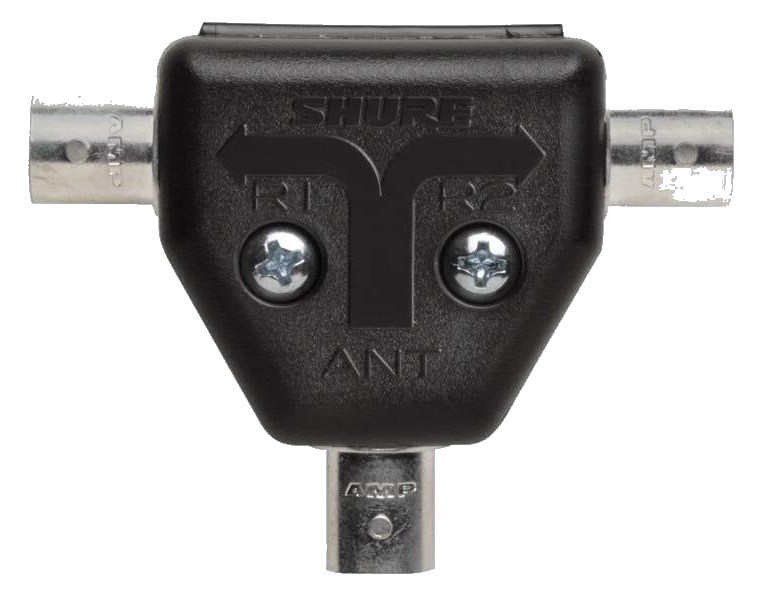
The Shure UA221 is the simplest way to share one antenna pair between two receivers: a passive two-way splitter with no power required, sold in pairs to cover both diversity sides. The roughly 3 dB insertion loss is fine for short racks and strong RF environments, making it the budget alternative to an active distro for two-receiver systems. In-line barrels that tuck behind the rack rail.
UnverifiedPower requirement is not verified in the catalog
Catalog estimate
~$197Use retailer rows for current price and stock
01 · What it does—and what that changes in your rig.
Product overview
Start with the payoff, then work through how it functions, where it fits, and the details that change a real build.
The payoff
Antenna Distro decisions, organized around the whole rig.
The UA221 is Shure's answer to a specific, common problem: you have one antenna pair in a good position and two receivers that need to see it. Each unit is a passive BNCThe twist-lock coax connector used for word clock and antenna runs — it locks, so it can’t be pulled out mid-show. barrel splitter — one input, two outputs, no electronics, no power, no rack space consumed. Shure sells them in pairs so you can cover both the A and B diversityA receiver with two antennas and two radio sections that continuously picks the stronger one — the difference between a dropout and a show. legs of a two-receiver system in a single purchase. It's not a distroOne pair of antennas feeding many receivers through an amplified splitter — replaces the forest of whips and keeps RF levels consistent. in the full sense; it's a signal-sharing junction that gets out of the way and costs almost nothing to own or operate.
Documented outputs
22 destination connections
Documented inputs
1Based on documented inputs
Rack space
Outside rackPlan a shelf, tray, or stage position
Shure product panelOutside rack · Unverified
Function
How it works in the path
Passive splitting means a roughly 3 dB loss on each output leg — you're dividing signal power, not amplifying it. In a strong RFRadio Frequency — the wireless part of wireless. RF planning is why big rigs scan, coordinate, and combine antennas instead of hoping. environment with short cable runs, that loss lands well within the sensitivity headroomThe margin between your normal level and where things clip — headroom is what absorbs the snare hit you didn’t see coming. of any current Shure receiver and most competing hardware. Where it becomes a real consideration is at the edge of range, in dense RF environments, or when you're running long BNCThe twist-lock coax connector used for word clock and antenna runs — it locks, so it can’t be pulled out mid-show. cable back to the rack. The UA221 has no depth to speak of and zero power draw, so it doesn't care where it sits in the cable chain — but physics still cares how far the signal has already traveled before it splits.
Best fit
Where it earns its place in the system
This is the right tool for a two-receiver IEMIn-Ear Monitor — earpieces that replace floor wedges, feeding each player their own mix. The reason this whole rack exists. or wireless mic rig where budget and simplicity are priorities and your antennas are close to the rack or pointed at a compact stage. If you're running three or more receivers off a single antenna pair, stop here and look at an active antenna distroOne pair of antennas feeding many receivers through an amplified splitter — replaces the forest of whips and keeps RF levels consistent. — passive splitting compounds losses with every tap. Similarly, if you're working long cable runs or a crowded RFRadio Frequency — the wireless part of wireless. RF planning is why big rigs scan, coordinate, and combine antennas instead of hoping. environment, the 3 dB you're giving up may matter more than the price difference between this and an active solution. For a clean two-way split in a small rig, though, it's hard to argue with something this simple.
In the rack
Details worth deciding before load-in.
Use one UA221 on the A-antenna leg and the second on the B-antenna leg — the kit is designed for exactly this paired deployment across a full diversityA receiver with two antennas and two radio sections that continuously picks the stronger one — the difference between a dropout and a show. system.
Keep the total BNCThe twist-lock coax connector used for word clock and antenna runs — it locks, so it can’t be pulled out mid-show. cable run from antenna to each receiver as short as possible; the passive loss here adds directly to any run loss already in the cable, so a 50-foot run to a split is a worse starting point than a 10-foot run.
If your receivers have adjustable RFRadio Frequency — the wireless part of wireless. RF planning is why big rigs scan, coordinate, and combine antennas instead of hoping.gainHow much the preamp amplifies the incoming signal. Too low and you’re hunting through hiss; too high and peaks clip. or sensitivity settings, check them after installing the splitter — recovering the 3 dB loss at the receiver end is often straightforward and costs nothing.
These are in-line barrels with no rack earsThe flanges that bolt gear to the rack rails. Desktop boxes without them need a shelf, tray, or drawer to live in the case., so plan for cable management: label both outputs clearly at the split point so you can trace diversityA receiver with two antennas and two radio sections that continuously picks the stronger one — the difference between a dropout and a show. legs quickly at load-in without following each cable back to its receiver.
02 · Know the whole path before you buy.
Signal path
Learn the route as a block diagram: source, product function, transport, and destination. Select any block to see what enters, what changes, and what leaves.
Interactive block diagramAuto-looping · hover, focus, or tap to hold a stage
Port-type signalProduct functionSystem boundary
Follow one signal from source to destination
Each block answers the same three questions: what arrives, what changes here, and what leaves.
01 · Source · selected
bnc
bnc
01 · Source
1 documented input
bnc
Arrives as
1 documented input
Connector
bnc
Signal
antenna
03 · What this product asks of the rest of the system.
Compatibility
Treat connector names as the start of the check—not the answer. These are the boundaries that determine a complete working path.
Best fit · Antenna Distro
Use it as antenna distro tracked outside rack rails; follow the manufacturer’s mounting and form-factor guidance.
Plan the companion path
Complete the path with upstream and downstream gear that matches connector, direction, signal type, protocol, and wiring standard.
Connector boundary
Documented connectors: bnc. Match connector, direction, and signal type—not shape alone.
04 · Every connector, grouped by job.
I/O ports
Switch the product view and the documented port inventory updates with it—hardware and data stay side by side.
Every connector, grouped by job.
Switch panels to keep the hardware view and the documented port list in sync.
Front panelRear panel
All documented ports for Shure UA221 Passive Splitter Kit
Port
Panel
Connector
Direction
Signal
Channels
Antenna In
rear
bnc
input
antenna
—
Out 1
rear
bnc
output
antenna
—
Out 2
rear
bnc
output
antenna
—
Showing 3 of 3 documented physical ports.
05 · Compare the decision, not just the price.
Alternatives
The rows are organized around fit, power, I/O, and system role so a cheaper unit cannot hide a more expensive workflow.
UA221The Shure UA221 is the simplest way to share one antenna pair between two receivers: a passive two-way splitter with no power required, sold in pairs to cover both diversity sides. The roughly 3 dB insertion loss is fine for short racks and strong RF environments, making it the budget alternative to an active distro for two-receiver systems. In-line barrels that tuck behind the rack rail.View gear →
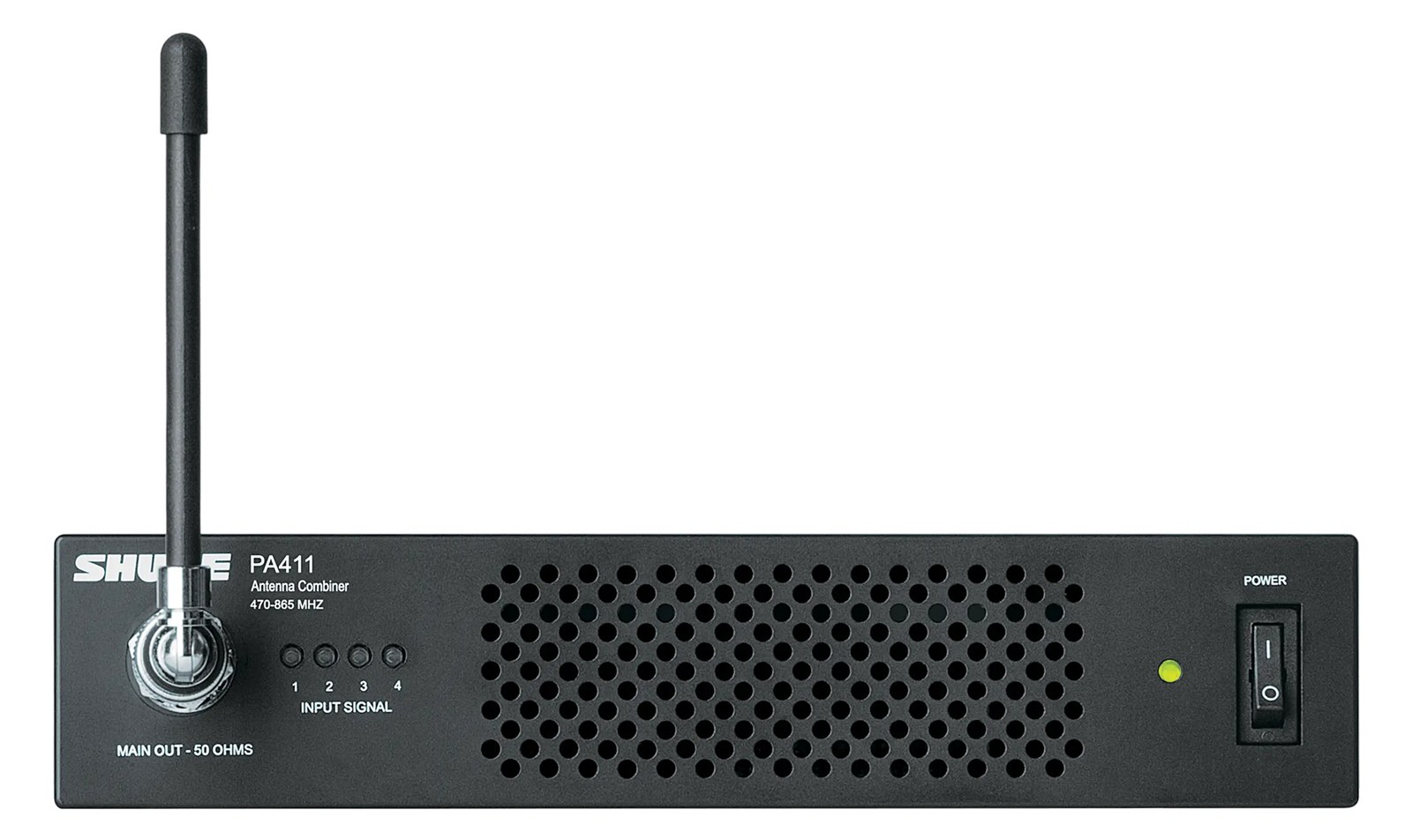
PA411The Shure PA411 combines the RF from up to four PSM 300 transmitters onto a single antenna, cleaning up the intermodulation and antenna farm that comes with stacking bodypack transmitters. It is the standard first upgrade for a multi-channel PSM 300 IEM rack, feeding one PA805 directional antenna instead of four whips fighting each other. Half-rack format mounts beside a fourth transmitter or on the included hardware.View gear →
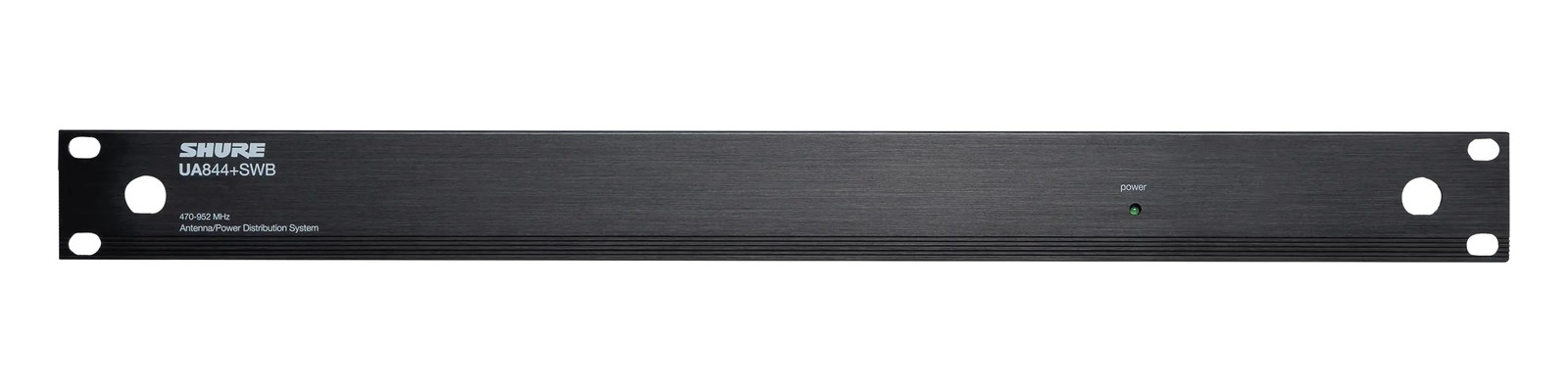
UA844+SWBA compact and reliable antenna splitter for smaller Shure wireless deployments, the UA844+SWB distributes one antenna pair to four receivers while providing DC power to in-line antenna amplifiers. It is a great fit for rigs with up to four PSM or ULX-D receivers that need shared antenna distribution. If you need more than four outputs, step up to the UA845+SWB.View gear →
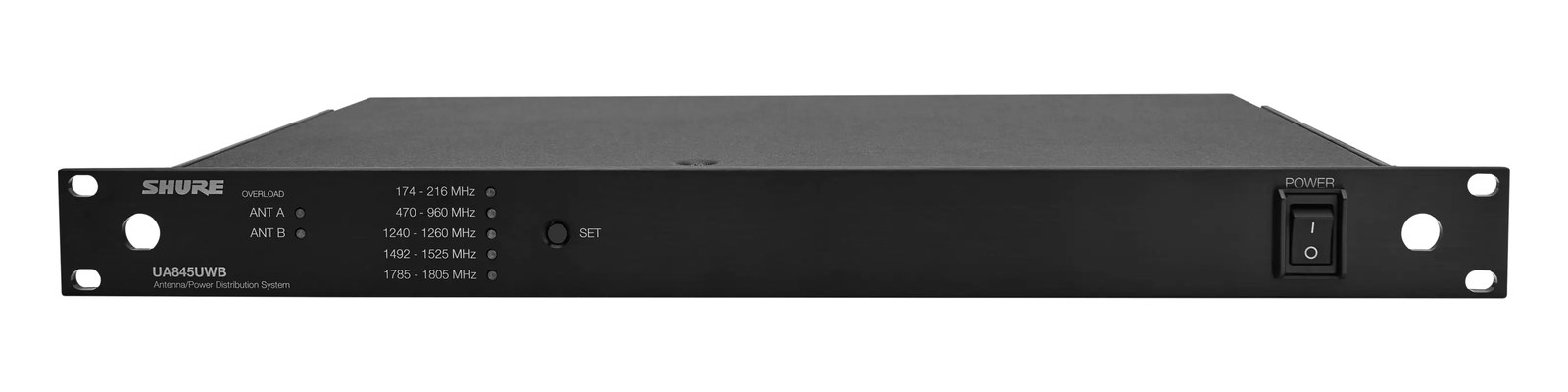
UA845UWBThe UA845+SWB is the standard antenna distribution unit for Shure PSM and ULX-D wireless systems, splitting a single antenna pair to feed up to five receivers per side. Active gain compensation ensures consistent signal levels across all outputs, which is critical when scaling up to larger channel counts. Essential for any rack with more than a couple of wireless receivers sharing a common antenna source.View gear →
06 · Resolve the questions that can change the purchase or build plan.
Planning questions
Short, source-backed answers surface rack fit, power, cabling, and connection details before they become surprises.
Where does the Shure UA221 Passive Splitter Kit live in a complete rig?
The catalog assigns it no rack units. Builder tracks it as non-rack gear; follow the manufacturer’s mounting, case, and form-factor guidance.
How much power does the Shure UA221 Passive Splitter Kit draw?
Its power requirement is not yet verified in the catalog.
What connections does the Shure UA221 Passive Splitter Kit have?
3 documented physical ports, including Antenna In, Out 1, Out 2.
07 · See this gear inside a complete system plan.
Builder preview
Builder keeps non-rack gear in the same bill of materials, budget, dependency, and connection plan as the rack-mounted system around it.Open in Builder