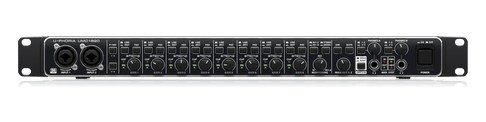
The Behringer U-Phoria UMC1820 is the budget workhorse of rack interfaces: eight Midas-designed mic preamps, 18x20 total I/O with ADAT expansion, and MIDI, for around what one boutique preamp channel costs. It is the pragmatic pick for a first playback or recording rack where channel count matters more than pedigree. The most-searched interface the catalog was missing.
~$229Use retailer rows for current price and stock
01 · What it does—and what that changes in your rig.
Product overview
Start with the payoff, then work through how it functions, where it fits, and the details that change a real build.
The payoff
Audio Interface decisions, organized around the whole rig.
The UMC1820 is a USB audio interface that earns its rack unitThe standard slice of rack height: 1U = 1.75″. A 3U box takes three slices; half-rack gear pairs two units side by side in one. by doing a lot of work for very little money. Eight combo XLRThe standard 3-pin locking connector for mics and balanced line signals — pin 1 is the shield, pins 2 and 3 carry the balanced pair./TRSTip-Ring-Sleeve — a 1/4″ jack with three contacts carrying a balanced signal or a stereo pair. A guitar plug with one extra ring. inputs with Midas-designed preampsThe gain stage that lifts a mic’s tiny signal up to line level — the first thing a signal hits, and a big part of how a console sounds. feed a USB 2.0 connection, and eight balancedCarries the signal on two wires and cancels whatever noise both pick up — why mic cables can run hundreds of feet hum-free. TRS line outputs plus a pair of XLR mains give you real routing flexibility on the analog side. ADATOptical digital audio: 8 channels at 48 kHz down one Toslink lightpipe (4 at 96 kHz). The usual way to add more channels to an interface. in and out extend the channel count further if you add an optical preamp or digital stageboxThe I/O endpoint on stage: mics plug in there and one digital line (AES50, Dante) carries everything to the console. The snake, digitized. down the road. At $229, it occupies the role of primary interface in a budget playback rig or first IEMIn-Ear Monitor — earpieces that replace floor wedges, feeding each player their own mix. The reason this whole rack exists. rack build — the kind of slot that would otherwise stay empty until the budget caught up.
Documented outputs
1515 destination connections
Documented inputs
12Based on documented inputs
Rack space
1UBuilder checks available rail space
Behringer product panel1U · 12W
Function
How it works in the path
Fifteen watts of draw on a standard IECThe standard three-prong appliance power inlet on rack gear — the kettle lead. C13/C14 in spec-sheet speak. connection means it plays nicely with any rack power conditionerFilters venue AC, clamps surges, and gives the rack one tidy inlet. Not a voltage regulator and not a battery — just cleaner power. and won't stress a road case outlet strip. The 150mm depth is genuinely shallow, which matters in a half-built rack where depth clearance is already tight. The ADATOptical digital audio: 8 channels at 48 kHz down one Toslink lightpipe (4 at 96 kHz). The usual way to add more channels to an interface. port is the sleeper spec here — pair it with an ADAT-equipped stage boxThe I/O endpoint on stage: mics plug in there and one digital line (AES50, Dante) carries everything to the console. The snake, digitized. or preampThe gain stage that lifts a mic’s tiny signal up to line level — the first thing a signal hits, and a big part of how a console sounds. expander and you can push up to eight additional channels over a single ToslinkThe square optical connector that carries ADAT or S/PDIF audio as light down a fiber — immune to hum and ground loops. cable without touching USB bandwidth. MIDI I/O is a real DINThe round 5-pin connector classic MIDI uses — the original way synths, pedals, and playback rigs talk to each other. connector, not a USB adapter, which simplifies cabling if your playback system needs to trigger devices. The USB 2.0 connection is the throughput ceiling; high sample ratesHow many times per second audio is measured when digitized — 48 kHz is the live standard; 96 kHz measures twice as often. with full channel counts can stress older host machines, so verify your laptop or playback computer's USB controller before the first show.
Best fit
Where it earns its place in the rack
This interface belongs in rigs where the mission is channel count and reliability at a constrained budget — small-venue IEMIn-Ear Monitor — earpieces that replace floor wedges, feeding each player their own mix. The reason this whole rack exists. setups, rehearsal-room recording rigs, or a spare interface kept in the case for emergencies. Engineers running professional touring rigs with high headroomThe margin between your normal level and where things clip — headroom is what absorbs the snare hit you didn’t see coming. requirements or analog-critical signal chains will want to look at interfaces with more robust convertersThe circuitry that turns analog audio into digital data and back (A/D and D/A). Converter quality sets a digital rig’s sound ceiling. and driver ecosystems. The Midas preampThe gain stage that lifts a mic’s tiny signal up to line level — the first thing a signal hits, and a big part of how a console sounds. branding is real in the sense that the circuit lineage traces there, but the UMC1820 is not a boutique tool — it is a pragmatic one. If your priority is getting eight inputs and eight outputs into a 1UThe standard slice of rack height: 1U = 1.75″. A 3U box takes three slices; half-rack gear pairs two units side by side in one. rack space without spending a month's rent, it makes a strong case for itself.
In the rack
Details worth deciding before load-in.
Use the ADATOptical digital audio: 8 channels at 48 kHz down one Toslink lightpipe (4 at 96 kHz). The usual way to add more channels to an interface. output to feed a digital IEMIn-Ear Monitor — earpieces that replace floor wedges, feeding each player their own mix. The reason this whole rack exists. transmitter system or additional converterThe circuitry that turns analog audio into digital data and back (A/D and D/A). Converter quality sets a digital rig’s sound ceiling. if your wireless rack has an optical input — you reclaim all eight TRSTip-Ring-Sleeve — a 1/4″ jack with three contacts carrying a balanced signal or a stereo pair. A guitar plug with one extra ring. outputs for monitor mixes without adding another device.
Lock your sample rateHow many times per second audio is measured when digitized — 48 kHz is the live standard; 96 kHz measures twice as often. before doors and don't let a DAWDigital Audio Workstation — the recording and playback software (Logic, Ableton Live, Pro Tools) at the center of a computer rig. on the same machine change it mid-show; the UMC1820's USB driver can require a restart to recover from a sample-rate conflict, which is not a problem you want at hour two of a set.
Run a short IECThe standard three-prong appliance power inlet on rack gear — the kettle lead. C13/C14 in spec-sheet speak. cable directly to the first outlet on your power conditionerFilters venue AC, clamps surges, and gives the rack one tidy inlet. Not a voltage regulator and not a battery — just cleaner power. rather than daisy-chaining off another device — at 15W it's a light load, but giving it a clean, dedicated outlet eliminates a variable if you're chasing ground noise.
Label the eight TRSTip-Ring-Sleeve — a 1/4″ jack with three contacts carrying a balanced signal or a stereo pair. A guitar plug with one extra ring. line outputs on the rear panel before the interface goes in the rack — once it's screwed in at 1UThe standard slice of rack height: 1U = 1.75″. A 3U box takes three slices; half-rack gear pairs two units side by side in one. with other gear above it, reading the rear silk-screen becomes genuinely difficult at load-in.
02 · Know the whole path before you buy.
Signal path
Learn the route as a block diagram: source, product function, transport, and destination. Select any block to see what enters, what changes, and what leaves.
Interactive block diagramAuto-looping · hover, focus, or tap to hold a stage
Port-type signalProduct functionSystem boundary
Follow one signal from source to destination
Each block answers the same three questions: what arrives, what changes here, and what leaves.
01 · Source · selected
XLR/TRS combo + toslink
¼-inch TRS + toslink
01 · Source
12 documented inputs
XLR/TRS combo + toslink
Arrives as
12 documented inputs
Connector
XLR/TRS combo + toslink
Signal
analog audio
03 · What this product asks of the rest of the system.
Compatibility
Treat connector names as the start of the check—not the answer. These are the boundaries that determine a complete working path.
Best fit · Audio Interface
Use it when 1U and 130 mm of depth fit the case.
Plan the companion path
Complete the path with upstream and downstream gear that matches connector, direction, signal type, protocol, and wiring standard.
Connector boundary
Documented connectors: XLR/TRS combo, ¼-inch TRS, toslink, spdif coax. Match connector, direction, and signal type—not shape alone.
04 · Every connector, grouped by job.
I/O ports
Switch the product view and the documented port inventory updates with it—hardware and data stay side by side.
Every connector, grouped by job.
Switch panels to keep the hardware view and the documented port list in sync.
Front panelRear panel
All documented ports for Behringer U-Phoria UMC1820
Port
Panel
Connector
Direction
Signal
Channels
INPUT 1
front
XLR/TRS combo
input
analog audio
—
INPUT 2
front
XLR/TRS combo
input
analog audio
—
INPUT 3
rear
XLR/TRS combo
input
analog audio
—
INPUT 4
rear
XLR/TRS combo
input
analog audio
—
INPUT 5
rear
XLR/TRS combo
input
analog audio
—
INPUT 6
rear
XLR/TRS combo
input
analog audio
—
INPUT 7
rear
XLR/TRS combo
input
analog audio
—
INPUT 8
rear
XLR/TRS combo
input
analog audio
—
LINE OUT 3
rear
¼-inch TRS
output
analog audio
—
LINE OUT 4
rear
¼-inch TRS
output
analog audio
—
LINE OUT 5
rear
¼-inch TRS
output
analog audio
—
LINE OUT 6
rear
¼-inch TRS
output
analog audio
—
LINE OUT 7
rear
¼-inch TRS
output
analog audio
—
LINE OUT 8
rear
¼-inch TRS
output
analog audio
—
LINE OUT 9
rear
¼-inch TRS
output
analog audio
—
LINE OUT 10
rear
¼-inch TRS
output
analog audio
—
MAIN OUT 1/L
rear
¼-inch TRS
output
analog audio
—
MAIN OUT 2/R
rear
¼-inch TRS
output
analog audio
—
OPTICAL IN
rear
toslink
input
digital audio
—
OPTICAL OUT
rear
toslink
output
digital audio
—
SPDIF IN
rear
spdif coax
input
digital audio
—
SPDIF OUT
rear
spdif coax
output
digital audio
—
MIDI IN
rear
midi din5
input
data
—
MIDI OUT
rear
midi din5
output
data
—
USB
rear
usb b
bidirectional
data
—
DC IN
rear
dc barrel
input
power
—
PHONES A
front
¼-inch TRS
output
analog audio
—
PHONES B
front
¼-inch TRS
output
analog audio
—
Showing 28 of 28 documented physical ports. Scroll to review the remaining rows.
05 · Compare the decision, not just the price.
Alternatives
The rows are organized around fit, power, I/O, and system role so a cheaper unit cannot hide a more expensive workflow.
UMC1820The Behringer U-Phoria UMC1820 is the budget workhorse of rack interfaces: eight Midas-designed mic preamps, 18x20 total I/O with ADAT expansion, and MIDI, for around what one boutique preamp channel costs. It is the pragmatic pick for a first playback or recording rack where channel count matters more than pedigree. The most-searched interface the catalog was missing.View gear →
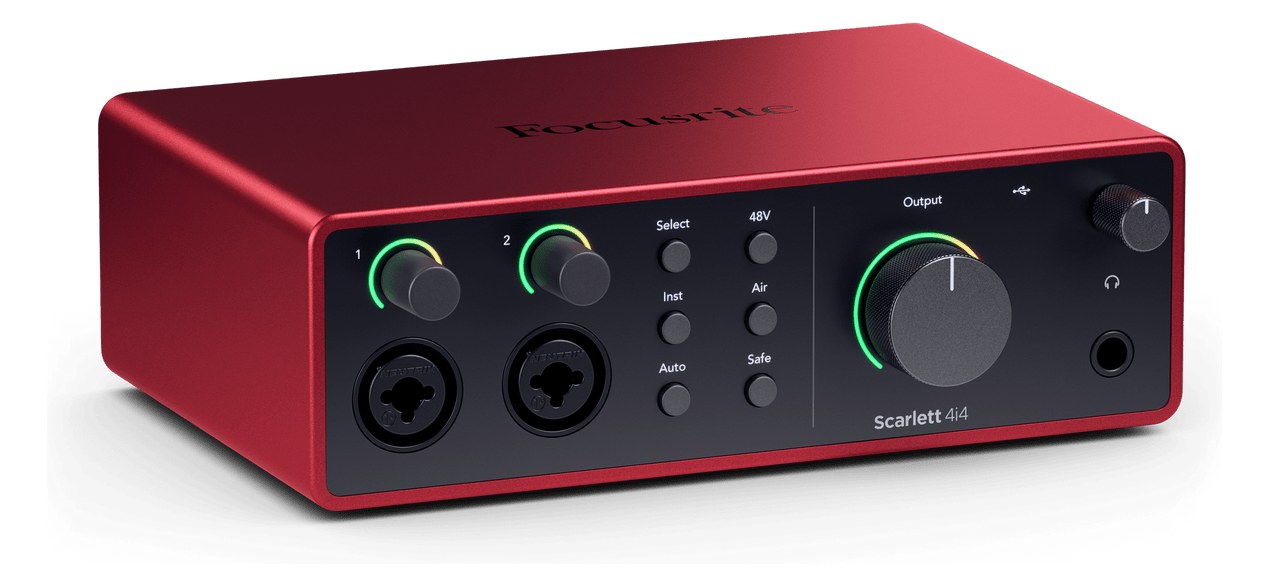
Scarlett 4i4 4th GenThe Scarlett 4i4 is Focusrite's popular mid-range interface with four inputs and four outputs, offering reliable performance and solid preamps at an accessible price point. Its USB-C connectivity and bus-powered operation make it convenient for portable playback setups, and the Air mode adds presence to vocal or instrument inputs when needed. A dependable choice for smaller playback rigs or as a backup interface in a touring setup.View gear →
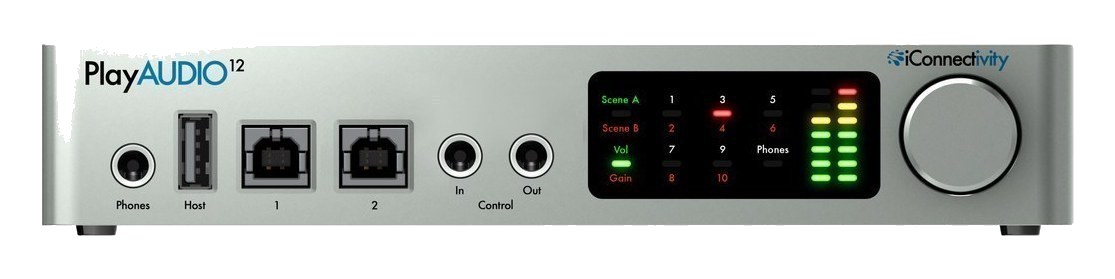
PlayAUDIO12The PlayAUDIO12 is purpose-built for live playback rigs, offering dual USB host connections that automatically fail over between a primary and backup computer with zero gap in audio. It provides 4 stereo outputs for click, tracks, backing, and spare, plus 2 inputs for talkback or ambient mics. The dual MIDI ports handle show control and patch changes. Its half-rack size pairs perfectly with a MIDI controller, and the automatic failover is the killer feature that makes it a touring standard for playback engineers.View gear →
Placement is only the start. Builder checks space · depth · weight, power headroom, dependencies, and compatible signal paths around this exact catalog item.Open in Builder